
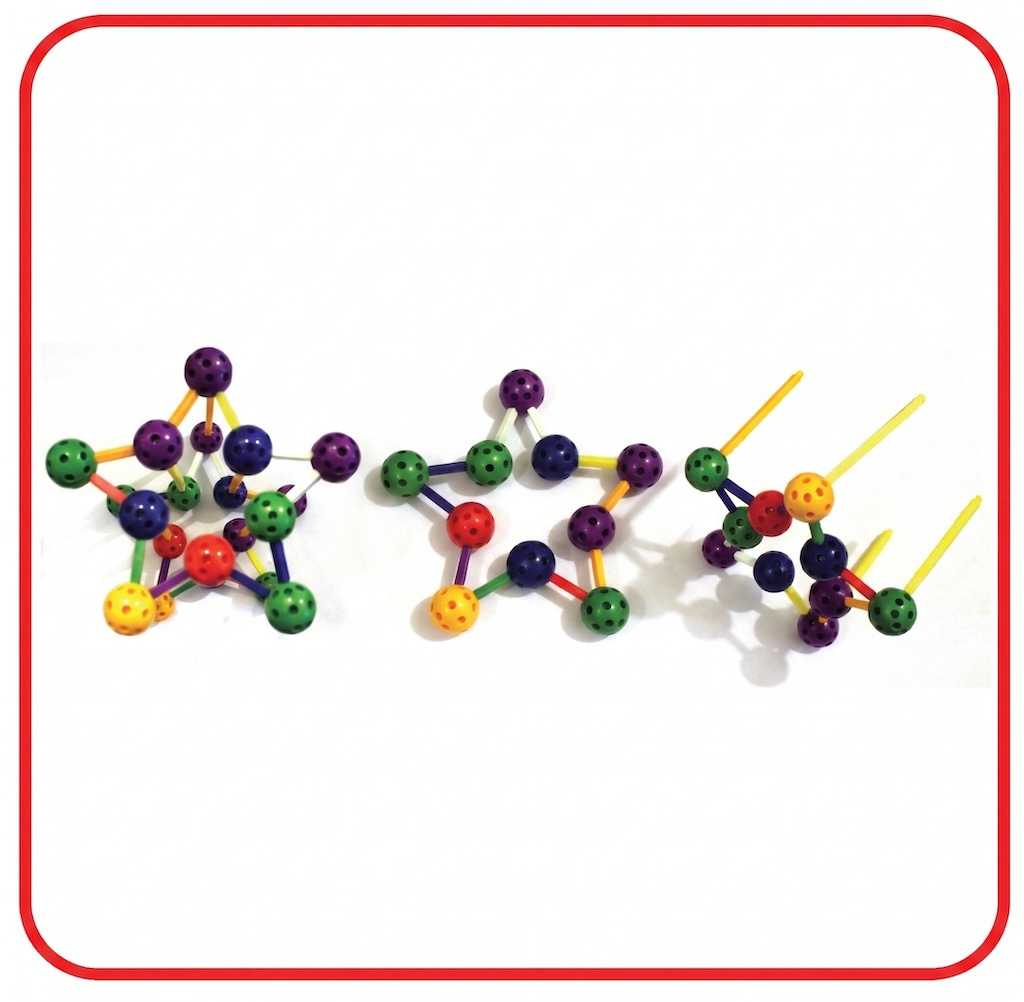
Tuesday you handed your child a coloured ball and asked what colour is this? Today you hand her the same ball, tie a string to it, and ask a harder question without saying a word: what shape can you make?
That small change — a string between the balls — is not a craft upgrade. It’s a move along a path Fröbel built deliberately, and most people who own the balls never realise the path is there.
The idea in one sentence: Fröbel arranged his whole sequence to travel from the solid to the point — the three-dimensional ball, down to the line, down to the single dot — and a ball strung on a thread is the exact hinge where a child steps off the solid and onto the line for the first time.
Here’s the part worth having in your head before you set anything out, because it changes how you’ll watch. In Fröbel’s design the ball is the point, the string is the line, and the shape they enclose is the surface. When your child lays three strung balls into a triangle, she isn’t “making a triangle” — she’s discovering that points connected by lines produce a surface. That’s the same idea that lives in his sticks-and-peas work, his stick-drawing, and eventually in drawing with a pencil. The strung ball is where it starts, because it’s the gentlest possible version: the line is soft, the points are things she already loves, and nothing has to be gripped or aimed yet.
And one sourced rule that will save you a frustrating afternoon: Fröbel was explicit that line work — sticks, and by extension strung shapes — should only begin once the child is already familiar with the solid Gifts. The balls first, as objects, as things to hold and sort and roll. Then the line. A child who hasn’t yet had her fill of the ball as a thing won’t be ready to treat it as a point, and pushing her there is where the tears come from. If Tuesday’s colour play felt too young for your older child, this is why it wasn’t wasted — it was the ground this stands on.
The material. Cotton balls, wooden beads, pom-poms — anything round with a bit of weight — and lengths of yarn, string, or shoelace. That’s it. (If you own Spielgaben’s first set, this is precisely what its balls-on-strings were made for, and the mapping is exact — but any ball and any string does the real work.)
The shapes look the same at every age. What changes is what the child is actually doing with them — and that’s the axis to build on, not difficulty.
For the youngest, a strung shape is a picture: a circle is a sun, a triangle is a roof. For the middle child, it becomes a problem: how many balls does a hexagon need, and why won’t five make one? For the oldest, it turns into structure: shapes joined into other shapes, flat lines lifted into three dimensions, the point-line-surface idea running in reverse. One material, three genuinely different lessons — which is what lets a four-year-old and a ten-year-old work the same string at the same table.
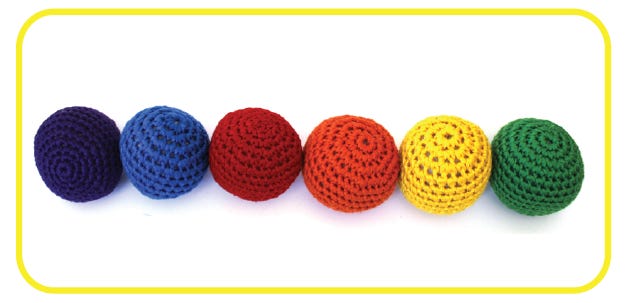
What she’s learning: that a line can be bent into a shape, and a shape can be something — a closed loop is a circle, and a circle is the sun.
Materials. Three to six balls on strings, or loose balls she can lay along a length of yarn. Longer strings are easier at this age — more forgiving of clumsy hands.
Comments
Nothing yet. Say the first thing.
Sign in to join the conversation.