
Identity is a seductive notion—certainty that we know who we are, and who others are, offers a handrail of cognitive steadiness amid the chaotic landscape of life. But how sure is that knowledge? Over time we may acquire illness or gain health, succeed or suffer, believe we are right but find ourselves on the wrong side of history, luck into wonderful relationships and lose people we love. Do the tides of fortune burnish us or redefine us? Do we perceive ourselves with any accuracy? (Note to self, whoever that is: Revisit The Doors of Perception.) Identity may be far more dynamic and context-based than we may wish it were, if it’s not an illusion altogether.
The New York City–based contemporary dance maker Heidi Latsky poses queries about identity in the very name of her company’s upcoming performance at the 92nd Street Y: Who Am I Now? When our worlds turn upside down, what are the stories we tell? Identity has been a theme of her work at least since 2006, when she focused her artistry on physically integrated work and a company of dancers with and without apparent and non-apparent disabilities.
Originally from Montreal, Latsky was a principal dancer with Bill T. Jones/Arnie Zane Dance Company from 1987 to 1993 and founded Heidi Latsky Dance in 2001. Latsky is heralded as a leader in physically integrated performance and activism, and her recognitions include an Emmy Award nomination, grants from the NEA and the Jerome Robbins Foundation, and commissions from the American Dance Festival, the Joyce Theater, and the Whitney Museum of American Art.
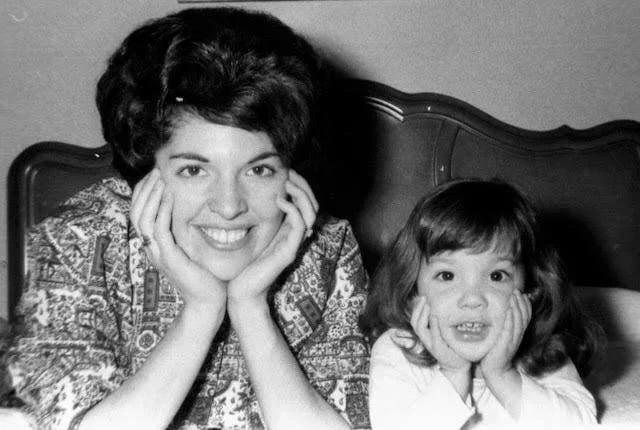
Latsky’s work tends to originate from personal places, but Who Am I Now? resonates in a new way. Her identity was recently upended by a brain-tumor diagnosis, followed by brain surgery in January 2024—and then grasping the surreal coincidence that her mother survived the same diagnosis during Latsky’s childhood.
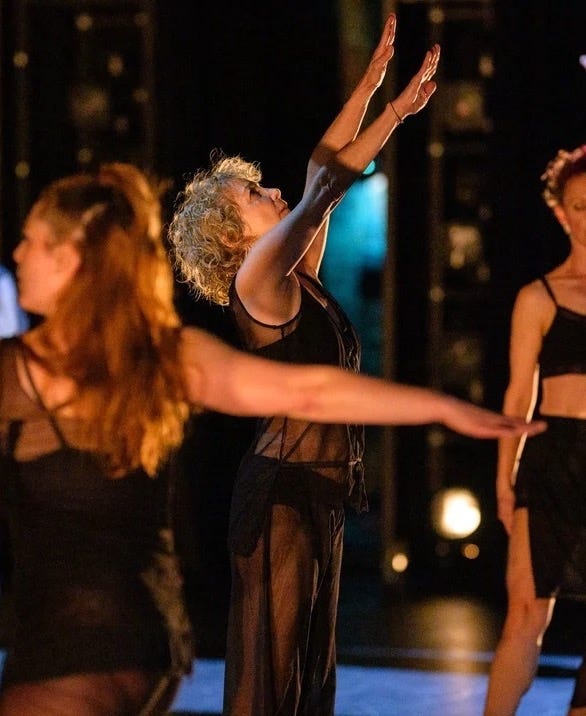
Presented by the 92nd Street Y’s 2025–2026 Harkness Mainstage Series season, titled Women Move the World and devoted to women and female-identifying artists, Who Am I Now? combines Living in the Grey, Latsky’s documentary film about five people living with non-apparent neurological disability; audience talkbacks; and performance excerpts from HLD’s new evening-length work, Tracking Parallel, named for the ways that we live in parallel with each other, the external world, and our internal experiences—tracking parallel, in Latsky’s parlance. Latsky’s musical score incorporates MRI sounds, a reference to both the technology of diagnosis and the protons that align—or track parallel—to make MRI imagery possible. (The components of Who Am I Now? are parts of a larger umbrella project called What Is Essential.)
Over Zoom, Latsky and dancers Leslie Taub and Meredith Fages unpacked some of the show’s many layers: isolation and connection, ability and disability, and the punctuated equilibrium we call identity.
Claudia Bauer: What is the origin of Who Am I Now?
Heidi Latsky: At different phases of anyone’s life, you ask yourself, who am I now? For the 92nd Street Y, we want to have that discussion with the audience, because I think we’re all going through some kind of upheaval right now, collectively. We all understand what upheaval is. We all experience it. If you live long enough, you’re going to have it.
When I was in the hospital [for brain surgery], I started creating in my mind. And two quotes came to mind. One was Ruth Bader Ginsburg’s quote, “Whatever you choose to do, leave tracks. That means don’t do it just for yourself. You will want to leave the world a little better for your having lived.” For me at the time, that quote was very powerful. And in The Little Prince, I think it’s the fox that says, “It is only with the heart that one can see rightly. What is essential is invisible to the eye.” To delve a little deeper into why that means so much to me, in the end what matters is heart and community and being honest and connecting. And I think that sums up Who Am I Now? What is essential?
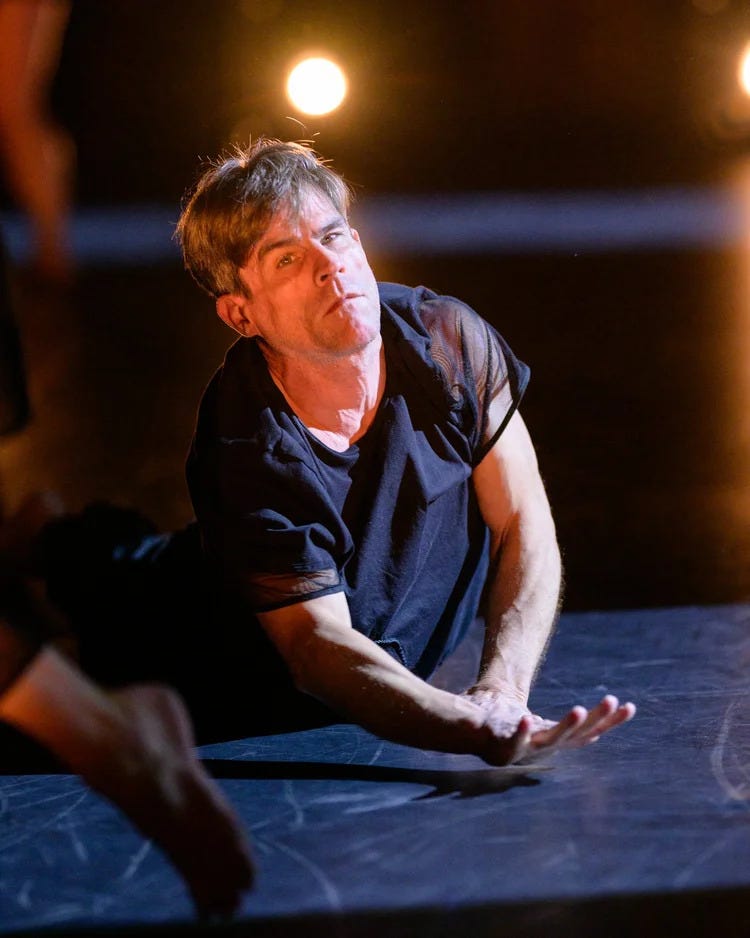
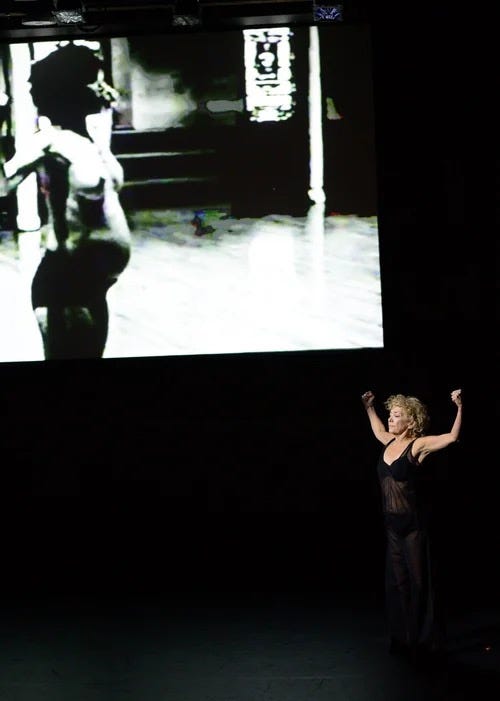
We’re showing two excerpts of Tracking Parallel. Rupture is the first section, for [HLD dancer] Nathan Trice, which he will do as the audience comes in. It’s to an MRI score with him talking about when he found out about his own brain tumor. The audience goes into the rehearsal studio, and then they leave him and walk into a collective experience with the eight of us, and a film that I created that’s very surreal, but quite serene and beautiful. That section is called Days of Awe. I got that [title] because I’m Jewish, and the ten days between Rosh Hashanah and Yom Kippur are called the Days of Awe, where you’re supposed to be self-reflective, asking for forgiveness, giving forgiveness. And I thought, wow, that makes so much sense. I love the poetic sense of Days of Awe. I feel like Tracking Parallel is more poetic now than I thought it would be.
CB: How does being part of season devoted to women resonate with you?
HL: All three of us here are mothers. Leslie is also a grandmother. And there is footage in the film of me dancing pregnant, topless, which to me signifies hope and that through chaos and ongoing upheaval there will always be pregnant women, and there will always be life. Women are changers and movers and have great wisdom if we’re given a chance, so it’s just a beautiful invitation to be with all these other women who I have great respect for, and to be honored as a female artist.
CB: But your cast is not exclusively female.
HL: We’re integrated in every way—different races, disabled, nondisabled, different ages, I’m 67. We have men and women. We have people who identify as nonbinary. It’s always important to me that we are inclusive, and especially when you’re dealing with non-apparent disability, which you can’t see, that the cast also comes through very different walks of life. Actually, Tracking Parallel is not about disability. It’s really about what I said before—it’s this yearning for connection, how we’re moving through, in a very surreal way, the times that we’re in. [Disability] will always figure into my work. This piece is more collective—what I see as an ideal world, when people come together. It was part of my healing, making this piece. I wanted people like Meredith and Leslie, who have both danced for me for a very long time. I couldn’t just work with anybody. I needed people I could trust.
CB: Leslie and Meredith, what does this work mean to you?
Leslie Taub: Where we are now in the physically integrated and disability dance ecosystem, I think we have a lot of people who are interested in becoming movers, and dancers at various levels, but one thing we don’t have enough of are strong disabled women in leadership positions. Strong disabled women choreographers, directors. And although she’s been doing this for a long time, before she became a disabled woman, Heidi is providing that. She’s a fantastic role model, especially for those of us with cognitive stuff that don’t get to see that [kind of person in leadership]. Supporting her in building this work was a starting point for me, but it’s also an example of what we can and should be doing more of.
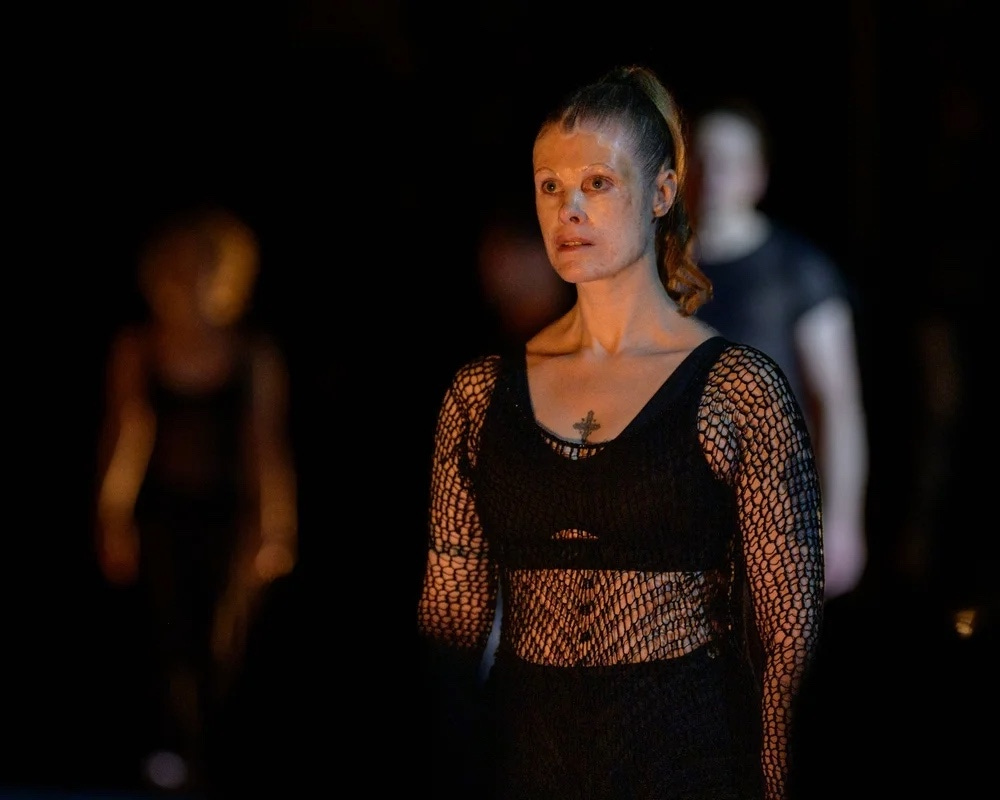
Sometimes I differ with other folks in the company or other folks in my communities on this, but I am personally not particularly interested in art that’s about disability. I’ve been in a physically disabled body my whole life, and as a person with acquired cognitive impairment, it’s just part of who I am. What I think is important is that when our own identities come into how Heidi choreographs, it is as an entry point to upheaval, to connection, to community building. I feel that she’s doing something really unique and special by allowing us to channel our specific interpretations or experiences into as close to a universal message as one can get. I don’t exactly believe that universal messages exist, but I feel it’s a beautifully open-ended work.
HL: I love what you said, Leslie. We abstracted it so that it has an essence.
LT: When I say it’s open-ended, I guess what I mean is that the audience will probably attach their own meanings to a lot of things. I don’t find it abstract in the sense that a lot of people are making work, just to be edgy or just for the point of making the shapes. I agree that it’s abstracted, but not in a way that’s hard to relate to.
Meredith Fages: In terms of the season, I have a ton of history with 92nd St. Y. I took my first improvisation workshop there when I was, I think, twenty-seven years old, in the same space where we are performing. And that space looks very different now, since it’s been renovated. The mosaic work is still painted on the ceiling, but there used to be these floor-to-ceiling black velvet curtains and these ornate, Baroque, hexagonal chandeliers. I met Heidi around [that] time, so being back in that room is very significant. I’ve also performed in that room. I’ve taken classes over the years. My son went to nursery school upstairs. I just still feel very connected to the institution.
HL: I have a longstanding relationship with the 92NY and the Harkness Center, first in the Eighties and Nineties. I was a resident artist there. I performed there. [Harkness Foundation Executive Director] Joan Finkelstein has been my mentor for years. Meredith, I want you to talk about the origin of Tracking Parallel.
MF: We’d been talking a lot about covid and Heidi’s being in the hospital and contemplating her mother’s experiences with multiple meningiomas throughout Heidi’s childhood and growing up. I track parallel with it in a slightly different way, but what is also in my ether—our ether—is that I’ve been dancing with Heidi January of 2007 and I have always been wanting to do a duet with her. The right time just sort of never came. But then we started making this piece in January of 2023. We had a specific opportunity to show it [in April 2023] at Westbeth, in the West Village, at a site-responsive festival. It was also a durational festival, because people were on this walking tour throughout the building. The festival took place over two days, and I think on the second day, we did the dance nineteen times or something. The dance was eventually called Tracking Parallel.
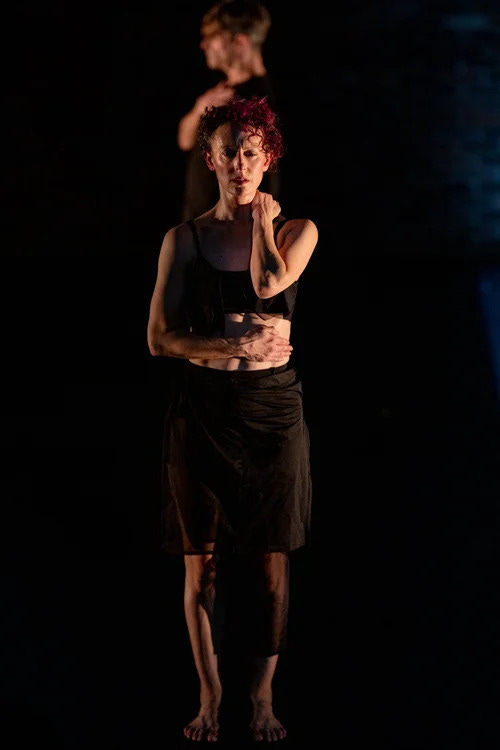
HL: It was about isolation. It was about me feeling like even though [covid] lockdown was over, I still felt we were all tracking parallel because we weren’t really connecting. Everyone was still afraid. At the time, I couldn’t smell, and I thought I had long covid.
MF: We started making this dance. Heidi wasn’t feeling well, and so it’s the way that we needed to make the dance for our bodies and our states of being at the time. It was very gestural. It was very faceted and kaleidoscopic. We did a lot of rotating, pivoting back and forth, like the facets of a square. At the same time, Janet Panetta, who had been my ballet teacher for several years and was someone I looked up to immensely, was ill in her final years of life with glioblastoma. Janet lived at Westbeth. I was trying to figure out how to show up for her in a way that perhaps I hadn’t quite done before, and I called her every week, even if I just left a message saying “You don’t need to call me back. I’m thinking of you.” She was ever-present in my mind, and I had seen her a couple of times while she was in those last few years of her life, which also coincided with covid, so nobody was really seeing anybody.
She was so larger-than-life, in so many ways, that the idea of her sort of fading away just…it crushed me. When we finally got to the performance weekend, I knew that, for myself, I was dedicating all of the performances of Tracking Parallel to Janet. And after having done the dance like seventeen times the first day and about to embark on the nineteenth time the second day, it was pouring—like legendary, biblical, monsoon pouring. And Heidi and I were dancing in this gallery that had a glass wall that opened on to this courtyard. And about three minutes before we were set to start the last run of the dance, the door at the far end of the courtyard opened, and Janet came out. I just grabbed my raincoat, and I ran into the rain, and I brought her in. She saw the dance, and then she left, and that was the last time I saw her alive. She died a few months later. The idea that this dance already was speaking for me to non-apparent disability, as it has grown and shifted into what it is now…I don’t even know how to finish the sentence. It’s just part of what it is. Choreographically, there’s a lot of reference to works that we’ve made for the entirety of my time with you, plus works even that preceded me.
HL: That was because initially I couldn’t move at all, so I was asking you to remember. I made a piece in 2006 for my mother, who had just died. And unbeknownst to me, that’s when I think the tumor in my brain started growing, because they think it was there for twenty years. I think Tracking Parallel with Meredith was one of the most horrifying—we would be rehearsing, and it was so minimal, and I would have to sit down and say, “I’m so sorry. I can’t do it.” And I even said to Meredith, “This is the failsafe. If we’re going to do it a lot of times, I may just lie down on the ground, and you just keep going, and we’re tracking parallel that way.” But I didn’t. I kept going. I did it.
I didn’t know what I had, and when I found out what I had, I had an eleven-hour surgery, and all of a sudden, I was back to myself. This is where Leslie comes in, because I had people around me, but I was yearning to be with people who really understood what I was going through. As I have gotten stronger and started dancing more, that’s when the piece evolved for me. I just didn’t want it to be about disability, as Leslie said, I didn’t want it to be about my isolation. I didn’t want it to be about me anymore. I wanted it to just be a landscape, but a layered one, as Meredith touched on, and a poetic one, and hopefully a moving one for the audience.
CB: We’re circling around something that you write about in the program: Tracking Parallel “plunges into the universal experience of upheaval.” Like you said, all of us, if we live long enough, are likely to experience changes in our bodies, our minds, our lives. We lose people. And there’s a meta-experience that, like Leslie was saying, other people project their own perceptions onto us.
HL: I think it’s a journey, and it changes and evolves. In my journey—and these two will have their own journeys—it was very much about me just getting it out. Because I’ve been an ally to the disability community for so long as a nondisabled person—now I’m disabled. What does that mean? Every time I touch my head [puts hands on either side of head]—I shouldn’t have done that, I’m going to cry—the surrealness of what happened to me, I still feel like, “No, I didn’t go through that.” People would say, “You’re going through such a horror.” And I didn’t experience it that way, partly because it was on my frontal lobes, and it takes away your affect and your executive function. I just was, like, floating. But after surgery, I was still floating, in a way. It wasn’t just a recovery. It was more like, “Did this really happen to me?
It’s so surreal and daunting, and yet not daunting either. It’s such a complex situation, and I feel like each of us has that. And I feel like right now in the United States, we’re experiencing the same thing. Like, how many people do you know who are walking around going, how did we get here? This piece, for me, is about the surreal aspect and also our drive to keep going. We all have such a drive to keep going, no matter what. There are some of us who will get immobilized by what’s going on, personally or politically. There are some of us who are going to just keep moving forward.
LT: There will always be change, right? And I guess, like Octavia Butler would say, change is the divine right, that whatever the divine is, change is that. Change is neutral in itself. Our life experiences, as individuals and as communities, are nonlinear. I feel like everything that we’ve tried has served a purpose of orienting us within the work and toward each other, which I think is really neat.
CB: Meredith, how does the notion of upheaval figure in your life?
MF: Admittedly, I am having a hard time figuring out how to translate the movement experience and the dance-craft experience back into words. Because in many ways, although I am working from a very specific set of lived experiences and choreographic tasks, it’s not important to me if the audience knows my specifics. I would rather be the canvas for the audience members to bring their own experiences.
HL: That’s tracking parallel, right? There’s no contest. I don’t want any of you [dancers] to bring your upheaval to the piece. That’s not what it’s about. It’s a pure dance piece. The only time our personal upheavals come into this is when we talk to the audience.
CB: Speaking of the audience, you describe the post-performance discussion as “not your typical talkback.” What do hope to accomplish with that dialog?
HL: It’s going to be challenging with this, because Who Am I Now? is usually a presentation where I speak about what happened to me, and my specific situation is a nondisabled ally. One of my questions, “Am I disabled enough?” comes up all the time. It’s like what Meredith is saying, like this contest of, am I really disabled? I guess I would want to hear from the audience first: What were your impressions from this work, and what did you get from this? How do you relate to that? What’s your identity? Is it really important to identify one way or another? These are my questions. Some people are very clear about their identity. I’ve always felt it difficult. When we first started working with people with disabilities, I would say, “Why do I have to identify as nondisabled and identify you as disabled?” It’s a big question for me. Then I got to understand it better from the disability community’s perspective. I understood that it was really important that I was nondisabled, that I identified that way. This is just another iteration of that, and opening it up to identity in general. What do you guys think? Will Tracking Parallel lend itself to the question, “Who am I now?”
LT: I absolutely think that particularly the Days of Awe section does lend itself to an audience asking themselves those kinds of questions about their own identity, about their relationships to others. Because of my own particular group of cognitive challenges, there are times when I’m stuck in that upheaval and not only am I not dancing in the most connected way, but I’m not always reading the piece as fully. I tend to record everything for myself, because I have some memory stuff, and so I’m frequently looking at little snippets of others [dancing]. And when I watch it, it simultaneously makes sense and provokes questions for me. I really love it as something to watch, and I feel strongly that the audience will as well, and that they will receive it in the same spirit that it’s offered.
HL: I have a lot more questions than answers. Maybe that’s okay.
MF: “Tracking parallel” is such a multivalent metaphor. At times I’m tracking with [HLD dancer] Jillian [Hollis], at times I’m tracking with Heidi. I’m tracking with myself. I’m tracking with the entire duration of my career and how I’ve changed over the years. There’s so much to investigate.
HL: That’s such a beautiful thing to say. It’s like I’m tracking parallel with my whole career, my dance life, where I was. Those of us who are self-reflective will ask “who am I now?” at very different points in life.
MF: Jillian and I have a duet that we are doing throughout the duration of the whole piece. We walk backwards in figure eights for almost ten minutes. And that’s kind of loaded. There are people in our way, or very close to being in our way. We can’t see them, so are they there? Are they people? Are they metaphors? What are they?
CB: Going backwards is very brave! [laughter] Heidi, I’m reflecting on what you said a few minutes ago about having more questions than answers. Perhaps the best place that we can get to is being present with having more questions than answers. I don’t know that there are answers to a lot of these things. As a person with an acquired non-apparent disability, I’m thinking about the difficulty of talking about disability while also trying to not talk about disability at the same time. It’s kind of a koan: We seem to have to talk about it in order to get past it. But are we getting past it?
HL: A lot of people said, “Keep telling your story. It’s very healing for you.” And I’m like, “It’s not healing for me anymore. I’m hoping it’s healing for other people.” I made the documentary Living in the Grey not for me, but for doctors specifically. I just showed it at Columbia Medical School. They need to hear our lived experience after we leave their office, so they have a better sense of who they’re dealing with. That’s why I don’t want Tracking Parallel to be about disability.
MF: Claudia, I was thinking about what you just said about being present with your own questions and being present with one another. I think it’s also being present with a sense of grace that the person that you’re with is also sitting with all those same questions. Like, it’s not just enough for me to have the questions. I have to recognize that everybody else also has the questions.
HL: We were at Montclair State University [with Who Am I Now?], and a student asked, “How do we become good allies?” In my experience, a good ally means nothing unless you have compassion, kindness, curiosity. I think that’s what Meredith is saying. Leslie had sixty-eight surgeries before she was fourteen. I had one surgery. It’s not about that. It’s about exactly what you said: We have questions, we don’t have answers, and the more we question, I think the better human beings we are. You can’t make assumptions so easily.
Heidi Latsky Dance performs at the 92nd Street Y on Saturday and Sunday, January 10 and 11, 2026. Purchase tickets here. Follow them on Instagram: @heidilatskydance
Comments
Nothing yet. Say the first thing.
Sign in to join the conversation.