
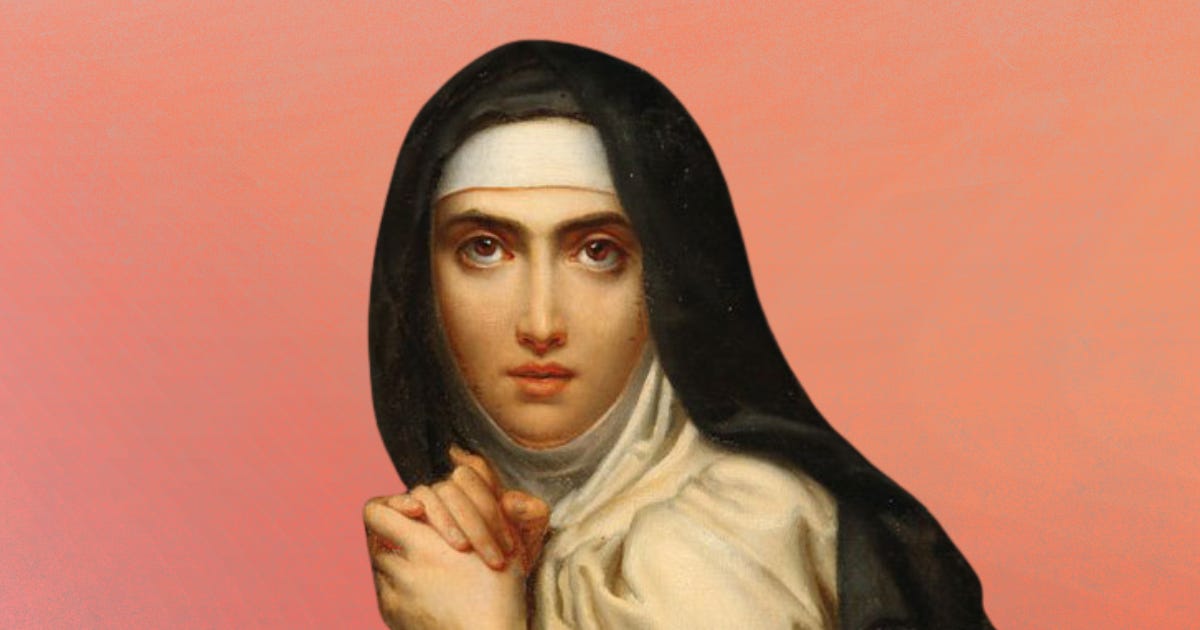
Teresa was born in Ávila, Spain, in 1515. She is best known for her reform of the Carmelite Order, a religious order devoted to prayer and contemplation. She insisted that her nuns be allowed to practice what she termed ‘mental prayer’, which is prayer that is characterised by an awareness of the relationship between the person and God – and, as such, is the bedrock of all prayer. As a result, her reform created a renewed interior Christianity.
But Teresa’s legacy has much wider ramifications for the world we live in today.
Her Foundations and letters show what a practical person she was, burdened by cares and concerns for the many convents she founded. In her comments on the Martha and Mary story in Luke 10 she taught that Martha and Mary must both be present in a person for the Christian life to be properly developed.
Teresa’s famous teaching on prayer combines simplicity with depth. In The Book of Her Life, she compares the praying person to a garden, describing four ways of watering the garden. These symbolise the various ways the water, or the grace of God, reaches a person, from the most laborious, involving drawing water from the well, to the one requiring the least effort, receiving rainwater.
In her use of natural imagery Teresa builds on an established spiritual tradition from the Bible onwards. Like her contemporary and friend John of the Cross, she was fond of taking images from nature. For example, she compared spiritual transformation to the process by which a silkworm eventually becomes a beautiful butterfly. In the wake of contemporary works on the spirituality of the environment such as Pope Francis’s encyclical Laudato si’, such metaphors have impact.
Also in The Book of Her Life, Teresa describes prayer as ‘nothing else than an intimate sharing between friends; it means taking time frequently to be alone with Him who we know loves us’ (8.5). Practising the prayer she called the ‘prayer of recollection’ involves making a deliberate choice or act of the will to be with God. It is a simple companionship with God that can dispose us to receive contemplative prayer as a pure gift of grace.
This is not teaching that is divorced from the concerns of our contemporary world. Indeed, Teresa’s use, in her most mature work, The Interior Castle, of the image of a castle to describe the interior journey, and her description of the various rooms or dwelling places in the castle, have been seen to herald the discoveries of modern depth psychology. The poisonous creatures that invade the dwelling places in the castle represent the negative side of human nature in a way that can be seen to parallel Jung’s concept of the shadow and the necessity for the shadow to be recognised and transformed if we are to be whole. As the person progresses through the various rooms in the castle (and there are as many steps backwards as there are forwards), they gradually learn how to discern the voice of God amid the clamouring voices from within and without. This journey is refreshingly unchurchy, involving self-knowledge and simplicity, and also speaks volumes to the highly connected world we inhabit, where the demands on our attention are constant and unrelenting.
There are other aspects of Teresa’s teaching that strike a strangely contemporary note. Sixteenth-century Spain was a society that placed a lot of emphasis on class and status, and it is in that context that Teresa said, in her meditation on the Lord’s Prayer in The Way of Perfection, that claiming God as our Father involves renouncing any claim to privilege. This was a radical concept indeed and, in our divided world beset by culture wars, is just as relevant a message.
Teresa kept a bookmark on which were the words, ‘Let nothing disturb you, let nothing frighten you … To the one who has God nothing is lacking. God alone suffices.’ She also insisted on the ‘determined determination’ that should characterise the life of the believer in Christ.
In what ways do these two attitudes of mind challenge you? Do you find them difficult, and if so, why? How can they help you as you progress in your Christian discipleship?
Buy 'A Month With St Teresa Of Avila'

No posts
Comments
Nothing yet. Say the first thing.
Sign in to join the conversation.