
I’ve resisted saying too much on the Jason Arday plagiarism and fabrication allegations because they’ve already been the subject of so much commentary and debate. For any of you who’ve missed the story, I recommend this piece by Kathleen Stock for Unherd. Suffice to say, the capacity for midwittery and gullibility in the highest echelons of British academia will come as no surprise to anyone who’s been following the sex and gender debate in recent years.
But the story has just taken another extraordinary twist, with the revelation that the police investigated and warned off a journalist who was investigating the plagiarism claims. Jack Grove, a reporter at the Times Higher Education Supplement, reportedly emailed a series of questions to Professor Jason Arday about his academic record: a standard aspect of journalistic practice. Someone proceeded to file a police complaint on the basis of this communication; Grove has not been told who, although the University of Cambridge has denied it was them.
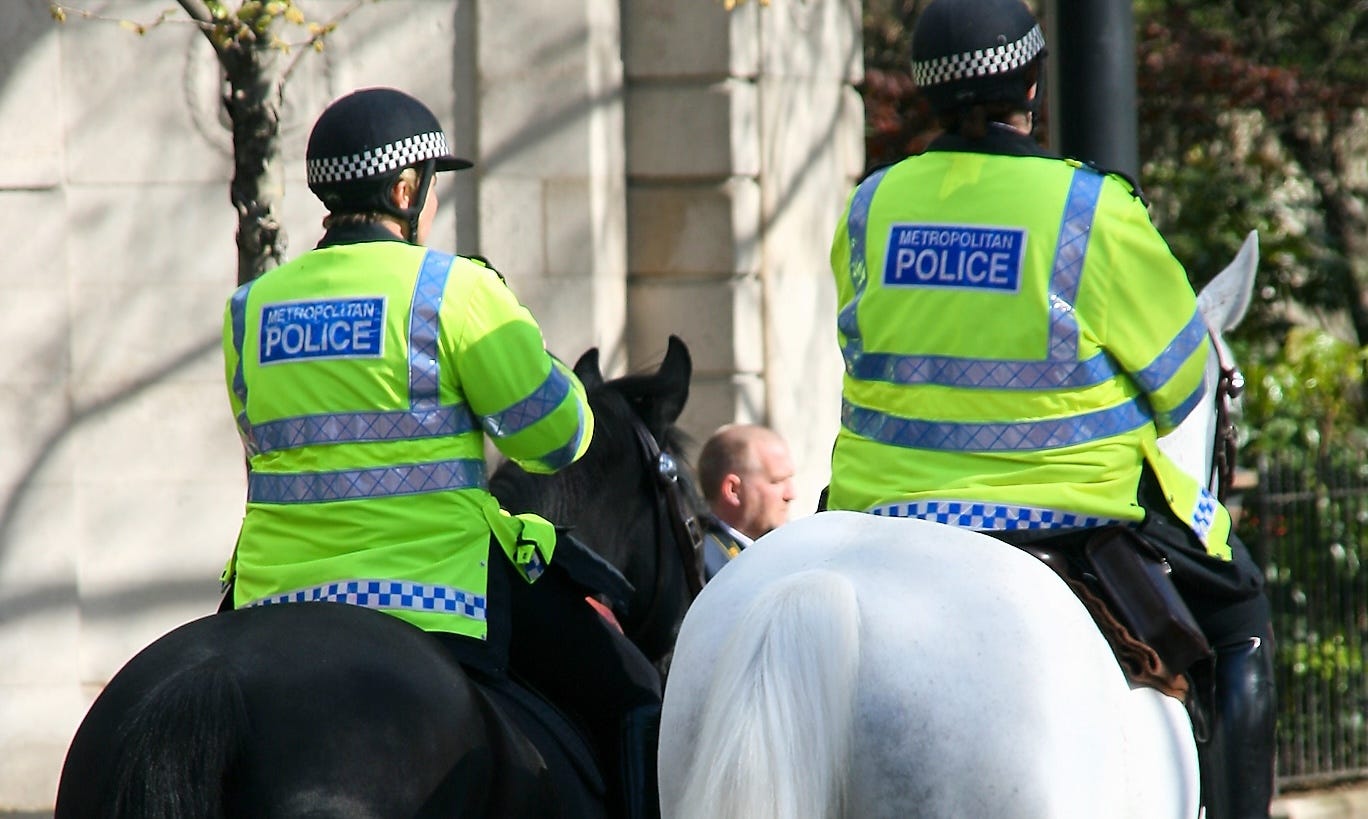
The Met then investigated Grove for the criminal offence of harassment by speech for four months. The first he knew of it was when a police officer contacted him to say they would be taking no action, and closing the case. But Grove reports that the police officer asked him not to contact Arday again because of the effect his communications had had on Arday’s mental health. After Grove clarified the officer was speaking to a member of the press, he says the officer again repeated his request that Grove refrain from contacting Arday on mental health grounds.
This account should send a chill down the spine of any journalist. The police have no business warning journalists off their legitimate inquiries because they might upset someone. Any whisper of this is an intolerable incursion of the police into the freedom of the press.
The police have form on undermining our democratic freedoms. I first started writing about police failures around free speech five years ago, when the High Court ruled that Humberside police had acted unlawfully in warning Harry Miller off expressing his views on the sex and gender debate on pain of criminal prosecution, and opining to the press that his views were ‘transphobic’. That judge warned of police over-reach:
In this country we have never had a Cheka, a Gestapo or a Stasi. We have never lived in an Orwellian society.
The Court of Appeal then went on to find that not only had Humberside police acted unlawfully, but that College of Policing guidance that the police should record all non-crime ‘hate incidents’ (NCHIs), as perceived by those who take offence at them, was an unlawful incursion on citizens’ freedom of expression.
One would think that such a ruling would prompt a significant rethink in the policing of speech. What it actually kick-started was a wrangle between ministers and the College of Policing. Back in 2023, ministers tried to get the College of Policing to comply with the law by issuing a statutory Code of Conduct on NCHIs setting out that the police cannot rely only on the perception of the complainant before recording a non-criminal incident against someone else. The College of Policing responded by issuing its own guidance, watering the government’s Code down, and taking out examples showing how the police must respect the right of citizens to express gender critical views. In March 2026, home secretary Shabana Mahmood finally announced that NCHIs would be scrapped in order to stop the policing of ‘perfectly legal tweets’.
There is much evidence to suggest that some parts of the police have become partial on the contested debate on women’s rights and trans rights. Many forces have paid campaigners that misrepresent the law to provide equality training or to assess them for ‘inclusion’. In recent years, there have been examples of police social media accounts being used to promote gender identity ideology, and police forces sharing misinformation about the law, such as wrongly telling citizens ‘being offensive is an offence’. This is completely unacceptable: the job of the police is to police the law, not make it up on the hoof, or penalise citizens for having views some officers might not like. The Met recently had to pay out £25k in compensation and issue a grovelling apology to the gender-critical comedian Graham Linehan, after armed officers arrested him on an incoming flight to Heathrow and detained him for ten hours on suspicion of inciting violence on the basis of three X posts.
But it is not just on gender and sex: there are other examples of the police getting it badly wrong on freedom of expression and freedom of association, whether that is threatening citizens who ‘undermine’ coronation celebrations with ‘robust action’ or arresting and charging people for displaying ‘coconut’ placards on a march (a racist act in my view, but not a criminal one).
There are very specific, limited circumstances in which speech might be criminal. These are tightly defined by primary legislation. The police need to be properly trained to understand those robust limits, and not to unlawfully overstep the mark by threatening citizens who are expressing themselves perfectly lawfully.
I think there are two factors that have contributed to the police increasingly getting the line between lawful speech and criminal speech very badly wrong. The first is an increasingly censorious culture - the increasingly-fashionable but mad idea that it is hateful or bigoted to refer to the fact a man is male if he identifies as female, for example. The second is the well-intentioned but ultimately damaging creation of NCHIs in the wake of the Macpherson inquiry into the murder of Stephen Lawrence, and its findings of widespread institutional racism in the Met. The inquiry recommended that the police adopt the definition of a racist incident as any ‘perceived to be racist by the victim or any other person’ and that non-crime racist incidents should be reported, recorded and investigated with equal commitment to crimes.
The legitimate aim was to help the police overcome their institutional racism and to build confidence in policing within ethnic minority communities. But twenty-five years later, this had evolved into a broad system of the police recording non-criminal ‘hate incidents’ that are perceived by the person reporting them as being motivated by hostility towards five of the nine Equality Act characteristics, which the College of Policing defined as encompassing unfriendliness or dislike. Police Scotland recently had to apologise to the Conservative MSP Murdo Fraser after it transpired it recorded one of his X posts likening being non-binary to identifying as a cat as a hate incident.
This has created a democratically-dangerous situation in which citizens can abuse NCHIs and speech crimes in order to weaponise the police into going after people whose views they don’t like. The police allowing themselves to be used in this way undermines our democratic rights to free expression and freedom of association, not to mention broader public trust in the police.
It is high time for an independent review, led by a former judge or similar, into how the police maintain the balance between freedom of expression and association on the one hand, and policing the very limited forms of speech that may genuinely be criminal on the other. Such a review should look at police training on the law on free speech and criminal speech, and how the police can learn from their mistakes. It should also consider whether the policing of speech should be situated in a specialist force that can bat away people clearly attempting to weaponise speech laws against people whose lawful views they don’t like.
No posts
Comments
Nothing yet. Say the first thing.
Sign in to join the conversation.