
There is a book that’s been sitting on the shelf in front of me for months. I often catch its spine from the corner of my eye, usually when my mind is half-wandering, like in moments like this. Technically, it doesn’t belong to me. I haven’t read it. Which is inconvenient, because apparently it has still been influencing me.
Spatial Intelligence: New Futures for Architecture, by Leon van Schaik.1
Osmosis is what the owner of this book calls it. He runs a speculative architectural practice, on some days of the week from the other end of the table, which we both share. Two coffee cups in different states of abandonment, and several drawings that belong to neither of us, and possibly to the project we haven’t started yet. A small territory negotiated without words. Objects slowly defect and pencils join new factions.
TRAFFIC,2 my desk mate, operates across architecture and urbanism, through computation, observation, and speculation. I mostly work on visual language systems for companies that are still becoming. We sometimes collaborate, more often not.
Something passes between us across the table that isn’t on the agenda. A question raised over lunch surfaces three weeks later when I’m trying to name something. A conversation about threshold pushes me to rethink the structure of a homepage I’m working on for a client — the transition between outside and in. I am drawn to this idea of influence and the way it inserts itself, somewhat sideways, into how we operate.
This is how influence works. Slightly ahead of where you were expecting it.
I’ve been studying this in one form or another since my final year at university, almost twenty years ago. Centred around an architectural concept for a bridge between the fictional cities of Nostalgia and Zeitgeist, the proposal explored the intersections of people-watching, surveillance, consumption, and image making. Clinic of the Cool3 was a rudimentary investigation into brands and identity as spatial experiences. Somewhere between Debord4 and a shopfront, it was trying to say something about how people enter brands, and what they find inside. What interested me then, without the vocabulary to fully say so at the time, was the disconnect between what human beings fundamentally need from their environments and what those environments actually deliver.

That gap was what I was trying to understand. I just didn’t have a name for it.
Leon van Schaik calls it spatial intelligence: our capacity to understand the conditions for experience between bodies, materials, environments, and meanings, and intentionally produce those effects through design. A form of accumulated perception, it comes from doing, making, and actually being in the mess of things long enough that you stop noticing you’ve learned something. It lives in the body before the mind catches up.
Brands are not buildings, obviously. But they face a similar architectural problem in that people have to enter them, even briefly, and locate themselves within them. There is usually no single moment when this begins. It happens slowly, through a kind of permeation, like osmosis. Spatial intelligence is what allows a designer to work with this. Cultivating it is the ongoing, largely unconscious project of locating ourselves, culturally, socially. A kind of reckoning with place, a way of understanding where we are. Which is either reassuring or mildly unsettling, depending on the day.
Arguably, we have always understood ourselves through the environments we find ourselves in. The rooms we return to. The streets we move through. Brands work in much the same way, as environments we step into — physical, digital, and psychological spaces where identity takes shape. They leave marks.
Many of the spaces that shape our identities have authors we never chose, through systems that operate largely in the background. Alongside traditional forms of spatial knowledge, computational systems now contribute to how we navigate and interpret the world. Algorithms determine what feels familiar, what surfaces, what disappears. Platforms are continually refined around us, shaping the images, references, and aesthetics that circulate through everyday life before we’ve had a chance to develop opinions about them. These forces introduce new ways of understanding how environments are formed and experienced.
Spatial intelligence is useful, if you’d like to have some say in the matter, and reclaim the stories you tell yourself about who you are and where you belong.

Most of my work begins with a brief. A client arrives with a question, a request, a set of expectations. It gives everyone a map and the comforting feeling that we are all walking toward the same place. The brief is useful and necessary. At the same time, it can also become a subtle cage around the work, a set of invisible lines that determine what a problem is allowed to be. It keeps the work focused. But it also keeps it from wandering into the places where the most interesting discoveries tend to live.
A brief can tell you what someone wants, or doesn’t.
It rarely tells you why anyone should care.
Some people may find this mildly annoying, mostly because the why is usually the bit everyone wants neatly packaged and delivered. Unfortunately, the knowledge that shapes design work, the spatial intelligence van Schaik describes, cannot be turned into a document. You can’t brief it in. You can’t add it as a deliverable. It takes time to develop, and it accumulates through collected experience, reflection, and practice. There is no faster version of this.
Which is, strangely enough, how this essay appeared.
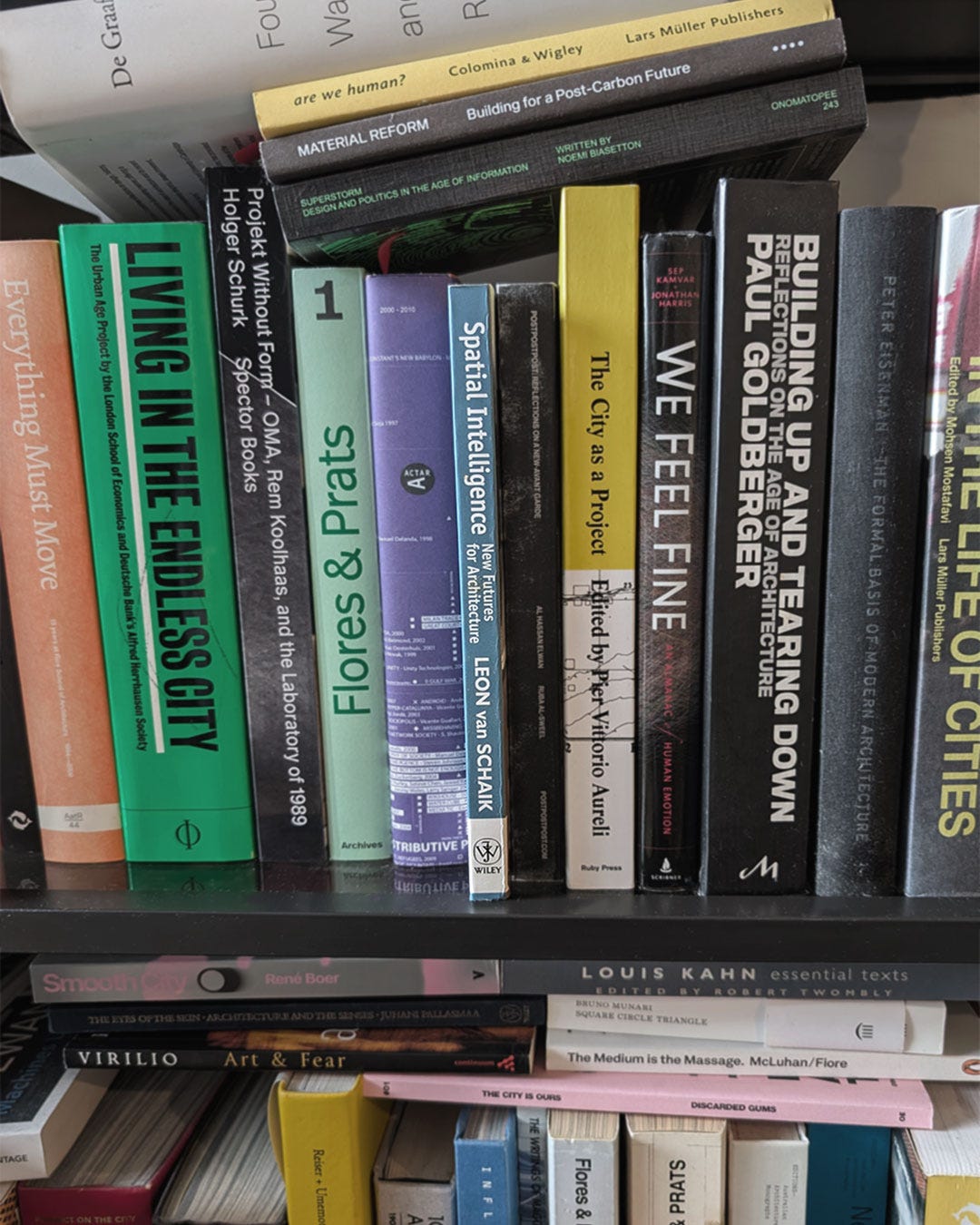
The book is still sitting on my shelf. I still haven’t read it. This feels like the sort of confession that should come with a more dramatic explanation, but there isn’t one. It has simply remained there, quietly occupying space, while the argument it’s been making, from across the room, is the one I’ve been trying to work out here.
Osmosis, apparently, doesn’t require permission.
Thanks for reading.
Feel free to share drafts— with someone who might appreciate a quiet read.
, (1960).")

Van Schaik, Leon. Spatial Intelligence: New Futures for Architecture. Wiley, 2008.
TRAFFIC is a collaborative design practice working across architecture, urbanism, and computation. trafficcollective.com
Thesis project, Master of Architecture, 2008. Developed in response to a Mind the Gap studio brief.
Debord, Guy. The Society of the Spectacle. Black & Red, 1977 (orig. 1967).
Comments
Nothing yet. Say the first thing.
Sign in to join the conversation.