
About a week ago, I walked into GOMA, Brisbane’s Gallery of Modern Art, expecting an exhibition and found something else: a kind of atmospheric test, a rehearsal for being human. It seemed designed to gently interrogate a type of awareness that emerges through light, temperature, and the small adjustments your body makes when it realises the room is paying attention.
Olafur Eliasson, Icelandic–Danish artist and spatial thinker, works in the space where environment and perception converge. His installations don’t pursue spectacle for its own sake. What they offer instead is a recalibration of sorts. Perception, in his hands, feels provisional—it’s a negotiation. Occasionally, a quiet reckoning. We stop being spectators. Our presence is part of the mechanism.
Childhood shapes how we see the world. For Eliasson, summers in Iceland with his grandparents left an imprint on his understanding of light, landscape, and what it means to perceive. I recognise a similar impression from my own summers in India—moments that continue to shape how I notice place, atmosphere, and presence.
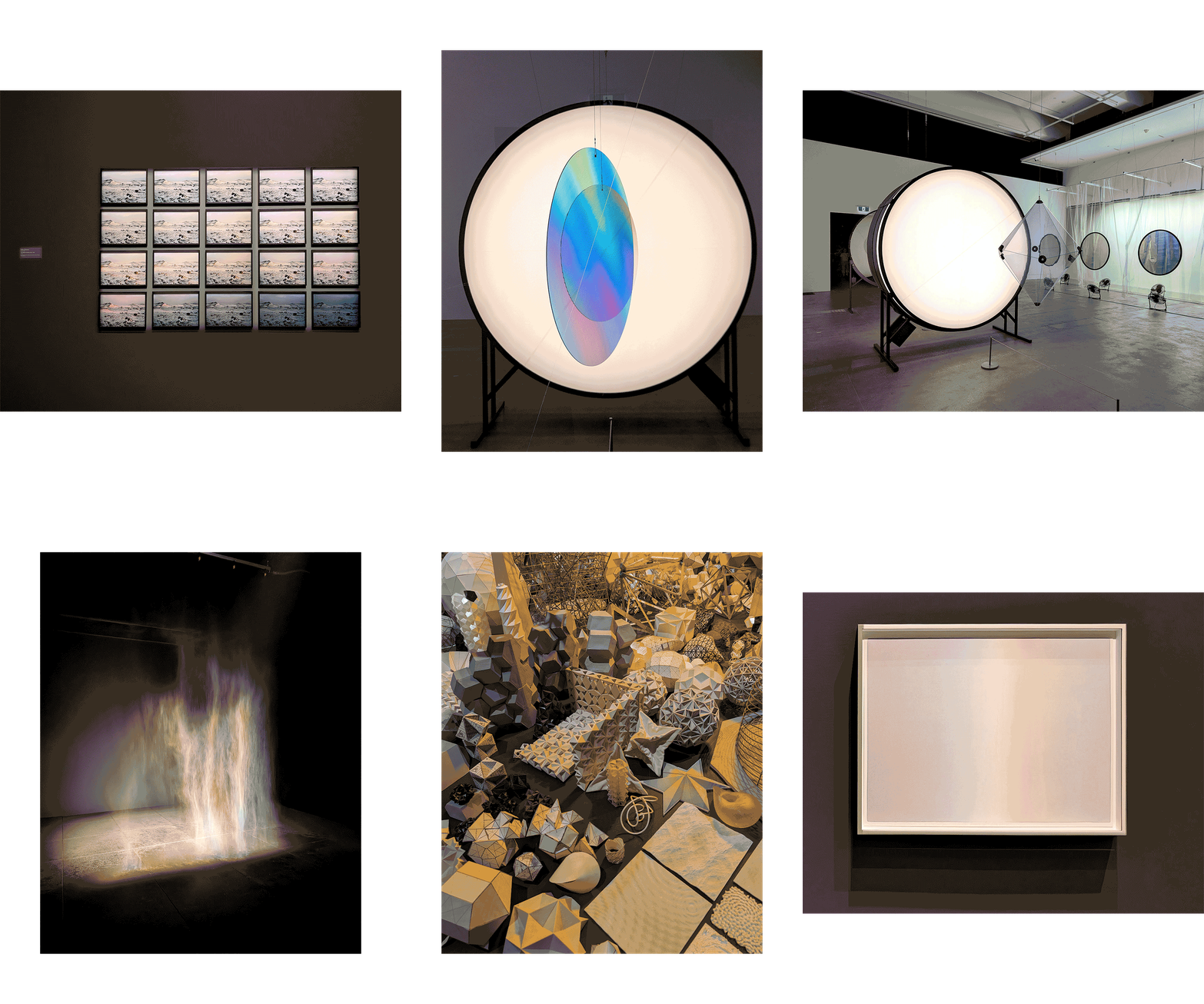
Before the installations expand into cosmic sun, prisms, and geometric cities, Eliasson begins with Iceland: photographs of clouds forming, ice dissolving, shadows stretching across volcanic ground. They read like architectural site studies: observations, not conclusions. The prologue is almost monastic. Light becomes a structural material, time a surface, weather a foundation. From this ground, the rest of the exhibition grows.
The exhibition widens into Pluriverse Assembly, where colour spills out in planetary spirals, as if someone has cracked open a small hatch to the universe’s backstage: the mechanism on one side, the cosmos it conjures on the other. The poetry and the scaffolding are presented without hierarchy, nothing mystical, nothing hidden, just light doing its work. The show refuses linearity; it moves the way ideas do, expanding, refracting, plural by design.
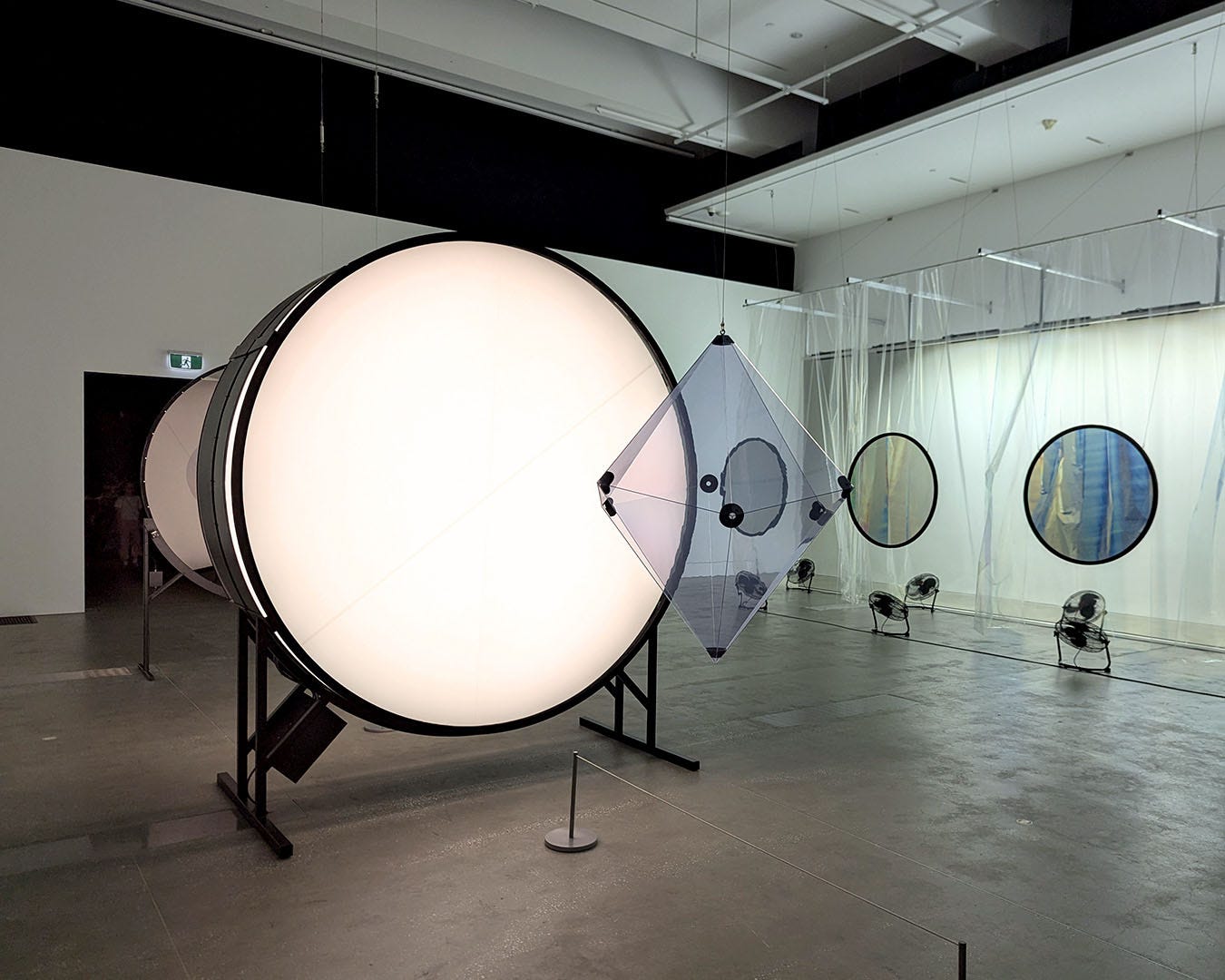
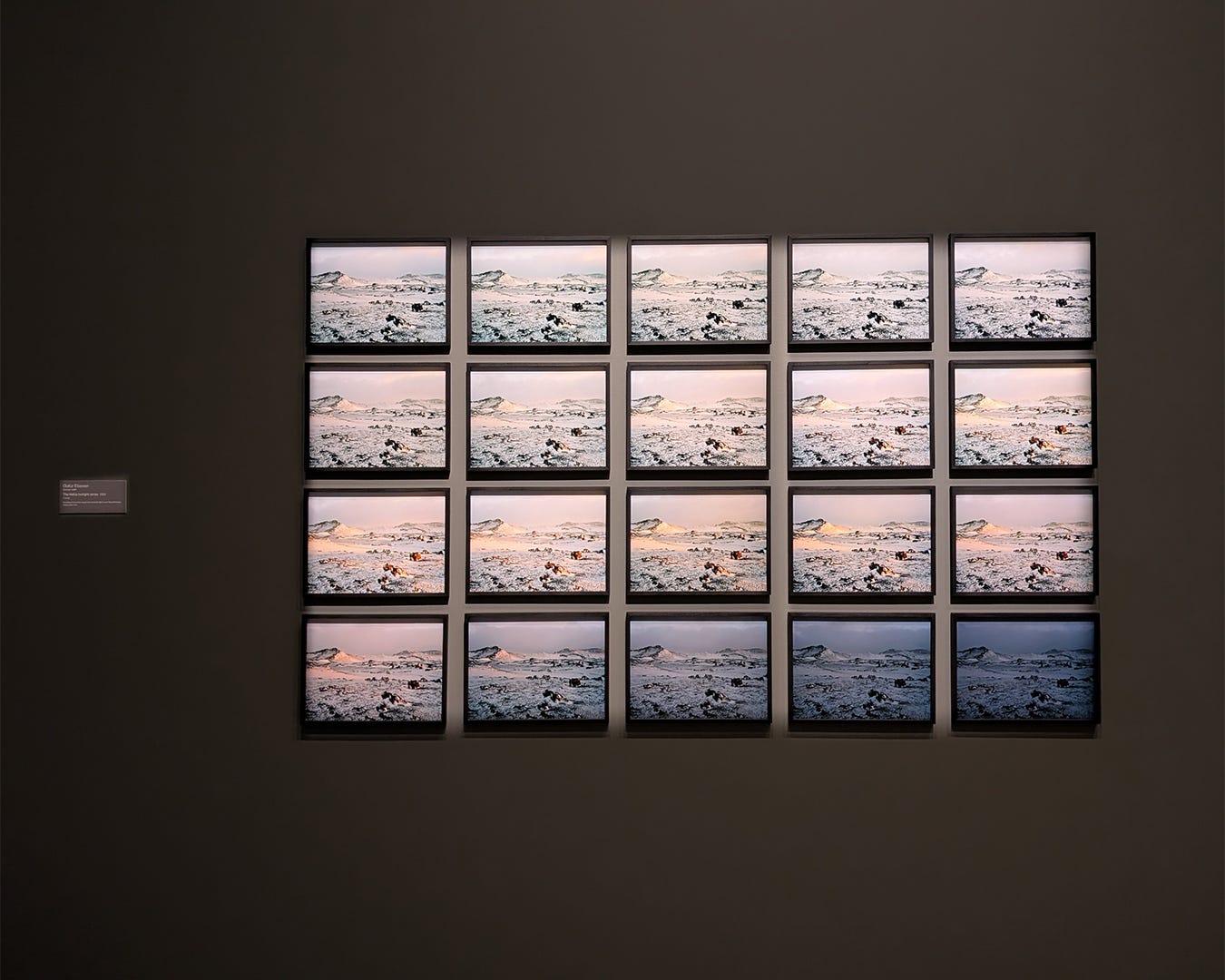
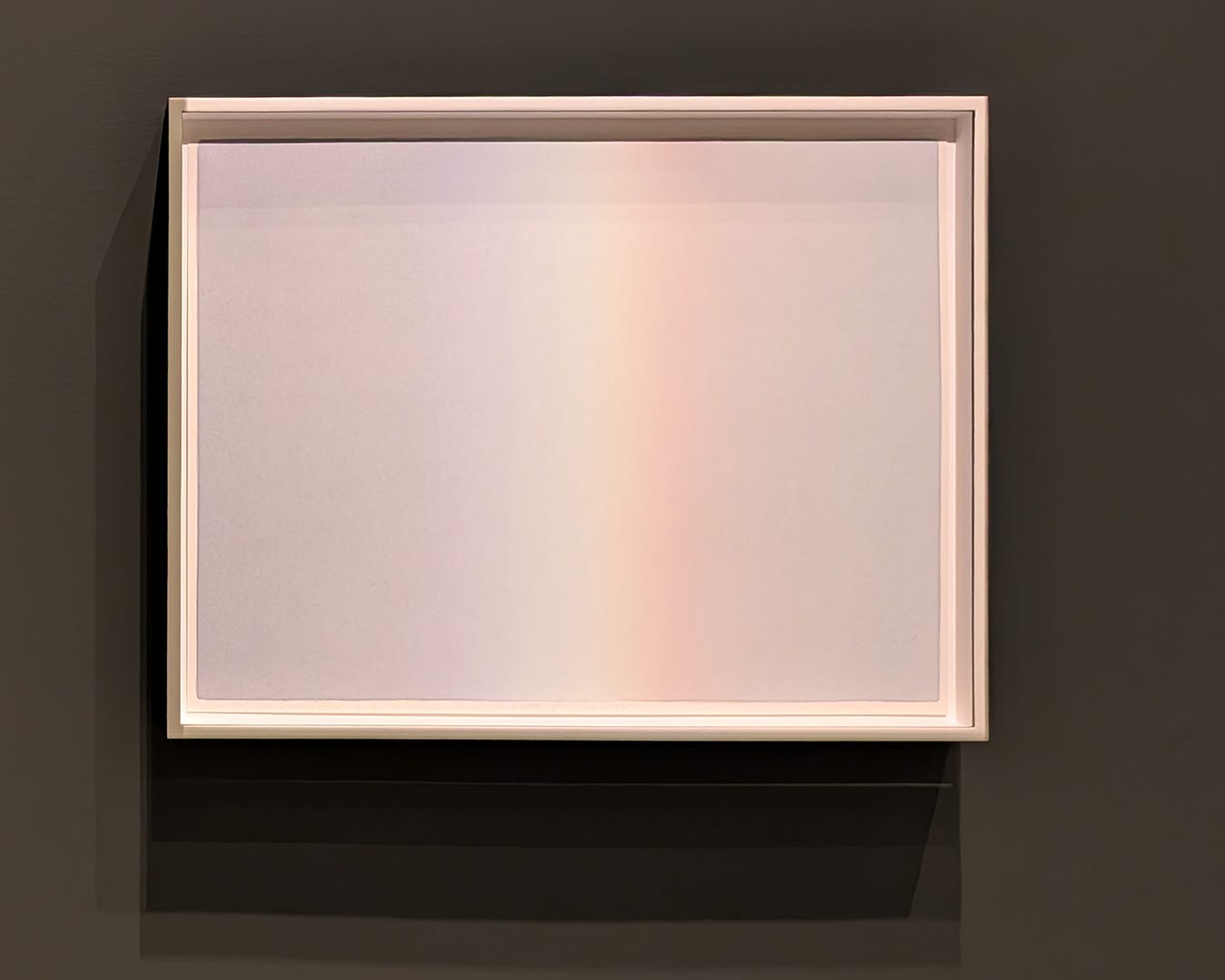
This leads into Perspectives and Truths, where Your negotiable vulnerability seen from two perspectives and Your truths begin to ask harder questions. The works are built from polarising filters that invert colour, erase it, or reveal it depending on where you stand. Black dissolves into white; a curtain shifts from monochrome to spectral. These pieces feel like diagrams for contemporary life: perception as something provisional, situational, dependent on willingness to move. Truth becomes a shifting gradient rather than a fixed coordinate.
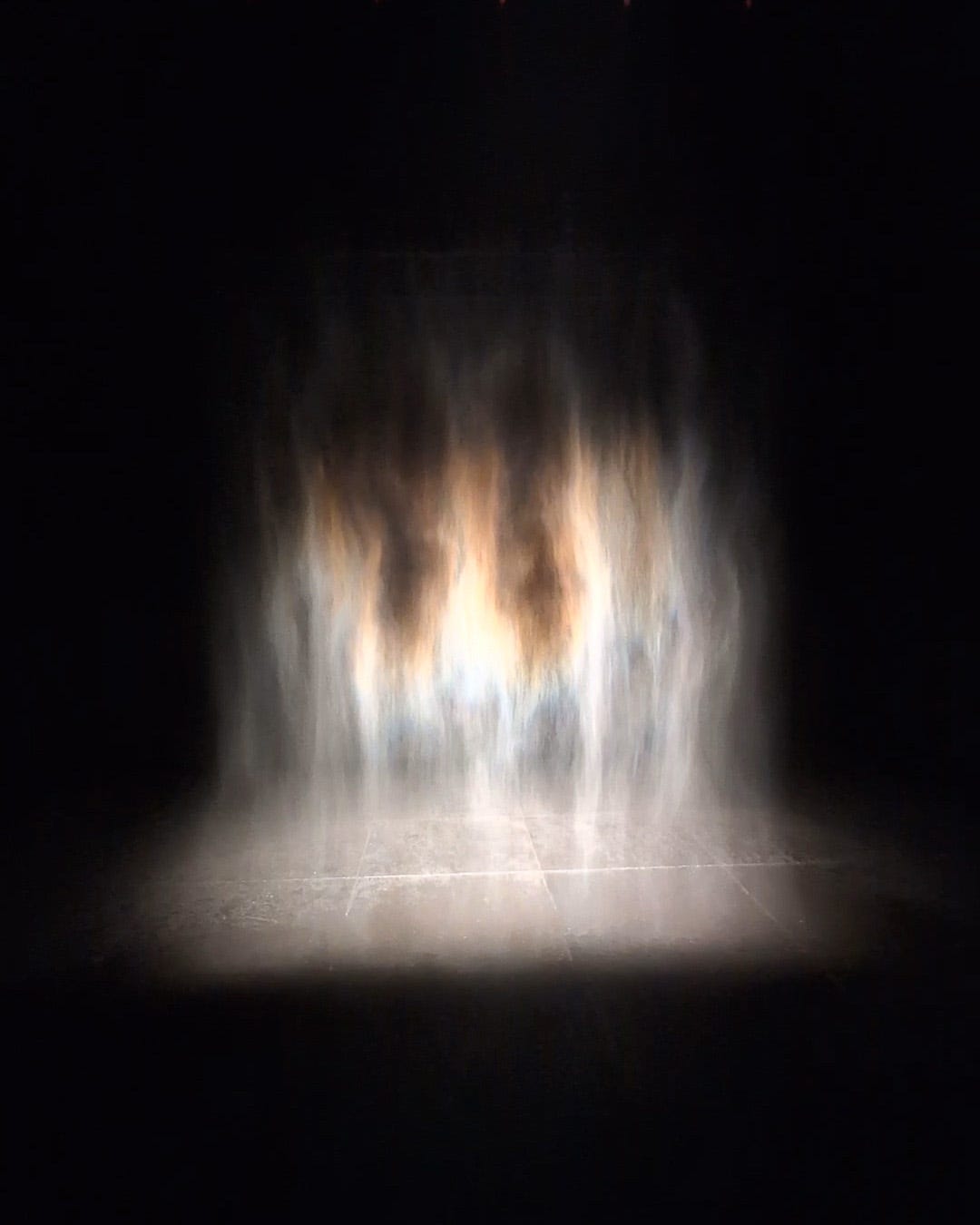
Beauty (1993), arguably the emotional core of the entire exhibition, offers an understated intensity: a thin veil of mist, a single beam of light, and a rainbow that only exists if you commit to looking. It’s an early reminder that design is co-authored. Shift a few centimetres and the experience collapses. It reads like an architectural truth: form is nothing without the position of the body encountering it. Space is never neutral; it’s an agreement.
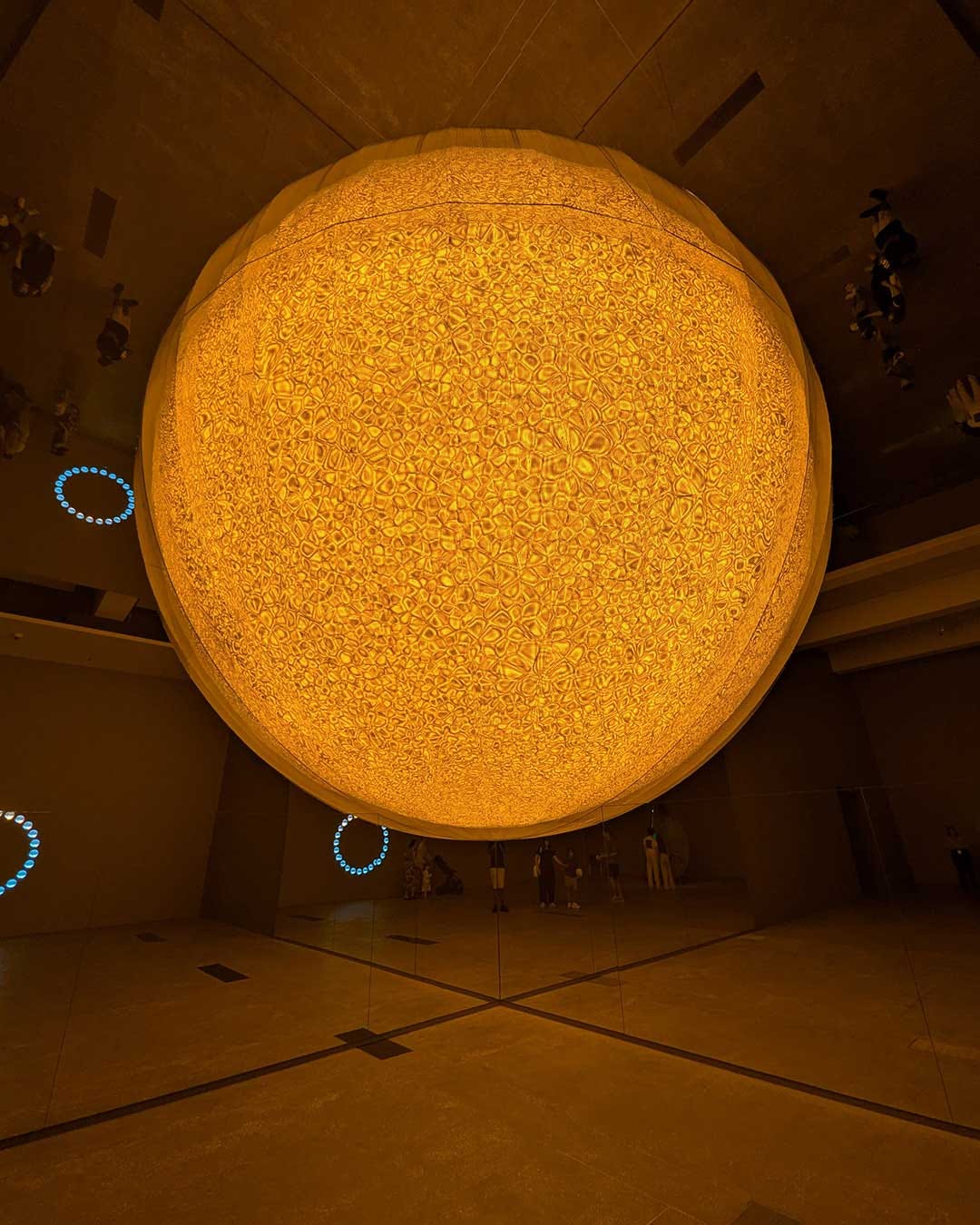
At the centre of the exhibition is Presence (2025): a chamber of yellow monofrequency light, mirrors, and optical interference patterns that recalibrate scale and depth. It feels as if the sun has slipped indoors. Shapes flatten, colours retreat, silhouettes turn graphic, almost architectural. You notice your own movement, the movement of others—the choreography of bodies negotiating shared space. Here, presence itself becomes part of the structure.
Nearby, Firefly city (2025) turns inward: a rotating lantern of mirrors and coloured glass, scattering flickers across walls. Where Presence expands the body outward, Firefly city pulls it into a more meditative register. The two rooms feel like companions: one solar, one nocturnal.
Eliasson’s sense of responsibility is tangible in The glacier melt series 1999/2019 (2019). Leaning into activism without theatrics, shrinking ice is presented as a long horizon line—less an artwork than a temperature reading. Model for your circular city (2024) and The cubic structural evolution project (2004) offer counterpoints: systems for building, unbuilding, rebuilding. My eight-year-old gravitated immediately to the LEGO city—an evolving micro-urbanism study in collective authorship. Part play, part planning, part soft manifesto on how easily worlds can be assembled, and how lightly they can be held.
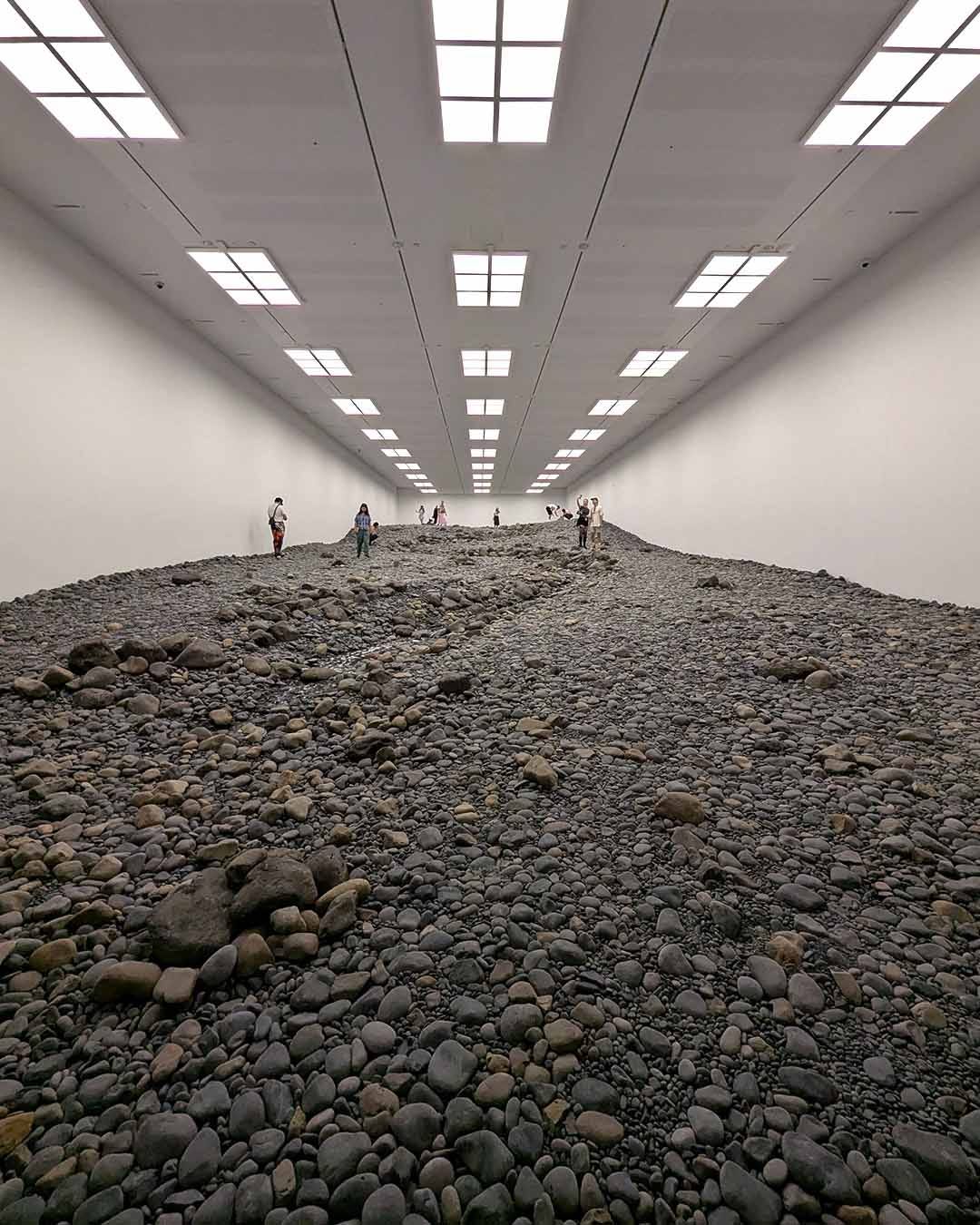
Riverbed (2014) disrupts everything. The gallery floor disappears under a field of volcanic stone and a thin thread of running water. There is no path. Walking over the rocks, your stride shortens, your posture adapts, your weight recalibrates. The body becomes a participant, not a passive courier for the eyes. It is, in its own way, a subtle provocation—an architectural reminder that comfort is a habit, and habits shape what we believe is possible.
What Eliasson does so deftly, and what resonates with my own practice, is show that perception can be designed. It is not fixed but active and relational, shifting with context, temperature, and the presence of others. We are variables within the system, necessary parts of the equation.
Leon van Schaik writes on spatial intelligence, (a later post on this), which gives language to this idea: perception is inseparable from bodily experience and memory. How we move through rooms, trace familiar routes, or cross thresholds shapes what we remember and how we imagine ourselves in the world. Spatial thinking produces continuity—a sense of self formed as much through orientation as reflection. Eliasson makes this visible. By designing conditions rather than objects, he invites us to notice how presence itself is partially composed through movement, attention, and relation to others.
Rather than moralising or staging spectacle, the exhibition shifts us by a few degrees—just enough to remind us that the atmospheres we inhabit shape us as much as we shape them. Architecture is not only about walls, floors, and thresholds, but about the conditions that make attention possible.
You don’t leave the exhibition so much as drift out of it—light recalibrated, pace softened, senses slightly re-tuned.
Thanks for reading.
A brief pause, as the year closes.
Feel free to share drafts— with someone who might appreciate a quiet read.

Comments
Nothing yet. Say the first thing.
Sign in to join the conversation.