
… when a damp
Fell round the path of Milton, in his hand
The Thing became a trumpet; whence he blew
Soul-animating strains—alas, too few!
Wordsworth, “Scorn not the Sonnet…”
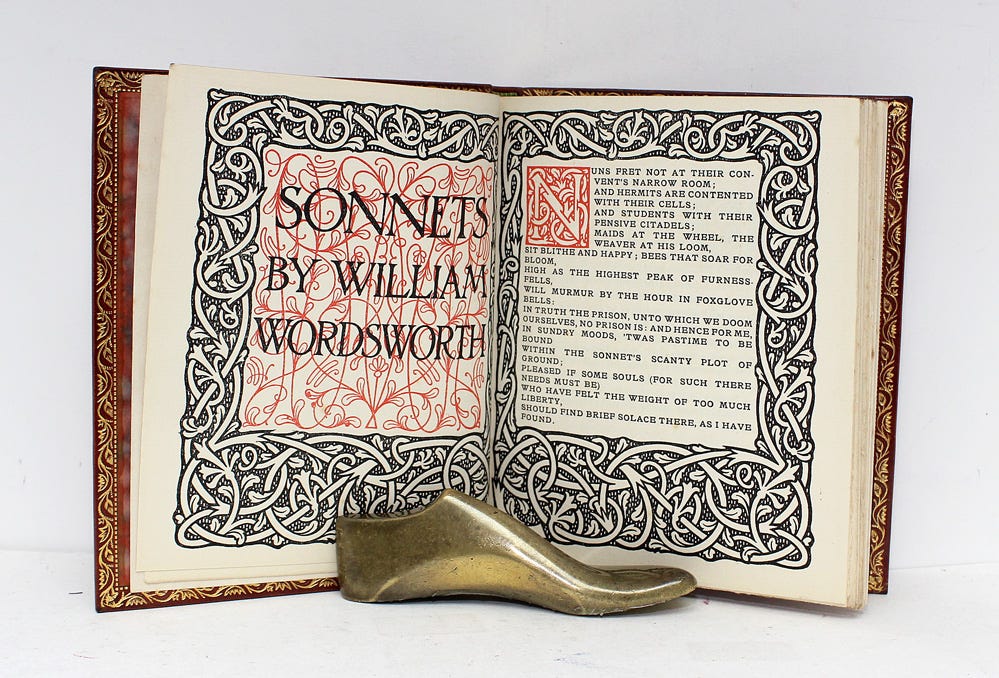
How many sonnets have you read by Wordsworth? Most readers of English poetry will know at least one, “Composed upon Westminster Bridge, September 3, 1802”, evoking London on a sunny autumn morning (“Earth has not anything to show more fair”). And then there are perhaps are a handful of others well-known by their opening lines e.g. “It is a beauteous evening, calm and free”; “Milton! Thou should’st be living at this hour”; “The world is too much with us, late and soon”; “Nuns fret not at their convent’s narrow room” — the last being Wordsworth’s sonnet about how, “for me,”
In sundry moods, ’twas pastime to be bound
Within the Sonnet’s scanty plot of ground
— a phrase which gave a recent new anthology of sonnets its title:
Selected editions of Wordsworth tend to represent his sonnets sparingly. The fact that he wrote sonnets about sonnets, though, ought to be a clue that he was unusually fluent in the fourteen-liner. This week, reading the back page of the Times Literary Supplement, I learned — from the ever-interesting “M.C.” — that the official tally has been estimated at 595. Or, to do the maths, 8,330 lines of sonnetry.
Only the real fans, I suspect, seek out “The River Duddon” (1820), a series of 34 sonnets on that Lake District watercourse; or the 45 sonnet-postcards he wrote about his tour of Scotland in 1833; or the crisp fourteen published in 1841 in defence of the death penalty, countering calls for its abolition from “weak-minded humanitarians” such as Charles Dickens. And if that’s not enough, there are always the Ecclesiastical Sonnets of 1822, which narrate the history of “the Church in England” in 102 poems.
Seriously intended though all these sequences are, there is something comic about the way that Wordsworth, once he started to write sonnets in his early thirties, seems to have been unable to stop. When he published his own collection of them in 1838 — at the age of 68 — the Author’s Preface noted casually that
Twelve new ones were composed while the sheets were going through the press
A later volume, The Sonnets of William Wordsworth (1899), edited by G.C. Moore Smith, appeared in the pocket-size Temple Classics series. Smith writes that this is a “comprehensive edition”, enlarging Wordsworth’s original compilation:
Strange to say, although by the time of his death in 1850 he had vastly added to the number of his Sonnets, no more separate collection than that of 1838 has been made to this day.
It contains 521 sonnets, mostly two to a page. And as far as I can tell, no more comprehensive edition has been made to this day. So I wonder where the figure of 595 comes from? The closest corroboration I can find is a review of a 1973 study of Wordsworth and the Sonnet by Lee. M Johnson, which states that “Wordsworth wrote 535 sonnets, not counting several dozen blank verse sonnets embedded in The Prelude, The Excursion, and other poems”. A full five dozen of these would bump 535 up to 595 — although I’m not entirely convinced by the critical notion of an “embedded” blank verse sonnet i.e. 14 lines in an unrhyming long poem that work nicely on their own.
What really interests me about all this, though, is that the sonnets by Wordsworth which have been remembered by readers all date from his earliest enthusiasm for the form, despite later being reprinted out of chronological sequence. His own account of how he started to write sonnets is one of spectacular inspiration:
In the cottage, Town-end, Grasmere, one afternoon in 1801, my Sister read to me the Sonnets of Milton. I had long been well acquainted with them, but I was particularly struck on that occasion by the dignified simplicity and majestic harmony that runs through most of them, — in character so totally different from the Italian, and still more so from Shakespeare’s fine Sonnets. I took fire, if I may be allowed to say so, and produced three Sonnets the same afternoon, the first I ever wrote except an irregular one at school. Of these three, the only one I distinctly remember is “I grieved for Buonaparte.” One was never written down: the third, which was, I believe, preserved, I cannot particularise.
One telling detail here is “never written down”: from the first, it seems, Wordsworth was able to work out a whole new sonnet in his head. Another is the fact that Milton’s sonnets are notable for addressing public figures and events during the Civil Wars, giving Wordsworth license to use the form to respond to his disillusionment with the aftermath of the French Revolution, and the rise of Napoleon.
At the same time, Wordsworth was struck by “the dignified simplicity and majestic harmony” of Milton’s sonnets, suggesting their appeal to the principle of radical simplicity that he had recently asserted in the “Preface” to Lyrical Ballads (1800): “fitting to metrical arrangement a selection of the real language of men”. To illustrate the argument of the “Preface” about the need to purify the elaborate and artificial “Poetic Diction” of the eighteenth century, Wordsworth takes the example of a sonnet by Thomas Gray, of which he asserts:
The only part of this Sonnet which is of any value is the lines printed in Italics; it is equally obvious, that […] the language of these lines does in no respect differ from that of prose.
Only five lines are italicised.
Spontaneous composition, responding to the contemporary moment; consistently simple, prose-like vocabulary; and an overall formal harmony: these ingredients give us, I think, the recipe for Wordsworth’s early sonnets. And if we put the well-known poems mentioned in my opening paragraph back into the chronology of their composition, we find that all of them date from the same year: 1802, when Wordsworth and his sister, Dorothy, travelled to France to visit Annette Vallon, the woman he met and had a daughter with during the Revolution a decade earlier, but had not seen since the outbreak of war between Britain and France in 1793.
Comments
Nothing yet. Say the first thing.
Sign in to join the conversation.