
A few months ago I turned Claude into the operating system of my business.
Sixteen skills. One setup interview. Claude learned my niche, my audience, my offers, and my voice rules, then read all of it before writing anything. I stopped explaining my business to AI every morning.
It worked. I used it daily for months.
And every few weeks I hit the same wall.
I would ask for the email a person receives when they reach checkout and stop. Nothing owned the job. I would ask what a buyer gets in the 72 hours after paying, so the thing gets used instead of refunded. Nothing owned it either.
I had a welcome sequence skill and a nurture sequence skill. Past the nurture arc, I was back in a blank chat, re-explaining my own funnel.
So I mapped it on paper.
Then I mapped what a one-person business actually runs on.
There are eight sequences. I had two of them built properly.
The core idea held up, so it survived the rewrite untouched.
One profile, read by every skill. You answer a setup interview once. From then on, every output matches your niche, your audience, and your voice. Your banned words stay banned.
Skills, not prompts. A prompt is a message you paste. A skill is a method with steps, checkpoints, guardrails, and reference material behind it. The difference shows up in the output.
Skills hand off to each other. Validate the idea, build the product, write the page, plan the launch. Each one picks up where the last stopped, because they share the same profile.
That architecture stayed. Everything sitting on top of it got rebuilt.
Version 1 had four layers:
Clarity Engine,
Content Machine,
Revenue System,
Reflection Loop.
Version 2 has five.
The email side moved out of Revenue System and became its own layer, called Message Relay.
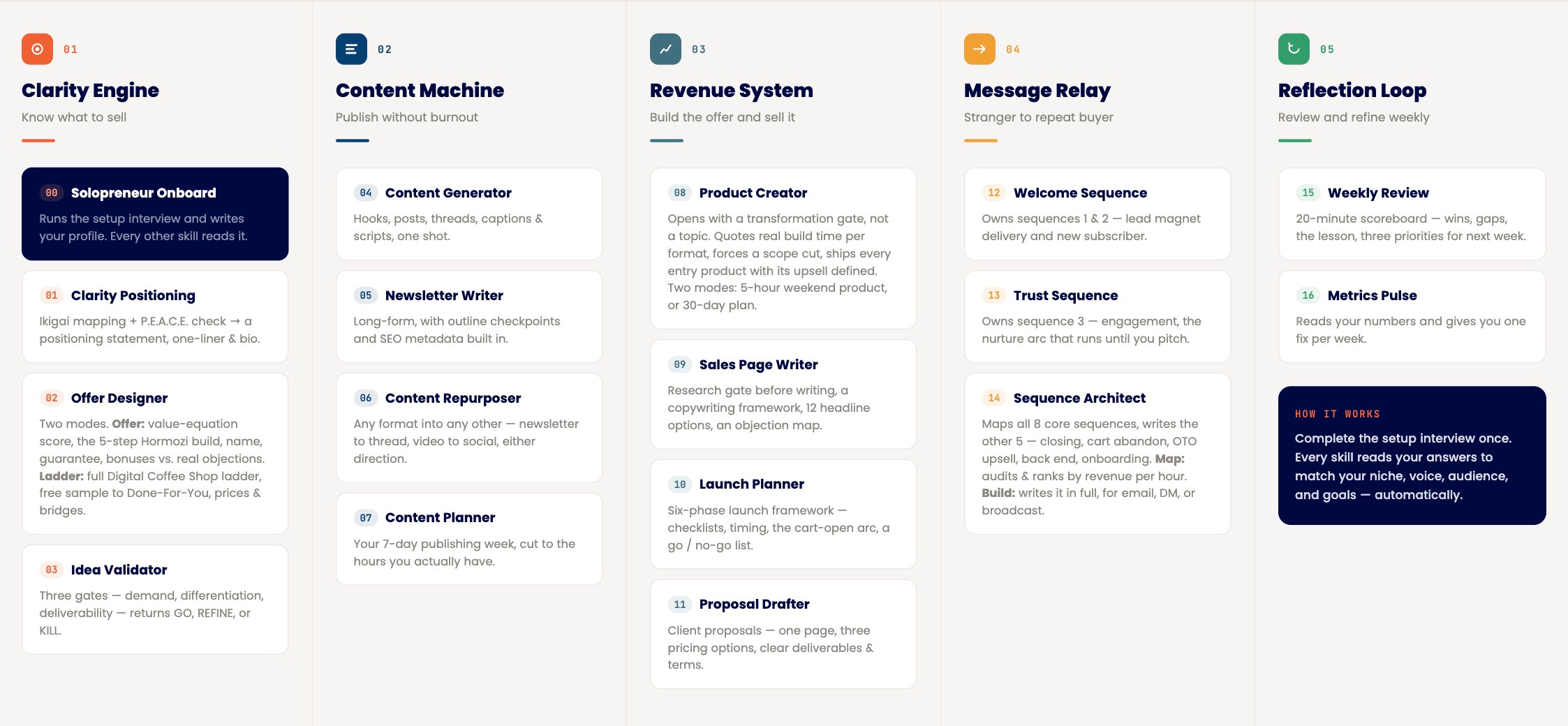
The name is deliberate. These sequences work as a relay. Each one hands the reader to the next, from first opt-in through to repeat buyer.
Here are all eight. Count how many you have.
Lead magnet delivery. They asked for the thing. Do they get it in under a minute, with one instruction for using it today.
New subscriber. Who you are, what happens here, why staying is worth it.
Engagement. What goes out between pitches so the list stays warm. Your newsletter lives here.
Closing. The open-cart emails when an offer window ends.
Cart abandon. They reached checkout and stopped. Warmest lead you will ever have.
One-time offer. The upsell in the minute after a yes, when willingness peaks.
Back end offer. The next thing you sell to someone who already bought.
Product onboarding. What a buyer receives so the purchase gets used instead of refunded.
Most solopreneurs run 1, 2, and 3. Sometimes 4, thrown together the week of a launch.
Sequences 5 through 8 are where a one-person business earns real margin, and almost nobody builds them.
Three skills now own this layer, with one owner per sequence so nothing overlaps and nothing gets skipped.
Welcome Sequence owns 1 and 2. Trust Sequence owns 3. A new skill, Sequence Architect, maps all eight and writes 4 through 8.
The part I use most is the map. It audits what you have, marks each sequence LIVE, PARTIAL, or MISSING, then ranks what to build first by revenue per hour of build time rather than by position in the relay.
Then it picks one. Exactly one, for this week.
A solopreneur who tries to build eight sequences at once builds none. The skill refuses to let you.
It also refuses to write a sequence your platform cannot fire. Cart abandon needs checkout tracking. On a Substack-only setup, the skill tells you so instead of writing three emails destined to never send.
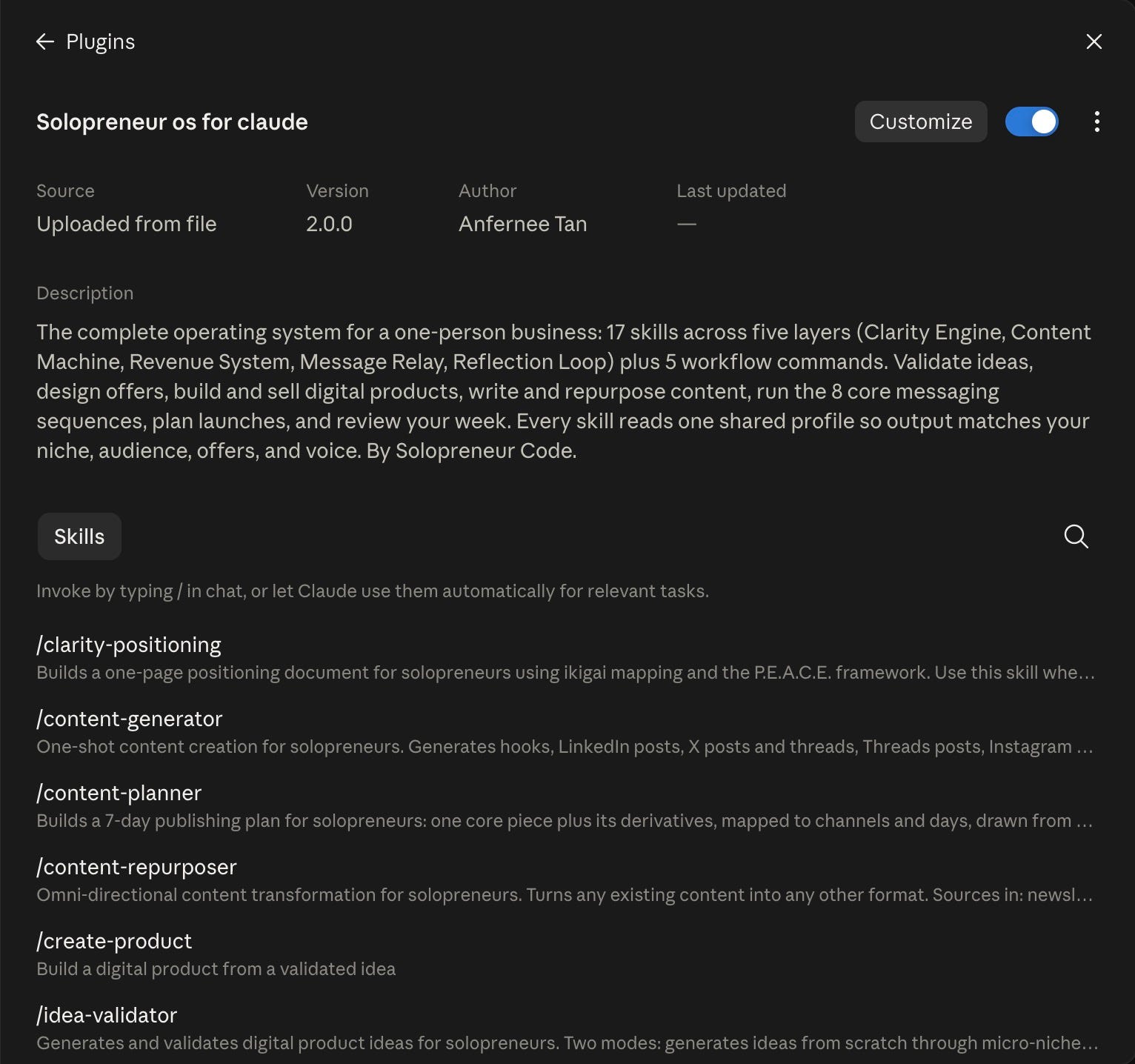
/solopreneur-onboard — Runs the setup interview and creates your solopreneur profile.
/clarity-positioning — Builds your positioning, niche, and one-liner using ikigai and P.E.A.C.E.
/offer-designer — Designs a single offer or the full ladder, priced and wrapped to convert.
/idea-validator — Scores a product idea and returns GO, REFINE, or KILL.
/content-generator — Writes one-shot posts, hooks, threads, captions, and short scripts.
/newsletter-writer — Writes long-form newsletter issues and articles, 800 to 2500 words.
/content-repurposer — Turns any existing content into any other format.
/content-planner — Builds your 7-day publishing plan from your content pillars.
/product-creator — Builds a digital product from idea to packaged, priced asset.
/sales-page-writer — Writes the full sales page: headline, offer, proof, objections, CTA.
/launch-planner — Plans a launch end to end using the C.R.E.A.T.E. framework.
/proposal-drafter — Drafts a client proposal with three pricing options.
/welcome-sequence — Writes the 5-email welcome sequence for new subscribers.
/trust-sequence — Writes the nurture sequence that builds authority before the pitch.
/sequence-architect — Maps all 8 core sequences and writes the 5 you’re missing.
/weekly-review — Runs your 20-minute weekly review and sets next week’s priorities.
/metrics-pulse — Reads your numbers and gives you one fix for the week.
The offer skill in version 1 built you a ladder. Free sample, entry, mid-ticket, Done-With-You, Done-For-You, with prices and the bridges between tiers.
Useful. Also incomplete.
A ladder tells you where products sit. It answers none of the questions a buyer weighs before paying.
So Offer Designer now has two modes.
Ladder mode does what it always did, with a money model check added.
Offer mode builds a single offer strong enough for the right buyer to feel silly saying no. It runs like this:
Check the market first. A strong offer to the wrong audience loses to a weak offer in the right one.
Score the offer on four levers. The outcome, the buyer’s belief in reaching it, how long it takes, and how much effort it demands. Most of us push on the first two and ignore the last two, which is where the cheap wins sit.
List every problem the buyer hits, before, during, and after. Then turn each one into a named solution.
Generate delivery options across six dimensions, including a deliberate ten times more expensive version and a one tenth version. Both often become real tiers later.
Trim and stack. Cut anything with high cost and low value. Keep the near-zero marginal cost assets: templates, filled examples, recorded walkthroughs.
Then it wraps the offer. A name built from a five-part formula. A guarantee routed by price and format, with a measurable pass or fail criterion attached. Two or three bonuses, each tied to a real objection you collected in step three.
And scarcity you actually enforce. Every claim ships with a line naming what you must do to make it true. Close the cart. Remove the bonus file. Stop the coupon.
If you cannot enforce it, the skill deletes it.
There is one more thing in there worth the price on its own. When an offer stalls, the skill refuses to rebuild it. It runs a fatigue ladder instead, cheapest fix first: creative, then copy, then the name, then duration, then the bonus, then structure last.
Most stalled offers need a new wrapper, not a new offer. I have wasted months learning that.
Product Creator used to start with a format. Ebook, course, template.
Now it starts with a gate. Three questions, before any structure exists:
What problem does it solve. What challenge does it overcome. What result does it achieve.
Then one sentence: how will the buyer be different after using this.
Everything else derives from those. People buy change, not information. A product built from a topic instead of a change is the most common reason a finished product does not sell.
Four other things changed.
Real build times. The moment you pick a format, the skill quotes what it takes. A checklist is 30 minutes. A template bundle is 1 to 2 hours. A PDF guide is 2 to 4 hours. A mini-course is 4 to 8. You commit with the cost visible.
A forced scope cut. After outlining, the skill checks whether any single section is big enough to stand alone as its own product. If it is, that section gets cut out and becomes a separate product, a bonus, or an upsell. Point A to Point B, never Point A to Point Z.
Two named build modes. A weekend product runs five hours across a Saturday and Sunday. A 30-day plan runs four weeks for anything larger. No invented timelines.
An upsell shipped with every entry product. The split: the entry product says what to do, the upsell says how to do it faster. The skill outputs it as a named product with a price, even before it exists. That becomes your next build.
There is also a beta step now. Small group first, then three questions: what did you love, what could be improved, what is still confusing.
Version one beats version none.
Sales Page Writer used to gather inputs and write.
Now it runs a research gate first. What is unique about the product. Who buys it today. What phrases do they use for their problem, in their words. What nearly stopped past buyers, and what convinced them.
Then it picks one copywriting framework and tells you which one it picked and why, instead of silently blending three.
Then it generates twelve headlines, runs them through a filter, and selects one while holding three alternates.
At the end you get an objection map. Every hesitation you named, and the element on the page answering it.
It also edits in three passes. It counts how often the page says “we” versus “you”. It reads for sentences running out of breath. And it checks every sentence pulls the reader into the next one.
The rest of version 2 is unglamorous, and it matters more than the headline features.
Every one of the other 13 skills got audited for the same things: does it load your profile, does it gather inputs before producing, is the method specific enough to produce something good, does it hand off correctly.
Four real bugs turned up. The onboarding tour still described four layers and never mentioned the new skill. The launch planner credited the wrong skill with writing the cart emails. The metrics skill routed every sequence fix to two skills and orphaned five sequences. The launch checklist had post-purchase items with no owner.
Then a style pass removed 75 semicolons and 6 em dashes from the instruction files, because a pack enforcing your voice rules should follow its own.
None of this shows up in a feature list. All of it shows up in the output.
Solopreneur OS for Claude is $97 on Gumroad. One time. The price does not rise, and every 2.x update is included, so anyone who bought version 1 gets all of this free right now.
BUT If you are a paid Solopreneur Code subscriber, at either tier, you already have it. Nothing to buy. It is in your vault.
Worth running the math if you are on the free list.
The pack alone is $97. A Paid annual membership is $79. The extra $32 gets you this pack plus the entire Premium Vault, the AI Toolbox, the monthly Action Lab sessions, and everything I build for the next twelve months.
I am not going to pretend a deadline exists. There is no founding price and no countdown. The product enforces honest scarcity, so running fake scarcity to sell it would be a strange way to start.
ONE SINGLE Paid Annual Membership at $79 to get everything worth more than $1,500!
Take five minutes. Write down the eight sequences. Mark each one live, partial, or missing.
You do not need my pack to do it. You need the map.
Then build the one you are missing that costs you the most. For most people reading this, it is cart abandon or product onboarding, and both take an afternoon.
I had two of eight. I teach this for a living. Whatever your count is, you are in better company than you think.
Reply and tell me your number. I read everything.
Q: I bought version 1. Do I pay again?
A: No. Every 2.x update is included in the original purchase. Download the new files, replace the old ones, and keep your profile. It still works.
Q: I am on the free list. What do I actually get by upgrading?
A: This pack free, the Premium Vault, the Solopreneur Success AI Toolbox, monthly live Action Lab sessions, and priority support. Paid runs $29 a month or $79 a year. Mastery is $149 a year and adds early access to everything new.
ONE SINGLE Paid Annual Membership at $79 to get everything worth more than $1,500!
Q: Do I need a paid Claude plan?
A: No. The skills run on any Claude plan, including Free, with the usual usage limits. They work on Claude.ai, Claude Code, and Cowork.
Q: I sell services, not digital products. Does the messaging layer apply?
A: Yes, with different labels. The closing sequence closes a booking window instead of a cart. The one-time offer becomes an add-on at proposal time. Product onboarding becomes client onboarding. The skills adapt and say which variation they are running.
Q: Will the output sound like AI?
A: The profile carries your voice rules, including your banned words, and every skill enforces them. The skills also refuse to fabricate stories, testimonials, or numbers. Where your real material belongs, they stop and ask you for it.
Every time you open Claude, you re-explain your business from scratch.
Your niche. Your voice. Your offers. Ten minutes lost before it writes a single useful word.
Solopreneur OS for Claude fixes that.
One setup interview. Then 17 skills across five layers, covering positioning, content, sales pages, launches, and every email sequence your business runs on, all reading your profile before every output.
Validate → Build → Sell → Follow Up → Review.
One system, one voice, one business.
Let’s crack the growth equation and build a thriving one-person business on your terms!
Anfernee
Comments
Nothing yet. Say the first thing.
Sign in to join the conversation.