
Most solopreneurs treat email like a slot machine.
Write something, hit send, hope it lands. The solopreneurs who actually convert do the opposite.
They run a small set of repeatable messaging sequences that do the selling for them, on autopilot, across email, SMS, social, and ads.
Here’s the good news.
You don’t need a 12-person marketing team or a bloated automation stack to pull this off.
You need eight sequences, each with one clear job.
Build them once, and they keep working while you sleep, travel, or focus on the parts of the business only you can do.
This post breaks down all eight, what each one is for, how many messages you actually need, and where to start when you’re a team of one.
A broadcast is a single message sent to everyone at once.
It has its place, usually for news or a quick update.
But a broadcast asks a cold reader to make a decision right now, with no build-up.
That’s a hard ask. I know they won’t buy from me for sure.
A sequence is different.
It’s a planned series of messages, each one moving the reader closer to a single outcome.
One message earns trust. The next delivers proof. The next creates urgency.
By the time you ask for the sale, you’ve already done the work that makes yes feel obvious.
For a solo business this matters even more.
Your time is the bottleneck.
Sequences turn your best thinking into a system that runs without you in the room.
Write the message once, and it greets every new subscriber, recovers every abandoned cart, and welcomes every new customer, forever.
I run almost all my sequences in Gumroad, read more about Gumroad here:

Think of these as a relay.
Each sequence hands the reader off to the next, from first opt-in all the way to repeat buyer.
You don’t have to build them all at once.
You do need to know where each one fits.
The goal is to deliver the lead magnet the second someone opts in, then make sure they actually use it.
Most people download a freebie and forget it exists.
This sequence fights that.
Message one hands over the access link.
Message two nudges them to open it and shows a quick win.
Message three points them back to your about page so they learn who you are.
The building blocks are access to the lead magnet or training, proof it works, and the process to follow.
Get message one right first if you’re doing this alone.
A fast, clean delivery email sets the tone for everything that follows.
This sequence is your handshake. It runs right after the lead magnet lands, and its only job is to build credibility, goodwill, and a real connection with a stranger who barely knows you yet.
Answer the questions new readers always have.
Point them to your best social accounts. Share results and any authority markers like interviews or press.
The building blocks are an FAQ email, a social media connection prompt, proof through results, and authority through media or interviews.
On your own, just write one honest FAQ email.
It removes friction and does more heavy lifting than any clever hook.
This is the workhorse.
Its job is to keep leads warm and steadily drive them toward buying a product or booking a call.
If you sell one core offer, this sequence can run for 27 steps or longer, essentially forever.
It’s where your ongoing newsletter lives.
You rotate through message types so it never feels like one long pitch.
The building blocks are the ping (a quick check-in), the process (how you do things), promotion, proof, problems you solve, curated content, value stacks, sample content, and behind-the-scenes factory tours.
Batch a month of these in one sitting.
Variety keeps it alive, so rotate the block types instead of pitching every week.
When a promotion is ending, this short burst closes the cart and creates urgency in a very short window, usually about two days.
It’s tight, direct, and unapologetic about the deadline and a clear reminder of the value on the table.
The building blocks are urgency, proof, and value stacks.
A real deadline is non-negotiable here. Fake urgency trains readers to ignore you.
Someone got all the way to the cart and stopped. That’s your warmest lead.
This sequence re-activates them before the intent fades, sending them back to the order form or checkout.
Remind them what they were about to get, handle the silent objection, and make returning to checkout effortless.
Urgency, proof, and value stacks are the building blocks.
One recovery message within an hour of abandonment beats three sent days later.
A one-time offer works because the buyer already trusts you enough to pay.
Right after purchase, they’re at peak willingness, so this sequence presents a complementary product at a discounted price they’ll only see once, usually for two to three days.
Value stacks, process, urgency, and proof make up the building blocks.
Pick one product that naturally extends the first purchase.
Relevance beats a steep discount.
This is where solo businesses earn real margin.
A buyer of your low-ticket product is the perfect candidate for your premium offer, so this sequence bridges the gap and moves them toward your higher-ticket coaching, agency, or consulting offer, showing the deeper transformation available when they work with you more closely.
Again, the building blocks are value stacks, process, urgency, and proof.
Lead with a client result, then invite a conversation.
High-ticket sells through trust, not pressure.
The sale isn’t the finish line, it’s the start of the relationship.
Buyers who use your product stay, refer, and buy again.
Buyers who forget it request refunds.
This sequence reinforces the purchase and walks people through the product step by step, so usage goes up and refunds and cancellations go down.
Proof, process, and curated content are the building blocks.
Map the first win your product delivers, then build the onboarding around getting the customer there fast.
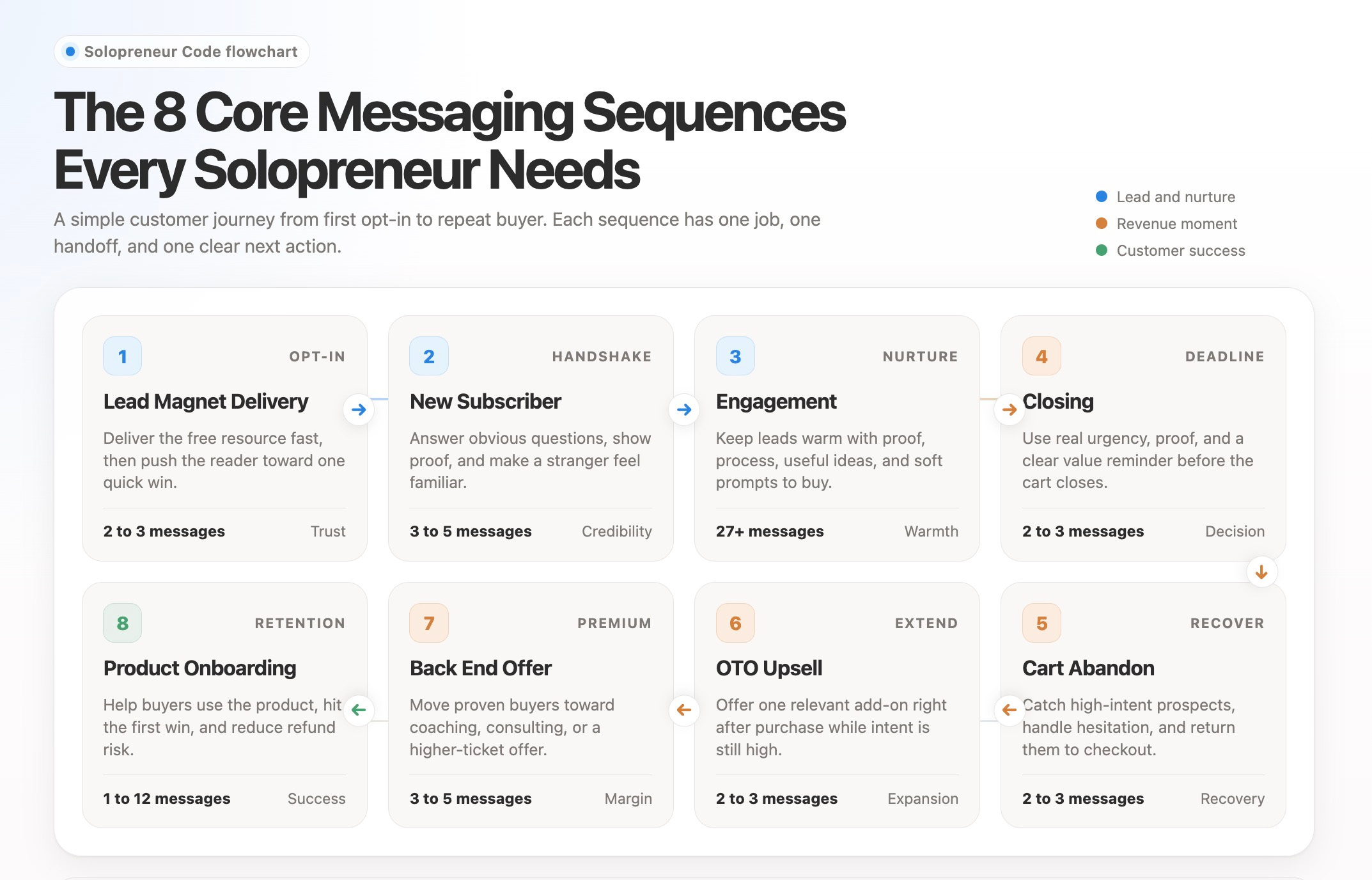
Eight sequences sounds like a lot when you’re the whole team.
It isn’t, if you sequence the build itself. Here’s the order that gives you the fastest return.
Start with delivery and onboarding. These protect money you’ve already earned. A clean lead magnet delivery and a solid onboarding flow cut refunds and build trust immediately.
Add the engagement sequence next. This is your relationship engine. It nurtures every lead you’ll ever collect, so it pays off longest.
Layer in the revenue sequences. Closing, cart abandon, OTO upsell, and back end offer all move money. Add them as you launch offers that need them.
Refine the new subscriber sequence last. By now you’ll know which questions and proof points actually land, so you can write it with real data instead of guesses.
Two rules keep this sane for a solo operator.
Write each message once and reuse the good ones across sequences.
And resist the urge to automate everything on day one.
A single strong email beats five mediocre ones stuck in a broken flow.
Remember, no one says you need to get everything to work on day one.
Want to shortcut the entire building process?
Simply get Solopreneur OS for Claude.
I’ve built all the core messaging sequences into the plugin.
Every time you open Claude, you re-explain your business from scratch.
Your niche. Your voice. Your offers. Ten minutes lost before it writes a single useful word.
Solopreneur OS for Claude fixes that.
One setup interview. Then 16 skills covering positioning, content, sales pages, launches, weekly reviews that all read your profile before every output.
Validate → Build → Sell → Review.
One system, one voice, one business.
You win by sending the right message to the right person at the right moment, on repeat, without touching it every time.
That’s what these eight messaging sequences give you.
Build them one at a time, starting with the two that protect what you’ve already earned.
Within a few weeks you’ll have a system that greets, nurtures, sells, and retains, all while you do the work only you can do.
Want more systems like this, built for a team of one?
Subscribe to Solopreneur Code and get the frameworks, tools, and AI workflows that help you get more done and earn more, without the hustle.
You’re doing everything. But nothing is moving?
You are doing everything. But nothing is moving.
That is not a motivation problem.
Most solopreneurs are learning from everywhere and getting nowhere. Too much information. No clear system connecting effort to results.
You have everything it takes. You just do not have a clear system yet.
That is what paid subscribers get. Every system, playbook, prompt, and template. All inside the Premium Vault.
All for $79/year. That’s $6.58/month.
Upgrade now and unlock the Premium Vault worth thousands of dollars.
The Premium Vault holds the secret behind posts like this one, including the tools and resources I use to build the one-person business I love.
Let’s crack the growth equation and build a thriving one-person business on your terms!
Anfernee
Comments
Nothing yet. Say the first thing.
Sign in to join the conversation.