
Hi everyone, and welcome to our newest subscribers. Great to have you along!

We have spent the better part of spring and early summer exploring some of our common ideas of God.
Ideas and beliefs are not the same thing. A belief, in today’s context, is an intellectual, conscious conclusion about something. For example, I intellectually believe God loves me.
An idea is an underlying assumption, conclusion, or principle in which our hearts are rooted, but of which we are generally unaware.
So while I may consciously believe that God loves me, I may function from the idea that God is perpetually disappointed in me, grudgingly spends time with me, or only accepts me if I perform.
Beliefs are generally influenced through instruction, while ideas are generally formed through relationships and experience.
If we wish to become deep people, people increasingly attuned to God, others, and ourselves, we journey with Jesus and a trusted friend into our ideas and wrestle with what we find there. This is a necessary part of the spiritual journey.
I am occasionally asked why I think uncovering these mysterious, hidden ideas is such an essential part of our discipleship adventure.
To properly answer that good question, let’s zoom out a bit.
A few decades ago, Janet Hagberg and Robert Gulich wrote a book called The Critical Journey, which I’ve referenced before. It theorizes that our spiritual journeys can be categorized into six stages. Keep in mind, these stages are just theory, and many other discipleship models have been introduced over the years. I’ve just found this particular book to be the most helpful in my work.
The six stages are, as paraphrased by me:
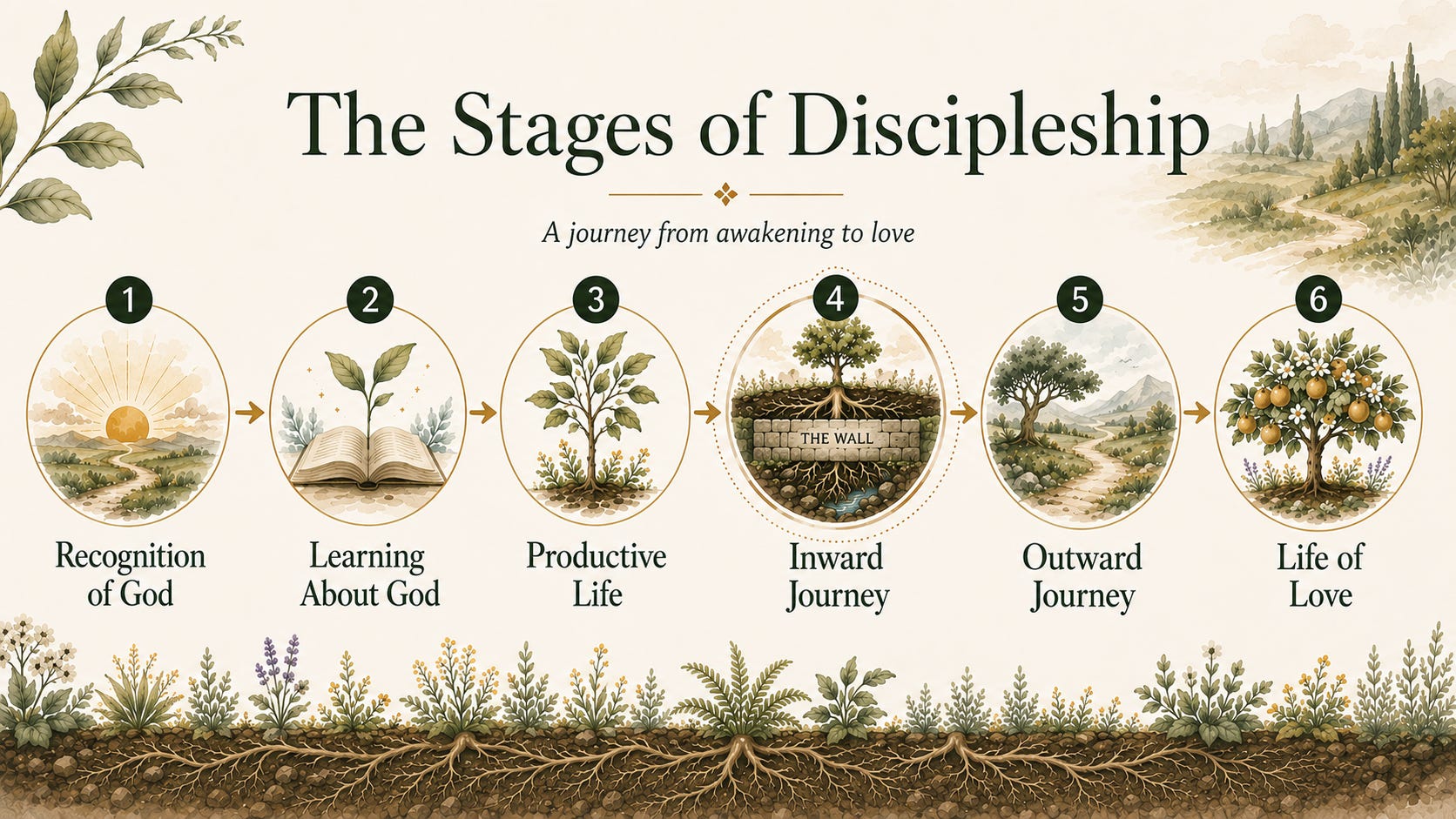
Hagberg and Gulich make it clear that we don’t necessarily move through these stages in linear order. We may bounce around and skip stages, and perhaps find ourselves in two at one time.
However, they also make the point that while the current modern Christian institution excels at Stages 1, 2, and 3, it provides little or no guidance in Stages 4, 5, and 6.
Yet the deeper qualities of Jesus we long to assume — a secure attachment to God, a life of little anxiety, radical generosity, inner security, giving up of control, self-giving love — are most often formed in these later stages.
Why modern Christian institutions are of little help to us in Stages 4, 5, and 6 is something we’ll explore another time. However, I’ve yet to find a church leader who disagrees with Hagberg and Gulich’s assessment. If we find ourselves facing Stage 4, we are usually on our own.
One reason that we have few options for guidance in and through Stage 4 is a general disdain for self-introspection in modern Western Christianity. The Inward Journey is just that — a time of intentionally diving into the caverns and crevices of our own hearts to uncover what’s hidden there courageously.
Modern evangelicalism, for example, typically rejects such a practice. The concept of spending time exploring our ideas, desires, stories, wounds, control tendencies, faded dreams, unmet expectations, talents, and delightful personality quirks is often denounced as selfish navel-gazing. This is particularly true in command-and-control environments, where power and authority are consolidated in a senior minister or a celebrity. The last thing power structures want is more self-aware people.
The rejection of self-introspection isn’t always overt. However, if we pay close attention, we find the idea nestled into various Christian euphemisms and practices. “Just fix your eyes on Jesus.” “If you find yourself self-focused, get out and serve.” Go, go, go, multiply, multiply, multiply is the maxim of modern Christianity. Such outward energy leaves little room for the Inward Journey and, sometimes, that’s on purpose.
Granted, to spend too much time in Stage 4 can become an end in itself. However, I’m not concerned with that. A lack of self-awareness and self-knowledge is a far greater challenge today compared to those who may get stuck in the inner journey. If they do, they don’t understand the purpose of Stage 4 in the first place.
Somewhere in Stage 4, we run up against the Wall. Hagberg and Gulich suggest that for most, it appears near the end of a time of introspection. For me, it was the entry point.
The Wall is a time of challenge, doubt, pain, suffering, or change that causes our hearts to question the things we accepted and found secure in Stages 1, 2, and 3. Am I really valuable? Is God truly good? Is my life going somewhere? Is my doctrine my security blanket? Where is all this peace that God promises? Why is there so much evil?
There comes a moment when the prayers stop working the way they once did. The certainty that once held us together begins to fracture. The Bible may still sit on the nightstand, but opening it feels different from the way it once did. God has not disappeared, exactly, but He suddenly seems quieter than before.
The Wall takes on myriad forms: a lingering theological question, a divorce, a death of someone close, an illness, a career change, a move, a betrayal. It may be something sudden, or it may be the visible appearance of doubts that have lingered for years.
Either way, The Wall seems to be Jesus’ invitation into the deeper stages of life and reality. And, not surprisingly, it tends to be His invitation to explore the ideas in our hearts.
There is a theological assumption undergirding Stage 4 and the Wall that has lost some favor in the last 150 years or so, and it’s called double knowledge.
Double knowledge states that to know God, we must also know ourselves. To know ourselves, we must also know God. Knowledge of self and knowledge of God are intertwined and interdependent.
We find this concept clearly running through the Psalms and Proverbs, and it is assumed in much of the Hebrew Bible and the New Testament. Early church fathers such as Augustine wrote about it, and it’s woven through church history at least up through Calvin.
As the Age of Enlightenment took over, it seems to have created a schism. Those who rejected the idea of God became enamored with the quest for self-knowledge, which can turn into self-worship. At the same time, modern Christianity swung the pendulum the other way, insisting that self-denial implied or required self-ignorance.
We find ourselves in a similar, polarized environment today. That’s somewhat ironic, considering we assume the essential importance of double knowledge in many other circumstances.
For example, to marry a person who doesn’t know themselves is to invite disaster. Intimacy requires a commitment to knowledge of self and the other. If you’ve ever befriended someone only to discover, down the road, that the person refuses to come to grips with their own hearts, chances are you backed off. Willful self-ignorance can become dangerous for those in the vicinity.
Double knowledge is the pathway into intimacy. And if there’s something we’ve learned as we explore deep discipleship, it’s that God desires us intimately. To know one another in the closest way possible requires both parties to be raw, vulnerable, and open with each other, and with themselves. There is no other path.
So, we find ourselves full circle, back to my original assertion that the journey into deep discipleship requires a time of uncovering our hidden ideas. If we wish to become more like Jesus, to increasingly think, act, relate, and love as He does, we increasingly accept His kind invitations to experience Him more intimately. And that requires us to know both Him and ourselves more intimately.
If we accept the premise that we all function from a largely unconscious operating system — a complex mix of ideas and desires that sit at the bedrock of our hearts — we now realize that uncovering our true ideas about God, ourselves, others, and creation is a good, right, and noble stage of our spiritual journey. Though it’s often painful, it is also a great kindness.
It is here that I admit an uncomfortable conclusion that I’ve arrived at by simple observation of myself and many others. When presented with the Wall, most of us will choose not to engage it. We will retreat to Stage 1, 2, or 3 where we feel it’s safer. Or we will numb ourselves with a vast array of technological and pleasurable distractions. Or we will jump out of the journey altogether — we “deconstruct.”
Why do we retreat? Because the Wall asks us to surrender the identities we’ve spent decades constructing. It asks successful people to admit they are frightened, competent people to admit they are confused, and religious people to admit they do not know God as well as they imagined. No wonder we avoid it.
Combine that with the fact that modern churches provide little guidance through this pivotal stage, and, in some cases, will kick you out if you admit you’re there, and we have a crisis on our hands. I suspect this is why Hagberg and Gulich wrote:
“In my judgment, there will not be a significant spiritual recovery in our land or in the world unless or until we can more gracefully and adequately sojourn with people through the Wall. And I believe the major reason we are stuck in front of the Wall goes back to a core belief most of us still hold. Our core belief is that we are not truly loved by God and accepted, or that God’s grace is not sufficient.”
Or, to use our Soil & Roots vernacular, we operate from the idea that God doesn’t truly love us, because our relationships and experiences have formed us that way.
This may sound like a private spiritual matter, but it is not. What happens in the hidden life of individual people eventually becomes the culture we all inhabit.
Having spent the last five years studying, researching, writing, and podcasting on deep discipleship and the inward journey, I occasionally ask myself, “So what? If the majority of people who claim some affiliation with Jesus are comfortably living in Stages 1, 2, and 3, isn’t that good? What’s the big deal?”
From a 30,000-foot standpoint, it’s a huge deal.
Here in the West, we have evolved, or perhaps devolved, to the point where we rely quite dangerously on institutions, bureaucracies, and large systems to form the cultures in which we want to exist. And we get quite animated when those systems fail to deliver the cultures we want.
The sheer amount of energy, time, money, and effort we spend on our political systems provides Exhibit A. It’s true here on Substack and on every other major social media platform. It’s true on most traditional media platforms. We are deeply invested in increasingly massive political systems that we assume will provide the moral, financial, and social fabric of our cultures.
Here’s the problem: Cultures only change for the better when the people in those cultures become better people.
It seems to me we are wasting an extraordinary amount of time and energy on systems and institutions instead of the much more difficult work of exploring how we, one at a time, become better people. And the best person to model our journey after is the most human human.
Whether we accept that Jesus is king of the universe and savior of mankind, the fact that He is the greatest social and cultural reformer in history is not at issue. He is the embodiment of the virtues He espoused, and the most integrated, relaxed, secure, relationally shrewd, transformative person to walk the planet. To become more like Jesus is to become better. To become more like Jesus is to make culture better.
Besides, as C.S. Lewis wryly noted, all of these systems, bureaucracies, institutions, and systems we invest so heavily in have the lifespan of a gnat. You and I are eternal.
So if the path to becoming love, to becoming less angry, forgiving of our enemies, self-sacrificing, less controlling, and relationally shrewd must pass through a time of growing in self-knowledge, why not journey through? If courageously uncovering our hidden ideas of God, self, others, and creation is a good, right, admittedly painful part of our path to becoming better, should we not gather together and work through the Wall with each other?
Because if we truly want to live in better cultures, we must first become better individuals. And that is precisely Jesus’ hope for us.
Duc In Altum
Brian
Updated resource: This article has been expanded into a fuller evergreen guide on the inward journey, the Wall, and why lasting cultural renewal begins with personal transformation: Why Personal Transformation Comes Before Cultural Renewal.
The organization, Soil & Roots, is focused on helping guide us through Stage 4, the Inward Journey and the Wall, on our quest to become people of depth. We are currently reviewing the last 5 years of research and practicum (called the Greenhouse) and developing a 2-year small-community framework for such a journey, guided by a facilitator.
If you're interested in joining one of these groups of 4-12 people or facilitating such a gathering, jump over to our website and sign up for our newsletter there. More info on these small communities is forthcoming.
I jumped out of our normal podcast cadence and released a special, personal episode this past week. I share some of my story and how it relates to deep discipleship, what we are doing this summer at Soil & Roots, and what is coming down the pike. It’s raw, vulnerable, and heartfelt. Check it out here.
Comments
Nothing yet. Say the first thing.
Sign in to join the conversation.