
part 1 link : What the hell is quantum physics 🔗
part 2 link : What the hell is quantum physics🔗
What is quantum Entanglement 🔗
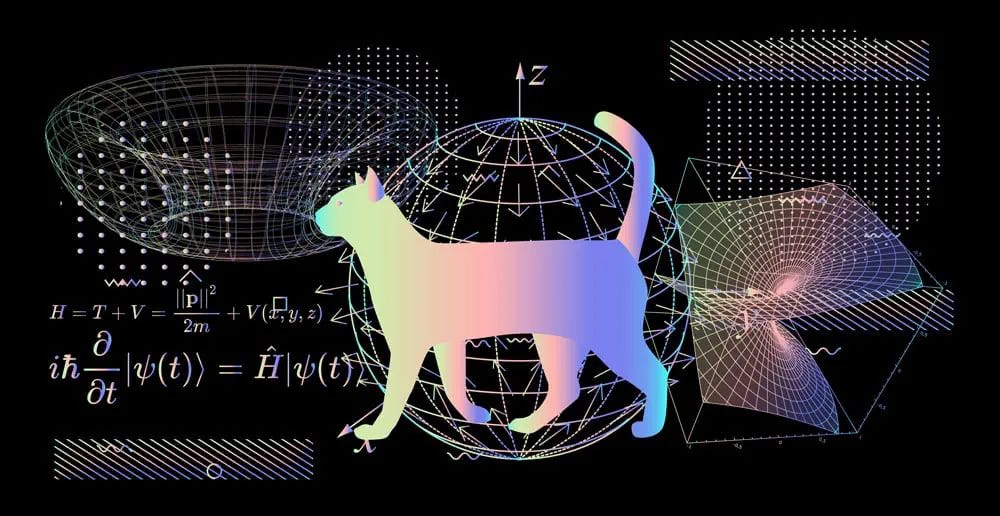
Welcome back guys! In Parts 1 and 2, we touched on a weird rule in quantum physics. Superposition- the idea that quantum particles can exist in multiple states at once until they’re observed.
Whenever people talk about superposition, one famous phrase always gets thrown around. It is Schrödinger’s Cat. You’ve probably seen the memes, or heard someone say a cat is both dead and alive at the same time.
But who was Schrödinger, why did he put a hypothetical cat in a box, and what does it actually mean for reality? Let’s break down the whole story!
⚠ this is a beginner’s guide
In 1935 an Austrian physicist named Erwin Schrödinger proposed a thought experiment (a scientific “what-if” scenario played out in your head—no real cats were harmed, okay hehe).
He asked us to imagine a completely sealed, opaque box containing four things
A live cat.
A single radioactive atom that has a exact 50% chance of decaying over the course of one hour.
A Geiger counter (a radiation detector) hooked up to a tiny hammer.
A sealed glass vial of poison.
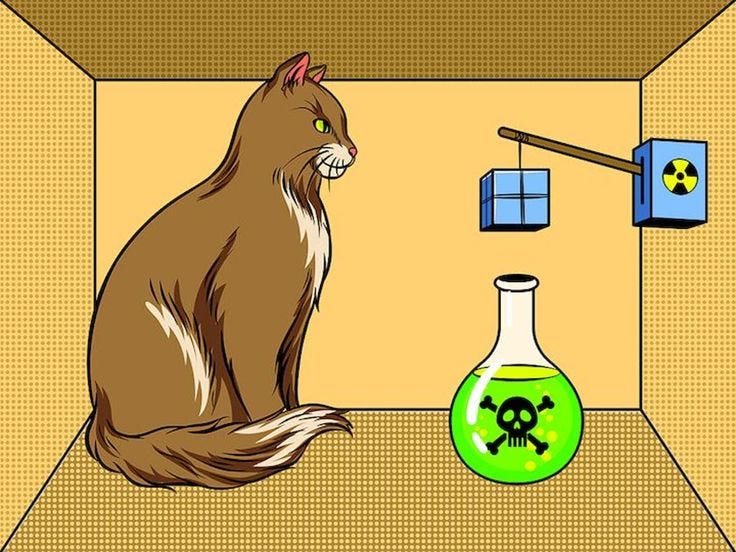
How the Trap Works:
If the atom decays, the Geiger counter detects it, drops the hammer, smashes the glass vial, releases the poison, and the cat dies.
If the atom does not decay, the hammer stays put, the vial remains unbroken, and the cat stays alive.
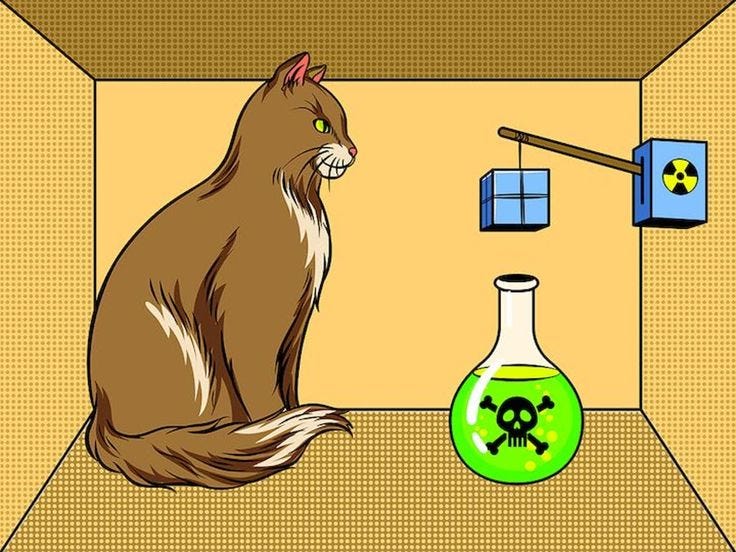
easy right??? Wait till you hear the craziest part.
Here is where quantum weirdness comes in. According to the mainstream physics view of the 1930s (called the Copenhagen Interpretation):
Before you measure a quantum particle, it doesn’t exist in just one state. The radioactive atom is simultaneously decayed AND undecayed- a fuzzy cloud of possibilities called a superposition.
Only when an observer opens the box and looks inside does the universe force the atom to choose a single reality.
Now let’s follow Schrödinger’s chain reaction:
The hammer’s state depends on the atom.
The poison’s state depends on the hammer.
The cat’s life depends on the poison.
Therefore, if the atom is in a superposition of decayed and undecayed, the cat must be in a superposition of dead AND alive at the same time- until you open the box to check.
WTF right!!!!
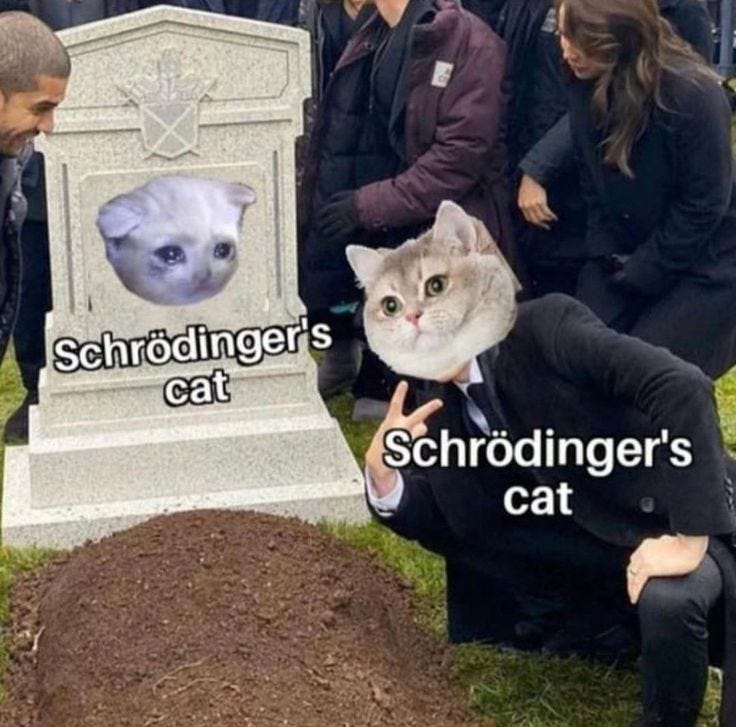
Here is the biggest misconception about Schrödinger’s Cat. Schrödinger didn’t create this experiment to prove that a cat could be dead and alive at once. He created it to show how absurd that idea was!
Schrödinger thought the Copenhagen Interpretation was ridiculous when applied to everyday objects. His point was simple: “If your theory says a cat can be alive and dead at the same time just because no one is looking, then your theory is missing something!”
Instead of solving quantum physics, his joke backfired and became the ultimate textbook illustration of how weird the quantum world really is. lol
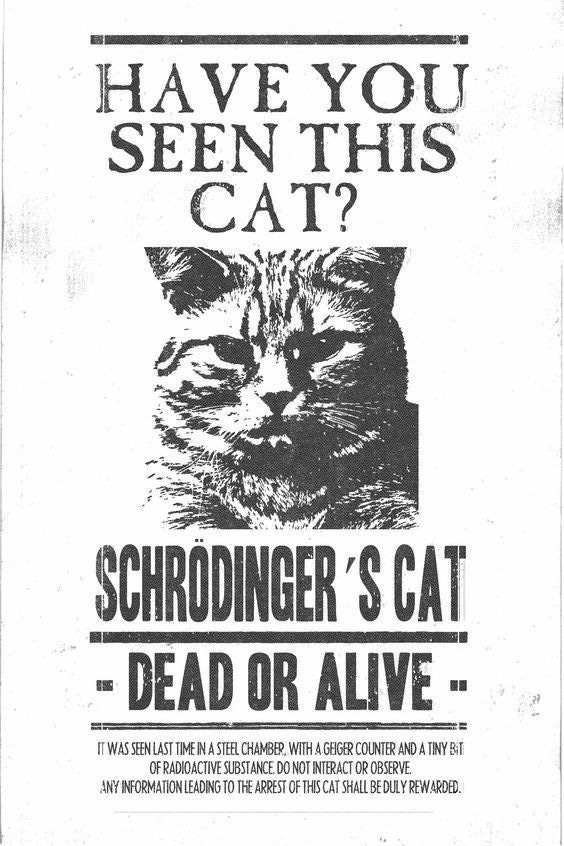
So, is the cat actually dead and alive in real life? No.
In the real world, macro objects (like cats, boxes, and hammers) are constantly bumped by trillions of surrounding molecules, heat, and light. This constant environmental interaction causes a process called Decoherence. (We talked about this in 2nd part)
Decoherence forces quantum superpositions to collapse into a single reality almost instantaneously- long before a human ever opens the box. The Geiger counter observes the atom the moment they interact. You don’t need a human eye to be an observer. Any physical interaction with the environment counts.
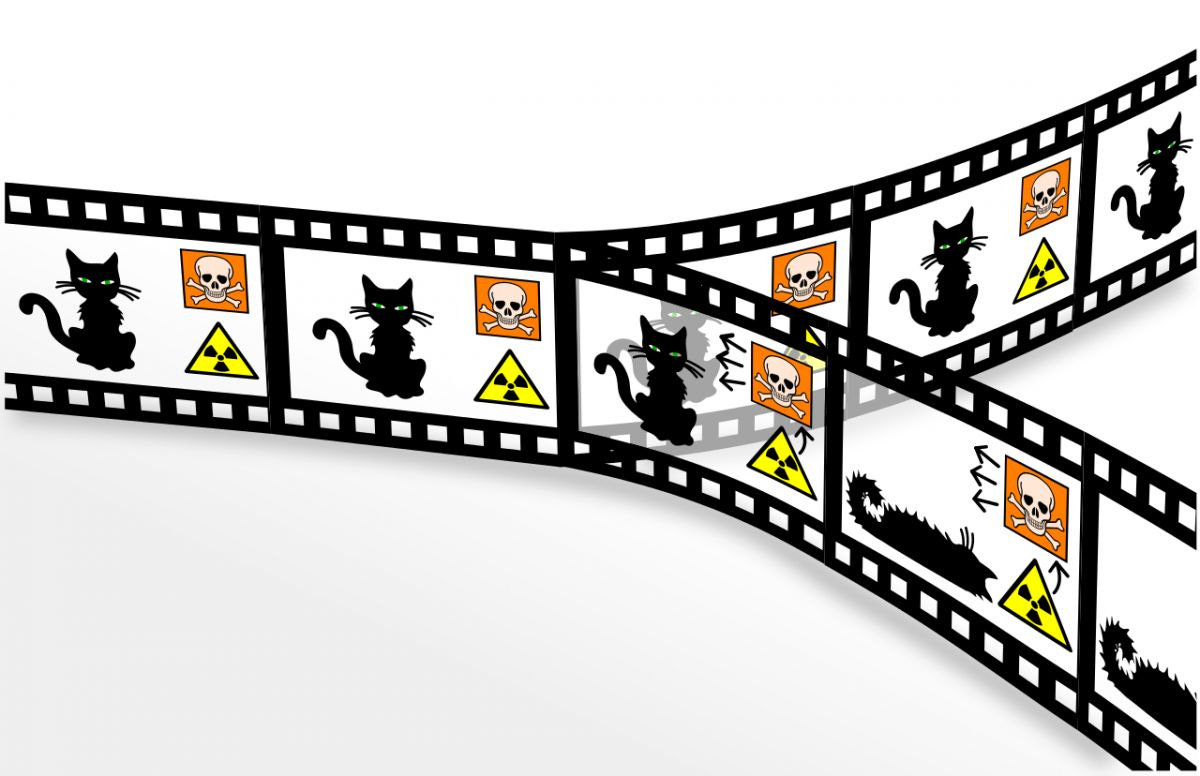
What if the superposition doesn’t collapse?
In the 1950s, physicist Hugh Everett proposed another mind bending solution called the Many worlds Interpretation-
When you open the box, the universe splits into two parallel timelines.
In Universe A, you open the box and find a happy, living cat.
In Universe B, you open the box and find a dead cat.
In this view, the cat was never dead and alive in one world. it lived in one universe and died in another, branching reality forever.
Schrödinger’s Cat isn’t just an existential debate for philosophy majors- it is the foundational key to Quantum Computing (in part 2)
Classical Computers (like your phone) process information using bits that are strictly 0 or 1 (dead or alive).
Quantum Computers use Qubits, which exist in a superposition of 0 and 1 at the same time (just like Schrödinger’s cat).
This ability to process millions of possibilities simultaneously lets quantum supercomputers solve complex problems- like modeling drug molecules or breaking encryption- in seconds rather than millennia.
Schrödinger’s Cat teaches us that the rules of the subatomic universe don’t work like the rules of our everyday world. Particles can live in a land of endless possibilities until the universe settles on an answer.
So the next time you’re waiting on an important email, a text back, or exam results, just remember, until you check your phone, you’re in a superposition of good news and bad news! 😂
SEE YOU WITH AN ARTICLE ON BLACK HOLES NEXT TIME!!! subscribe you curious people🌿
Comments
Nothing yet. Say the first thing.
Sign in to join the conversation.