
part 1 (what the hell is quantum physics) 🔗 👈
Wow... I am honestly so incredibly happy (and, not going to lie, a little confused!) to see how many of you absolutely loved the first part of this quantum journey! I didn’t know so many of you were secret physics nerds.
Because you all showed so much love, here is the highly anticipated Part 2. Just like last time, I have simplified this as much as humanly possible so that anyone can dive in and get their mind blown. Let’s get weird!
(but the problem is the more I simplify this, the more I want to write further..hehe)
If you survived the first dip into the quantum pool without your brain totally short circuiting, congratulations. You officially know more about reality than 99% of the population.
Now that we know quantum particles are weird, let’s talk about how they behave when we push them. Grab your coffee (or whatever beverage you hope stays on the table), and let’s dive back in.
In our first article, we mentioned that particles can act like waves. But how do we actually know that? It all comes down to the most famous experiment in physics history: The Double-Slit Experiment.
Imagine you are standing in front of a wall with two vertical slits in it. If you throw tennis balls at the wall, some will go through the slits and hit the back wall, forming two neat, vertical lines. Super simple, right?
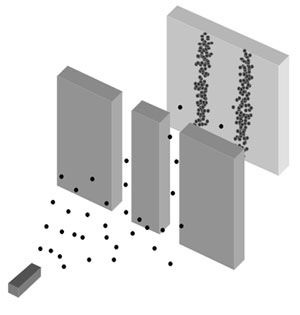
Now, imagine we do the exact same thing, but instead of tennis balls, we shoot a stream of tiny quantum particles- like electrons.
When we shoot the electrons through the two slits, they don’t form two neat lines. Instead, they behave exactly like water ripples!
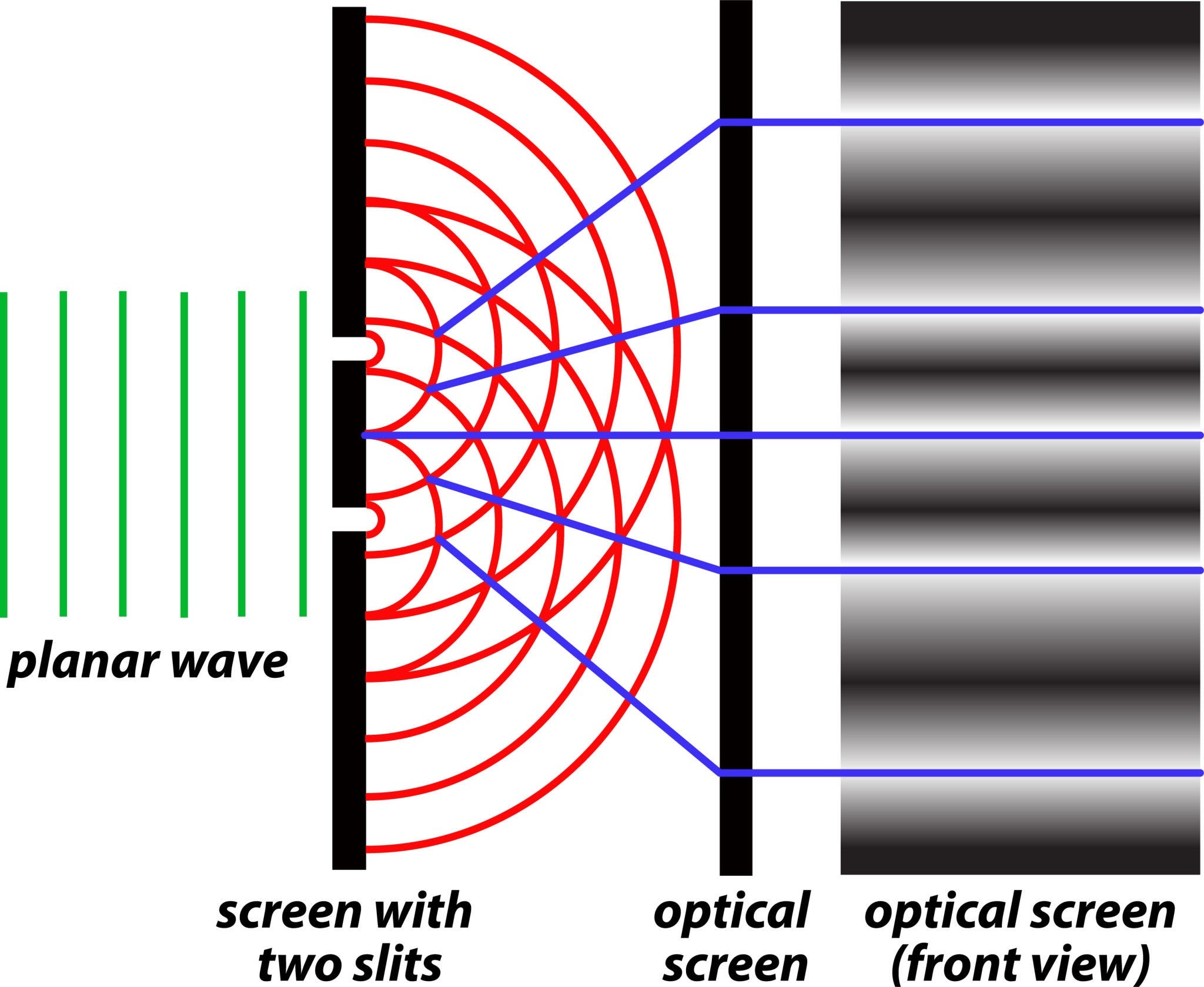
As you can see in the diagram above:
A planar wave (a flat, orderly wave front) heads toward a screen with two slits.
Passing through the slits splits the wave into two curved, overlapping wave patterns (shown in red).
Where the peaks of these waves collide, they amplify- where a peak meets a trough, they cancel each other out.
This results in a striped pattern of light and dark bands on the optical screen.
Here’s the part that makes physicists want to pull their hair out. even if we fire the electrons one by one, so they have no other particles to bump into, they still build up that striped pattern over time! It’s as if a single electron travels through both slits at the same time, interferes with itself, and decides where to land.
And if you put a camera (special detectors) by the slits to spy on which slit the electron actually went through? The wave pattern instantly vanishes (the wave behavior collapses), and they go back to acting like regular tennis balls. The universe literally changes its behavior just because we are looking.
I really want to make this topic long cuz it’s so interesting. Still, since this is a beginner’s guide, many people tend to get lazy about reading if a topic gets too long, so I’ve attached further info on this (ofc very interesting parts) at the end of this article. Please read that as well
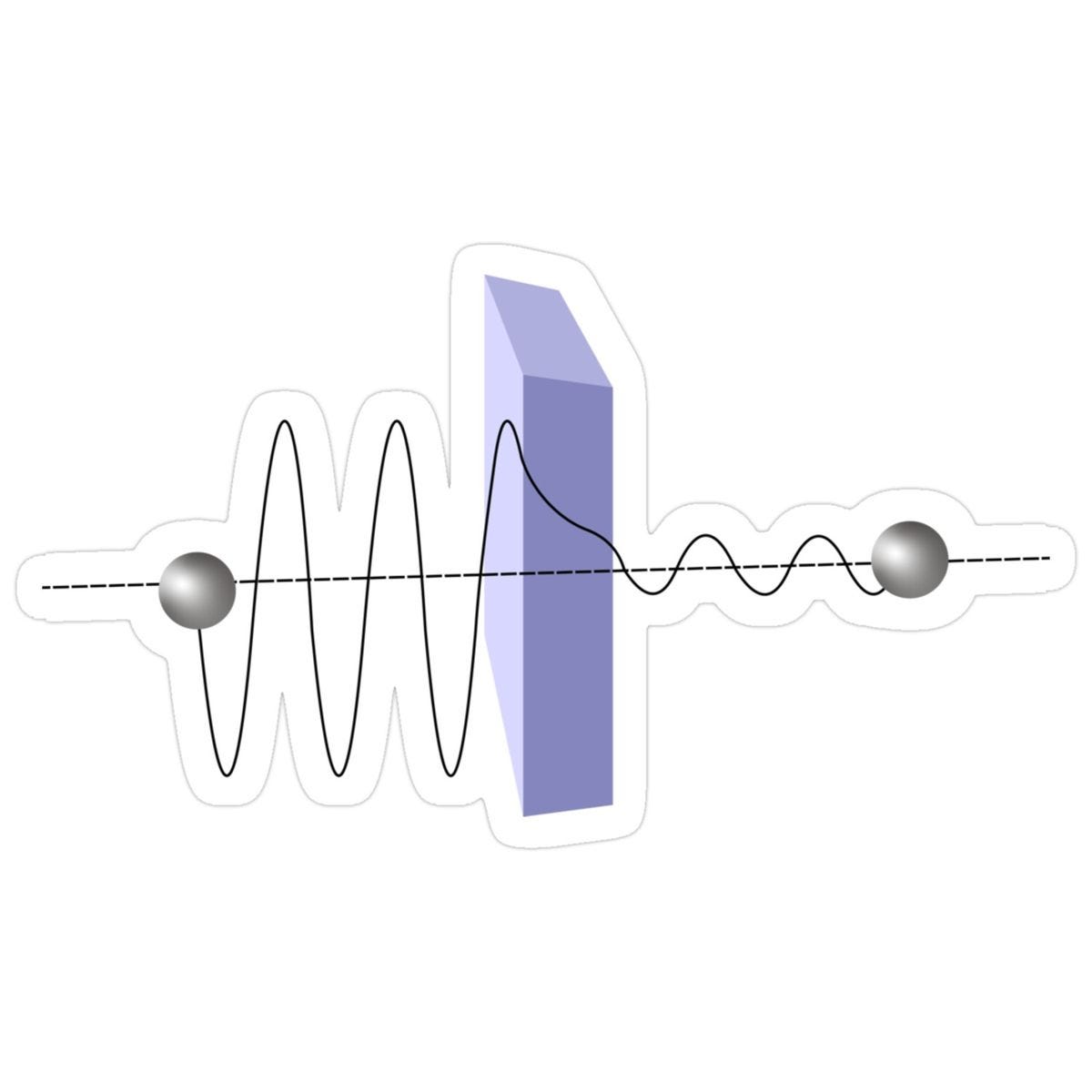
If you sprint at a solid brick wall, you are going to end up with a concussion. In classical physics, if you don’t have enough energy to get over or through a barrier, you get bounced back. No exceptions.
At the quantum scale, particles have a cheat code called Quantum Tunneling.
Because particles are actually fuzzy clouds of probability (waves), their possibility wave can slightly overlap with the other side of a solid barrier.
In plain English: There is a tiny, non-zero chance that a particle hitting a wall will simply vanish from one side and instantly reappear on the other side. It literally teleports through the barrier.
Without this ghost mode glitch:
Our Sun wouldn’t shine: The Sun generates light by fusing hydrogen atoms. Normally, those atoms repel each other like magnets, but quantum tunneling allows them to pass through their magnetic barriers and fuse anyway, powering our solar system.
Your USB drives wouldn’t work: Flash memory uses quantum tunneling to push electrons through solid insulating barriers to save your data.
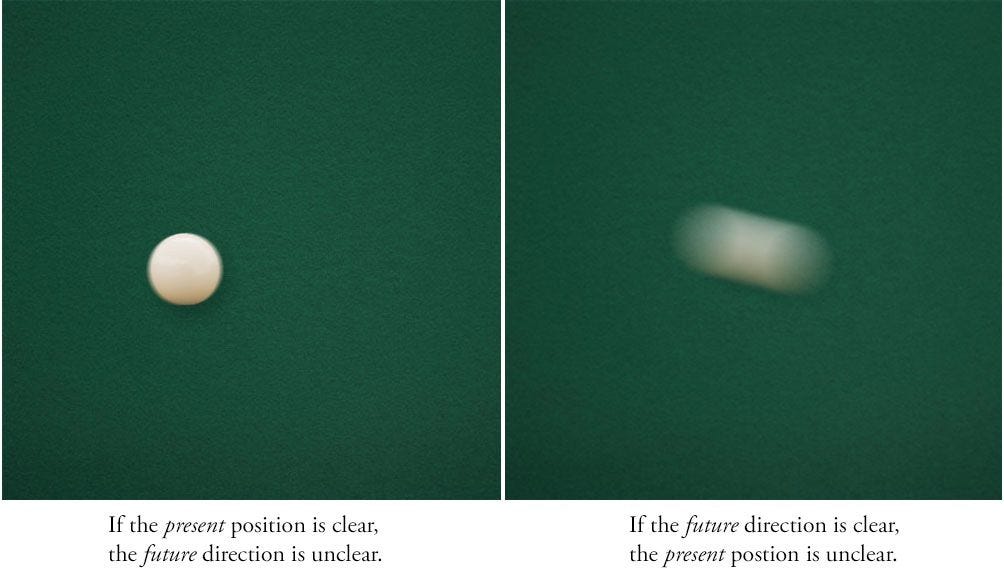
You’ve probably heard people say, “You can’t know both where a particle is and where it’s going.” This is Heisenberg’s Uncertainty Principle, and it’s not a limitation of our cameras or technology. It is a fundamental law of nature.
Think of a fast moving fan. If you take a high speed photo, you can pinpoint exactly where a single fan blade is, but you can’t tell how fast it’s spinning from the static picture. If you take a long exposure photo, you can see the blur and calculate the speed, but you no longer know exactly where the blade is at any single millisecond.
The quantum world works the exact same way. The universe has a built in “limit” on how much information it will reveal to us. The more precisely we measure a particle’s position (where it is), the fuzzier our knowledge of its momentum (where it’s going) becomes.
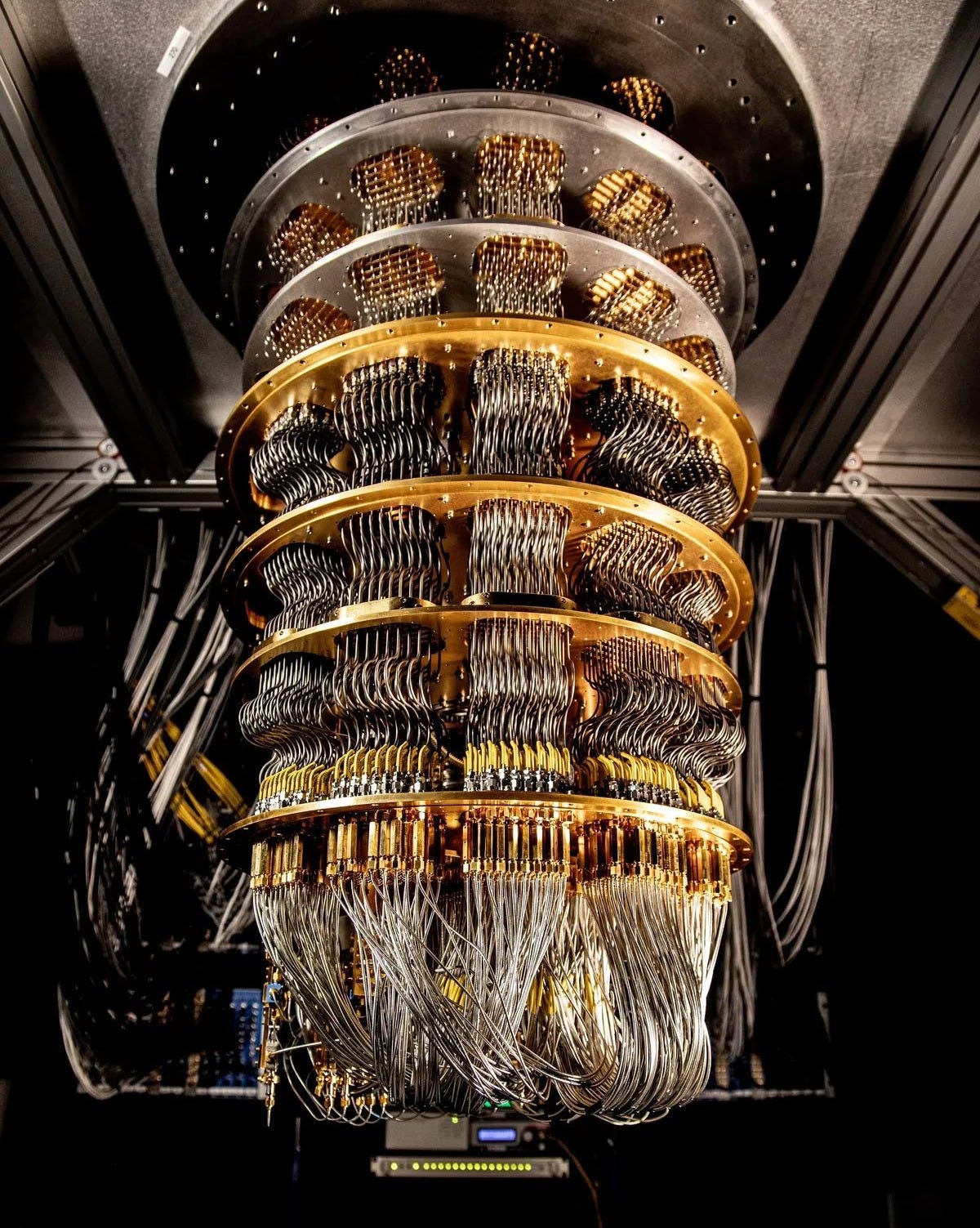
So, why are tech companies investing billions of dollars into this? Because of Quantum Computers.
Standard computers use “bits” (microscopic switches that can either be a 0 or a 1). But a quantum computer uses qubits. Thanks to superposition (being in multiple states at once) and entanglement (being linked instantly across space), a qubit can be 0, 1, or both at the exact same time.
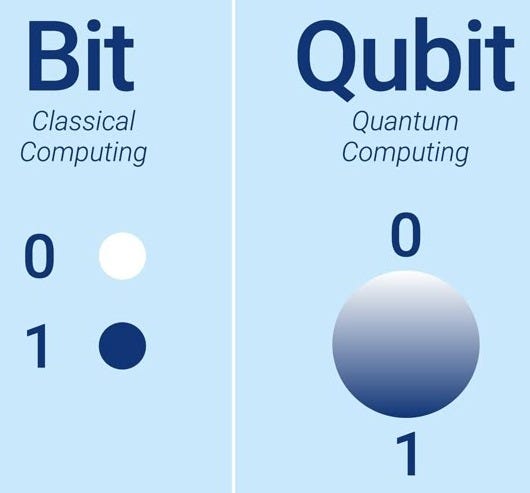
This allows quantum computers to process massive amounts of possibilities simultaneously, solving problems in seconds that would take a normal supercomputer thousands of years to figure out like designing life saving drugs from scratch or perfectly predicting global weather.
We are living in the early days of a technological revolution. It’s wild, it’s confusing, and it proves that the universe is far more creative than we ever imagined!
More about the double-slit experiment, weird and interesting parts about it
When we say a wave collapses because it’s being observed or measured, it sounds like the electron has a mind of its own and gets stage fright. But the physical reality of a quantum measurement is much more brutal.
To observe something as tiny as an electron, we have to touch it with something.
In our macro world, you see a tree because billions of harmless, gentle light particles (photons) bounce off it and hit your eyes. The tree doesn’t move because it is massive compared to those tiny photons.
But an electron is incredibly small. To see which slit the electron went through, we have to shine a light on it.
Shining a light means hitting the delicate, fuzzy electron wave with a photon. This collision is like hitting a soap bubble with a speeding tennis ball.
The moment that photon collides with the electron, the delicate “cloud of possibilities” (the wave) gets violently disrupted. The electron is forced to drop its fuzzy wave behavior and snap into one single, physical coordinate.
In physics, this transition from a fuzzy quantum state to a solid classical state due to interacting with the environment is called decoherence.
(There are many methods other than this, but every single method requires some form of interaction with the electrons)
The universe does not allow an electron to act like a blurry wave if measurable information about its exact position exists
By placing a detector anywhere in the experiment, you force the electron to choose a reality. It stops acting like a wave of possibilities and starts acting like a solid bullet.
Technically, yes, but practically, no.
According to the math of quantum mechanics, absolutely everything including you, your cat, and a cup of coffee has a wavelength. However, because of how the math works, the larger and heavier an object is, the infinitesimally smaller its wavelength becomes.
Your personal wavelength is so incredibly tiny that it is completely undetectable by any instrument we could ever build.
Furthermore, you are made of roughly 10^27 atoms. Every single one of those atoms is constantly bumping into air molecules, dust, light, and each other. Because of these trillions of constant, microscopic collisions, your body’s quantum wave state is collapsed by the environment trillions of times every single second.
You are simply too big and too noisy to ever exist as a fuzzy quantum wave. The universe is constantly measuring you just by letting the air touch you!

This is a spectacular sci-fi concept, and it is a popular philosophical theory! But let’s look at what physics actually says about it.
In the early days of quantum mechanics, some famous physicists (like Eugene Wigner) wondered if it took a conscious mind to cause a wave collapse. They argued that if a machine measures an electron, the machine itself enters a superposition of having measured it and not having measured it, until a conscious human looks at the screen.
If you follow that logic down the rabbit hole, you get the argument I mentioned: Does the entire universe only exist in a solid state because some ultimate, higher-dimensional observer is looking at it?
While it is an awesome cosmic thought experiment, modern physics has largely moved away from the idea that consciousness is required for quantum collapse.
As we saw with decoherence, a quantum wave collapses whenever it interacts with any external physical system even a single stray photon or gas molecule. No brain, soul, or higher-dimensional alien eye is required. The universe observes itself simply by having its parts bump into one another.
Comments
Nothing yet. Say the first thing.
Sign in to join the conversation.