
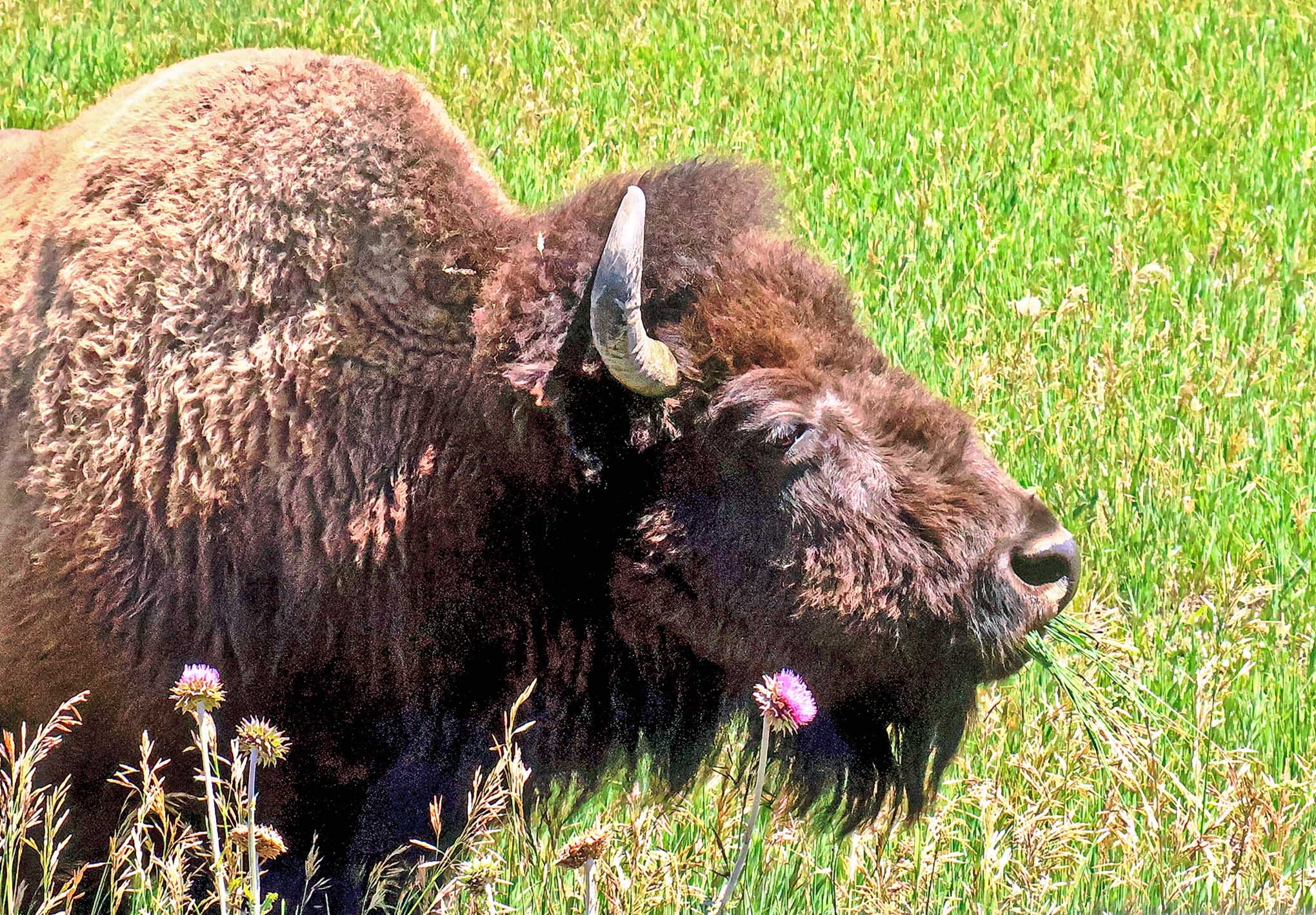
NOT on the menu in Yellowstone.
John pulled up to the line at the Old Faithful Grill.
“Hmm, a bison burger!” he thought. “I should get that.”
Then, he noticed it was a bison-beef burger.
Wait. In the next line of items?
“Hey, a bison brat!”
But then he noticed it was a bison-pork one.
John had no idea how much or how little bison might be in the mix.
He also had no idea if the bison was grass-fed its entire life, or if, like most commercial bison, it was corn-finished like beef.
The Sioux and other Plains Indians, after being forced onto reservations, barred from hunting bison and being given American beef for their meat rations, complained that it tasted too sweet. And they were right. (Sadly, though being generally right in a recent piece about the latest expansion of CAFO feedlots, Inside Climate News claims this only started after World War II. No, it actually took off around the time of the Civil War, just not in as industrialized of a level.)
But, John was enticed. He had never seen bison alone, let alone free-ranging bison. He’d seen some chewing through grasses this morning, though, and he figured that surely, a bison-beef burger would still really be bison.
“I want that bison burger,” he told the cashier as he pulled out his wallet.
A man sidled up beside him.
“Good choice,” he said.
“Really? Thanks for letting me know, but how do you know?”
“I didn’t catch your name, but I am Zan Boden, president and CEO of Xanterra. We’re the food concessionaire company here in Yellowstone.”
“Oh, cool! And, I’m John.”
“John, we have been and are continuing to scientifically taste-test that bison burger and bison sausage. We’re looking for the right percentage of bison that hits the public’s sweet spot. We’re also taste-testing a proprietary bison flavoring mix to enhance that. With a planned company expansion, we expect to do more like this.”
“Oh, cool.”
What Boden didn’t tell John is that Xanterra’s culinary labs were eyeing using bison offal to produce bison lab meat, while looking to tweak any specific DNA that gave bison its particular flavor. Boden thought that, if Xanterra could pull this off, it wouldn’t need to use any actual bison meat at all in its bison-beef burger or bison-pork sausage.
After leaving John to pick up his order, the light bulb went on for Boden.
“We need to call that the Buffalo Bill burger,” he said to himself. “I’ll think of a name for the sausage.”
I’ve had totally grass-fed bison. And, it is different from commercial beef.
I wouldn’t eat anything “bison” at a national park concessionaire, in part per actual knowledge of them and my recent snark.
Even if 100 percent bison, it’s some commercial stuff that’s fattened on grains and potato scraps, in feedlots that are about as much an abomination as cattle feedlots.
And, the reality is surely that Xanterra puts about 2 percent bison meat, and from a CAFO-type bison feedlot, in one of its bison-beef burgers at Yellowstone. Don’t get me started on the hypothetical of lab meat from offal from one of those feedlots.
But, don’t worry! If its snarked-by-me hostile takeover of Delaware North, which has the retail stores concession at Yellowstone, goes through, John can get a made-in-China fake china bison plate at the next door gift shop and eat his fake bison burger on that fake bison plate.
No posts
Comments
Nothing yet. Say the first thing.
Sign in to join the conversation.