
It is World Cup season. On social media, Japanese football fans won praise for tidying up stadiums. Back home, that praise also sparked a critical post and image imploring Japanese men to “Please do it at home.” The post also pointed to Japan’s poor gender-equality record, including men spending little time on housework and childcare. Bloomberg reported that Japanese men do little unpaid labour at home. The BBC similarly noted, using 2021 OECD data, that Japanese women spend over three hours per day on unpaid work, more than five times that of men.
In this vein, public praise for men’s civic-mindedness can sit alongside unequal expectations inside the home.

Atsuko TAMADA@atsukotamada
日本人男性によるサッカー場でのゴミ拾いが注目されているようだが、日本人男性の家庭内労働時間は国際的にみても極めて低い水準。まず家の中のケア労働を分担してほしい。


World Cup 2026 @ofootball__
After the game ended, Japanese fans stayed in the stadium to collect paper and waste. Respect, Japan. 🇯🇵
10:23 AM · Jun 16, 2026 · 2.04M Views
62 Replies · 12.8K Reposts · 61.3K Likes
It was also the Father’s Day weekend, including in Singapore. As we celebrated fathers’ contributions and sacrifices, it felt timely – even as many are doing more in Singaporean homes – to ask what would allow fathers to be more present.
Most recently, sociologist Teo You Yenn’s multi-week bestseller about parenthood and doing family included a chapter on the uneven burdens and consequences of work and care for men and women (“Unease: Life in Singapore Families,” Chapter 4). Her interviewees reflected “that men today do more housework and caregiving than their own fathers did.” However:
“The big picture will be obvious to anyone living in Singapore today: women take on more housework and caregiving than men do, even when they also do wage work; men carry greater responsibilities to be wage earners, even when their wives work.”
Yet, even against this unequal backdrop, with household duties disproportionately borne by mothers and fathers facing provider expectations and workplace norms that make caregiving harder, Singaporeans overwhelmingly – and I mean, overwhelmingly – believe that the status quo should not hold. Among married respondents, 99 per cent agreed that fathers and mothers are equally important caregivers. And when it came to the home, 95 per cent of married respondents and 98 per cent of single respondents agreed that both parents should share responsibilities at home equally.
The data on perceived parental responsibilities come from the 2021 Marriage and Parenthood (M&P) Survey, involving approximately 5,900 respondents (2,848 single or never-married and 3,017 married Singapore residents). Overall, attitudes in Singapore have become more egalitarian. More respondents now reject the idea that mothers should be the default full-time caregivers and more say that household and caregiving responsibilities at home should be shared.
Based on what respondents say, from 2016 to 2021, those agreeing that “Ideally, the mother should take care of her children full-time,” fell from 56 to 40 per cent among married respondents, and from 40 to 24 per cent among single respondents.
Singaporeans believe and say care should be shared, yet actual practice and action still lag behind these beliefs and attitudes. In the same section of the 2021 M&P Survey, it is stated that “married women continued to do more at home compared to their husbands, primarily in the area of child-related care.” Additionally (emphases mine):
“On average, women spent about 6 hours on a normal weekday on childcare, and 10 hours on weekends. In contrast, men reported an average of 3.6 hours on weekdays and 7.7 hours on weekends. In general, women were less satisfied with the division of domestic labour compared to their male counterparts, with 59% of women saying they were happy with the division, compared to 72% of men.”
The unequal sharing of care is not limited to childcare. It also shows up in the ordinary work of keeping a household going. In 2016, mothers reported spending 2.6 hours on domestic chores on a normal weekday, compared with 1.5 hours for fathers.
SG-LEADS, the Singapore Longitudinal Early Development Study, is a nationally representative longitudinal panel study, which means it has tracked and repeatedly collected data from a sample of households with Singaporean children since 2018. In its June 2022 update, using data from the Wave 2 survey conducted in 2021 (involving 4,352 Singaporean children and their primary caregivers), SG-LEADS presented findings about the time spent engaged directly with parents on weekdays and weekends. Relatedly, the Wave 2 report showed that 95.7 per cent of primary caregivers were the children’s biological mothers.
Unsurprisingly, when comparing the time children spent with their mothers and fathers, across the categories shown – caregiving, play, social activities, achievement-oriented activities, and travel – children spent more direct time with mothers than fathers, though the size of the gap varied by activity. In the categories shown, fathers do not exceed mothers in direct time spent with children.
While attitudes have moved strongly toward shared caregiving and many fathers want to be present, everyday care remains gendered. These gaps are not only about hours. They are also about responsibility, such as planning, coordination, school communication, medical appointments, and being the default parent. Today’s fathers are more present than older stereotypes suggest, and likely more present and engaged than their own fathers, but mothers still carry more of the work of care, with its routine, repetition, and responsibility. Furthermore, the conditions that would allow fathers and mothers to share household and caregiving duties more equally are also uneven.
Given these disparities, it is tempting to fault individual fathers for not stepping up. Individual accountability still matters, especially where fathers refuse to match their partners’ time and effort. More broadly though, fathers in Singapore – like mothers and parents in general – are constantly navigating constraints. If we want fathers, as parents, to spend more time at home and with their children, then financial pressures, work schedules, work-life balance, affordable care, support systems, and social expectations matter too.
In the 2021 M&P Survey, when married respondents were asked about why they decided not to have any more children, the top six reasons – based on those who selected the reason among their top three – were financial cost (64 per cent), having enough children (50 per cent), the stress of raising children in Singapore (49 per cent), difficulty managing work and family demands (34 per cent), the lack of good caregiving arrangements (17 per cent), and difficulty conceiving (14 per cent).
Towards the end of the aforementioned chapter in her book, Dr. Teo expounds on the disconnect between Singapore’s ostensibly “family-friendly” policies and the realities of (gendered) inequalities, and how this contributes to housework and care labour being treated as low-status, feminine labour:
“Men have not stepped up in the domestic sphere in the ways women have stepped up in the earning sphere. Women, including those who can afford paid care, remain responsible for resolving care needs, and this impedes their workplace advancements. Importantly, the issue of reconciling work and care, although widely shared and a consequence of significant social transformations, is cast as a ‘private’ problem to be sorted out by individual families and usually by ‘the woman.’”
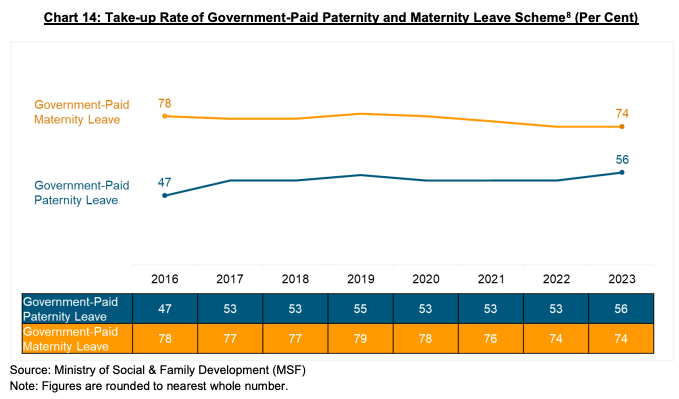
For me, the data around government-paid paternity leave are illustrative as a test case. The broader literature is clear that father involvement matters for child development and family well-being. Singapore research using SG-LEADS data makes the case more concrete. Children whose fathers took at least two weeks of paternity leave had better problem-solving and word-recognition skills, as well as fewer behavioural problems. Fathers felt closer to their children, mothers reported lower stress and higher marital satisfaction, and family relationships improved. Sure, paternity leave alone may not necessarily encourage couples to have more children, but it confers enough benefits to fathers and their families for it to be a no-brainer (and its value does not just rest on fertility).
And yet, in 2023, recorded take-up of government-paid paternity leave stood at 56 per cent. This was up from 47 per cent in 2016, which supports the broader picture of fathers doing more. Nonetheless, because the figures exclude cases where employers did not submit claims, the recorded claims still show a large gap between entitlement and use, and this gap tells us something about how fathers are expected and enabled to provide care from the beginning. Paternity leave is not about fathers “helping” mothers, but fathers being recognised, expected, and supported as parents from the beginning.
Today, eligible working fathers of Singaporean children born on or after April 2025 are entitled to four weeks of government-paid paternity leave. Eligible working parents are also entitled to six weeks of shared parental leave for children born from April 2025 to March 2026, rising to 10 weeks for children born from April 2026.
The easy conclusion is that fathers do not care enough, or that they are happy for their wives to shoulder most of the childrearing duties in the first months of their children’s lives. The more complicated and less satisfying interpretation is probably that we do not know enough. Are fathers deterred by workplace perceptions, by the fear of being seen as less committed, or of imposing on colleagues? What penalties, formal or informal, do they anticipate? Would take-up improve if more peers took leave? How do mothers, grandparents, domestic workers, and employers shape fathers’ choices?
The available evidence points to class and occupational stratification, especially in leave-taking. Blue-collar workers appear less likely to apply for paternity leave because of job concerns. Similar concerns are likely shared by lower-wage, shift-based, contract, or operational workers, who may face higher risks when taking leave or asking for flexibility. For instance, “fathers with machine operator, assembler and cleaner jobs were less likely to take paternity leave,” and such fathers may further experience long work hours and a male-dominated work culture.
Thanks for reading socialservice.sg! This post is public so feel free to share it.
For a social service sector that wants to bridge the gap between belief and practice, the first step is to identify what we do not yet know. Globally, similar to the trends in Singapore, more are recognising the importance of fatherhood and fatherhood research:
“According to some estimates, the average time dads spend caring for their kids each day has quadrupled over the past 50 years. Their attitudes about parenting are also changing. Today, men are about as likely as mothers to say parenting is a key source of meaning and a central priority in their lives. Roughly 85% of fathers identify parenthood as one of the most important aspects of their identity.”
(This is not just an abstract interest for me. As a postdoctoral fellow at the University of Denver, I spent two years supporting the evaluation of the “Nurturing Dads and Partners” programme, which integrated peer and co-parenting support to build fathers’ skills and family protective factors. I remain deeply involved in fatherhood-related research.)
For a start, here is a list of father- and fatherhood-related questions worth exploring:
Paternity leave: What predicts fathers’ actual use of paternity leave, especially among lower-wage and shift workers? Who are the fathers not using their leave, and what prevents them from doing so? How do employers, supervisors and peers respond when fathers take leave? In other words, beyond its legal availability, what are the cultural scripts fathers navigate?
Financial considerations: Given that finances and work-family demands are central to parenthood decisions, which anxieties around the cost of living, income security, and workplace predictability shape fathers’ caregiving decisions?
Social work practice: How do family coaches, social workers, and teachers and school staff engage fathers compared with mothers? In ComLink+ and other family-support programmes or settings, which parent is (first) contacted, who attends meetings, and how are fathers invited in without displacing or burdening mothers further?
Father-specific programmes: What types of father-specific interventions work in Singapore, and for whom? How effective are one-on-one or group-based fatherhood programmes? For fathers who may have been less involved, absent, or navigating divorce and separation, how might co-parenting courses be useful?
Alloparenting, or “It takes a village”: What if fathers and mothers are not expected to do everything on their own? How might alloparents – other caregivers who share parental care, such as grandparents, relatives, neighbours, and paid caregivers – share the responsibilities? In Singapore, any serious discussion of “It takes a village” also has to reckon with our reliance on migrant domestic workers inside the household.
(Dr. Teo examines in detail the assumptions upon which Singapore’s social welfare policies are built: self-reliance, familial support, and “Many Helping Hands”.)
Discussions of fatherhood are inevitably intertwined with discourse about masculinity and expectations of men in contemporary society (e.g., “Of Boys and Men”). In Singapore, since 2009, “Dads for Life” describes itself as a national movement “to inspire, mobilise, and involve fathers.” More recently, a coalition of 12 men’s groups launched “MenToo,” a movement that “wants Singapore men to speak more honestly about mental health, relationships and the pressures they carry” and is also complemented by a research collaboration. (I agree with Jom that the movement is worth taking seriously, even if the name risks being read as a negation of #MeToo.)
The Japanese World Cup image states, plainly: “Please do it at home.” In Singapore, for me, that means asking whether work, leave, income security, family support, and social service practice make care shareable among parents. Dr. Teo’s reminder is useful here, that care should not be treated as a private problem for women to solve.
Rather than ranking fathers and mothers against each other, we want to make caregiving more shareable, so that mothers are not left carrying the invisible load or paying the “motherhood penalty,” fathers are not trapped only in breadwinner or provider roles, and Singaporean children receive care from adults who have the time and support to be present.
No posts
Comments
Nothing yet. Say the first thing.
Sign in to join the conversation.