
Social media is shifting. Consumption habits are changing, time spent keeps rising (now 18 hours and 36 minutes per week), but attention is fragmenting across more platforms, more formats, and more private spaces. For marketers, the rules of reach, relevance, and relationship are being rewritten.
Here’s your monthly update on what’s changing and what it means for you.
Read on for a summary, or you can watch the full deep-dive here, or grab the slides.
PS.
If you work in B2B, you won’t want to miss the only event dedicated to social media in B2B. Join us here 👉 https://www.socialdayb2b.co.uk/
Let’s dive in.
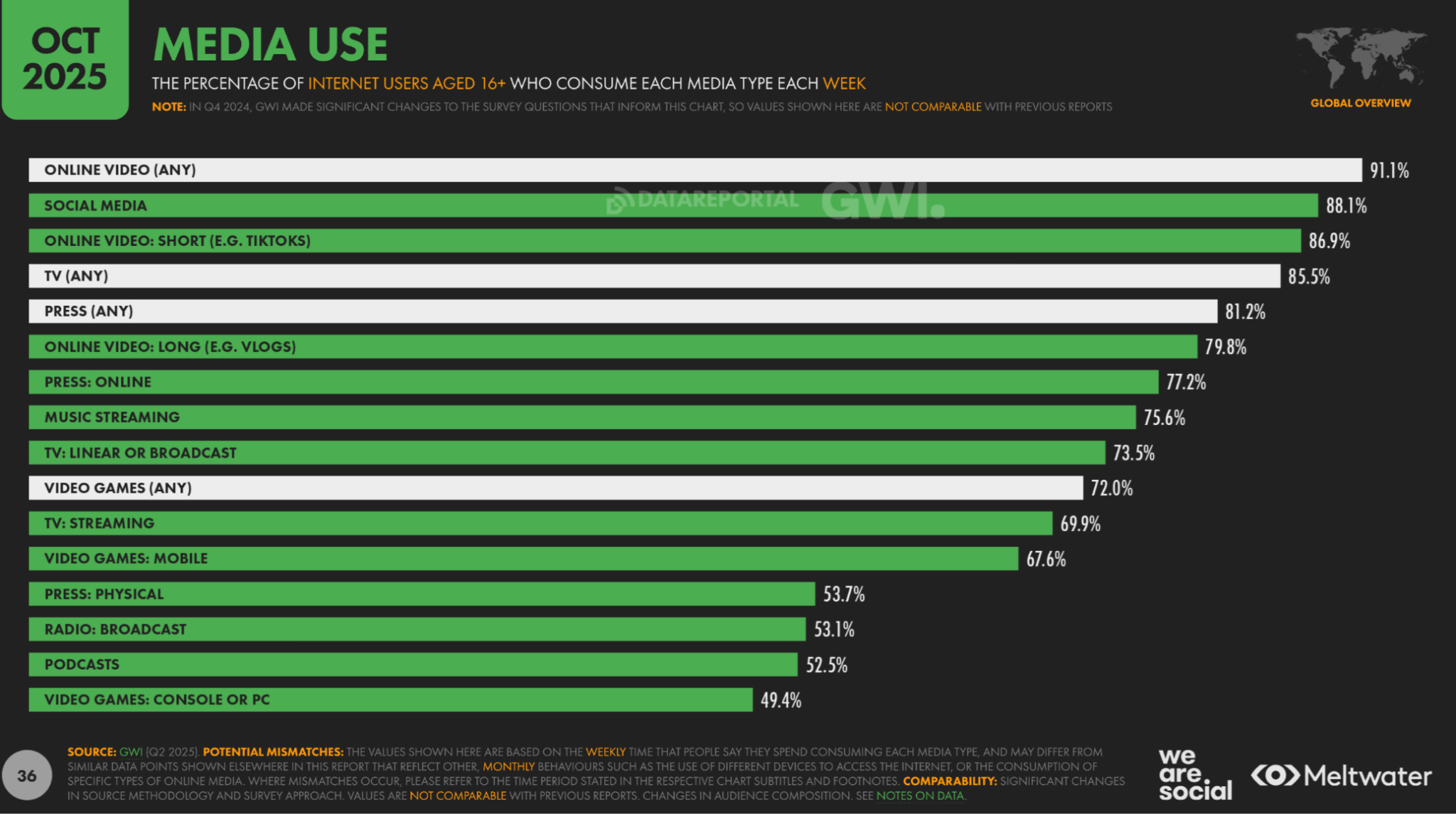
Video now dominates every corner of media use, but how people consume it is shifting.
On Instagram, Reels accounts for 50% of total time spent. However, Instagram Reels’ reach is dropping. It’s down 60% according to Metricool data.
However, engagement on carousels is up, and shares have doubled. Proof that users are shifting from public commenting to private sharing. Facebook, meanwhile, has quietly resurged: Reels views and interactions are climbing, with Facebook Reels videos up 25%, showing Meta’s renewed strength in short-form.
TikTok tells a similar story: reach is down, engagement is up. The days of plentiful reach are over. But if that means that our content is landing with the right people, I’m OK with this shift. Despite regulatory scrutiny, TikTok remains the top destination for news consumption. So, if part of your strategy is news-jacking trending moments, TikTok is the place for that.
YouTube Shorts’ reach has dropped; unfortunately, it’s following the same pattern as Instagram Reels and TikTok. We’ve seen this trend play out time and again: a new feature is released, the platform pumps up reach, everyone gets excited, and then, as the platform understands what content is working for whom, reach is reigned in and engagement rates increase. Despite this drop in reach, overall watch time continues to rise. Users are spending longer watching on-demand content, reaffirming YouTube’s place as the “home of intent”, where people go to learn, not just scroll.
Even LinkedIn is wrestling with video. Performance is down, but the platform remains determined to make it work. Expect LinkedIn to continue its push into video in 2026.
For brands, the takeaway is simple: the battle for attention has moved from reach to retention. Longer watch-time, not viral spikes, will define success.
OpenAI’s Sora launch shot to number one in the US App Store and gave us a glimpse of what’s next. Facebook popularised the notion of the friend graph; TikTok demonstrated that smarter recommendation algorithms were a better way of driving up watch time. And now, platforms like Meta Vibes and Sora are betting on AI-generated content as the next frontier of capturing audiences’ attention at scale.
This marks the end of the follower graph as we know it. Short-form video platforms are becoming less “social” and more “suggestive”, built around what the system thinks we’ll engage with, not who we know. Despite many social media users’ wishes for us to return to chronological timelines, the data speaks for itself. Simply put, social platforms are better at deciding what we should watch than we are.
LinkedIn has quietly joined the trend, too, training its recommendation models on user data (you can opt out, but few will).
For brands, this means depth becomes a competitive advantage. Generic content won’t survive in a world dominated by AI content. Only trusted human voices can create meaning.
Instagram DMs and broadcast channels are exploding. Threads is leaning into the trend with group chats. And we’re seeing a surge in smaller, more intimate spaces where audiences talk with each other, not at the algorithm.
This is where community becomes strategy. Social media success for a business should not be defined by reach, but by depth. When people share your brand story inside a group chat or community thread, it travels further, faster, and with far more credibility.
Again, as we know, this approach also impacts your brand’s visibility in LLMs and AI overviews. So this approach really is a win-win.
TikTok searches are up 40%, and the platform now shows search insights for every post, a clear signal that intentional discovery is moving to social, and we can no longer just think of Google when we think of search. Keywords in captions (and even spoken aloud in videos) now influence ranking.
Creators like Carrie Rose are showing how this works in practice: by optimising videos around natural language queries, her content is now appearing directly in TikTok search.
This has major implications. As users start searching “best B2B marketing examples” or “how to write a launch post,” platforms will prioritise content that answers questions, not just entertains. The line between SEO and social has officially blurred.
For brands, that means every post should serve a discoverable intent: educate, explain, or inspire action. Treat your captions like metadata, not as a throwaway afterthought.

As AI reshapes creation, algorithms reshape discovery, and users retreat into smaller circles, the next era of social media won’t be won by those shouting the loudest. It’ll be won by those most trusted by their audience.
Video will drive it. Search will surface it. Communities will spread it. But trust will decide who gets bought.
Hope you found this edition interesting, if so please give it a like so the newsletter reaches more people.
Thanks, as always,
Andy
No posts
Comments
Nothing yet. Say the first thing.
Sign in to join the conversation.