
Late 2017 to early 2018: That was about when it all began for him, a certain Taiwanese-American skateboarder, then in his mid-30s. Already internet-famous. Artistically inclined. Imbued with a sense of humor. Well liked and respected within various culturally-oriented communities. But, also, at a crossroads, facing general disillusionment with his professional career. Uncertainty loomed.
Until: the creation of a particular unstructured 6-panel cap that he conjured, in brushed cotton twill. Snapback closure. Familiar words that had risen from his mind were embroidered center-front on the crown. Produced overseas via a stateside manufacturing partner. 24 units total. Gifted to key friends. Awareness grew. Soon after: the re-up. Production run doubled. This batch sold through DMs. Shipped by USPS from Los Angeles. Product sell-through rate: 100 percent.
Suddenly now an entrepreneur in the “neoliberal hellscape,” growth became the target. Brand trademark secured. Instagram account created. E-commerce website constructed. Brainstorm sessions initiated. New SKUs developed. Retailers placed orders. Production quantities increased. Streetwear aficionados clamoured. Skateboarders? He wondered if they wondered... Soft goods only?
Because of his belief in the antiquated notion that a legit team would be the requisite next step, the thought of producing hard goods remained dormant. Seasons came and went. One day, a budding skater in Delaware caught his attention. DMs exchanged. Friendship forged. In time, it was she who would galvanize his expansion into the 7-ply maple market. New product category unlocked.
In December 2020, branded decks in popular widths were unveiled on Instagram, to an affirming 6,987 likes. KPIs exceeded.
The duo would go on to become a heterogeneous team of three. Four. Five. Six. Seven. Eight. Nine. Snowballed.
By late 2022—early 2023, road trips from L.A. had commenced. Untapped spots in atypical cities across the U.S. had been cased and probed. Filmers were hired to document the team’s stunts and group dynamics. Vlogs were uploaded to the brand’s media library and later disseminated in short clips across its social channels. Before long, the topmost assets from each rider — strategically held back — began to stack. Tipping point.
And so, it was inevitable — a full-length motion picture, supported by a newly minted production studio, Fantasy World Corporate Experience Media, Ltd. The objectives of the video were to expand awareness, generate visitor traffic, and position the brand as a visceral force in skateboarding today and well into the future. Bullseye.
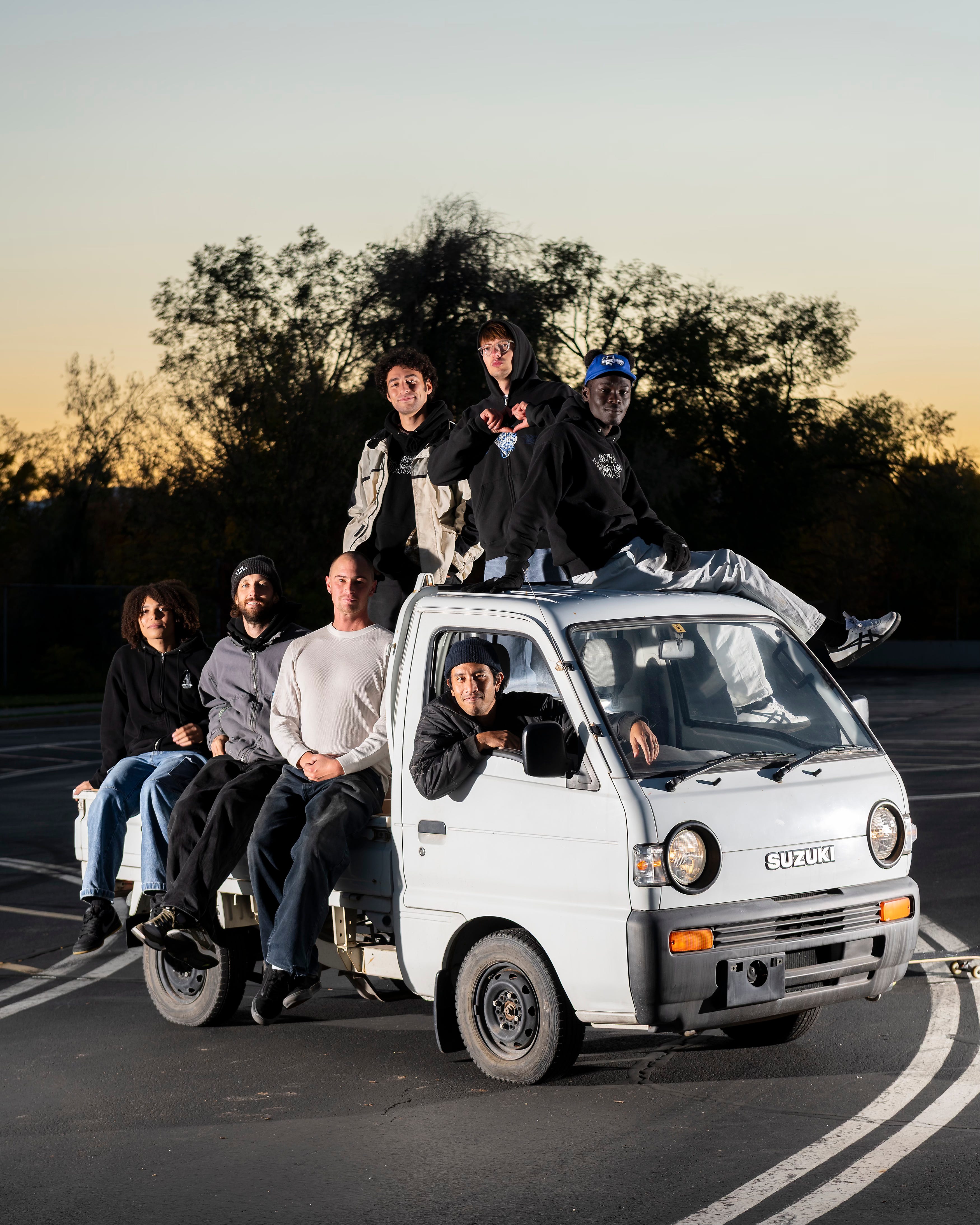
MR. SNEEZE: Give a roll-call of the Sci-Fi Fantasy team, please.
JERRY HSU: OK, so the team is: Ryan Lay, Corey Glick, Arin Lester, Gabbe Viking, Max Garson, Zak Anders, Akwasí Owusu, Joa Field, and myself.
MR. SNEEZE: What makes a rider on-brand for you?
JERRY: With a lot of Sci-Fi, a lot of my intentions were very, like, wayward… The first thing that I thought the Sci-Fi team should be is, like, underdogs. I grew up around people trying to build these super teams and I just didn’t think that that would be the most interesting thing to do. Not only would that be really difficult — almost impossible for me — but I just wanted to sponsor people that were creative outside of skateboarding, and had personalities that I really enjoyed being around.
MR. SNEEZE: Mhmm.
JERRY: I never really had, like, a very clear agenda [chuckles]. Um, it was really pretty vibe-based. But the underdog thing I really was conscious about, because I wanted to elevate skateboarders that I thought were really good but maybe were not being given the credit or the shine that they could possibly get.
MR. SNEEZE: Not to get into every rider one by one, but to pinpoint Arin: briefly, how did it all connect with her?
JERRY: So Thrasher had posted this compilation of her skating at her home skatepark years ago, and she kind of became this overnight sensation. Everybody was like, “Who is this girl?” I was just so intrigued by her because she looked cool, she skated cool, she did cool tricks… I started following her and I liked her personality online, and then I just DMed her [laughs]. I was just like, “Hey, what’s up, do you want some clothes?” because I didn’t make boards yet.
MR. SNEEZE: Right.
JERRY: We started talking and she wanted to come to California. So I flew her to California and she hung out with me and we became friends right away, like pretty close friends. That’s how it all started. She really liked Sci-Fi and she was like, “You should make boards.” She really encouraged me to become a skateboard company. It was always in the back of my mind, but I was being very reluctant. She was like, “Oh yeah, just do it, just try it, I think it would be cool.” And so that’s how Arin came about.
MR. SNEEZE: What was her home skatepark?
JERRY: She grew up in Arizona but she’s lived in Delaware since she was a teenager.
MR. SNEEZE: She was the first one on the team, then?
JERRY: She was the first. It just seemed so casual. She wasn’t pro, she was not established yet, so it was easy. It was just like, “Oh yeah, we’ll just be a team, you and me.” And then it started to kind of snowball after that.
MR. SNEEZE: Akwasí. What’s his deal?
JERRY: So Akwasí is from Fontana, California, which is a city pretty far east of L.A. County. I had seen footage of him. He had a Thrasher part. I followed his Instagram and I was just like, “This guy… He has a set of skills that are very unique.” I thought he was a perfect fit. Then a friend called me and said, “Oh, he doesn’t really want to ride for anybody, but he likes your company.” And so I hit him up and I was like, “Hey, what’s up.” That was pretty easy. He was just on right away.
MR. SNEEZE: He was just skateboarding pure? Not out there trying to—
JERRY: He has kind of an interesting relationship with skating. He’s an artist and has many interests, and I think with skating, he’s also, you know, he’s not a teenager. When kids are in their teens and they get sponsored, it’s sort of like, “OK, this is my whole life, I’m devoting everything to it.”
MR. SNEEZE: Right, yeah. Next to ask about would be Gabbe. Where did he even come from?
Jerry: [laughs] Yeah, yeah, I think he was pretty unknown. He is Swedish. He lives in Stockholm. I just found his Instagram and he was this really wild bowl kid who did really cool tricks and also dressed weird, and just seemed like his vibe was really cool. And yeah, same thing: I just hit him up, like, “Hey, do you want some boards?” I mean, it’s so funny because it was really just Instagram… I was very, “Oh, this could really bring an ingredient to this team that I think would help.”
MR. SNEEZE: He dresses weird, and he has this style. You wouldn’t think he rips but he actually does.
JERRY: Yeah, yeah! His style is… like, his steez, it’s very of today.
MR. SNEEZE: Yes.
JERRY: You know what I mean? It’s sort of like, uh, very pick-and-choosey. He’ll just pick and choose these little genres, things that we’ve lived through, and put it on, and doesn’t care.
MR. SNEEZE: And Gabbe would be the latest addition?
JERRY: Yeah, yeah.
MR. SNEEZE: OK. Joa: What? When? Where? Why? How?
JERRY: People always ask about Joa.
MR. SNEEZE: I’m sure.
JERRY: My very first introduction to Joa was him as this kid tagging me on Instagram. He was buying the stuff — he was buying boards, he was buying beanies. He was also posting himself skating, and I was like, “Oh, he’s pretty good.” So I started following him. But it was his personal account — not the Gifted Hater one. And this is how out of touch I was: I didn’t even know about Gifted Hater at the time.
MR. SNEEZE: Hmmh.
JERRY: This was how many years ago? Maybe three at this point? So I guess it was pretty new, but I didn’t know anything about that stuff. I called him and I was like, “Hey, can I send you boards?” And he was like, “Yeah, for sure, I like this stuff anyways, I’ll give it a try.” So I started sending him boards. And then when I put Ryan Lay on — he was already friends with Joa — Ryan was like, “Oh yeah, let’s go skate with Joa today.” And I met him and I liked him right away, and I thought he was really, really funny.
MR. SNEEZE: I see.
JERRY: It wasn’t until after that that I discovered this entire other persona that he has, which is very influential. It was kind of a shock to me [laughs]. I was like, “Damn, should I do this? Should I ask him to ride for this company? Because he does kind of fit everything that I want. I like him, I like his skating… Like, ‘Hmm.’” I asked everybody, and everybody was like, “Do it, he’s awesome, of course, do it.” And so, yeah, I put him on. I knew it would be controversial. I guess I was in a risky-type-move mood. That was also a little bit attractive to me: “Hmm, this will be interesting.”
MR. SNEEZE: Kind of shrewd, too?
JERRY: It could be construed as shrewd, I guess, if you’re referring to his following. His following was kind of a deterrent to me, because I was like, “Oh, I don’t want people to think I’m just, you know, callously, or, you know, trying to put this sort of internet-famous person on the team.”
MR. SNEEZE: Were you concerned — because you yourself are pretty respected in the skate industry, in a lot of the different zones of it — with him calling someone out, all of which could be accurate, were you or are you concerned with the blow-back?
JERRY: Sort of both. Most of it I’m just like, “Fuck it,” but some of the people that he talks about are personal friends of mine.
MR. SNEEZE: Yeah.
JERRY: Sometimes I do get a little bit nervous. Mostly it’s fine. I think people can separate— Most of my friends, anyway, they’re pretty mature about it. They’re just like, “Ah, yeah, he got me,” but other friends of mine who I won’t name have distanced themselves from me—
MR. SNEEZE: Hmmh.
JERRY: —because of sponsoring Joa. Basically, in their minds, it’s like I’m signing off on everything he says. People have unfollowed me. People that I’ve known for 20-plus years have acted weird in real life. And that sucks, but I understand. I’m not going to make a big deal out of it. I’m not going to confront anybody. I’m just gonna let them go through their process because there’s nothing I can do. I made a choice that I am 100 percent sure of.
MR. SNEEZE: Talking about the Sci-Fi video now, everyone was waiting for his part. And he had first part.
JERRY: So I think with videos, generally, the idea is to think about it narratively. The first part has to hit, the second-to-last part has to be really good, and the last part has to obviously be the best. So depending on how many people are in the video, or how long the video is, you do have to choose where people go based on the parts and where you think the audience will be emotionally, you know? Are you asking why he had first part?
MR. SNEEZE: No, no, I see why—
JERRY: After all the footage was in, we’re editing the video. We don’t know who’s going to have first part until we see everything. My idea for first part wasn’t really feeling correct because I wanted— It was close, but it just came down to Joa. And even that choice, Joa as first part, wasn’t planned, because it’s like, “Hey, here’s the introduction to us, and it’s Joa.”
MR. SNEEZE: Yes.
JERRY: I had conversations with the editors, like, “Hey, do we want that?” And I’m like, “Well, yeah, that’s fine to me, and also, this has the punch.”
MR. SNEEZE: It does.
JERRY: But he understood the stakes. There was a lot more riding on him personally in his performance than anyone else, I think. He really had to come through as the guy, as the critic, the critic.
MR. SNEEZE: Yeah, yeah.
JERRY: There were a lot of things that we kind of disagreed on in the edit. It was funny, he was just like, “This can’t go in.” And I’m like, “What do you mean? This is great, I want this in.” And he’s like, “No, you don’t understand: I might have touched on this manual or it just looks like I did.”
MR. SNEEZE: That’s what I was going to ask you.
JERRY: Stuff like that, where I was like, “I understand, like, whatever you want,” but it’s just so funny the amount of scrutiny that he put on himself — not funny, actually, it’s just appropriate. He’s intelligent. He understands where he lives in this ecosystem. I’m proud of him for even going for it because it does put you in a target: Everyone wants to do to him what he does to other elements of skateboarding. But, I don’t know, he’s just too good [chuckles]. It’s hard to step to him in his realm.
MR. SNEEZE: I watched, and he’d flip out and land bolts perfectly, and it kind of felt like you knew that he knew that he had to do that very cleanly.
JERRY: I think he would anyway.
MR. SNEEZE: I see.
JERRY: But even some things, I think he was just like, “Oh, whatever.” Because, at the end of the day, he is just a skateboarder who wants to have fun skateboarding.
MR. SNEEZE: He still had fun.
JERRY: It’s mostly about fun for him. He took the video seriously. His whole Gifted Hater thing is about his love of skateboarding. When he makes critiques of the industry it’s because he’s like, “I want skateboarding to be better and all these things are interfering with that.”
MR. SNEEZE: So the overall reaction to the video…?
JERRY: I was very happy. I was also having a nervous breakdown before it came out because I’m so neurotic. I’ve never been in charge of making a video before. I’ve been in videos, but you just skate and then someone else takes care of everything. So being on this side of it was way different.
MR. SNEEZE: Yeah.
JERRY: Honestly, very touched by the reaction. It really hit in a way that made me feel validated and appreciated. And obviously it’s not just me — an entire group of people made this video. But the messages that I was sent, and the feelings and sentiment that I saw, were very heartwarming. I was really, really glad that skateboarding in general was just like, “We love the video and we’re thankful that you made it.”
MR. SNEEZE: Positive feedback goes a long way, especially when it’s your own thing.
JERRY: The reaction to the video was a serious gift to me that I needed. Because running a skateboard company, it’s— You can burn out pretty easily, especially when you’re small and there’s not a lot of people. The energy that it gave me to be stoked and keep going was priceless.
MR. SNEEZE: 100 percent.
JERRY: There were times where I was editing with my editors and I was just like, “Oh my God, I don’t know,” you know? Like, “I just don’t know. I don’t know if people are going to get this, if it’s going to hit.”
MR. SNEEZE: Was there a city on the premier tour that surprised you as far as the reaction?
JERRY: [chuckles] Well, I would say the biggest crowd and the most surprisingly completely supportive was Boston. Because I think, like, it’s, you know: East Coast. Boston. It has a very—
MR. SNEEZE: Hah, yeah.
JERRY: The pride, and just more attitude-type city. But the warmth of the people in the city was amazing. It was true skateboarding. It was truly like, “You’re skaters, we’re skaters, welcome, let’s go, I want to take you here, how long are you staying?” You know, that whole thing [laughs]. Maybe in my mind I just built up this thing about, like, “Ah, Boston’s going to fucking hate us!”
MR. SNEEZE: [laughs] Shout out Boston.
JERRY: Thank you, Boston. But all the cities — Minneapolis, Chicago, Austin, Portland — everybody really showed up and really showed their love.
MR. SNEEZE: Let’s talk about the filmers, the main guys, Matt King and Luke Murphy.
JERRY: Luke is our on-the-ground guy who was with us the most. He’s really the one who put in a lot of the grinding-ass filmer work, which is gruelling. He’s also one of those— Filming really matters to him, you know? He really, really cares about it in all aspects, even like fixing the spot or knowing where all the spots are. He’s kind of that full package.
MR. SNEEZE: And Matt?
JERRY: The first time I saw Matt he had a mohawk and he was wearing pink Chet Thomas Globe shoes, and he just kind of had this really weird vibe. I keep saying “vibe.” I’m saying “vibe” too much.
MR. SNEEZE: Hah.
JERRY: He just had this really weird style, which I immediately was like, “OK, I like this guy.” And then I realized he was kind of this cult video maker from Chicago, and I didn’t know that. I watched his videos and I was like, “Oh, I like how dark and weird this stuff is.” It was kind of like when you’re a kid and you see a Nine Inch Nails video and you’re like, “Oh wow, this is scary but I like it.” So I kind of kept him around because I knew that, eventually, once we began making this video, I would need Matt’s vision.
MR. SNEEZE: So would you say the vision for the video is more Matt’s, with input from you and Luke?
JERRY: I would say it’s kind of hard to gauge the amount of Luke’s vision and Matt’s vision. Because I think Luke’s vision and contribution to the video is more difficult to see. Do you know what I mean?
MR. SNEEZE: Yeah, yeah.
JERRY: I think Matt gets a little bit more credit for the video, but they should really get equal credit, because Luke’s technical contribution and his choices really made the video special in a way that’s a little bit invisible. It’s like when you’re watching something good — like a movie, or whatever — there are things that you don’t clock. And part of the reason you don’t clock it is because it’s done right. And Luke had a lot to do with that. Matt’s vision is way more prevalent and on the surface. Luke’s contributions were more below the surface, but just as important.
MR. SNEEZE: What about the editing process?
JERRY: Putting two cooks in the kitchen to make a skateboard video was a risk. It was definitely something that I was like, “Fuck, this is a little bit of a conundrum.”
MR. SNEEZE: And being that they’re both skate filmers.
JERRY: Yeah, totally, they were both out filming. Luke was with us most of the time. Matt would come when he could — he has a kid, so he can’t come out as much. But, yeah, putting these two guys together, I was like, “OK, I really hope I can manage this.” And at first it was a little bumpy, but I just talked to them both. I was like “Hey, just get together and try to understand each other’s process and respect each other.”
MR. SNEEZE: Mhmm.
JERRY: My contribution was mostly about guiding the feeling of the video and making suggestions about where things should go. I let them handle the music — especially Matt, who’s a little bit more in-tune to things that are not necessarily popular but would work really well. I really trusted him. He would show me songs and I’d be like, “I don’t understand this at all. I don’t know if this will work.” But then further along in the process, when you see more of it come together, it was just right.
MR. SNEEZE: Yeah.
JERRY: I didn’t want to be one of those people that tried to control what this video
would be — especially based on my experience. I didn’t want this to be the Jerry video. I wanted it to be the Sci-Fi video. I wanted it to be a video for today. I understood I had to step back when necessary.
MR. SNEEZE: So, insert graphical element, insert animation… That was Matt? That was you?
JERRY: Well, that was me. Ideally, I wanted more of the 3D stuff — Jon Baken does all of our 3D art — because originally my idea was to have it sprinkled throughout the video, maybe before everyone’s part. But honestly, budget-wise, I just couldn’t afford that.
MR. SNEEZE: Ah.
JERRY: At the time that we were making this video, that was one of the roughest times for our company. We were spending so much money that I was like, “Fuck, I can’t do that.” So I just had him make the intro with the coffin. The 3D intro before that is by Aaron Chan, and that’s just a play on a classic studio logo type of introduction, based on Hong Kong action movie stuff. And then there’s other visuals in the video that are pulled directly from the internet by this guy who runs this Instagram account called @CrisisActing. All that stuff in the video — like the dogs, the Japanese guy dancing — was him putting together a compilation for me so we could sprinkle it out in the video to break things up.
MR. SNEEZE: It wasn’t heavy-handed, which that stuff can be.
JERRY: My role was also to help with deciding what was too much and what was not enough, like, “Too much here is bad, we need to back off here.”
MR. SNEEZE: You touched on the music. It felt like a WeDidIt mix, and I mean that complimentarily. It also wasn’t a Baker soundtrack, it wasn’t a William Strobeck score…
JERRY: Yeah—
MR. SNEEZE: Female vocals are cool, I think, for a skate video.
JERRY: Yeah, there’s no classic rock, there’s none of that shit. ’Cause I told both Luke and Matt that I wanted feeling over anything: “Please awaken something in people who love skateboard videos.” I think they accomplished that. And part of that was the music.
MR. SNEEZE: Yeah.
JERRY: I don’t think everyone liked it. I think a lot of people were just like, “Oh,
I don’t get this.” And that’s fine, but I think the audience that I wanted to speak to really liked it.
MR. SNEEZE: Are you reading the Slap thread about it?
JERRY: No, I don’t check that. It’s too emotionally draining for me. I just sort of let everyone — because everyone else reads it — give me a report on what’s going on. Going into chat rooms or reading too many comments — it’s completely unpredictable how it’s going to affect you mentally. Sometimes you do need to trust yourself.
MR. SNEEZE: Yeah.
JERRY: ’Cause I’ve already been through it. I’ve already been through reading too much about myself. It altered me and changed me in ways that were unproductive. Also, it’s very hard to discern whether someone is being sincere online.
MR. SNEEZE: Endless Beauty, the title, where did that come from?
JERRY: I collect phrases like that that we put on product. Sometimes it’s in Chinese characters. I like to hide little Easter eggs, little messages in everything. So I had made hats and boards, and under the logo it would say “Endless Beauty” or something like that.
MR. SNEEZE: Right.
JERRY: And I was with Arin and Max and we were talking about what the video could be called. I was throwing stuff out there and they were sounding way too lofty and too complicated. And Max, actually — I think he was wearing a hat that said “Endless Beauty,” or the board he was riding said “Endless Beauty” on it — he was like, “Why don’t you just call it Endless Beauty?” And I was like, “Perfect. That’s perfect.”
MR. SNEEZE: What was another title that you were considering?
JERRY: One title that I was throwing around was Immortal Machine [chuckles]. First of all, it was too close to Toy Machine. And it sounded too industrial. In my mind, “Immortal Machine” was, like, your mind being uploaded into something like a cloud, or like, living forever through technology.
MR. SNEEZE: Hah.
JERRY: There’s also so much sort of Asian new-agey aesthetic in the company already. Endless Beauty has that kind of like, I don’t know, like you’d see a Vietnamese nail salon called Endless Beauty or something.
MR. SNEEZE: I don’t know your wife, Katina. I’m from Vancouver so I kind of knew who she was, since she lived there, too. The name Sci-Fi Fantasy, did you come up with that together? Does she give you input on stuff?
JERRY: [pauses] She gives me an enormous amount of input. She didn’t come up with that name, but she did notice I was going through something at that time, before I did anything with Sci-Fi. She noticed, like, “OK, something is wrong with you. You need to do something. You need to make something. Something needs to happen because you’re difficult to be around.” You know, just like supportive wife shit.
MR. SNEEZE: Mhmm.
JERRY: Basically, she handed me this blank notebook and was like, “Here, why don’t you just write down a bunch of names, ’cause you’re good at that. Maybe something will happen.” And that’s how it happened [laughs]!
MR. SNEEZE: Sick.
JERRY: I probably wrote down 30 names, and Sci-Fi Fantasy was just the one that spoke to me. And the reasons I thought it would work are: Not only does it sound cool and look cool, it’s also a completely ubiquitous phrase that literally everyone is familiar with. When I checked the trademark database, there were no companies or products or anything that had that name, so I was lucky. I immediately scooped it and was like, “OK, this is mine.”
MR. SNEEZE: What did she say when you ran that name by her?
JERRY: She loved it. Yeah, she was like,
“I think that’s it.”
MR. SNEEZE: I run a lot by my girlfriend. She’s usually like, “No, no, no, but this one isn’t terrible.”
JERRY: [laughs]
MR. SNEEZE: Is it that kind of thing?
JERRY: Yeah, I have to kind of emotionally prepare for that because, you know, I’ll show her something and I’ll be, “What do you think?” And I really, really trust her taste, and she’s very honest, so she’ll just be like, “You know what, I don’t think this is it,” or, “It needs more.” It’s all very constructive.
MR. SNEEZE: Yeah.
JERRY: She also understands subcultures, you know, so she can really back it up if she’s like, “Yo, I don’t think this is it,” and she’ll tell me why. And sometimes I ignore her, ’cause I’m just like, “No, I’m going with this.” But she does help me quite a bit.
MR. SNEEZE: I can see that.
JERRY: But sometimes it’s harsh. Sometimes you’re just like, “Ah, I really like this and I worked so hard on it but you’re right.” Because sometimes you just need that objective perspective.
MR. SNEEZE: You know those couples and one of them just fans out so hard on the other, like whatever they do is just amazing no matter what?
JERRY: Yeah, yeah! I have certain sets of people. There’s these two groups that I go to. The ones that are just gonna be, “Oh my God, perfect, you killed it!” And then the other group is just gonna be like, “I don’t understand this. Tell me why this is what you want?” And if I can’t explain why this is good, then I know, you know?
MR. SNEEZE: [laughs] That’s nice you have two groups!
JERRY: [laughs] It really works for me! I think everyone should do it. You should have the rub-your-back-and-forehead-kiss group, and you should have the look-at-you-weird group who are like, “Dude, are you sure about this?”
MR. SNEEZE: Hah. Um, OK. The trends. The waves. You completed the video in 2025. Where do you see the brand going now, 2026?
JERRY: I think for me, my goal right now is to not only speak to skateboarders but broaden that a little bit. Not too much. But, like, artists really like it. There’s this whole community of cinematographers who hit me up all the time and tag me in stuff. And then my wife, who works in film, she’ll be like, “Oh yeah, the DP, he was wearing it today.” Stuff like that.
MR. SNEEZE: Mhmm.
JERRY: I think the audience is broad, but, you know, the skateboarders, I think we got that handled. It’s important to speak not only to them.
MR. SNEEZE: Yes.
JERRY: And that’s tough. Because skateboarders, they’re very finicky and also very critical, and they’ll be like, “Why are you trying to do this other thing?”
MR. SNEEZE: Yeah.
JERRY: It’s part of my job to pay attention to what’s going on and what’s coming.
MR. SNEEZE: Exactly.
JERRY: I’m discerning about what’s happening but I also don’t have a tight grip on anything in terms of— I’m not like, “Oh, Affliction is the best seller at Zumiez, we need to start making Affliction-type stuff.” I don’t really think like that.
MR. SNEEZE: Right.
JERRY: I note it and I’m like, “OK.” This is also something that my wife helps me with — kind of trend forecasting stuff. It’ll be as simple as, “Hey, what color is the thing next year?” And, you know, “Oh, purple. Make purple stuff.” And that stuff will hit, it’s so funny. Not always.
MR. SNEEZE: Not always but—
JERRY: On my side it’s definitely, like, trying to zoom out, look at everything that’s going on, kind of keep an eye on stuff, and then make a decision about where you want to fit into that. There’s no crystal ball, either. You can totally flop a thing. The thing about it is: You do need to take risks and stand behind them and learn from them. But in terms of trends and stuff, it’s like, trends are, by definition, something that is temporary.
MR. SNEEZE: Do you worry about oversaturation? Do you stress, well, not stress, but shops just want the logo. Just do the logo.
JERRY: So it’s both, where— Basically, yeah, just the plain logo does the best. But sometimes I get so sick of it that I try to do a lot of other stuff. I’ll do more graphically-oriented things where the logo’s very small or maybe it won’t even say it all. You know, as a designer, I’ll just be like, “Ah, I’m so sick of these words.”
MR. SNEEZE: Totally.
JERRY: But at the end of the day, the logo is king. The logo, from a design perspective, is nothing. It’s the words. It’s just a serif font that comes with Photoshop. I have to respect the logo — the words at least. But it’s a mixture. I mix it up.
MR. SNEEZE: What makes a Sci-Fi graphic a Sci-Fi graphic?
JERRY: Well, something I would say is corporate graphic design. I grew up in a home where my parents were both computer engineers. I grew up in San Jose which is like Silicon Valley. I grew up around a lot of computer stuff: catalogs, going to my parents’ work, books about DOS and Windows, all that shit. My parents wore T-shirts from computer conventions.
MR. SNEEZE: Right.
JERRY: It took a minute to find my voice. But when I started looking at more corporate graphic design, I was like, “Oh, I think this is it.” And then something else that I was really interested in was — and this comes from being obsessed with Tumblr in the Tumblr heyday — finding a lot of images of new-agey, Asian, like, sort of ghosts and spirits-type culture. I was pulling a lot of those images.
MR. SNEEZE: Mhmm.
JERRY: But sometimes it’s not those things at all. Sometimes it’s a cool painting my friend made, or something like that. I like paintings, so I think that there’s kind of a fine-art angle, too, to Sci-Fi.
MR. SNEEZE: Incorporating fine art is always good.
JERRY: It’s all those things. Also, I like to play on sporty stuff, too. Like how logos are put on a NASCAR. Or I’ll be looking through a F1 magazine from 1989 and there’ll just be a page of merch that they were selling through mail-order. I’ll look at that and be like, “This is the type of design that I like.” Oh, and one more thing: internet culture. I really like meme culture, and the aesthetics of memes.
MR. SNEEZE: And then there’s nostalgia and trying not to get too trapped in that.
JERRY: Yeah, nostalgia is dangerous. Also, you can’t pander. It’s a razor thin line. I try to recontextualize in a way that hopefully appeals to people and makes sense.
MR. SNEEZE: Yeah.
JERRY: And it’s not just like—
MR. SNEEZE: References.
JERRY: It’s not just references, right. I’m not going to take something and just be like, “Here it is.” I have to do something to it. It’s kind of hard to explain.
MR. SNEEZE: Are you independent?
JERRY: Independent?
MR. SNEEZE: Do you have investors?
JERRY: Oh! No. We’re 100 percent independent.
MR. SNEEZE: Competing in the game as an independent business, does that get you down sometimes? With such heavy corporate domination everywhere these days. Kids don’t know that you’re just a small brand so their expectations are the same. And, like you said with the video, you didn’t have enough budget to do all the 3D animation you wanted. Nobody knows that. But if you were Supreme or adidas, they have that marketing budget and production budget to do whatever they want. Does that weigh on you?
JERRY: Oh, yeah. Being totally independent is very scary because you’ll be hood rich for a month, but then you gotta pay the bills. You have to pay for all the boards you just made. Pay for all the T-shirts, all the hoodies, all the hats you just made. And then you’re just like, “Fuck, this is scary.” But if other people own your brand, or say you’re at a distribution company and they handle all the production for you, you know, that’s great, you have no— Your cut will be smaller if it doesn’t do well — and they do take a big cut — but you don’t have to worry about the cost of production.
MR. SNEEZE: Nobody seems like they’re independent anymore, or want to be.
JERRY: Having corporate support, like real solid financial support: that’s wonderful, but you do have to answer to them. And people like that, their language is numbers. It’s difficult as a creative to be like, “Oh well, I know those flopped, but, you know, they’re cool, and what I’m going to do next is also going to be cool, so please trust me.” And if the numbers don’t cross a certain line—
MR. SNEEZE: You’re done.
JERRY: They’re going to be, “Alright, this is not what we’re into, this is fucked.” And then you’re completely just, “Oh shit, we built this whole infrastructure based on this amount of money that we were getting, and now it’s all gone.” And that could be the beginning of a total collapse. That’s the danger, but also the trade-off. Having 100 percent control over what happens is more my style. I don’t like the anxiety that being 100 percent independent gives me, but I do like not answering to anybody.
No posts
Comments
Nothing yet. Say the first thing.
Sign in to join the conversation.