
Article by Nic Fensom
“Don’t call me a graffiti writer!” gruffed RAMMΣLLZΣΣ, inside his apartment in Battery Park City, New York, in the fall of 2009. “I mean, that’s the worst thing you could call me.”
After showing him a copy of SNEEZE, he proceeded to call the logo “toy,” a graffiti term meaning “no good.”
“You’ve got to do something about that!” he opined.
But the name, SNEEZE — that he liked.
“Good letters,” he said, cracking a warm smile.
It was as if we were suddenly discovering that we shared old friends in common; the same letters in the names helped ease the tension in the room — for a second.
“RAMMΣLLZΣΣ is not a name, it’s an equation of quantum mechanics,” he quickly continued. “I am Sigma One.”
Sigma (Σ) means “total sum.” It is an upper-case Greek letter that resembles an upper-case Roman letter E — only with what RAMMΣLLZΣΣ described as having a “broken spinal cord.”
In the mid-to-late-70s, when he’d spray-paint an intricate “RAMMΣLLZΣΣ” in wild style across a whole subway car, he’d write Greek Σ’s in place of Roman E’s. To him, this transformed the remaining letters into mathematical variables defying space, time, and language.
“The letter is ‘off the page.’ It flies now. It defends itself and fights in flight,” RAMMΣLLZΣΣ said.
Arrows with harpoon heads were strategically added for armament. Once the car pulled away from the subway yard and into New York’s subway system (the unofficial-official battleground for the premier graffiti artists at that time), his wild style was ready to roll.
RAMMΣLLZΣΣ grew up in Far Rockaway, Queens. He was very tall with a bit of a hunch. At the time of our original meeting for a photoshoot to accompany an interview in 2009, he looked like a former NBA big man. Wearing a do-rag and an old Supreme T-shirt (of his own design) under a leather vest, he reclined in a La-Z-Boy armchair, speaking his unique mind.
“If you got science, you got science!” he quipped.
In order to allow me to take his photo (RAMMΣLLZΣΣ did not want his face photographed), he got up to put on the full-body costume of Destiny, a violin-toting space warrior “wombed-man.”
All in all, there were 20 different character costumes that he collectively titled “Garbage Gods,” each of which was made from post-consumer waste. Intricate small-scale model sculptures of each god were created, too.
“Whatever doll I made, I’ll wear.”
After taking a few shots as Destiny, he grew impatient and promptly showed me the door.
Press on RAMMΣLLZΣΣ is rare. Hiroshi Egaitsu, a hip-hop writer and university lecturer, remembers discovering him for the first time inside an early ’80s issue of Brutus, a long-running Japanese pop culture magazine. The article was titled “New York’s New Cultural Elite.” Appearing opposite a group photo with the likes of Andy Warhol and Jean-Michel Basquiat was a young and handsome RAMMΣLLZΣΣ in X-Men style sunglasses, throwing a gang sign.
“I don’t know why but I thought, ‘This guy must be very cool,’” Egaitsu recalled from his studio in Kyoto. “And of course, then I listened to Beat Bop, and thought, ‘Wow, this is really something.’”
Produced by Basquiat in 1983, Beat Bop was one of the first examples of hip-hop pressed on 12-inch vinyl. It played as a serious freestyle battle between RAMMΣLLZΣΣ (who role-played as a pimp) and rapper K-Rob (who role-played as a schoolboy). Commercially, it was a bust: too trippy for people to comprehend, and with a run time of 10 minutes, too long to listen all the way through. Some would say Beat Bop was 10 years ahead of its time.
In early 2002, Egaitsu travelled unannounced to New York from Tokyo. His mission: to track down RAMMΣLLZΣΣ and interview him for the now-defunct Japanese street culture magazine, relax.
Luckily, Egaitsu had a Japanese female friend staying in New York who had befriended RAMMΣLLZΣΣ after seeing him perform as Chaser the Eraser outside a TriBeCa club a handful of years earlier. RAMMΣLLZΣΣ called her his “crime secretary” (any project he agreed upon was called a “crime”) and she arranged the meet-and-greet for Egaitsu and photographer Keetja Allard at the “Battle Station,” the renowned loft RAMMΣLLZΣΣ was living in near the Holland Tunnel.
“When I saw him for the very first time in his TriBeCa apartment, I told him I loved Beat Bop, that it was the best hip-hop record ever,” Egaitsu said, laughing slightly. He continued: “And RAMMΣLLZΣΣ said, ‘Don’t tell me that again, otherwise I’ll kill you.’ It was a joke, of course, but I was nervous and had jet lag.”
Heading into their meeting, Egaitsu’s idea was to produce a two- or three-page story. Then, suddenly, the deputy editor of relax called from Japan to pressure him for 20.
RAMMΣLLZΣΣ announced to Egaitsu and Allard that he wasn’t prepared to leave “the perimeter of his toilet.”
“So… 20 pages?” With photos just inside his apartment?” Egaitsu remembered asking the photographer in disbelief. “Ahhh! We had to change everything that first day.”
“We really had to walk gently around this guy’s territory and do whatever made him feel comfortable,” Allard said.
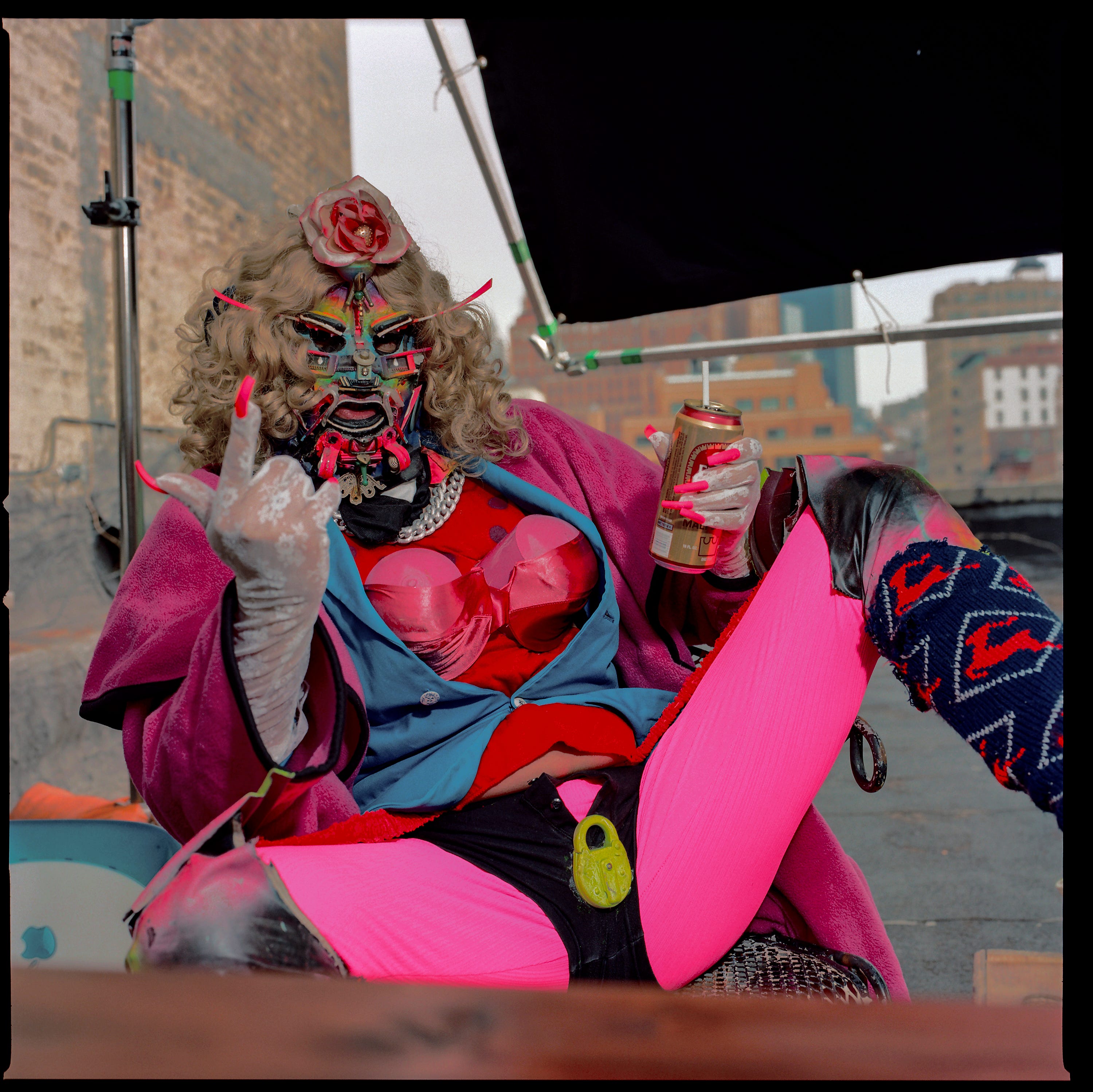
She suggested that they transform his rooftop into a “mythological urban area,” and shoot him in as many of his Garbage Gods that he could still fit into. RAMMΣLLZΣΣ was OK with that.
“He had different movements for the characters, sort of like psychosomatic acting. He would try to explain it, but there was always so much information about each character that I really couldn’t retain it all, and focus on focusing [the camera] and the lighting.”
It took them a week to finish. The photos turned out sick. The most entertaining: Vain the Insane, a curly-haired galactic samurai goddess who donned black underwear with a gold padlock on the crotch over hot pink leggings, sipping Olde English out of a can with a straw.
“I wanted to give Vain her Annie Leibovitz moment, so I shot her with a 20-by-20-foot screen behind,” Allard said, laughing as she spoke, “that sort of Annie Leibovitz on-set style while having a drink.”
During the shoot Egaitsu learned that, coincidentally, RAMMΣLLZΣΣ had already begun some “crime” for Supreme. To thoroughly complete his article, Egaitsu needed to make one last stop in New York before his flight home: Supreme’s head office in SoHo to meet with its founder, James Jebbia.
“When we’d work with him on the skateboards or artwork for [the collections] or for the shops, he’d always come through,” Jebbia recalled, as he recounted his meetings with RAMMΣLLZΣΣ. “He wasn’t a flake.”
When Allard’s contact sheets of RAMMΣLLZΣΣ had landed on Egaitsu’s editor’s desk, along with some additional supporting content contributed by Supreme, RAMMΣLLZΣΣ had unequivocally made the cover of relax’s now-legendary July 2002 issue.
“That was just the beginning,” Egaitsu said, taking a deep breath. “In 2004, we flew RAMMΣLLZΣΣ to Japan.”
While RAMMΣLLZΣΣ liked the thought of his letters taking flight, he didn’t like the thought of himself getting on an airplane.
“I’m too tall for the seats, and there’s too many people at the airports,” he griped in 2009, before mentioning his hassles with security. “They saw Traxx in the bag and they just didn’t understand. ‘What is this dude’s head doing in your bag?’”
For two weekends in July, he performed in three select Garbage God costumes at a trio of packed-out release parties in Tokyo, Sendai, and Osaka for This Is What You Made Me, a dark, otherworldly hip-hop album produced by DJ Kensei.
Kids in the crowd who only knew of RAMMΣLLZΣΣ through Supreme stood watching in shock. The same Vain the Insane screen printed about 10 inches high onto T-shirts was up on stage looking 10 feet tall, drenched in sweat, rapping ferociously into the mic.
“I can rhyme off the top of my head at certain speeds and in five or six different voices, but I got old and can probably only do three or four now. Bite your tongue enough you’re gonna lose a voice,” RAMMΣLLZΣΣ laughed.
Fittingly, RAMMΣLLZΣΣ was staying in Nakano (as arranged by the crime secretary), a neighborhood in Tokyo known for its dark sci-fi and manga subcultures.
“We took him to shops in Nakano, not fancy shops, but ones that sold used stuff, party stuff,” Egaitsu said. “He was picking up things off the street, garbage, too. He was always making something and thinking about artwork and creating from that mish-mash.”
“Even though everything was found — if you look at his sculptures or his outfits, it was all made of stuff that he had collected — it was always balanced and proportioned, and really quite precise,” Jebbia said.
As a teenager in the mid-’70s, RAMMΣLLZΣΣ studied dentistry at Clara Barton, a public high school for health professions in Crown Heights, Brooklyn.
“I learned how to make false teeth. We hung out with the nurses and did our thing,” RAMMΣLLZΣΣ had said. “In every one of my sculptures there’s a little bit of dentistry in every casting.”
Applying his dexterity from dentistry, he briefly went on to study jewelry at the Fashion Institute of Technology.
But what really got him into New York City: the A train and his equation — plus help from some new friends.
“Through DONDI in Brooklyn and through other students up in the Bronx: A-ONE, KOOL KOOR, TOXIC,” RAMMΣLLZΣΣ said, before adding, with gusto: “When we wrote on the trains — and I do mean trains! I did not do street, never! I did not do bathrooms, did not do classrooms, no hallways in no buildings. Trains, inside and out, that’s what I did.”
In the ’80s, galleries in Europe began investing in New York graffiti writers.
“Initially they just literally saw kids with spray cans and were like, ‘You guys write graffiti? Come on, we’re flying you to Europe! Let’s paint on canvases there; we’re going to sell them,” recalled Claudia Gold, artist, jack-of-all-trades, and a former New York City graffiti writer. “And then they cherry-picked RAMMΣLLZΣΣ because he was the father of that whole school of thought… of how letters need to be placed, and this warfare motif that came with it.”
There is footage from 1985 of him in a gallery in Zürich, Switzerland, nonchalantly pouring five-gallon buckets of fuming epoxy mixtures into canvas-sized castings. Inside the castings were carefully placed skulls, bones, film negatives, crystals, and broken beer bottles. Once the epoxies had hardened into thick sheets — with the objects protruding from its surfaces to give dimension — he’d tag, flick, and drip them with spray paint in the same way and with the same principles as he had done on the subway cars years before.
“They haven’t dated at all,” Egaitsu said matter-of-factly after thinking back to when RAMMΣLLZΣΣ showed him some of his epoxy-based paintings, such as Marker and a Mic, The Assassination of Gutenberg, and Tower’s of Panzerism Mega Stroke at the Battle Station in 2002.
Whatever the medium, his timeless works are rising in value, and, within the last four to five years, have broken six figures at auction.
Except only for some stints in Europe before the early ’90s, RAMMΣLLZΣΣ was never represented by any legitimate galleries in New York. By then, the art world had grown tired of graffiti artists in general — too much hassle and infighting.
“He wasn’t shown, so it wasn’t like, ‘Wow, I’m doing all this work and we’re going to sell it.’ No galleries would touch him because he wasn’t politically correct,” Jebbia said, before adding, “He was similar to van Gogh — I’m doing this ’cause I’ve gotta do it.”
In 1991, he put on his own show at Manhattan Mini Storage on Varick Street, long before the idea of co-opting mini-storage was even a thing.
“He had probably about 10 different rooms that all connected to each other in this labyrinth, it was wild,” Gold said. “He had lights set up, and all of these crazy sculptures that were very similar to his outfit, and then he rolled into the rooms, literally, on a skateboard.”
RAMMΣLLZΣΣ used to skate.
“Hell yeah,” RAMMΣLLZΣΣ said before laughing. “We had them big fat chunky wheels!”
Supreme and that cherished issue of relax put me on to RAMMΣLLZΣΣ when I was a kid. He died quietly in 2010 at the age of 49, about eight months after my meeting with him. The New York Times reported the cause of death as heart disease.
Shortly before he died, Allard saw him, out of the blue, having what she called a “Mary Tyler Moore moment.”
“He was turning around in the street with this big grin on his face looking at everything, like maybe he knew he was going to die,” Allard said. “I was going to say hi, but I didn’t want to interrupt him.”
Gold’s first encounter with RAMMΣLLZΣΣ was while sitting on a stoop in Chinatown in ’89 or ’90, when he offered her a sip from a 40-ounce bottle of malt liquor early one morning.
“He was like, ‘Here, you want some?’ And I was like, ‘No thank you.’ And he said, ‘More for me, more for me!’” Gold laughed. “I’m telling you, I’ve turned that into my personal mantra!”
“Most people assumed he was this nutty kind of guy who had no boundaries,” Jebbia said. “He wasn’t difficult, he wasn’t a pussycat. He was just really straightforward and straight up.”
“I had some awkward moments with him, but after, he was nice and warm and had a sense of humor,” Egaitsu said, pausing for about 10 seconds. “We did the live shows, his performances, right? Our next step was to have his art show in Japan.”
Egaitsu and the crime secretary could only have imagined.
In 2012, The Suzanne Geiss Company gallery in SoHo, New York, paid tribute to RAMMΣLLZΣΣ by suspending, as if in flight, his A-to-Z of “Letter Racers” for its inaugural show. Each letter-shaped sculpture — made of corrugated plastic and random nick-nacks — loosely resembled a Star Wars enemy spacecraft growing up out of a custom skateboard chassis.
The show was spearheaded by RAMMΣLLZΣΣ’s wife, Carmela Zagari, a makeup artist agent who had been with him since the days of the Battle Station.
“I miss my husband very much… too much for any species to comprehend. I don’t sleep ’til I go to sleep,” Zagari replied in an email from December, 2010. “I am busy now with making sure the world views his work in major institutions.”
About six months after the “Letter Racers” show had ended, Zagari died suddenly from a freak accident inside their apartment in Battery Park. Neither she nor RAMMΣLLZΣΣ were survived by family.
In 2018, Red Bull Arts New York in Chelsea staged the largest survey of his work to date — an expansive two-floor show titled RAMMΣLLZΣΣ: RACING FOR THUNDER. It included many rarely seen pieces from private European collections and an extensive display of his costume designs.
Vain the Insane was sure to be included.
“May hell freeze over,” RAMMΣLLZΣΣ responded in 2009, when asked for any last words of wisdom or advice.
Hiroshi Egaitsu and Avi Friedman contributed reporting.
No posts
Comments
Nothing yet. Say the first thing.
Sign in to join the conversation.