
I walked into a law firm recently. Four partners, twenty staff, fifteen years of growth behind them. No CRM, no project tracker, no documented process. Just people. The partners knew which matters were urgent because they could feel it. The office manager knew which clients needed chasing because she’d been doing it long enough to read the signals. The senior associate could tell you the status of every file he touched, not because it was written down, but because he carried it. The whole business ran on context that lived in people’s heads, and it worked.
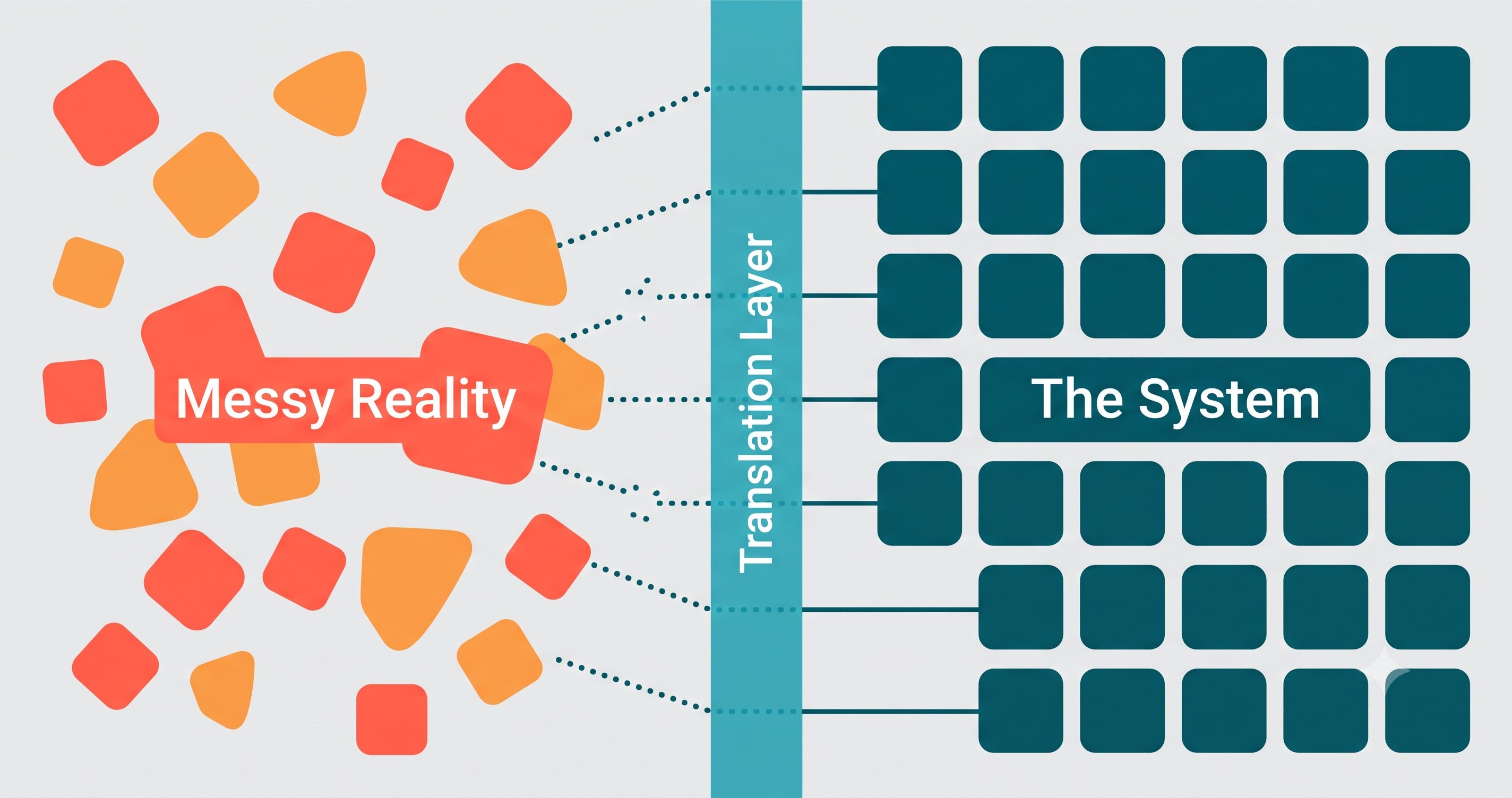
All of that knowing was work, though nobody counted it that way. Every day, those people took the messy, half-felt reality of the business and turned it into something a system could act on. A file gets billed, a client gets called, a matter moves. The system only ever saw the clean output, because the translating happened in someone’s head, for free, and it never made it onto a job description. For as long as businesses have run on technology, humans have done that job. They were the translation layer, sitting between the fuzzy reality and the structured system, filling the gap by hand. It was invisible, because it was just the work.
In a strange way it’s a compliment to us. People are remarkable at operating in mess. A founder can hold the whole state of a business in their head: which clients are happy, which projects are sliding, who’s struggling, which deal is about to close. Not from a dashboard, but from a brain that’s brilliant at pattern matching on incomplete, contradictory information. We’re so good at it that we never noticed we were doing it.
Then a new kind of worker shows up.
AI is joining teams now, and not as a tool you open when you need it, like a calculator. It’s a collaborator that sits inside your system, reads your data, and works alongside your people. The problem is that it can’t do the translating. It can’t feel a client cooling off from the tone of their last email, or sense a project is off track because the founder’s gone quiet on it for three weeks.
Hand it a spreadsheet and watch it try. You know the one: client list in the first thirty rows, then a blank row, some cost modelling underneath, then notes jammed in column G that have nothing to do with the headers. The person who built it knows exactly what’s going on. AI takes a swing, and sometimes it nails it, and sometimes it can’t tell where the client data stops and the cost modelling starts. You won’t always know which time you got. And you can’t run a business process on “sometimes.”
People talk about AI slop. Most of it is human slop handed back to us: messy inputs, unreliable outputs. Give it a clear status, a real date, a workflow with defined transitions, and AI is genuinely excellent. The difference was never the AI. It’s what you hand it.
So the translating still has to happen, and the question is who does it, and when. The old answer was a person, silently, forever. That cost was real, it was just buried in everyone’s day, absorbed as the normal friction of getting shit done. Making the business explicit always paid off, even before any of this, because it made you easier to scale and easier to hand over. It just never felt urgent, because people were quietly covering the gap.
AI made the cost visible. Ask an agent to prep a client brief when there’s no structured link between meetings, projects and people, and it comes back with garbage. The gaps people used to step over become hard walls the moment AI tries to walk the same path.
For years, the business that ran on sharp people who just knew was the one everyone admired. Lean, quick, no bureaucracy, no process for its own sake. The over-documented shop down the road didn’t look ahead of you. It looked slow, bureaucratic, overstructured, a whole heap of unnecessary hard work. And even if you quietly knew you probably should be doing some of it, it seemed like overkill, the sort of thing only people who love structure would bother with. AI quietly swapped the scoreboard. The intuition-run business is now the hard one to move, and the structured one is the one that flies. The thing you were proud of, that you didn’t need all that admin, is the thing holding you back.
And it doesn’t land evenly. The translation work was never spread across the team. It sits with your best people: the partners, the office manager who’s been there twelve years, the senior associate who carries every file in his head. So getting ready for this doesn’t start with technology. It starts with the most valuable people in the building, and they’re the ones who often least believe any of it needs writing down. Because for them, it never did.
The strange comfort is that the thing making the cost visible is the same thing that makes it payable. Getting what’s in someone’s head into a system used to mean a brutal documentation project: workshops, templates, a manual nobody ever finished. Now you can rant and rave into a transcript for twenty minutes and let the machine shape it into something usable. The job that used to take a quarter now takes an afternoon. The wall between “it’s in my head” and “it’s in the system” just got a lot lower.
That law firm isn’t broken. Fifteen years of success says otherwise. But everything holding it together is sitting in four or five heads, and for the first time there’s both a reason to get it out of them and an easy way to do it. The machine will shape it, file it, make it usable. But you still have to sit down and say what you know. Nothing does that part for you.
Tim Jeffries runs Smooth Ops, a Notion consulting practice that builds operational systems for growing businesses. He’s a Notion certified consultant and partner based in Victoria, Australia.
No posts
Comments
Nothing yet. Say the first thing.
Sign in to join the conversation.