
Last week I was on a call with a 70-person professional services firm. We were designing the architecture for their new Notion workspace: meetings, projects, people, documents, tasks. The foundational stuff.
When I added a status property to the projects database, one of the directors pushed back.
“Why do we want to track status?”
Fair question. And honestly, a good one. They’d operated without formal project statuses for years. Their projects have fuzzy endings. A planning consent gets approved, but the client comes back for a variation six months later. Another one goes quiet, then wakes up. The directors just knew which projects were active and which ones were done. It lived in their heads, in the rhythm of the work.
And he was right. It had worked. I’ve actually pushed back on clients in the past for over-systemising: adding structure for the sake of structure, tracking things nobody looks at, building dashboards that answer questions nobody’s asking. If the humans can hold the picture and the business runs well, you don’t need a status field to prove it. That instinct to resist unnecessary admin is a good one. It keeps systems lean.
But something has changed.
I said: “One of the fascinating things about building a system like this is that humans have this amazing ability to just know. But if we’re building a system that AI is going to be a player in, we have to make a whole bunch of those things explicit that we never have before. To the point where sometimes it feels a bit dumb. You’re like, why are we spelling that out? But you really do.”
A beat of silence. Then one of the team members, not a director, someone who’d clearly been on the losing end of this conversation before, turned to him and said: “Did you hear that? ‘When it’s at scale, it’s hard for one person to know.’”
There was a touch of spice in it. She’d been tracking her own project statuses in Notion for months because she found it useful. She’d wanted the shared version. Now the argument wasn’t just about tidiness anymore. It was about whether AI could operate on a system where the state lived in one person’s head. And the answer was obviously no.
The director paused. “Yeah. Leave that there.”
No defensiveness. No drawn-out debate. The reasons had changed, and he moved with them.
That exchange is the whole article.
Nate B Jones wrote a piece recently about how issue trackers accidentally became the substrate for AI agents. His argument: tools with persistent state, defined verbs, ownership fields, audit history, and permissions are the ones agents can actually operate through. Tools without those properties get wrapped or replaced.
He called the cost of operating without that structure “the swamp tax.” The term stuck with me because I’ve been living it from the other end. I don’t build issue trackers. I build operational systems for small and mid-size businesses. But the pattern is identical.
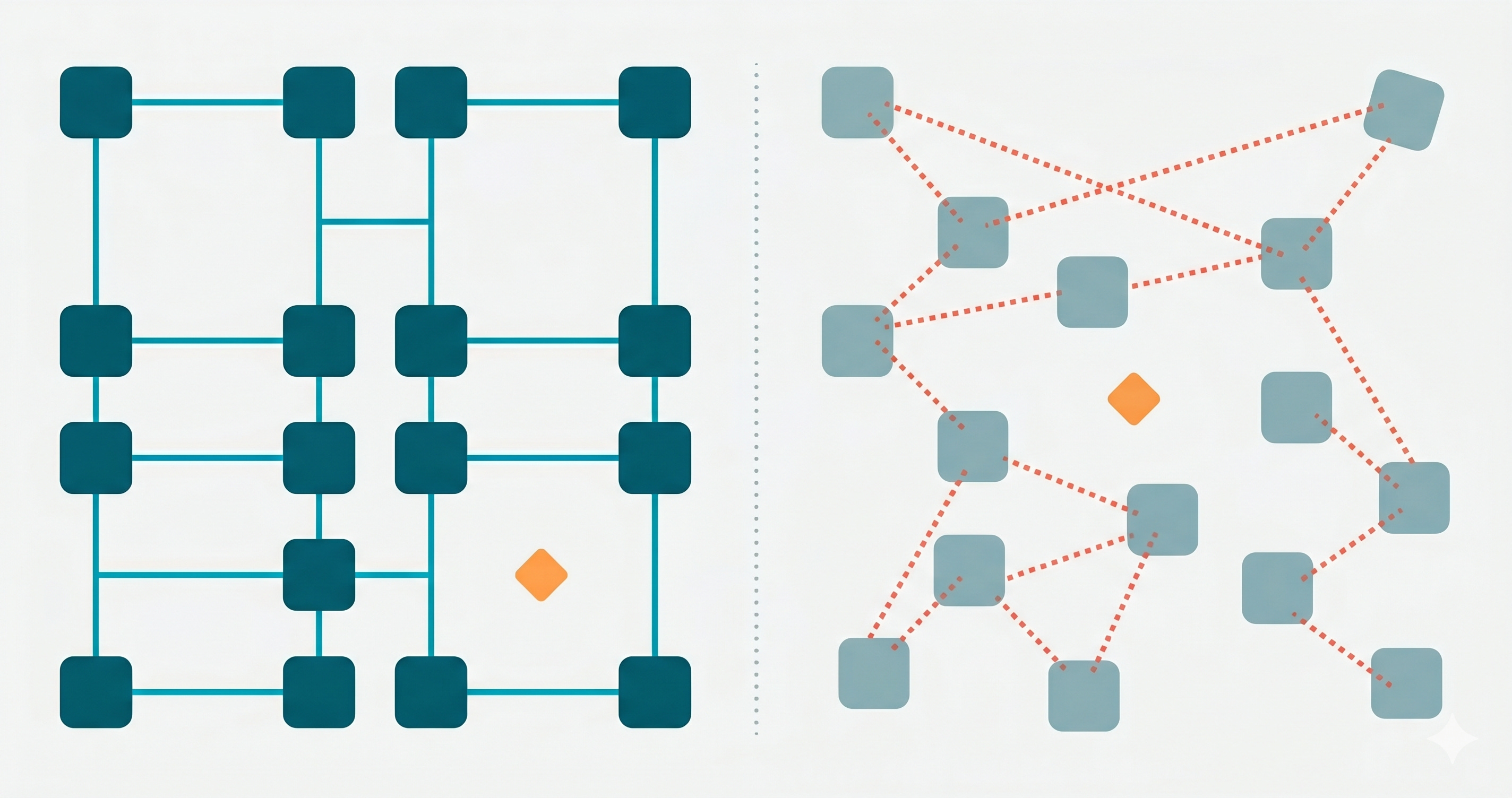
The swamp tax is what happens when a business runs on tribal knowledge, Slack threads, spreadsheets that one person understands, and processes that live in the founder’s head. For years, that was fine. Humans compensated. They had meetings to sync. They remembered things. They built workarounds. The tax was invisible because people were paying it every day without noticing.
AI agents can’t compensate like that.
An agent can’t infer that a project is finished because the director hasn’t mentioned it in three months. It can’t read the room. It can’t “just know” that the real status lives in someone’s head and the database field is stale. It needs a record with a status. It needs an owner. It needs the state to be explicit, structured, and current.
The swamp tax that humans absorbed quietly is now visible, because agents expose it immediately.
Here’s the thing I keep saying to clients, and it keeps landing: the work we’ve always done has suddenly become more valuable.
Five years ago, if I told a 30-person company they needed to consolidate their tools, build a connected database architecture, define their statuses, document their processes, and get their data clean, they’d nod politely and think: yeah, we’ll get to that when we scale.
It was good practice. It made things tidier. It helped with onboarding. But it wasn’t urgent. The business ran fine without it. The founder could hold the whole picture in their head, and the team compensated for the gaps with effort and goodwill.
That framing is dead.
If you want AI to do meaningful work in your business, not party tricks, not summarising a document you could have read yourself, but actually operating across your systems, preparing briefs, qualifying leads, following up on meetings, managing pipelines, then you need the substrate for it to run on. You need the boring structural work done first.
The consulting engagement that used to be “let’s clean up your workspace” is now “let’s build the infrastructure your agents will run on.” Same deliverable. Completely different strategic value.
I’ve built these systems for over 250 businesses. The swamp shows up the same way almost every time.
Projects without statuses. Like my director friend. The humans know, so nobody bothered making it explicit. Now the AI can’t tell what’s active, what’s done, and what’s dormant. Every query about workload, capacity, or pipeline hits a wall.
Knowledge that lives in heads, not systems. The founder knows how client onboarding actually works. Not the documented version. The real version. The one that evolved over dozens of engagements until it just became “how we do things.” None of it is written down. The AI has nothing to retrieve.
Data spread across tools that don’t talk to each other. CRM in one place, project tracking in another, client comms in a third. No relations between them. The AI can search each system individually, but it can’t follow the thread from a client conversation to a project decision to a task assignment. It’s flat retrieval instead of structured navigation.
Processes that exist as habits, not workflows. There’s no state machine. No defined transitions. No ownership fields. Just people doing things in a particular order because they’ve always done it that way. An agent can’t execute a process that doesn’t exist as structure.
Each of these was invisible overhead when only humans were reading the system. Each one becomes a hard blocker the moment you want agents to operate on it.
There’s a counterintuitive insight buried in all of this, and I think it’s the most important one.
The tool that will serve your agents best might not be the one with the flashiest AI features. It might be the one your team has been filling in honestly for three years because the experience never made them want to cheat.
I see this constantly. When people resent a tool, they route around it. Important decisions end up in Slack instead of the tracker. Statuses become performative. Records get created retroactively to satisfy a process nobody believes in. The data is technically there, but it’s garbage.
When people actually like the tool, the real work migrates into the system voluntarily. The state gets cleaner. The ownership stays current. The dependencies reflect reality.
Back on that call, two of the team members were already tracking project statuses in their own setups. They found it useful. They wanted the shared version. The data quality was going to be better because the people using it wanted to use it, not because someone mandated it.
That’s the foundation agents need. Not a mandate. Not a policy. A system people actually maintain because it works for them. The human UX investment you made three years ago is now paying dividends you couldn’t have predicted.
Nate framed this as boring tools winning. I’d frame it slightly differently for the businesses I work with.
The boring work won.
Not the tools themselves. The work of sitting in a room with a team and saying: what are your actual statuses? What does “done” mean for you? Who owns this? Where does this information live? The architecture work. The sense-making. The process of making implicit knowledge explicit and structural.
That work was always valuable. It made businesses more organised, more scalable, more resilient. But it was competing with a hundred other priorities, and it often lost.
Now it’s the prerequisite. Not the AI itself. Not the model. Not the prompt engineering. The substrate underneath. The businesses that did this work early, even before they knew why it mattered, are the ones deploying agents that actually work. The ones that didn’t are looking at a retrofit bill they didn’t budget for.
The gap between those two groups is going to widen fast.
If you’re running a business and you want to be on the right side of this, here’s where to start.
Audit your state. For every major process in your business, ask: where does the current state live? If the answer is “in someone’s head” or “in a Slack thread somewhere,” that’s your swamp. The AI can’t read it. An agent can’t act on it.
Make ownership explicit. Every project, every task, every client relationship needs a clear owner in a field, not an implication. “Everyone knows Sarah handles that” is not a data model. It’s a liability.
Define your verbs. What does it mean to start a project? To complete a task? To hand off to the next person? If these transitions are social conventions rather than structured state changes, the agent has to guess. It will guess wrong.
Build for the humans first. Don’t optimise for AI readability at the expense of human usability. The best agent substrate is a system people actually use honestly. If the team hates the tool, the data will be bad, and no amount of AI will fix bad data. Get the UX right. The agent readiness follows.
Start with one connected system. You don’t need to rebuild everything. Pick the process that matters most, probably the one closest to revenue or client delivery, and build it properly. Meetings connected to projects connected to people connected to tasks. One clean, relational system that AI can navigate. Then expand from there.
I sat in a room last week and watched a director resist adding a status field because his team had never needed one. By the end of the conversation, two of his colleagues were already advocating for it. Not because AI demanded it. Because they wanted it for themselves.
That’s the pattern. The structural work that makes a business legible to its own people is the same work that makes it legible to agents. It was never optional, not really. We just treated it that way because the humans could compensate.
They can’t compensate forever. And the agents definitely can’t.
The work you were already doing, or should have been doing, just became the most valuable thing on your roadmap. Not the AI strategy. Not the model selection. Not the prompt library. The boring, foundational, architectural work of making your business actually legible.
That’s what I build. It’s what I’ve always built. The only thing that’s changed is how much it matters.
Tim Jeffries runs Smooth Ops, a Notion consulting practice that builds operational systems for growing businesses. He’s a Notion certified consultant and partner based in Victoria, Australia.
No posts
Comments
Nothing yet. Say the first thing.
Sign in to join the conversation.