
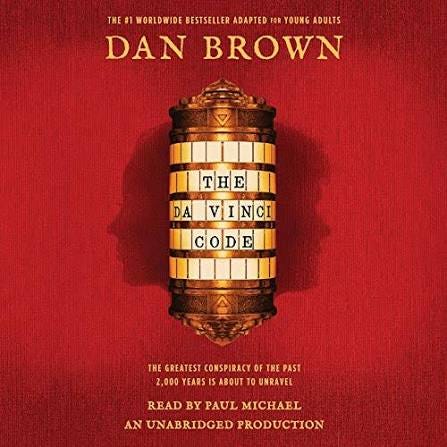
Cover, The Da Vinci Code, young adult edition. Doubleday / Penguin Random House.
The cryptex is a marble cylinder with five lettered dials and a vial of vinegar inside it, and if you force it the vinegar breaks and dissolves the papyrus and you lose the answer forever. You cannot pick it and you cannot cut it open. You apply the correct word and it opens.
The entire novel is that object, repeated.
For anyone who came in late, the shape of it is this. A curator is shot in the Louvre at night and spends his last minutes arranging his own body into a puzzle. An American professor of symbology is pulled out of a hotel at half past midnight to read it. The dead man's granddaughter, a police cryptologist, turns up and the two of them run, and the puzzle opens into another puzzle, which opens into the claim that Jesus and Mary Magdalene had a child and the bloodline survives and the Church has spent two thousand years suppressing it. There is an albino monk. There is a knight in a wheelchair who is not what he appears. It moves.
Dan Brown was a New Hampshire English teacher who had published three novels almost nobody bought, and then wrote a fourth one that sold eighty million copies and became the second best selling book of the decade, and I think it is worth being honest about why before taking it apart.
The machinery is genuinely good. The chapters are short and every one of them ends on a yank, a revelation or a door opening or a sentence cut off mid-thought, and doing that four hundred times without the reader noticing the trick is a real craft and most literary novelists could not manage it for a chapter. The pacing is engineered rather than felt. And the central premise is a good one, which is a thriller where the weapon is knowledge, where the thing that saves you is having read something, and where the chase is won by the person who can interpret faster. That is a compliment I mean sincerely. A book that made millions of people believe that knowing about paintings might one day be urgently useful is doing something no museum campaign has ever pulled off.
The Da Vinci Code is a chain of containers. There is a message hidden on the Mona Lisa, and the message points to a painting, and the painting conceals a key, and the key opens a box, and the box holds the keystone, and the keystone is a cryptex, and inside the cryptex is a smaller cryptex, and inside that is a poem, and the poem points to a tomb, and under the tomb is the answer. Four hundred pages of Russian dolls. Every single one has exactly one thing inside it and exactly one correct method of opening.
The structure is the pleasure of the book and it is also, accidentally, its argument, and I do not think Brown noticed he was making it.
Because the containers are not only objects. Sophie Neveu is the last living descendant of Jesus Christ and Mary Magdalene, which means her body contains the secret, which means she is the artifact. Mary Magdalene matters in this book because she was pregnant, so her significance is her contents. The Mona Lisa is a woman painted by a man that turns out to be a puzzle left by that man for other men to solve. The Louvre itself is a container with a woman's body arranged inside it in the opening chapter, positioned in a pattern, waiting to be read correctly by someone qualified.
Every woman in this novel is a cryptex. You apply the right word and she opens and there is a man's message inside.
Comments
Nothing yet. Say the first thing.
Sign in to join the conversation.