
On the twenty ninth of March, 1770, a twenty one year old artist in Boston sat down to write the angriest letter of his life.
He had spent weeks on an engraving of the massacre in King Street. He had paid for the paper and the printing out of his own pocket. And before he sent it to press he had shown it to an older, better established engraver whose professional opinion he respected, because that is what you do when you are twenty one and the other man has a shop and a reputation and you would like to be him in fifteen years.
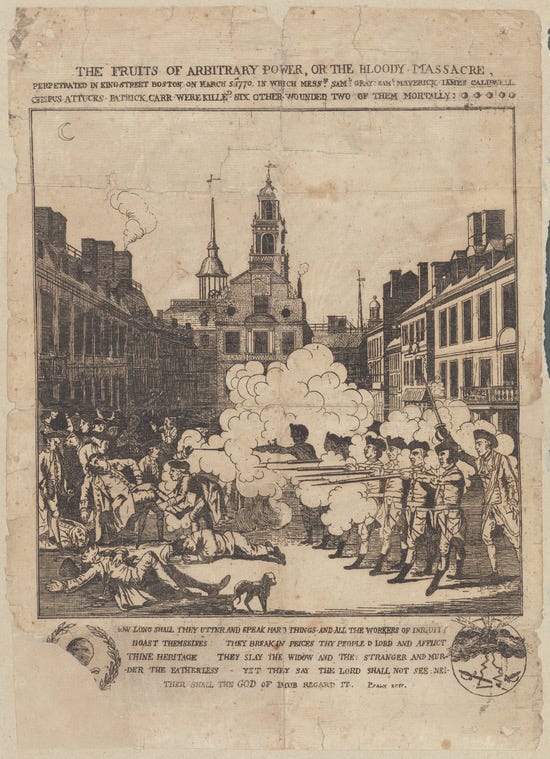
The Fruits of Arbitrary Power; or, the Bloody Massacre (Henry Pelham, 1770, engraving)
That man engraved a copy and advertised it on the twenty sixth of March, a week before the original had reached the public. He did not adapt it or compete with it. He simply had it out first, the way you have a thing out first when somebody has handed it to you and gone home.
So Henry Pelham wrote to Paul Revere.
When I heard that you was cutting a plate of the late Murder, I thought it impossible as I knew you was not capable of doing it unless you coppied it from mine and as I thought I had entrusted it in the hands of a person who had more regard to the dictates of Honour and Justice than to take the undue advantage you have done of the confidence and Trust I reposed in you. But I find I was mistaken and after being at the great Trouble and Expence of making a design paying for paper, printing &c.
He also told him this, which is the sentence I would have had engraved on something:
If you are insensible of the Dishonour you have brought on yourself by this Act, the World will not be so.
The World was not so. The World bought Revere's version, put it in every schoolbook it printed for the next two hundred and fifty years, and has never once heard of Henry Pelham, who was correct about everything and lost anyway.
And then, at the end of all that, Pelham reminded Revere to send the hinges his mother had ordered.
Four paragraphs on the destruction of his honour, and then a purchase order.
Which is the whole man in one letter, written by somebody with every reason to want him dead. You could rob Henry Pelham blind on a Monday and he would still need hardware from you on Thursday, because there was nobody else in Boston who could make it as fast or as well.
Everybody knows the horse. The midnight ride, the lanterns, the lone rider through sleeping towns. Longfellow wrote that in 1860, thirty five years after Revere died, for a country about to tear itself in half and desperate for a hero everyone could still agree on, and the poem is a work of literature that happens to have a real man's name in it. I have no interest in relitigating the ride. Everyone has done the ride, at length, usually in April and usually in a tone. He was not alone, he did not shout that phrase, and he was detained by a patrol before he ever reached Concord. None of that is the interesting correction.
The interesting correction is that he had a shop.
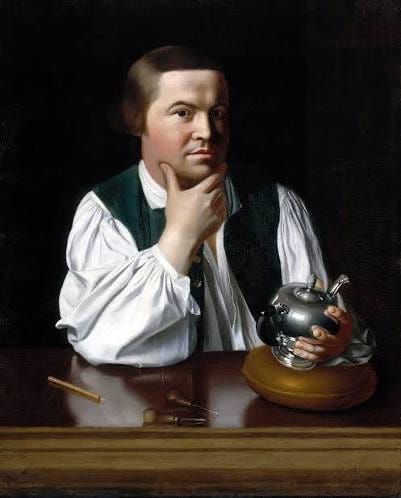
Portrait of Paul Revere by John Singleton Copley (c. 1768 to 1770, oil on canvas)
Here is the man, briefly, because he is usually introduced as an event rather than a person. Paul Revere was born in Boston at the end of 1734, one of a dozen children of a French Huguenot named Apollos Rivoire who had come over alone at thirteen, apprenticed himself to a goldsmith, and anglicized his name to something the neighbours could say. The father taught the son the trade and then died in 1754, when Paul was nineteen and too young under the law to be a master, so the boy ran the family shop anyway until he was old enough to be allowed to. He was married twice, buried a wife, fathered sixteen children, and lived to eighty three, which means one man's working life reaches from a colonial port town under a king to an industrial republic with a navy. He was at the bench for sixty of those years.
That is the job, and it is worth knowing what the job actually involves, because people hear silversmith and picture a man tapping delicately at something small. To raise a bowl you start with a flat disc and you hit it, from the outside, working in a spiral, over a stake, and the metal moves under the hammer about a millimetre at a time. Thousands of blows. The silver work hardens as you go and stops cooperating, so you heat it until it glows dull red and let it soften and start again, and then again, and the annealing leaves a grey oxide skin you have to pickle off in acid before you can see what you have done. Then you planish the whole surface with a flat faced hammer to take the dents out, and file, and burnish, and only then does the thing look like an object rather than a fight. It is loud. It takes days. Your hearing goes.
Then he set his mark on the underside, where the customer would not see it.
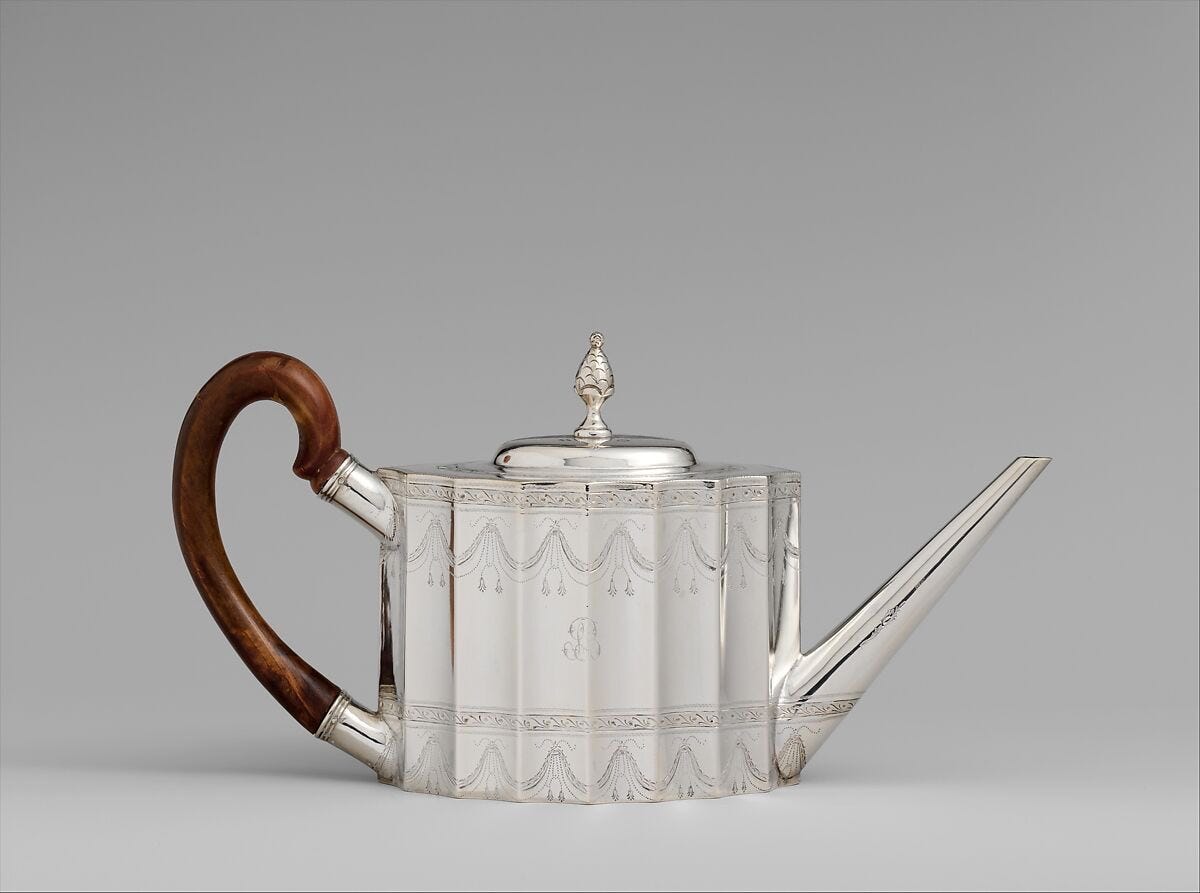
Silver Teapot by Paul Revere Jr. (c. 1796 to 1797, silver with wooden handle)
And he made everything. That is the part that gets lost when he is filed as a silversmith, because the shop was not a boutique. Teapots and tankards and spoons, yes, and also shoe buckles, thimbles, buttons, sword hilts, spurs, porringers, christening basins, coffin plates for funerals, surgical instruments, spectacle frames, a set of false teeth if you needed them, and the branding irons and printing plates and business cards and bookplates and tavern signs and hymnbook covers that came out of the engraving side. He engraved the colony's paper money. He would cut you a picture frame. If it was metal and you needed it by Friday, Revere was the answer, and Boston knew it, which is why a man he had just robbed still wrote to him about hinges.
Thousands of objects, with that mark on the underside, and a great many are still in collections and still get handled with gloves. When you take the poem away what is left is a pair of hands and a customer list, and both are more interesting than eight hours on a horse.
Consider what he does with a punch bowl. In 1768 the Massachusetts House voted not to rescind a letter the crown had ordered them to rescind, and ninety two members held the line, and Revere made them a bowl. Round, silver, engraved with their number and their cause and with a torn Stamp Act at the base of it. The point was that fifteen men could stand around it in a room and drink out of a thing that told them who they were. A punch bowl is a peculiar weapon. But a set of opinions held by ninety two men who have never been in a room together is not a movement, and a thing you can put your hands on is.
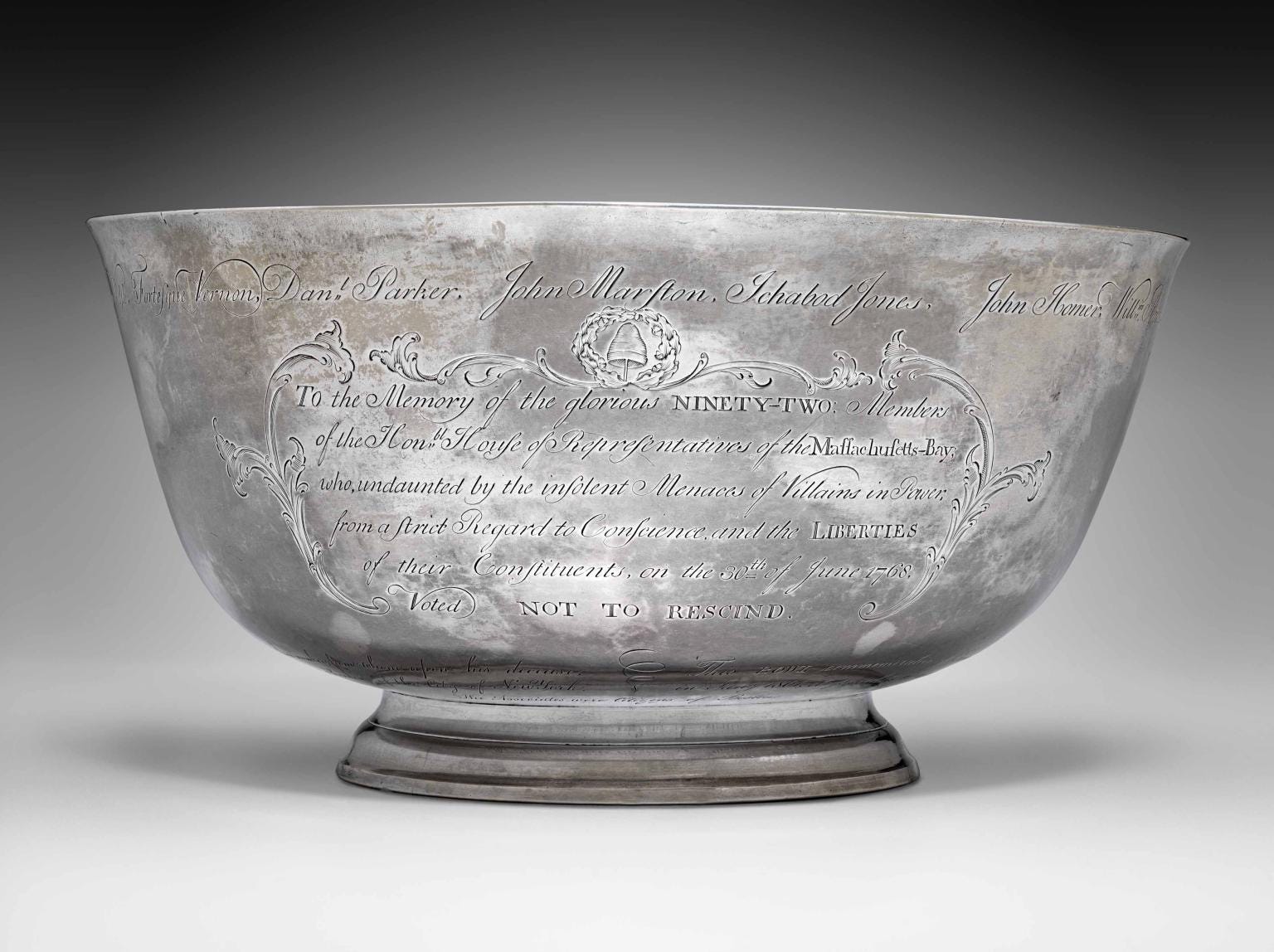
The Sons of Liberty Bowl by Paul Revere Jr. (1768, silver punch bowl commissioned by fifteen Boston patriots)
Print was faster and cheaper and travelled further, which is where the Pelham business comes in and where the schoolroom version of him should quietly stop being taught.
Revere's engraving of the Boston Massacre is one of the most effective pieces of political communication ever produced in North America. It shows a tidy line of redcoats firing on command into unarmed colonists, blood already in the street, a clean story of villains and victims imposed on a night that was chaotic and legally murky and that ended in acquittal for most of the soldiers, defended, incidentally, by John Adams. Over two hundred copies went out. It ran in newspapers and on broadsides. It is in your school textbook right now and it is why you picture the massacre the way you picture it.
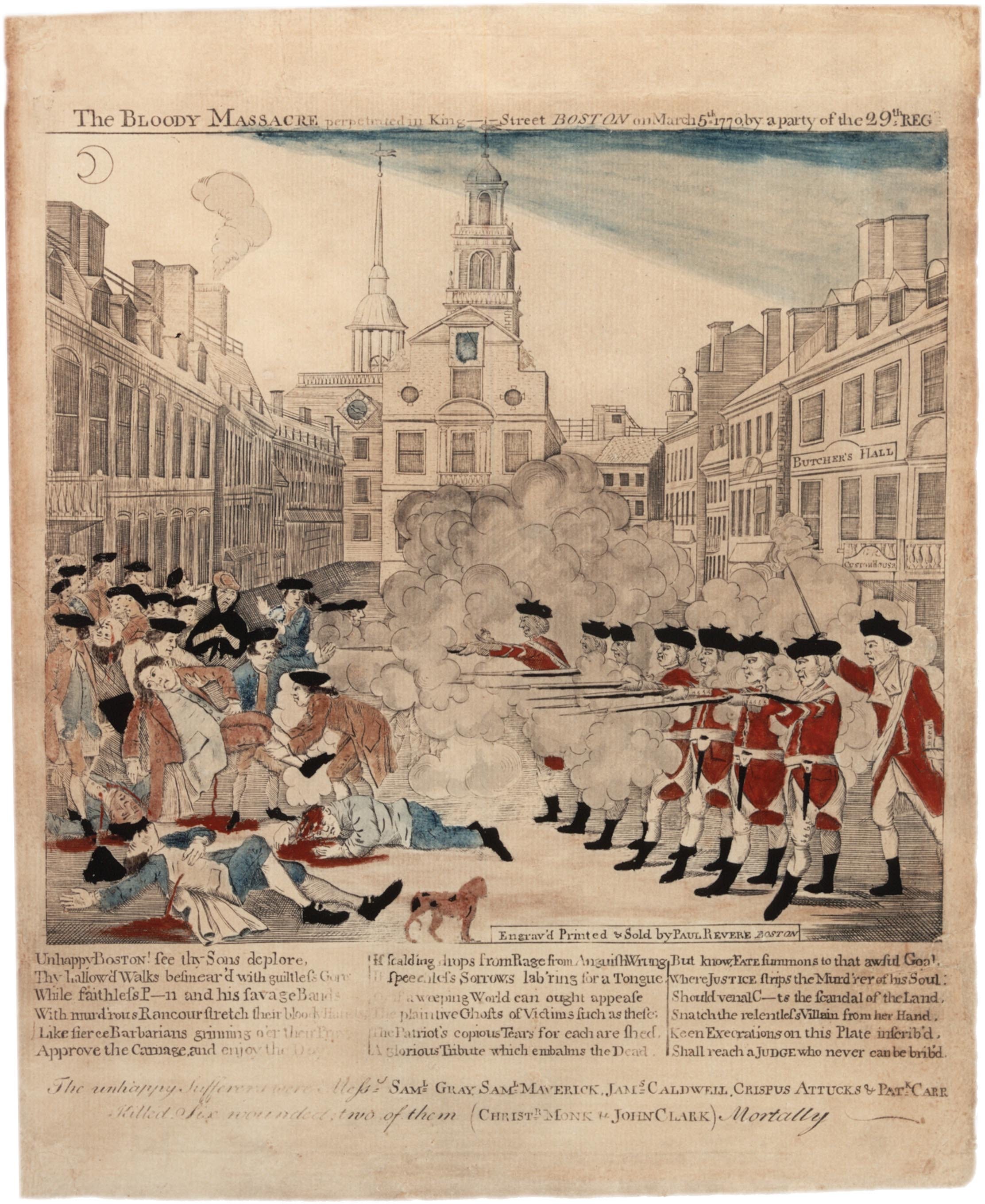
The Bloody Massacre perpetrated in King-Street Boston (Paul Revere, 1770, hand-colored engraving)
And Revere took the composition off a twenty one year old who had handed it to him in confidence.
In fairness to the period, intellectual property in 1770 was not what it is now and copying engravings was ordinary practice, and Revere copied constantly. The State Department, which owns one of the prints, puts it flatly, that virtually none of Revere's engravings was of his own invention and that he copied whatever came to hand, most often British prints, and adapted them by changing the captions. That was the business, and it made him an aggregator with a press.
But Pelham lent it to him. That is the part that is not ordinary practice in any century, and Revere had it advertised inside a fortnight, and Pelham, who went on to become a Loyalist and left for England in 1776 and is remembered by roughly nobody, never got the credit and never got over it. Only one complete copy of his version is known to survive.
The man the poem sold as a messenger was one of the best image makers in the colonies, and he got there partly by being faster than the person he took it from.
Once you see the pattern it is everywhere. Revere was useful to the revolution because he could make anything and knew everyone, and the shop is what put him in the room. The merchants bought his silver and the printers worked next to him, and the political men needed a hand they could rely on, and he engraved the colony's paper money, which is a job you give to somebody you trust with the actual mechanism of the economy.
He also pulled teeth. For a few years in the late 1760s he advertised dentistry, cleaning teeth and wiring in false ones with fine silver wire, and claimed in print that he could do it as well as any surgeon dentist from London, which is a marketing claim rather than a credential and which he was in no position to make, having never been to London.
Which brings us to the story about Joseph Warren, and to the thing I did not expect to find.
The story goes that Warren was killed at Bunker Hill in June 1775, stripped and thrown into a shallow grave, and that when the British evacuated Boston nine months later Revere helped exhume him and identified his friend by the dental work he had done, the ivory tooth and the wire he had twisted himself. It is presented everywhere as the first forensic dental identification in American history. It is in medical museums. It is on the National Museum of Health and Medicine's wall.
The staff at the Paul Revere House will tell you the sourcing is thin. Nobody has found a mention of it earlier than General William H. Sumner's Reminiscences of Gen. Warren and Bunker Hill, and that book was published in 1858, eighty two years after the exhumation. The Revere House's own researcher has said plainly that a source that far after the fact makes it tricky to call definitive, and that awareness of the uncertainty has been growing.
Eighteen fifty eight.
Longfellow published the poem in 1860.
Put those two dates next to each other. In the late 1850s, with the country visibly coming apart, somebody needed a man alone on a road at night and somebody needed a man kneeling in a pit recognizing his own wire in a stranger's jaw, and both of them arrived within twenty four months, and both are still being taught, and one is on a plaque in a federal museum.
Two stories, two years, both of them about a man recognizing something in the dark.
Which is a shame, because the actual life needed no help, and the best of it happens after everybody stops paying attention.
Revere did not retire into gentlemanly glory when the war ended. He was in his fifties and he got bigger. He opened an iron and brass foundry and cast bells, hundreds of them, and I would like to be clear that this is the part of his life I actually envy. Church bells, still hanging in New England towns, still ringing on Sunday mornings over people who have no idea, and one that ended up in Singapore because his daughter Maria lived there. He made a sound that is still going.
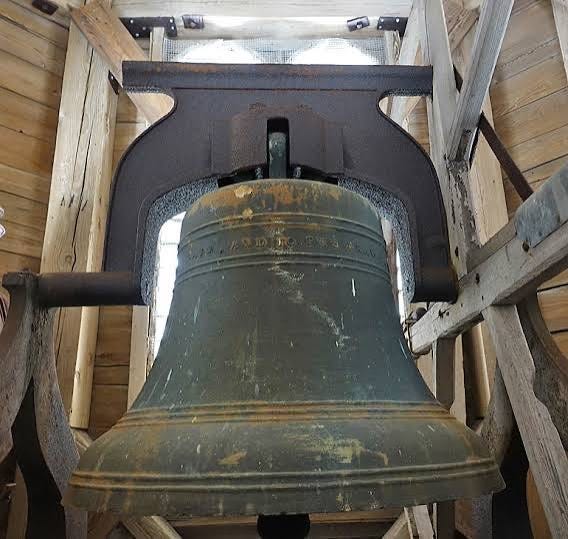
Church Bell for the Congregational Meetinghouse, Falmouth, Massachusetts (Paul Revere Jr., cast 1796, bronze)
He cast cannon too, and bolts and spikes and fittings, which is unglamorous and which is what the new republic actually needed, since a country that cannot make its own fasteners is a country that buys them from somebody who might stop selling.
Then at sixty five, an age at which most men in 1801 were already dead and the rest were being encouraged to slow down, he mortgaged himself to the eyeballs and built the first copper rolling mill in the United States, in Canton, Massachusetts. Nobody in America had rolled copper into sheet at scale. He worked it out, with fits and starts and government money that arrived unreliably, and his copper went onto the hull of the USS Constitution and onto the dome of the Massachusetts State House, where it is the reason that building looks the way it does in every photograph you have ever seen of Boston.
He died on the tenth of May, 1818, at eighty three, a wealthy industrialist with sixteen children and fifty one grandchildren.
The company is still going. It is called Revere Copper Products, it is employee owned, it sits in Rome, New York, and it marked two hundred and twenty five years of continuous manufacturing this past June. For most of the twentieth century one of its divisions made Revere Ware, which means the reason there is a saucepan with a copper bottom in your grandmother's kitchen is a sixty five year old man in Canton, Massachusetts, working out how to roll sheet with nobody to ask.
None of which is a shape the poem could use. And I want to be annoyed about this for a paragraph, because the horse is not an isolated problem.
Look at how this country handles its founding generation generally. We got a set of lawyers and planters in wigs, arranged around a table, having ideas. Portraits, all of them standing, none of them working. Jefferson at a desk. Franklin with a kite, which at least involves an object. Every one of them rendered as a mind that occasionally has hands rather than a pair of hands that occasionally has thoughts. And the actual composition of the thing was tradesmen. Printers, brewers, ironmongers, shipwrights, coopers, tanners, a great many men with filthy fingernails and a ledger and an eye on what the competition was charging, and the revolution moved at the speed of what they could physically produce and distribute. Somebody had to cut the plate and cast the type and make the fasteners for the ships, and if nobody could, the ships did not sail and the war ended differently.
None of that is in the mural. You cannot paint a supply chain. So the country picked the one night this particular manufacturer spent on a horse and built a poem around it, and the poem is now the entire man in the public mind, and it is about the eight hours he spent not working.
A nation founded by shopkeepers is harder to put on a horse. The revolution needed things by Tuesday and Revere was the man who had them by Tuesday, and the same speed that got the paper money engraved on time got Henry Pelham's design onto the street a week ahead of Henry Pelham. It is one skill. Nobody has ever managed to separate the half of it that builds a country from the half of it that robs a twenty one year old.
Longfellow needed a knight, and what was actually available was a supplier.
Henry Pelham knew exactly what Revere was, better than Longfellow ever did, and he put it in writing on the worst day of his professional life. He spent four paragraphs on honour and justice and the confidence he had reposed.
And then he asked about the hinges, because he still needed them, because there was nobody else.
No posts
Comments
Nothing yet. Say the first thing.
Sign in to join the conversation.