
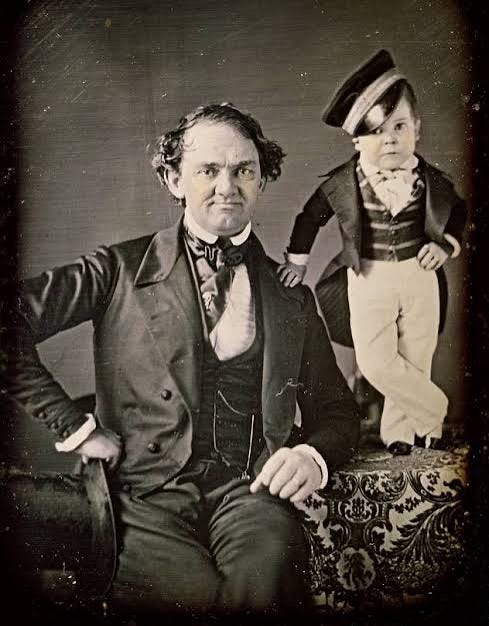
P.T. Barnum and General Tom Thumb, c. 1843.
Start with the room.
August 1835, a saloon in New York City called Niblo's Garden. A Black woman is sitting in a chair. Her name is Joice Heth. The man who has leased her body for one thousand dollars is standing nearby, collecting admission. He is twenty-five years old. His name is Phineas Taylor Barnum. She is telling stories, in a voice the papers describe as thin and strong by turns, about the infant George Washington, whom she claims to have nursed when she was a young woman more than a century earlier. She is, according to Barnum's playbills, one hundred and sixty-one years old.
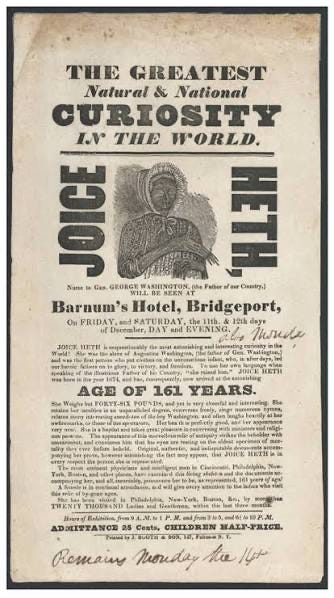
Joice Heth exhibition broadside, 1835.
She is not. She is probably about eighty. Blind, mostly paralyzed, missing most of her teeth. She has been leased, re-leased, and toured through at least three cities before Barnum found her. He did not discover her. He bought a fraud someone else had already built, and he made it bigger.
This is where American mass entertainment begins. Not in the circus tent people associate with his name. The circus came late, decades after this, when he was already old. Jumbo the elephant, the Feejee Mermaid, Tom Thumb in his tiny military uniform bowing to Queen Victoria, every image the twentieth century scrubbed clean and handed you in a biopic, all of it came later, and all of it was built on what he figured out in that room in 1835. Which was this: a paralyzed Black woman in a chair, compelled to tell bedtime stories about her supposed dead master's childhood, while a young showman at the door counts the quarters. Every popular version of Barnum begins somewhere else. Mine doesn't.
You know the version of him the twentieth century decided to hand you. The ringmaster in the red coat and top hat, the impresario, the "Greatest Showman" who discovered talent and loved his wife and sang. That Barnum is a lie, or more precisely, he is a costume stretched over the real one the way he would later stretch a fake Jumbo over a wooden frame. The actual Phineas Taylor Barnum was born in 1810 in Bethel, Connecticut, the son of a small-time innkeeper. He failed at a general store, at a lottery, and at a weekly newspaper that got him sued for libel and sent him to jail for sixty days. By the summer of 1835 he was twenty-five years old, broke, and looking for a way to convert other people's attention into money. A man named R. W. Lindsay offered to sell him a lease on an elderly enslaved woman being exhibited as the oldest living human in North America. Barnum took the deal. He had found his medium. It was her.
He would spend the next fifty-six years as the most influential entertainer in American history, and for most of that time he was not primarily a circus man. What he built first, and what actually matters, was a machine for converting public argument into ticket revenue, and he built it on her body. The rest of this essay is what he did with the blueprint.
When attendance flagged, Barnum planted a letter in a Boston paper under a pseudonym, claiming that Joice Heth was not a person at all. He wrote that she was an elaborate automaton made of whalebone, India rubber, and numberless springs, operated by a hidden ventriloquist. He wrote this about a woman sitting alive in a chair a few blocks away. Attendance went back up. People who had already seen her paid to come back and check whether they had been tricked the first time. The argument was the product. The body was incidental. He spent the rest of his life refining the trick, and the trick works because being fooled stops feeling like humiliation once you get to weigh in.
Joice Heth died in February 1836. Barnum sold tickets to her public autopsy. Fifty cents a head. Fifteen hundred people came. A surgeon named David L. Rogers opened her chest in front of the audience, and the audience watched, and when the autopsy concluded that she was probably eighty and not one hundred and sixty-one, Barnum planted another newspaper article claiming the wrong body had been cut and that the real Joice Heth was alive and well and about to go back on tour.
I want you to sit with the sentence I just wrote. He sold tickets to a Black woman's autopsy. He then sold the newspaper story that the autopsy had been a hoax. Her body was his product alive, dying, and dead, and the argument about which dead body was actually hers was a product too. He did not invent the American entertainment industry. He perfected it on her. Everything that comes after, the mermaid and the museum and the elephant and the operating logic of every screen you have ever looked at, runs on the software he built in that room.
Seven years later he leased the Feejee Mermaid from a Boston showman named Moses Kimball and took everything he had learned from Joice Heth and built it into a machine. The mermaid was ugly. Not endearingly ugly, actually ugly. A dead monkey's shriveled face grafted to a dried fish tail with visible stitching, the whole thing about eighteen inches long. It looked like something a witch would keep in a jar. Anyone who looked at it could see it was a monkey's torso sewn to a fish's tail. That was not the problem. That was the point.
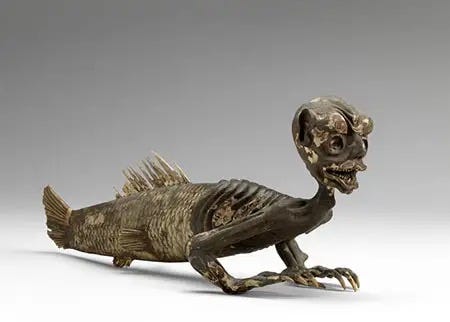
The Feejee Mermaid, exhibited by Barnum beginning in 1842.
Barnum invented a British naturalist named Dr. Griffin, who had supposedly authenticated the specimen. He hired an accomplice to pose as Griffin. He wrote pseudonymous letters to himself and planted them in New York papers as if they had come from correspondents in three different states, and spent the summer of 1842 staging a public debate about the mermaid's provenance before the object was ever displayed. By the time it went on view at the American Museum in July 1842, the New York public had been arguing about it for weeks. Admissions tripled. People paid to see the thing they already knew was a monkey. They paid to participate in the adjudication. They paid to feel like experts. They paid to disagree with their friend on the walk home and to keep disagreeing about it over dinner.
What he really invented was subtle. A hoax, before Barnum, was a hoax. You were either fooled or you were not, and being fooled was humiliating. Barnum decoupled the transaction. He made the audience a co-author of the uncertainty. You did not pay to see the mermaid. You paid to have an opinion about the mermaid. That is a completely different product, and it is the product the entire attention economy has been selling ever since. Every reality television reunion, every is-she-lip-syncing TikTok comment section, every "wait is this AI" thread at two in the morning, every Reddit post asking whether a celebrity couple is actually together, is running on the Feejee Mermaid model. The object is almost beside the point. The argument is the thing you bought.
Neil Harris called this the operational aesthetic, the shift from is-it-beautiful to how-does-it-work. He got half of it in a book. Barnum got all of it in 1835 and did not need to write it down. The half Harris missed is how-do-I-feel-about-whether-it-works. A question with no answer is a question people will pay to keep asking, and the question is what Barnum had in inventory. The mermaid was just where he kept it.
By 1842 Barnum owned the American Museum at Broadway and Ann Street, and for the next twenty-three years it was the most visited building in North America. Five floors. At peak, fifteen thousand people a day.
Imagine the heat of it. Gaslight eats oxygen and there were hundreds of gas jets burning at once. Now add fifteen thousand bodies. The smell was animal, sweat, formaldehyde, and whatever the whale tank was doing by late afternoon. A brass band was playing somewhere. A barker worked the landing. Kids were screaming at the flea circus. No seating. No clear path. The stairways dumped you back out onto galleries you had already walked, and the crowd behind you would not let you stop moving even if you wanted to. You were not supposed to think. You were supposed to keep walking and keep spending. By the time you stumbled back out onto Broadway, blinking in the sun, you had not toured a museum. You had been processed by one. And you were going to come back next week.
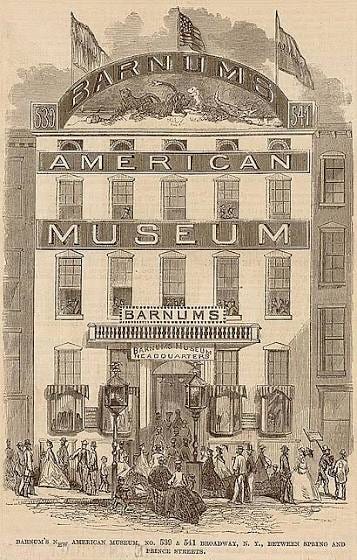
Barnum’s American Museum, New York, c. 1850s.
On the ground floor, wax figures of recent murderers, freshly modeled while the trials were still in the news. Up a flight, taxidermied elephants, a beluga whale in a freshwater tank (one of the first kept in captivity anywhere, the animal died within weeks, Barnum replaced it, the second one died, he replaced that one too), the Feejee Mermaid behind glass.
Higher up, the living bodies. Tom Thumb in a miniature military uniform. Chang and Eng Bunker, the conjoined twins from Siam whose name would become an American slur. Madame Josephine Clofullia, the bearded lady, whom Barnum paid a man to sue for being a man in a dress, so the marketing was the trial. An industrious flea circus. Magic acts. Dioramas of biblical scenes. An aquarium. A lecture hall where ministers preached temperance between the sideshows. Eight hundred and fifty thousand objects, by his own advertising. Almost none of them curated in any sense that Charles Willson Peale a generation earlier would have recognized. The organizing principle was that the visitor should not be able to stop moving.
The museum burned to the ground in 1865. Barnum rebuilt it within months. It burned again in 1868. He did not rebuild a third time. He went on the road with the circus instead, which is how most Americans now remember him, and which is the least interesting thing he ever did. The circus was a franchise built on a model the museum had already proven. Every department store with a Santa on the top floor, every Disneyland, every Instagram selfie museum made of pink clouds and ball pits, every aquarium with a touch-tank and a gift shop, is a descendant of the American Museum. The model is not "exhibit." The model is "keep them moving, keep them surprised, do not let them sit down long enough to ask whether any of this makes sense."
Here I want to give him his due, because the essay has been calling him a monster and he was that, but not only that. Barnum invented modern advance publicity, and the whole architecture of manufactured demand that every studio press cycle and product launch still runs on is his blueprint. His 1855 autobiography sold more copies in the nineteenth century than any American book except Uncle Tom's Cabin, and it is, if you sit down with it, very funny. He toured for free on temperance and meant it. As mayor of Bridgeport he built the city's water system and refused streetcar bribes at a moment when refusing bribes was not standard mayoral practice. The American Museum let a working-class visitor and a wealthy visitor share a building for twenty-five cents, at a moment when almost every other American cultural institution was actively sorting audiences by class. He gave a public stage to people no other stage in the country would have given them. Some of them used it. Some were destroyed by it. He did not distinguish between the two, and did not think he needed to. The credit is real. The refusal to distinguish is what the rest of this essay is about.
In 1882 he went international. The Zoological Society of London, facing financial pressure, agreed to sell him their African bush elephant for ten thousand dollars. The elephant's name was Jumbo, a word that did not exist in English before this animal and which now does because of him. The British public lost its collective mind. One hundred thousand British schoolchildren wrote personally to Queen Victoria begging her to stop the sale. That is not a figure of speech. A hundred thousand actual letters, written by actual children, delivered to Buckingham Palace, on the political priority of a single elephant. The Queen herself privately objected. John Ruskin published a complaint in The Morning Post. Fellows of the Zoological Society filed suit in chancery to block the transfer. The press coverage lasted for months in both countries, and every word of it was free advertising for an elephant that most people had already seen at the London Zoo for a shilling and would now be asked to see again for twenty-five cents in New Jersey.
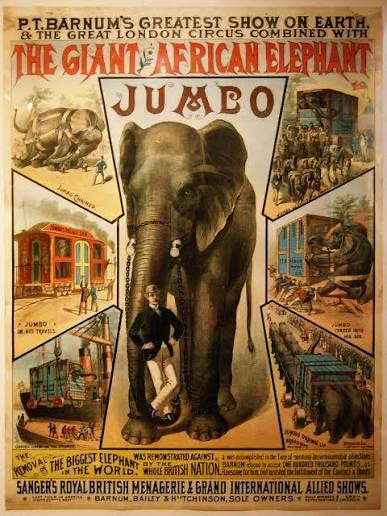
Jumbo promotional poster, c. 1882.
Jumbo arrived in New York in April 1882 to a parade. He toured for three years. In September 1885, in a rail yard in St. Thomas, Ontario, Jumbo was struck by an unscheduled freight train and killed. Barnum told reporters that Jumbo had died heroically pushing a smaller elephant off the tracks, which was a lie. He had the body skinned and the skeleton mounted. Then he had the skin stretched over a wooden armature to create a taxidermied replica of the elephant, and he toured the skeleton and the replica together, advertising them as "double Jumbo," because one corpse was not enough content. The hide eventually went to Tufts University, where Jumbo became the school mascot, and where the hide burned in a building fire in 1975. The tail survived. It is in the Tufts archives. You can make an appointment to see it.
I think about this more than is healthy. The animal became the merchandise became the martyr became the replica became the mascot became the object in the archive became the object in this essay. At every stage the thing being sold is the mourning. The audience is not buying the elephant, the audience is buying the feeling of having lost the elephant, which is a feeling Barnum manufactured and sold them in the first place. This is the template for every celebrity death cycle of the last hundred and forty years. You can watch it play out in real time on any given Tuesday.
He ran for Congress and lost, served in the Connecticut state legislature, and ended up mayor of Bridgeport. In 1865, from the floor of that legislature, he gave a speech in favor of the Thirteenth Amendment and the enfranchisement of Black men in his state, and the speech, if you read it, is moving. He said that a human soul is not to be trifled with, that it may inhabit the body of a Chinaman or a Turk or an Arab or a Hottentot, and that it is still an immortal spirit. He said it in public, for the record, at a moment when saying it cost him politically within his own party. He meant it.
He also, thirty years earlier, sold tickets to Joice Heth's autopsy.
This is one Barnum, one machine, and the machine is the reason both sentences are true. The machine he built in 1835 did not care what you felt about the Black woman in the chair. It only cared that you felt something, and that the something was strong enough to make you pay. In 1835, with an enslaved woman in a chair and a market that told you she was an object, the feeling for sale was wonder, skepticism, the cool thrill of deciding whether the object was real. By 1865 the Union was winning and the political weather had turned, and what sold instead was moral clarity. He was the same man running the same machine, reading the room, giving the crowd the version of the Black body they were now willing to pay to feel something about. Thirty years apart, the same instinct for what an audience wanted, applied to the same woman's body and then to the memory of it.
Maybe the final and most lasting thing Barnum taught American culture is not hypocrisy. Something worse. The habit of treating political virtue and political exploitation as two products on the same shelf, sold to the same customer, priced according to demand. The national talent for loving a man while knowing exactly what he was built on, for holding a showman as both monstrous and beloved without registering the contradiction, was not invented by social media or cable news. It was invented in 1835 by a broke twenty-five-year-old who realized uncertainty was the most stable product you could sell, and who spent the next fifty-six years refining the formula until he died rich and was memorialized as an American treasure.
I want you to take the device out of your pocket. The one you have been reading this on. Today it has already surfaced at least three arguments to you about whether something is real: whether a video is AI, whether a death was staged, whether the conflict you are watching is happening or being performed for the camera. That device is running the operating system Barnum installed in 1835. You did not pay twenty-five cents. You paid with your attention, which turns out to be a more expensive currency than he could have imagined, and you pay it every day, and you pay it again when you close this essay and open the next tab, which will be the argument.
The mermaid is in your pocket. She has been there the whole time.
You already paid. You are still paying. The show has not closed. That was never the point.
No posts
Comments
Nothing yet. Say the first thing.
Sign in to join the conversation.