
You have walked past this case. Six feet of oak veneer in a library lobby, two bays behind sliding glass that sticks, one glass shelf running across the middle. Two recessed bulbs in the top deck, aimed straight down, never adjusted since the day they went in. You did not stop, and you could not name one object inside it, and you were there eleven days ago.
I want to build one of these badly, on purpose, because I have built one badly by accident and it is easier to admit in the hypothetical.
The subject is the local high school, 1925 to 1965. That sounds like the easiest assignment in the building and it is not, because everyone reading this went to one. Familiarity does something strange to attention. The high school might be the most looked at and least seen building in America.
Top shelf. The panoramic class photo, matted, upright against the back wall. Two principals in oval frames, flanking, both of them looking like men who owned a paddle. A wool letterman sweater on a slant board with the chenille letter facing out. A graduation program with an engraved cover, because the twentieth century could not hand a teenager a piece of paper without putting a laurel wreath on it.
Lower shelf: two yearbooks open to spreads, a mimeographed newsletter, and two pages from the attendance register on angled cradles, tilted toward the viewer, lit and legible.
Every object in that case is mounted correctly. The cradles are right and the paper is not lying flat catching the downlight and reading as a blank. I want to be clear about that, because the interesting failure is not the one where somebody skipped a cradle. Skipping a cradle is an error you can see and fix in an afternoon. What I am describing is a case where the installation is clean and the thing still does not work.
Here is the part that fails. A case gets read with the body rather than the eyes alone, and this one ends halfway up.
The eye enters at whatever is loudest. Loudest is not the same as most important, and it is frequently not what you would have chosen. Everything in the case is grayscale paper except a wool sweater in two saturated colors with a felt letter stitched to the chest, and the sweater is also the only object in there shaped like a person instead of a rectangle. So the sweater is where the eye enters. Months in the boxes and the case opens on a teenage boy's chest. That is not a problem if I meant it. I am less sure I meant it.
From there the eye slides along the top shelf, following the mass and the light, until it reaches the glass shelf and stops. A horizontal line across a vertical field behaves like a period. Most visitors read it as the end of the thought and start looking for the way out. That is not laziness so much as a reasonable inference from the way the case is built.
Below that line, cradled and lit, is the attendance register.
The panoramic tells me a hundred and forty kids existed, which I already assumed. The register tells me one of them was marked present every day through February 1931 and withdrawn in March, with a note in the margin that she was working. Fifteen years old, in the handwriting of whoever kept attendance that spring. That is the show. It is angled at the perfect reading pitch below a shelf line that nobody crosses.
This is what I think people mean, or should mean, when they say a case is not working. Not that something is installed wrong. That the case has a top half and a bottom half and only one of them is in the exhibition.
Fixing it is not a mounting problem, so the mount vocabulary does not help. What the lower shelf needs is a reason for the eye to make the trip, and there are two ways to give it one.
The cheat is to move the sweater down. Loudest object below the shelf line, eye travels, problem gone. Except the sweater belongs upstairs with the class photo and the ceremonial material, so I would be tearing a hole in my own organization to patch a visual one. Anyone reading the labels would feel the case stop making sense without being able to name why, which I think is worse than being caught. It stops being curation somewhere around there and becomes merchandising.
The better version means going back into the boxes, and it is usually in there, because school records are lousy with printed ephemera. A homecoming poster. Two colors, letters six inches high, built to be read from the far end of a hallway by a sixteen year old walking fast. Loud enough to pull the eye down, and from the same years as the register pages sitting beside it.
With the poster upright on the lower shelf the case starts working. The eye crosses the shelf line because something down there earned the trip, and the register is already cradled and lit and waiting, so somebody might stop long enough to read a line of it. Nothing in the organization had to bend.
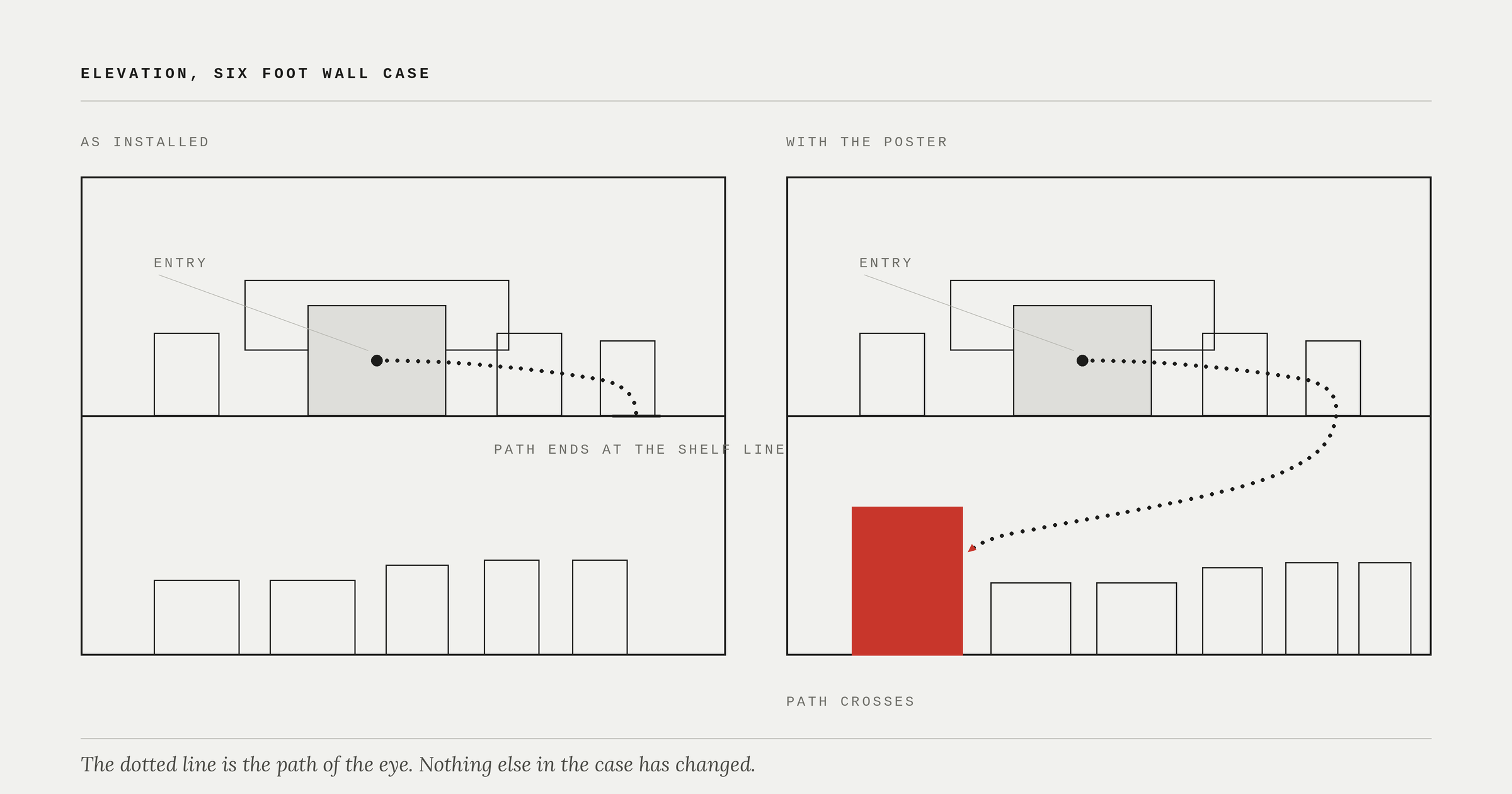
Worth noticing what that means. The case did not fail at the vitrine. It failed three weeks earlier at a table covered in material, when I decided what was worth the space and stopped looking. Every mount was correct because mounts are the part you can check. Selection is the part nobody can check, including me, because the object that would have fixed it was in a box in the next room the entire time.
That seems to be the test, or the closest thing to one I have.
Composition and argument wanting the same object.
When they disagree I am choosing between a pretty case that lies and an honest case nobody reads. That is a real trade, and it is why a good case is harder than a tidy one.
The display case is the smallest version of the problem. Scale it up and the same question follows you through every gallery you will ever stand in.
Everything I just described assumed one person controlling every variable. One collection and one afternoon to move a poster from a box to a shelf. Museums are not that. An exhibition in an actual institution is the output of five or six people with different jobs and legitimately different objectives, working inside constraints that were set before any of them read a single document. The reason exhibitions look the way they do is mostly not taste. It is the shape of what was possible.
Start with what is even available to put in the case. That was never a curatorial decision. The collection is what somebody kept, then what somebody donated, then what somebody at the institution agreed to accept. Every one of those filters is unevenly applied. Wedding dresses survive at a rate that has nothing to do with how often women got married and everything to do with the fact that a wedding dress gets stored in tissue and a work dress gets worn until it becomes rags and then becomes a rug. The rich are overrepresented in every collection in this country because their possessions were made well enough to last and because their descendants had attics rather than moves. When you look at a case about domestic life in 1840 you are looking at the survivorship pattern of American storage, filtered through a hundred years of accessioning decisions made by people who thought some things were worth a number and other things were trash.
So before a curator makes a single choice, the argument has already been narrowed to what somebody else decided to keep. Half the interpretive work in a good exhibition is figuring out what is missing and finding a way to say so with objects that are present, which is roughly like proving a negative using only nouns.
Then conservation constrains what can go out, and this one genuinely surprises people. Light damage is cumulative and it does not reverse, so institutions track exposure as an annual budget rather than a moment in time. Textiles and works on paper and anything carrying an organic colorant go out at very low levels and then rest in the dark for long stretches. That is why a quilt is up for three months and then back in a box for years, and why the object you traveled to see is a facsimile with a small apologetic line at the bottom of the label. Nobody is hiding it from you. Somebody calculated what another six months would cost and decided against it. The exact numbers vary by institution, but the principle holds everywhere: the most fragile object in the collection is usually the one that carries the most information, and displaying it consumes it.
Money constrains what can be borrowed. An object on loan comes with an insurance valuation, a facility report proving your building holds temperature and humidity within stated ranges, frequently a courier who flies with the crate and watches the unpacking, and a contract that specifies exactly how it may be lit and for how long. One borrowed object can cost more than every other object in the gallery combined. This is why regional museums build shows from their own holdings and why the same familiar objects keep crossing the country in crates. It is also why the phrase "from the collection of" on a label is doing more work than it appears to.
Then the committee. An exhibition team usually includes a curator who wants the argument, a registrar who wants the objects to survive the year, a designer who wants the space to read at a distance, an educator who wants the fourth graders to have something to do, and someone from development who has to keep a funder happy. Each of those people is right. The registrar is not being obstructive when she says the sweater cannot be pinned, and the educator is not dumbing anything down when she says sixty words is the ceiling for a label a nine year old is expected to finish. What comes out of that room is a negotiated document. That is most of why museum wall text sounds the way it does, which is to say like a very kind person carefully describing a stranger's dream. It is not that nobody there can write. The sentence had to survive five people, and the sentences that survive committee are the ones with nothing sharp on them.
Label length is its own quiet tyranny. Visitors do not read. That is not contempt, it is measurement, and it has been documented repeatedly since the seventies. People move through galleries faster than anyone designing them wants to believe, and they stop at a small fraction of what is on offer. When they do stop, the attention lasts seconds rather than minutes. So interpretation gets budgeted like currency. Fifty to seventy five words on an object label, a couple hundred on a section panel, and everything you know that will not fit goes into a catalogue essay four people will read or into your head where it stays. The curator standing in the gallery on opening night knows nine hundred things about the register page. The visitor gets sixty words. Choosing which sixty is the actual job, and it is closer to writing a poem than writing a paper.
And then there is the part nobody puts in the training. Donors have opinions about how their grandmother's things get displayed, and boards have opinions about which decades are appropriate to dwell on. There is no board in this country that wants a case about the year the mill closed. Every one of them wants a case about the year the mill opened. Institutions in small towns exhibit the history of people whose grandchildren still sit on that board, which shapes what gets said about the closing and about who owned the place. This is not corruption, particularly. It is proximity. But the interpretive range of a local historical society is narrower than its collection, and the gaps are usually not accidents.
All of which produces a strange object. An exhibition is the residue of every constraint I just listed, and it arrives in front of the visitor looking like a confident statement about the past. The visitor cannot see the loan that fell through or the sentence that got softened in the third review. They certainly cannot see the object that was never donated, because the family did not think a work apron was worth saving. They see a case that appears to say: this is what mattered.
The authority is structural.
It comes from the vitrine and the mat and the institutional letterhead, and it accrues to whatever survived the process, which is not the same as whatever was most true.
This is the thing I want people outside the field to understand, because it changes how you look at every museum you will ever enter. The gaps in an exhibition are rarely arguments. They are usually the shape of what survived, plus what the institution could afford to say in this town. Reading a case well means reading the constraints alongside the objects, and once you can do it you cannot stop.
None of this work shows. That is the strange part of the profession and possibly the reason it pays what it pays. Correct mounts are invisible by design. Composition is invisible when it succeeds and only becomes visible as a vague sense of boredom when it fails, and vague boredom does not generate a complaint anyone can act on. The negotiation, the loan that collapsed in February, the four hours spent getting a label from ninety words to sixty without losing the girl, none of it leaves a trace on the gallery floor. So the case sits there for the better part of a year being technically flawless and half unread, and nobody files a report, because there is nothing to report.
Nobody leaves a good case thinking about hierarchy. They leave thinking about a fifteen year old who did not come back after March.
All of which is available to anyone with a vitrine and the willingness to walk to the other side of the room. Stand where the visitor stands, at their height, with the glass shut, and watch where your eye quits. If it quits at the shelf line, the bottom half is not underperforming. It is not in the exhibition.
You have walked past this case. So did everyone else who came in that day. There is a register page in it with a girl's name on it, cradled at the correct angle, lit to standard, unread.
No posts
Comments
Nothing yet. Say the first thing.
Sign in to join the conversation.