

Perhaps the most historically significant aspect of Saturday’s assassination attempt—the third, or fourth, depending on how one counts—is that if I were to wait a few days to think about the event and, more critically, its narrative aftermath, most readers would have forgotten it happened. If they ever knew. Poke around on social media and you quickly find a strange performance of disinterest—posters declaring they couldn’t care less, they were watching something else last night, they were “being normal.”
They’re not wrong. So many pundits who’ve been normalizing Trump for years, for a decade now, are returning to our screens to mournfully declare that they were there, that we must never “normalize political violence.” But we have; it is normal now, the perpetual violence of the Trumpocene’s meaningless spectacle, the administration’s boat strike snuff flicks and invasions, the on-screen ICE murders and those we don’t see, the incomprehensible death-by-DOGE off-camera of hundreds of thousands in the poorest countries. And just as normal now are the many methods by which we turn away from “political violence” (which might more plainly be called just “violence”), or turn it into a joke, or tell ourselves that its very meaninglessness is paradoxical proof that “we are going to win.”
Win what? To even frame the struggle for a democracy we’ve yet to achieve in such terms grants too much to Trumpism’s dull reduction of life to a wrestling match, minus the fun costumes. Democracy isn’t a game you win; it’s something you do.
Or, you don’t. The 31-year-old shooter, Cole Allen, wrote a manifesto outlining the logic by which he concluded that murder makes more sense. It’s remarkable largely for how ordinary it is. Allen begins with apologies to family, friends, and those who in his travels with his guns he may have inadvertently put at risk. He states his conscious motive in familiar terms: “And I am no longer willing to permit a pedophile, rapist, and traitor to coat my hands with his crimes.” He lists his rationale — that is, his justifications — for his targets, declaring himself determined to avoid harming others.* Then he proceeds to a sort of Q&A series of five “objections,” his rebuttals to which all boil down to the same perverse pragmatism abortion clinic bombers have often cited to justify murder for the sake of life.
Trump and his legions have declared the manifesto anti-Christian. “He hates Christians. A hatred,” Trump told Fox. That positions Trump, as Allen’s target, as a defender of the faith. It also fits in the paradigm outlined in Trump’s National Security Presidential Memo on domestic threats, which cites “anti-Christianity” as an indicator of terror. If you’re a terrorist, you must be anti-Christian. If you’re anti-Christian, you may be a terrorist. To oppose Trump is to oppose God.
Trump set that as the narrative frame before the public had seen the manifesto. In it, Allen, said to have been part of a Christian fellowship at Cal Tech, thanks his “church family” and justifies himself in Christian terms akin to those used by Pete Hegseth and J.D. Vance to justify war against Iran.
Objection 1: As a Christian, you should turn the other cheek.
Rebuttal: Turning the other cheek is for when you yourself are oppressed. I’m not the person raped in a detention camp. I’m not the fisherman executed without trial. I’m not a schoolkid blown up or a child starved or a teenage girl abused by the many criminals in this administration.
Turning the other cheek when *someone else* is oppressed is not Christian behavior; it is complicity in the oppressor’s crimes.
To Allen, to refrain from violence would be the un-Christian act. Likewise, his invocation of rule of law is rooted in Christian apologetics, citing a variation of a verse that appears in Matthew, Mark, and Luke:
Objection 5: Yield unto Caesar what is Caesar’s.
Rebuttal: The United States of America are ruled by the law, not by any one or several people. In so far as representatives and judges do not follow the law, no one is required to yield them anything so unlawfully ordered.
Versions of both these arguments have been used by Christian militants to defend attacks on abortion providers.
This is not to say that Allen should be viewed as a Christian nationalist. He’s not. His social media, largely comprised of reposts of popular liberal and left accounts, makes clear that but for decision to turn to murder his politics wouldn’t be worthy of remark. He is not representative of those politics; just the opposite. He is, to date, the only one of the tens of millions who hold such politics to have attempted to assassinate Trump. He is an ugly aberration.
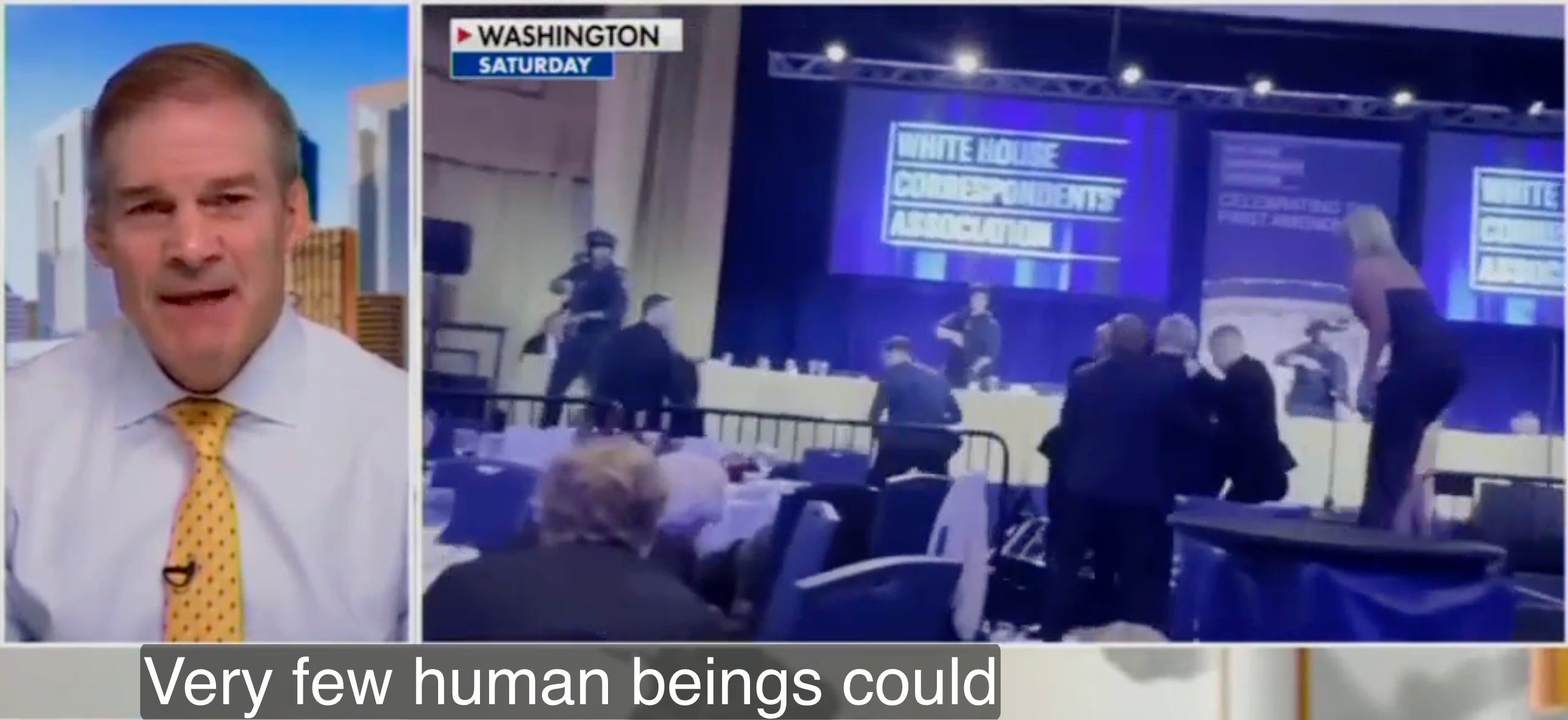
But to MAGA, he’s an opportunity. Predictably, they’ve declared him a standard bearer of the Democratic Party. Also predictably, but more intriguingly in terms of the ongoing deification of Trump, they’re using the event to shore up their man against internal division, against the defectors declaring the king demented. Here’s Rep. Jim Jordan on Fox News, declaring that “very few human beings” could have responded as Trump did — that is, duck and leave in the care of armed protectors. Jim Jordan, presumably, would have just fainted?
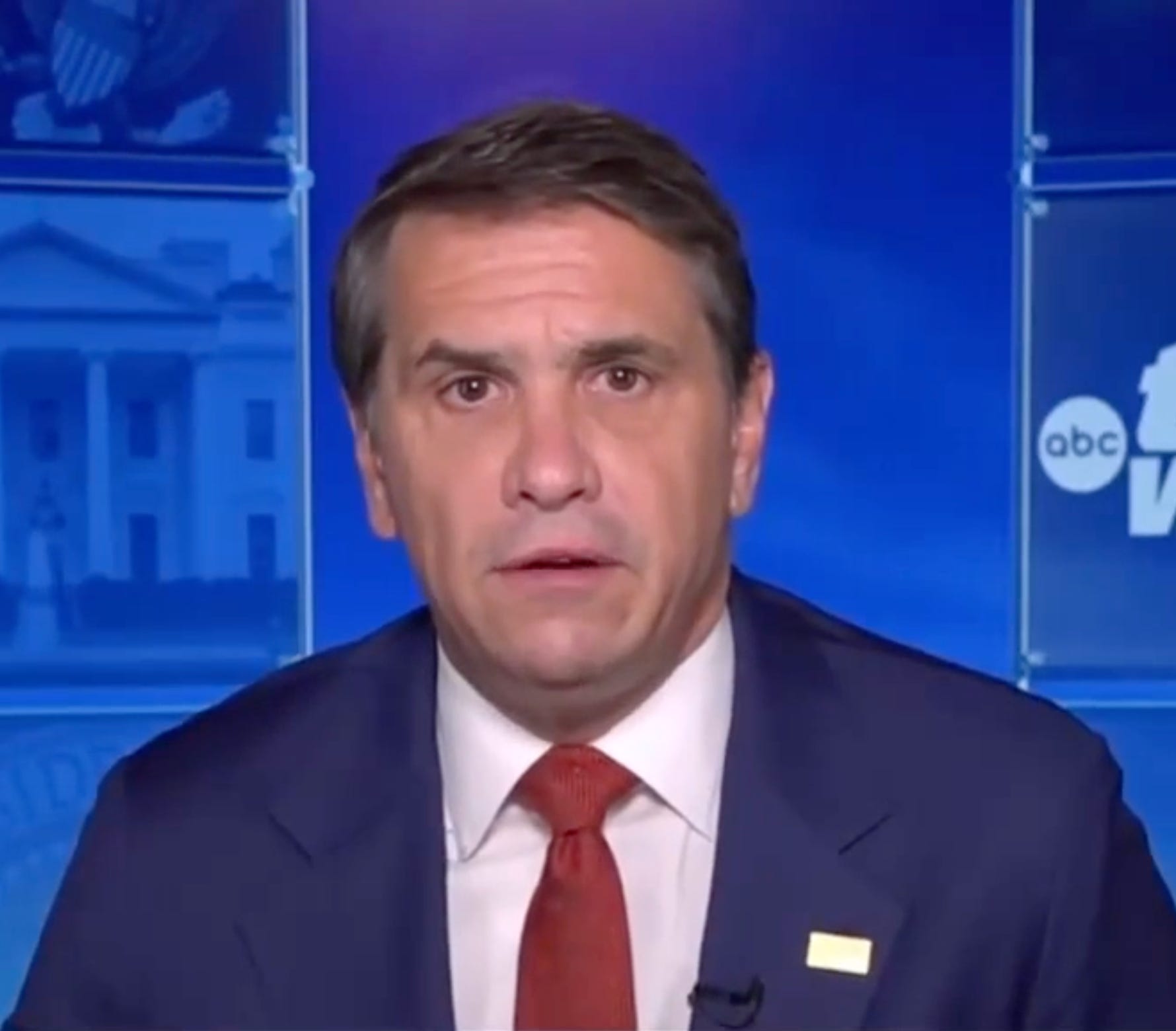
And here’s Acting Attorney-General and former Trump personal lawyer Todd Blanche looking pained as he takes to ABC to make the case that Trump has treated worse than any other president. “There is something unique about threats against President Trump.” Presidents Lincoln, Garfield, McKinley, Theodore Roosevelt, Kennedy, and Reagan, in particular, might disagree. From Blanche’s expression, I’m guessing he knows that much history, too. Just doing his job.
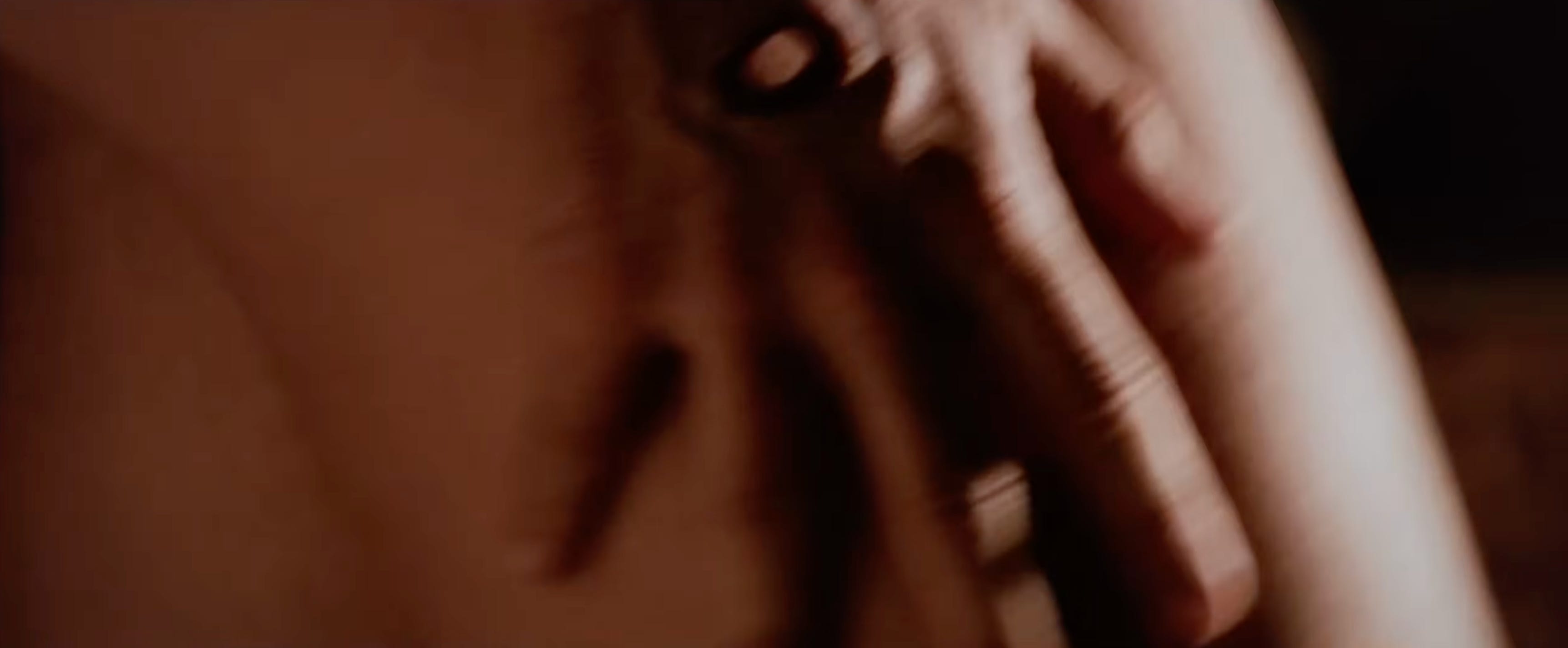
The job, here, is portray Trump as persecuted and imperturbable. “They keep trying to kill him!” declares one X user; “They can’t kill him!” exults another. “That poor man!” laments a MAGA sympathizer. “Hard as a rock,” trills another. Sandhya Dirks, my Dartmouth College colleague and a past contributor to this newsletter, puts the formula succinctly: “Victory over victimhood.” If this sounds like a dim echo of a familiar narrative, consider Christ on the cross; or, more accurately, ripped Jesus rising from the dead to a martial drumbeat at the end of Mel Gibson’s still-circulating 2004 Passion of the Christ, as seen in this clip of stigmata softcore:
“Symbolic victim but not actual one,” texted Sandhya,
since he survives. victory over victimhood while also legitimizing the victim-myth of the right. they can keep the persecuted, without ever having to be ‘weak’ -- capture the power of “victimization’ (which they did want, when they saw its power) while still getting to be superior and masters and supreme. it’s a neat trick. ‘they want him dead’ (claiming the power of victimhood) ‘he’s like a rock’ (never a victim, always superior, invincible). it also makes the other side into both the villain and the weak one, but now no longer to access any victim status ...
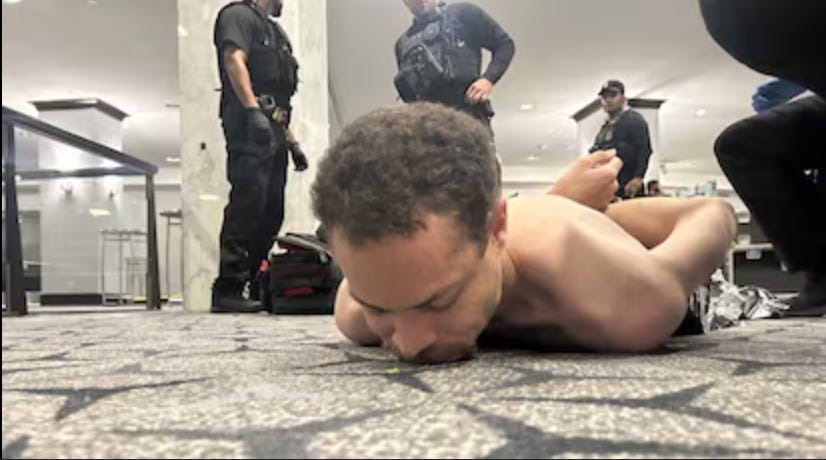
“Both the villain and the weak one” brings to mind this image quickly shared by Trump on Truth Social, Cole Allen stripped naked and appearing as if abjectly pressing himself into the carpet. Beefy cops, unthreatened by the pathetic figure, seem almost disinterested. It’s worth noting that this image—made by a photographer peering at Cole, who does not look back—has no attribution other than Trump himself. I don’t mean to suggest Trump took it; rather, it is the king’s view, the offending subject self-debased.
“The story arc of the week,” says Anthea Butler, the professor of religious history at Penn and another friend to whom I turn for her ability to read beneath the surface of fascism. Anthea confesses that when she first heard the news, her first thought was hoax; such is the meaninglessness of political event in the Trump years, the biggest insurrection since the Civil War officially rewritten by the federal government as a Democratic coup attempt. But Anthea knows Trump better than that: “He knows how to block a scene,” she says. Shots fired means story time, and this one wrapped up the arc nicely, from the Obama roast of Trump at the 2011 White House Correspondents’ Dinner through the years of his refusal to attend to what he imagined as his victorious return. Cole Allen, with his vain and idiotic last charge, gave Trump the finale he needed.
There is a racial politics to this spectacle. Or, that’s putting it too politely, in the very terms of spectacle I’d resist: Trump’s use of the photo is as racist as every one of his actions in power and before, an echo of his political “debut” via his 1989 full-page ad in the New York Times calling for the execution of Central Park Five, a group of young Black men accused of the rape of a white woman. And now a Black man in submission—not wrongly accused, but Trump, who has never acknowledged the innocence of the Central Park Five, is not one for such distinctions when it comes to race—and the surveillance camera video of the incident, “showing,” as Trump put it, “the violence of this thug that attacked the Constitution.”
“The Constitution,” by which he means himself. “L’etat, it me.” This thug, a racialized term; Cole Allen’s self-declared mixed-race identity “proof that the black vote is a monolith,” says one X poster. “A gay black liberal assassin,” says another, listing the enemy classes to which he belongs (I’ve seen nothing about his orientation), “black,” says Elon Musk’s AI, Grok, in response to quick queries regarding what to many within MAGA is the most salient detail regarding Cole Allen.
Musk himself has tweeted about the attack to his 239 million followers at least 18 times, seemingly obsessed with Allen’s race and his undergraduate education at Cal Tech. “Grad school indoctrination camps,” charges Musk, a naming of the enemy amplified on Breitbart, where the top post on the site’s account of the “woke assassin” declares “colleges have become nothing more than kook factories.” Many of the subsequent 12,000 comments pick up the theme. In rightwing circles, the problem is plain: “DEI methinks,” writes a Breitbart commenter.
Musk agrees. ”He’s not smart,” he snaps at a tweeter who mentions Allen’s masters’ degree in computer science. “He” here does a lot of work, standing in for Musk’s imagination of a racially-coded Democratic Party; like most of the Right, he sees Allen’s past support for Kamala Harris as not just evidence of his liberal politics (which it is) but as proof that there’s no sunshine between Harris, Allen, and the entire Democratic establishment. “If they’re willing to die to assassinate,” writes Musk, “imagine what they will do if they gain political power.” “He” can stand in for the all-purpose ”they,” which in the fascist imagination threatens what Musk has called “white replacement.”
The actual “Cole Allen” is as irrelevant to this narrative as are the almost any of the “facts” swirling around his name online, ranging from rightwing glee that he “identified” as a member of an enemy class, a teacher (he was apparently a part-time tutor for private company) to the certainty with which nearly every commenter on a Wall Street Journal post about the shooting insists that it was staged. To Trump and his supporters, the incident and perhaps this photo are proof that MAGA possesses, as Sandhya puts it, “all of the power, none of the weakness.” To anti-Trump conspiracists, it’s evidence of a false flag, just like Butler, PA; or, adjusted for political lens and affection for firearms, Sandy Hook. “Oscar-worthy!” If Cole Allen was really dangerous, some wonder, why aren’t the cops paying attention? “It’s almost as if when a politician’s rise is based on claiming everything is fake eventually no one will believe him," texted another close observer of fascism’s follies, his job potentially subject to Trumpist whim and thus here not named. “The Boy Who Cried Fake.”
But Cole Allen was dangerous. “Cole Allen,” the political narrative, is dangerous, a tool with which MAGA polices its internal dissenters—”I bet Tucker would have cried”—and reinforces the implicit divinity of its primary ego. But not for long! Both will likely be mostly forgotten in days. Tomorrow King Charles is coming to America! Maybe Tuesday we’ll take Cuba. The Straits will be closed this Wednesday, but victory will be restored by Thursday evening. There’ll be more Epstein disclosures, or another kerfuffle with the pope, or just a new poll, and we’ll know finally and at last that Trump is “DONE.” We may not notice, as we post the “BREAKING” news, how all-caps have crept into our language. We won’t have time. We’ll have moved onto a new outrage, a new “embarrassment,” a new picture of a bruised hand or a clip of I-can’t-believe-he-said-THAT."
Or we will have tuned out. I think of a liberal friend who acknowledges he hasn’t read the news since the election because he just can’t, and a left colleague who boasts that he hasn’t because he can—ignore it all, that is. It’s into this quickening current that both Cole Allens will disappear, along with our memory of a time when one did not have to debate how many assassination attempts the president had survived, or staged, whether it is three or four or five or even more, much like the unknowable number of wars he has ended.
Comments
Nothing yet. Say the first thing.
Sign in to join the conversation.