
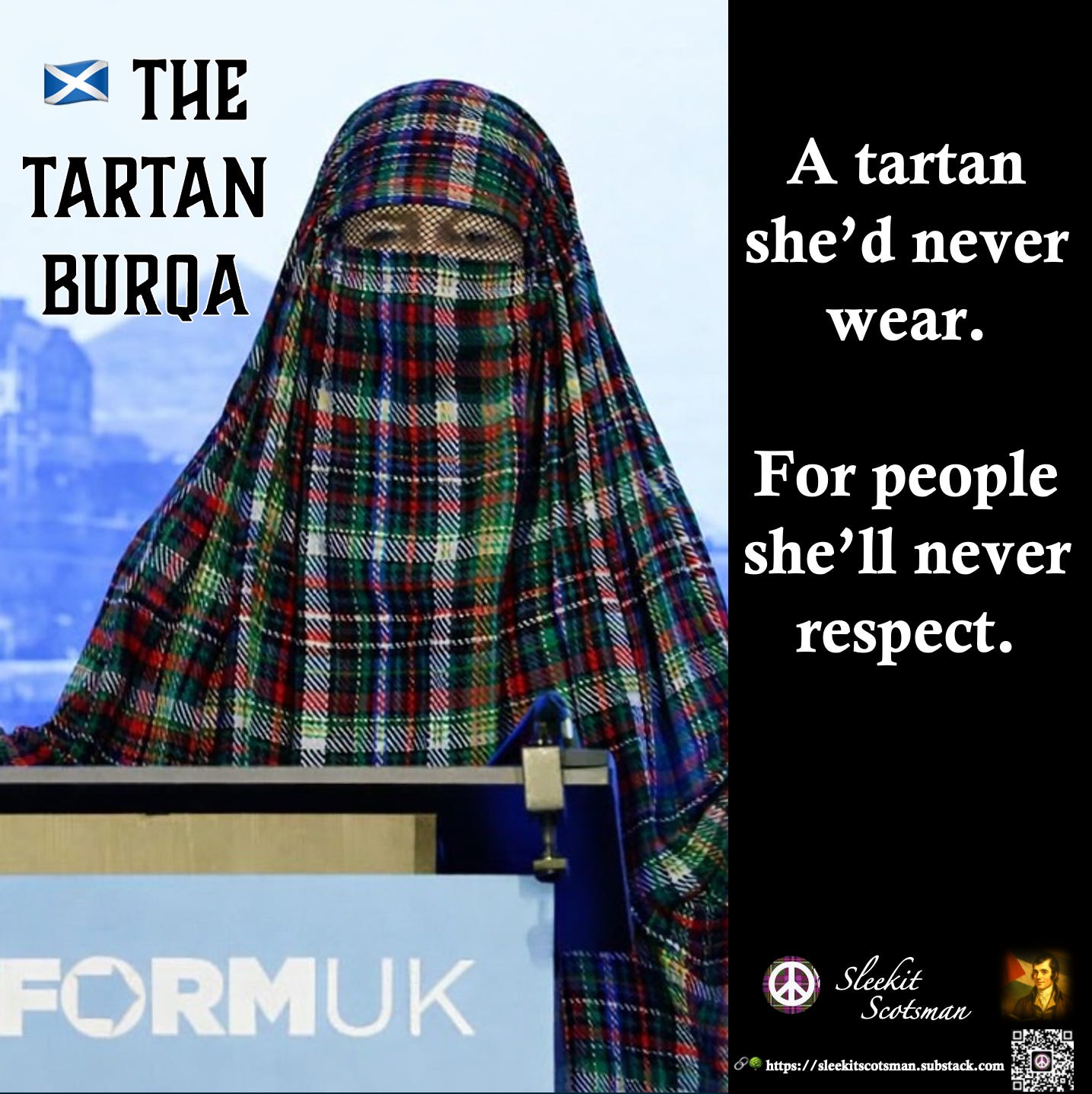
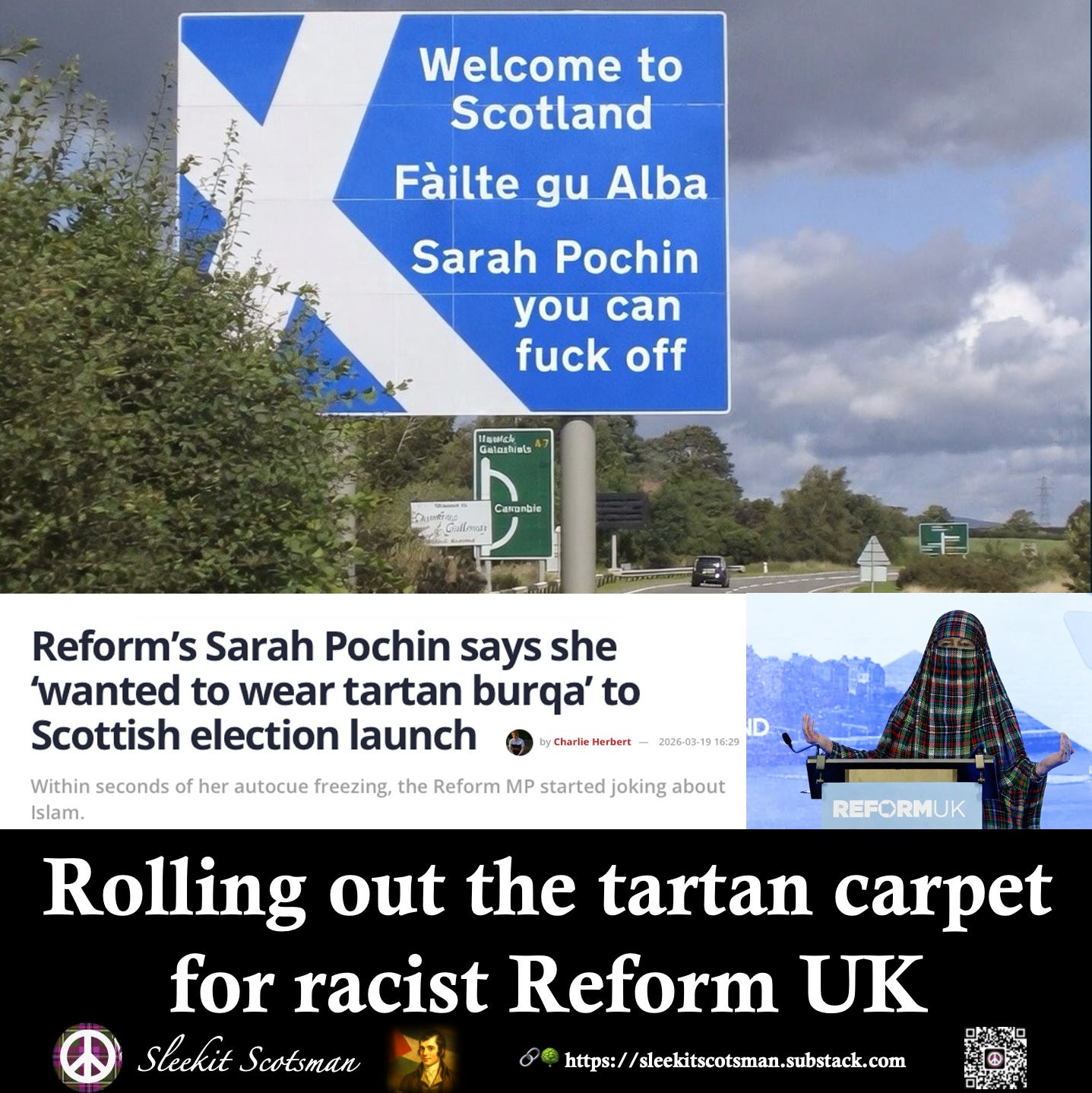
As a native kilt-wearing Scot I’m particularly proud of Scottish culture and our beloved tartans. They’re meant to be shared. But when they’re dragged into cheap political theatre, the hackles go up.
At Reform UK’s Scottish campaign launch, one MP joked she “wanted to come on in a tartan burqa.”
Throwaway racism, packaged as humour.
So I took her at her word.
Because behind the joke lies a deeper story.
Shortcut: Jump past contents to start reading main body of the article:👉 CLICK HERE
First published: 20 Mar 2026
Last Update: 22 Mar 2026 (see 🗄️Version History - Article Updates)
APPENDICES
END PAPERS
Political stunts are nothing new — but when it hits close to home, it stirs the Scottish hornet’s nest. 😡
That’s exactly what happened at Reform’s Scottish election campaign launch with party leader Nigel Farage.
Reform MP Sarah Pochin ad-libbed — or rather, revealed — a prepared line:
“I wanted to come on in a tartan burqa”
The crowd cheered.
Not at the joke - but at who the joke was about1.
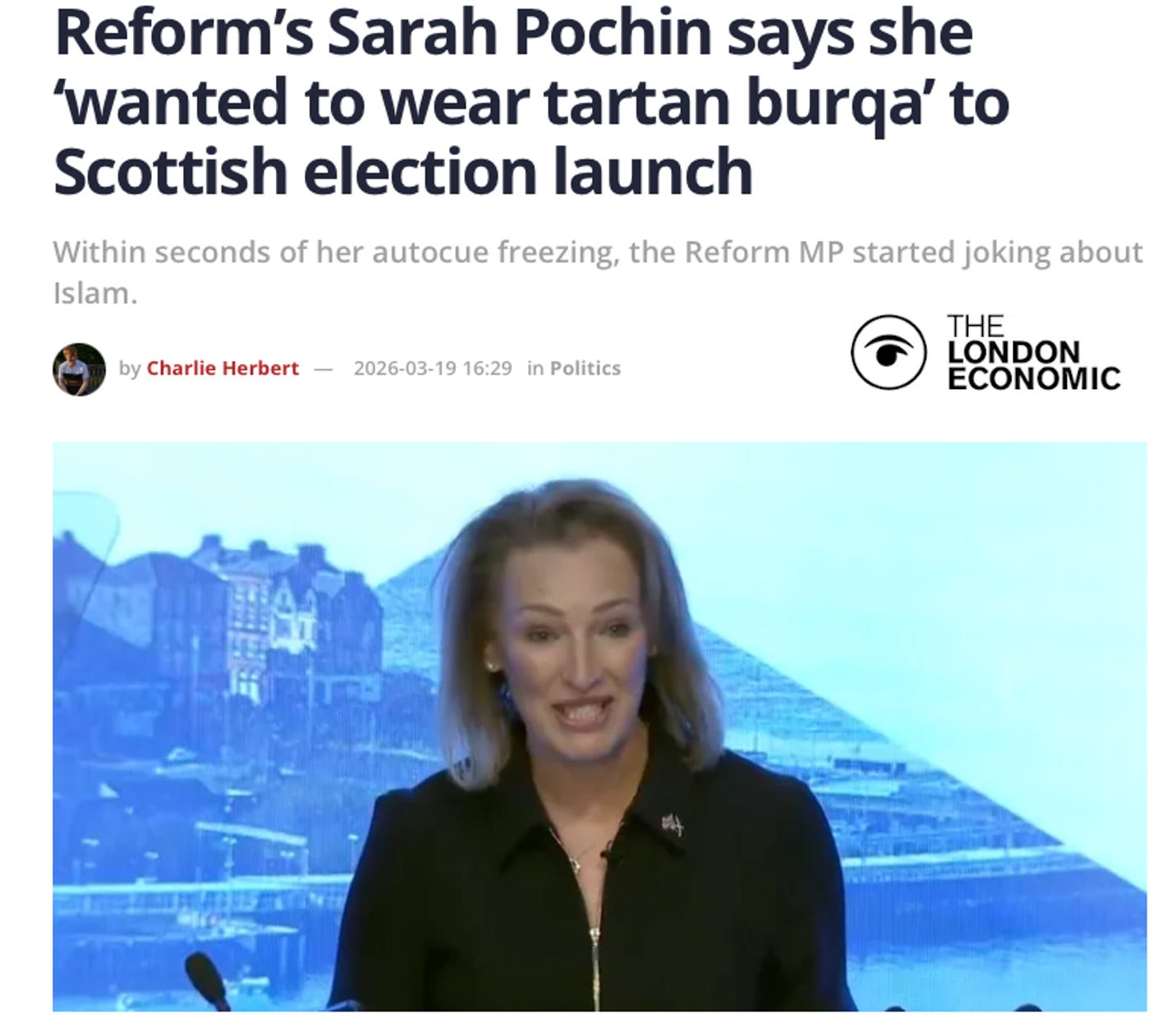
So I took her at her word.
And rendered it — using the “Spirit of Palestine” tartan.
Because behind the throwaway line is a deeper story.
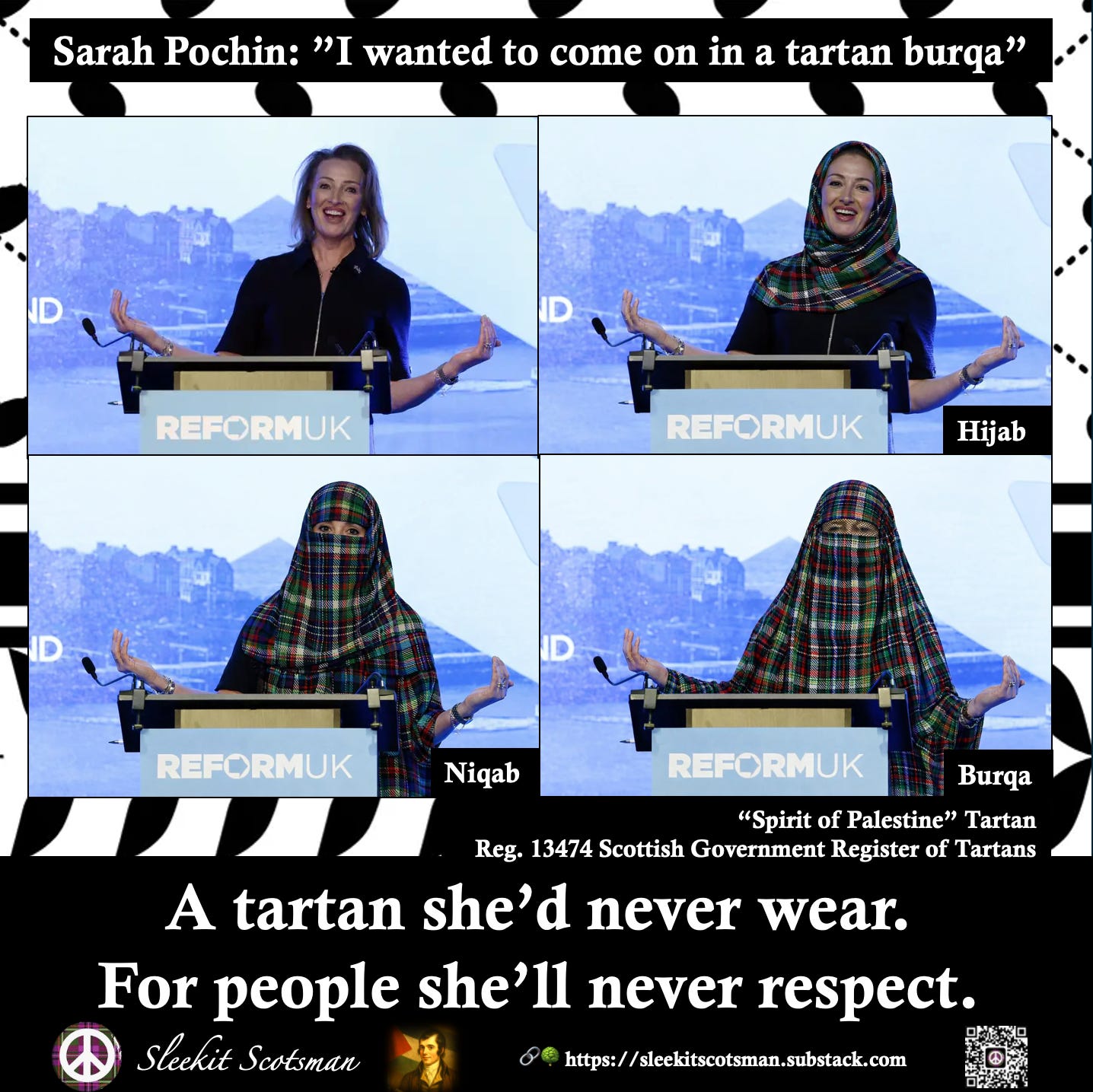
The Scottish Government maintain the official register of tartans. There are over 1000 in the register today, including a few hundred “traditional” original clan tartans - each having variations such as ancient, hunting and modern.
Within certain guidelines people can register their own tartans and I was very pleased to discover that in 2021 the wonderful “Spirit of Palestine” tartan was registered2.
It almost wasn’t.
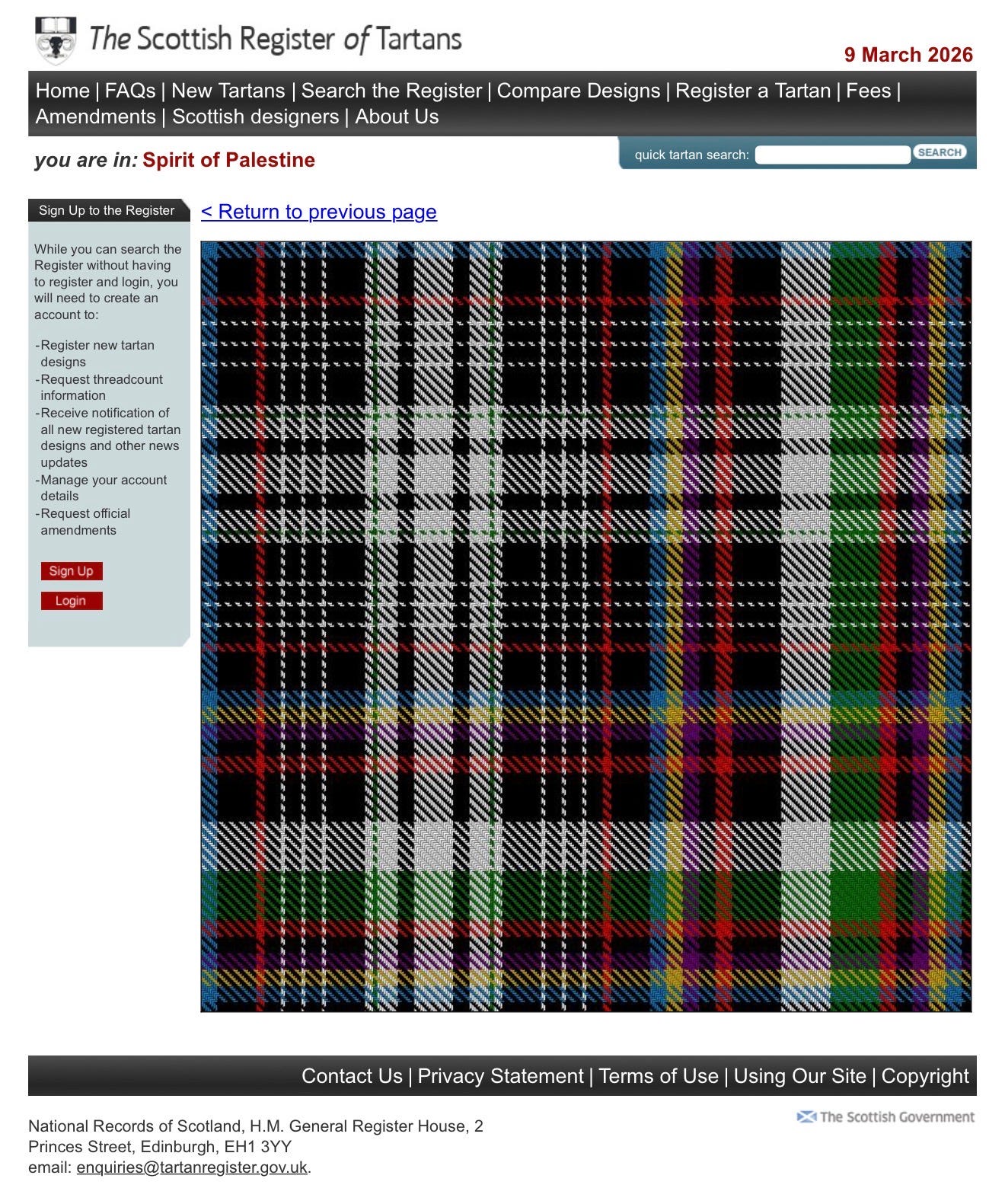
UK Lawyers for Israel objected - calling it “political” and also claimed that “Spirit of…” implied statehood3.
They filed their grievance in 2022 and with the UK Government’s recognition of the Palestinian State in 2025 their second argument does not hold water, if it ever did.
Fortunately the tartan is still registered and they still appear to be trading on the Spirit of Palestine website. With all proceeds of sale of tartan products going to charity.
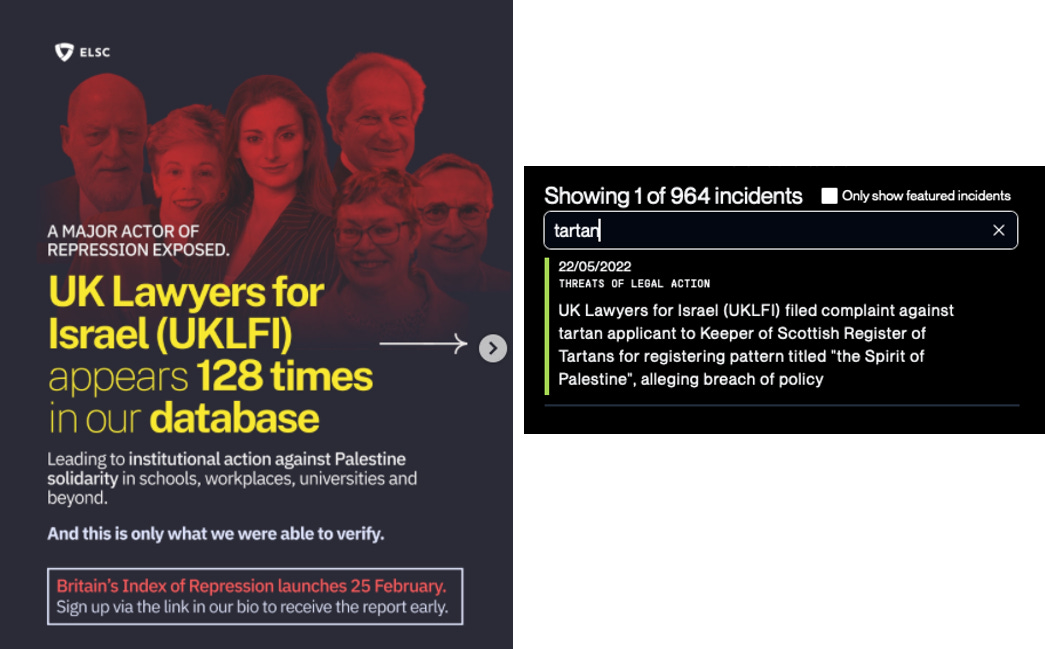
And UK Lawyers for Israel is quite rightly under investigation themselves for practicing “vexatious legal actions” designed to suppress pro-Palestinian voices4.
They appear 128 times in the European Legal Support Centre’s Index of Repression UK database including this incident.
Which I think is a case in point trying to suppress Palestinian culture.
Though it remains unclear who would weave the tartan. A mill weaving charity tartans found that they got so much grief over making a “Spirit of Ukraine” charity tartan that they decided not to produce any tartans related to the Israel/Palestine situation5.
Unfortunately that smacks of “fine for Ukraine but not for Palestine” …. which mirrors the broader political landscape in itself.
The issue of the burqa is taken up as a symbolic cultural trope to represent all Muslims as a political football by right-wing politicians globally.
Do we take up the Jewish custom of brit millah - ritual circumcision - as a trope to demonise the community? No. It is barely discussed. The day before the Reform launch the Jerusalem Post reported a 2 year old baby hospitalised with herpes after a brit millah ceremony in Israel6.
The burqa is weaponised for political reasons - as a tactic used by the right-wing to demonise a minority.
Someone to blame. If they’re immigrants, all the better.
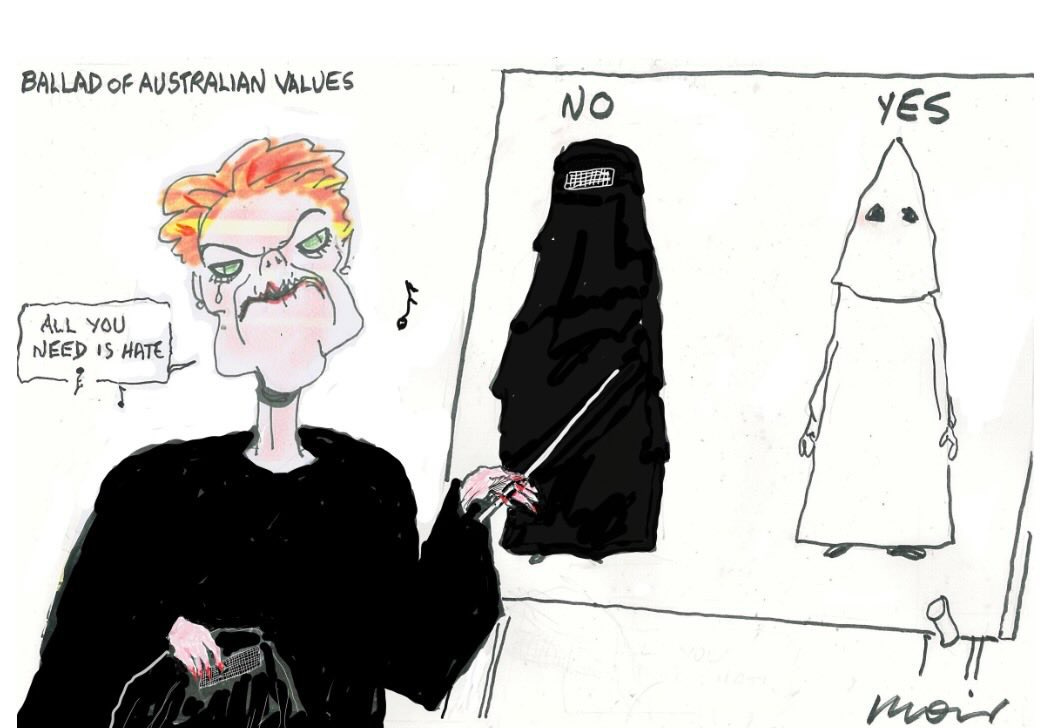
Australian far-right One Nation Senator Pauline Hanson has twice entered the Chamber wearing a full Burqa in protest at her private members bills to ban the garment being voted down.
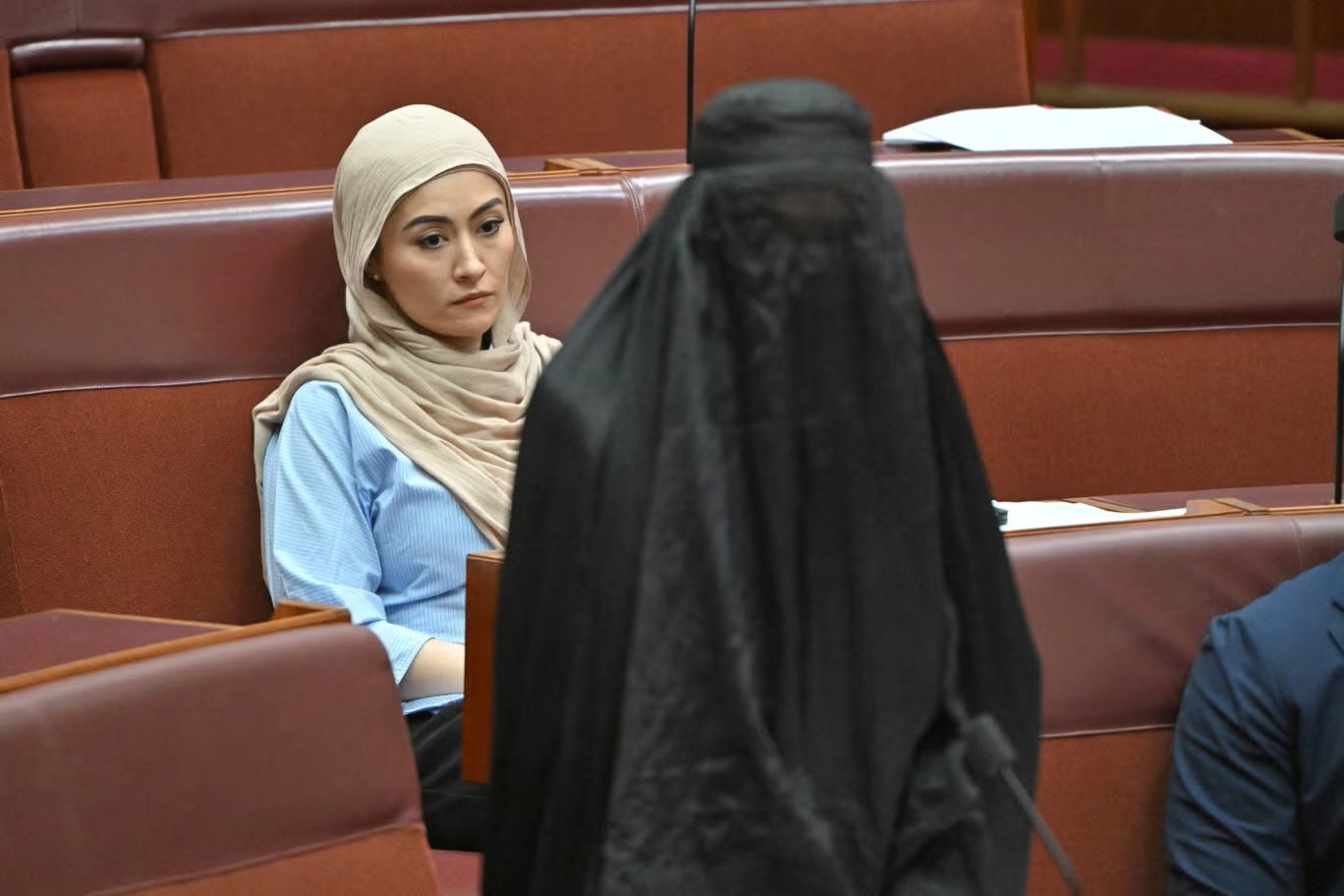
Hanson wore the burqa into the Parliament on 24 November 2025 - walking past Muslim Senator Fatima Payman sitting in her hijab trying to ignore her7. Actually now I look at the image - her expression is more one of resigned sorrow at such hate.
To Pochin herself.
Sarah Pochin became Reform UK’s first female MP in May 2025 winning the West Midlands seat of Runcorn and Helsby a by-election. By SIX votes over the Labour Party incumbent in an electorate of some 70,000 people (46.2% turnout)8.
She used the occasion of her first question at Prime Minister’s Questions on 4th June to question the Labor Minister:
“Given the Prime Minister’s desire to strengthen strategic alignment with our European neighbours, will he, in the interests of public safety, follow the lead of France, Denmark, Belgium and others and ban the burqa?”
This caused a rift in Reform themselves with the Muslim Chair of Reform Zia Yusuf saying this wasn’t official policy and her question was “dumb”. Shortly afterwards Yusuf stepped down … but then came back as foreign affairs spokesman and stated he supported a ban in certain contexts9.
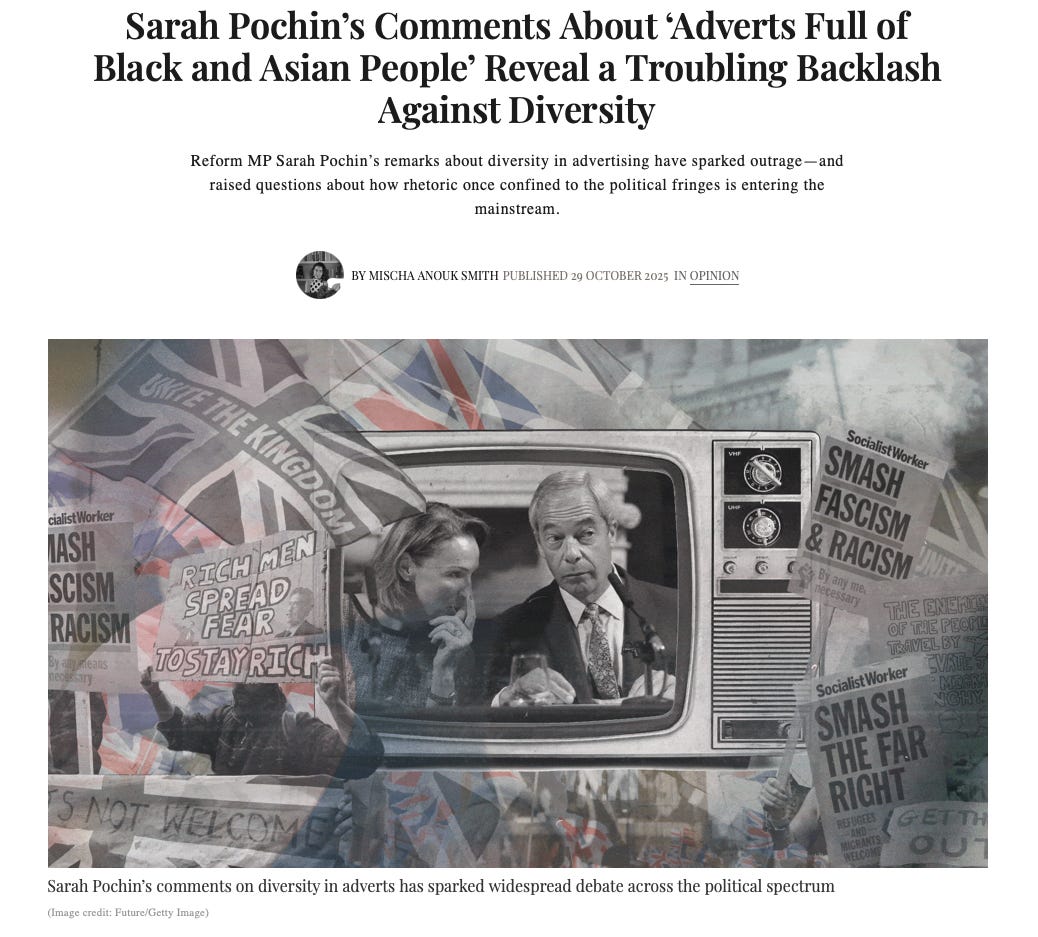
She has come out with other gems such as complaining about the amount of Black and Asian faces on UK TV adverts10 and more recently jumped on the bandwagon calling for a ban on Sharia Law.
The arguments for this just don’t stack up. Sharia is essentially a form of voluntary religious arbitration used to settle disputes, typically over divorce. Civil arbitration organisations exist and work alongside the courts ahead of law as a last resort.
The direct equivalent - which is notably rarely brought up - is the Jewish courts Beth Din11. A well established system for exactly the same purposes. The common phrase “let the Rabbis sort it out” being the equivalent.
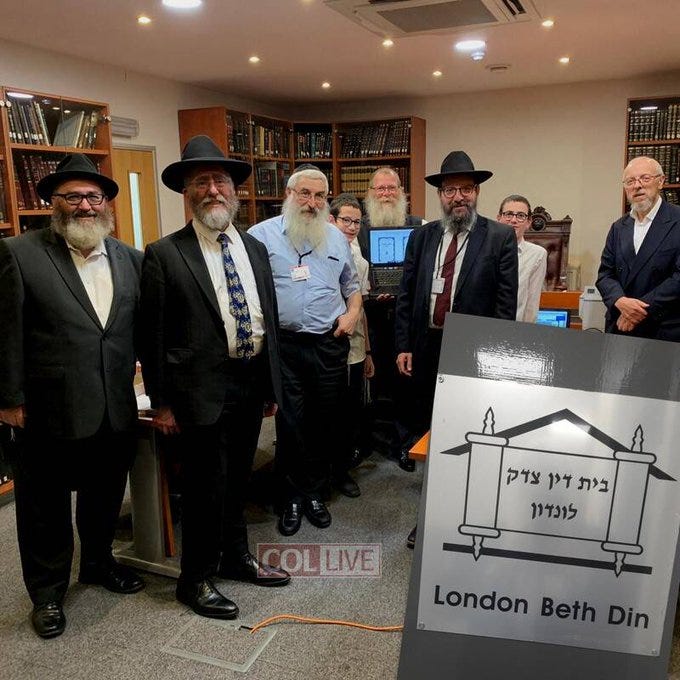
Legal Priority provide a good overview of Sharia Law12 here - which sounds almost exactly like the services offered by Beth Din Courts - see London Beth Din Court of the Chief Rabbi services13.
So clearly Pochin is focused on demonising one particular community.
And she made the burqa her calling card and brought it out the hat today as a prepared setpiece soundbite.
Well lady, you don’t mess with the tartan.
Some people take great offence at the idea that anyone can register a tartan (within certain criteria) — particularly when it comes to so-called “woke” designs.
I see it differently.
The sharing of tartans is a celebration of Scottish culture — a sign that others want to connect with it, wear it, and carry it forward.
But that spirit of openness is something opportunists like Sarah Pochin and Nigel Farage will never understand.
A joke on a stage.
A culture she doesn’t understand.
And a tartan she’ll never wear.
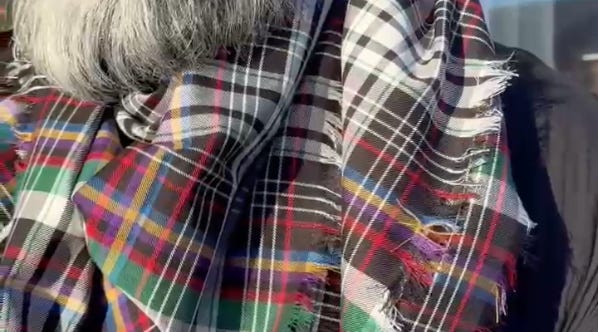
I really like this particular tartan and every colour does indeed have symbolism - even if you have to squint your eyes to see the keffiyeh analogy. And yes there’s politics in the description - as there is in the colours of the flag. How could you not with Palestine?
Palestinian flag
White - This colour means peace and love, it carries the message of the prophets who were sent to the beloved land of Palestine. It also means that our hearts are white, do not carry hatred against anyone and are filled with nothing but love for others.
Green - The green symbolises the green plains of the land of Palestine, it means goodness, development, blessing and hope for the future. It means that the buds of Palestine will grow and grow to be green branches heavy with fruits, it means that the barren land that was burned by the enemy will return again with joy in the new spring.
Red - The colour of blood means martyrdom, sacrifice and giving, and is it greater? That a person attains the honour of martyrdom, defending his religion, his family, and his homeland.
Comment: of particular note in Scotland from fierce independence prior to 1707. Robert Burns’s poem 1793 “Scots Wha Hae” - an imagined address by Robert the Bruce to his troops before the 1314 Battle of Bannockburn - expresses this passion14.
Black - represents mourning for injustice and persecution.
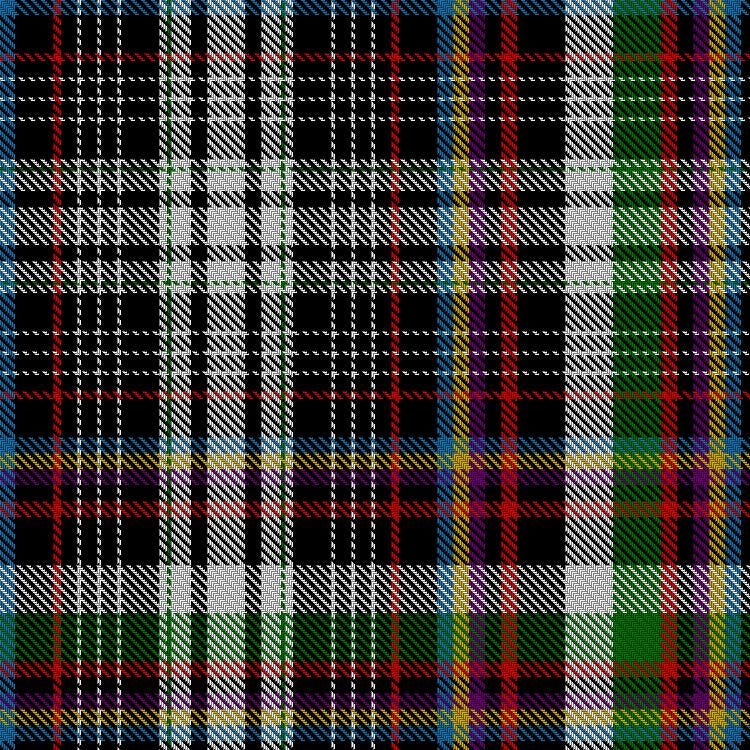
Other colours
Blue and Purple - security and compassion. These colours have been incorporated to represent the 7 million Palestinian refugees who have been denied the right to return to their homes for over 70 years. Blue and Purple have a connection to hope, resilience, and calm. These colours express the emotional turmoil linked to being a refugee, such as a sense of tragic loss and impending suspense.
Gold - symbolises the Dome of the Rock and Jerusalem. Gold is the final colour added to the tartan in recognition of the Dome of the Rock, which is perhaps the most renowned symbol of Jerusalem, the capital of Palestine.
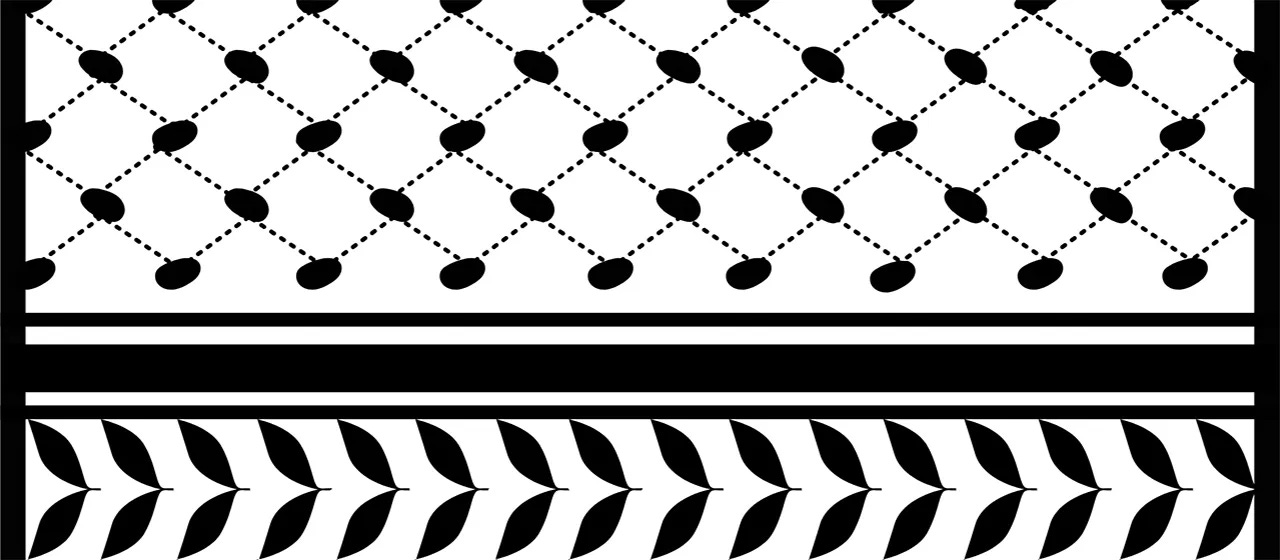
Keffiyeh analogy
white cross threads - represent fishing nets
green cross threads - olive leaves representing strength
thick black lines - trade routes going through Palestine and the rich history of merchants, travel and cultural exchange
for those interested in the history
Kilts or forms of them are common in multiple cultures and go back thousands of years. The Scots made them famous - elevated by Outlander! But the designs in Outlander are the true original Scots clans kilts, longer at the back and in plain darker tartan clan colours (as you would for hunting and fighting).
Kilts got their unexpected boost to today’s bright selection of colours after a posh Scot sucked up to a King.
Some background.
The last battle on British soil was fought in 1745 between Scots refusing to accept the 1707 union with England and the British army of English and loyalist Scots. This was the Jacobean rebellion led by Bonnie Prince Charlie - the young “pretender” to the throne - of the family many Scots considered to be the true king.
His army was massacred at Culloden near Inverness in the highlands of Scotland and Charlie was sent packing to France to spend the rest of his life in exile.
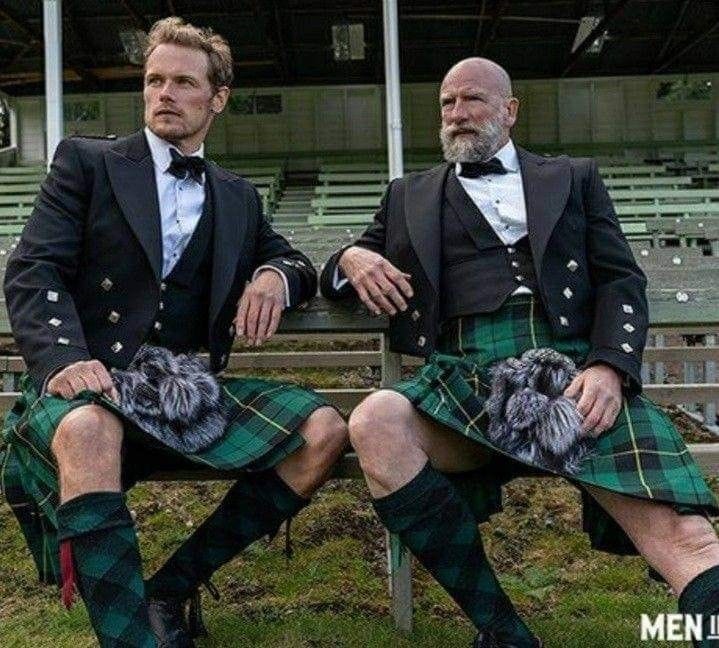
Back to Outlander - the time travel stones in the series are just down from Culloden. I’ve never really watched it but I know this from the amount of tourists about when I visited a few years back.
So … the evolution of the kilt.
After the 1745 Jacobite rebellion the British Government brought in a series of measures to quell uprisings. Part of that was to ban the wearing of the kilt - except by Scots military battalions in the British Army.
It was banned for some 50 years and by that time the connection with clan and land had dropped a generation and was less pertinent.
Around that time “Edinburgh Society” were entertaining themselves with their money, which I liken to the laughable monied absolute nobody trust funders covered in Australia’s dire weekend papers.
The Edinburgh set plucked Robert Burns from obscurity and into Edinburgh society to publicise his works and elevate his exposure - though he did not achieve broader fame until after his early death, a poor man.
An aristocratic Scots author Sir William Scott wrote multiple books around this time. He was a leading light in the Edinburgh set and a staunch monarchist.
He found the ear of the court and arranged a visit to Edinburgh in 1820 by George IV, the first formal visit by a monarch since the 1745 battle.
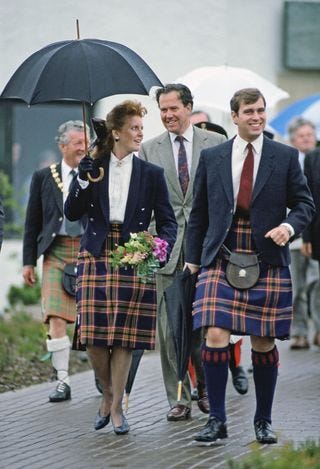
A theme Scott worked on was a Scots revival and brought back the kilt and tartans. But the equivalent of a “haute couture” version with shorter kilts and bright new tartans designed and woven by Edinburgh woollen mills.
They were a resounding success… and the rest is history.
Awfy bright kilts.
You know how I said we were happy to share around our kilted culture; maybe not with all…
Recommended Sleekit Scotsman ☮️🏴 substack articles related to this one

On International Day to combat Islamphobia, short research paper I wrote in September 2024 on Islamophobia in the context of human rights in France.
It is a balanced paper presenting the arguments on both sides but concludes with my view that the ban is invalid on multiple grounds.
Scotland’s differing approach to Palestine contrasting with the UK Government (first published 4 December 2023):
First Minister Humza Yousaf’s personal connection to Gaza
Political events in the UN and the UK leading up to the 21 Nov Scottish Parliament motion on a ceasefire in Gaza
The impact of the Scottish Vote
This article shows the setup of the Parliamentary system in Scotland using the US and Australian government systems as comparative examples. Among topics discussed:
Geographic areas of the UK with different names
Devolved parliaments v Central parliament and their respective legislative powers
Why can Scottish MPs vote on purely English issues but not vice versa?
A review of the policies of the Scottish National Party (SNP) the dominant party in the Scottish Parliament with First Minister Humza Yousaf. To understand their position (over the obvious call for independence) I look at a few key moments:
2014 Scottish Independence Referendum
2106 UK Brexit Referendum
Differentiating policy positions
As Scotland qualify for the football World Cup for the first time since 1998 … a musical déjà vu I can’t unhear…. !
A bit of humour firmly routed in solidarity! ✊🇵🇸🏴
A complete index of ALL Sleekit Scotsman articles, categorised, hyperlinked and with descriptions for easy browsing.
Sleekit Library
·
November 8, 2025

This is a categorised view of Sleekit Scotsman articles, with summary overviews and links to articles themselves. You’ll find subsets of these listed as relevant at the back of Sleekit Scotsman articles for further related reading.
First published: 20 Mar 2026
Last Update: 22 Mar 2026
Sleekit Scotsman ☮️🏴 articles are updated periodically to add latest information on the subject of the article for relevance
Updates
22 Mar 2026: replaced cover image, minor edits Appendix A (added “Scots Wha Hae”)
20 Mar 2026: added internal URLs

Sleekit Scotsman ☮️🏴 also publishes on a number of social media channels - please also consider subscribing to these:
✍️ Substack SleekitScotsman: this publication
📸 Instagram: @sleekit.scotsman https://www.instagram.com/sleekit.scotsman/
🧶 Threads @Sleekit.Scotsman: https://www.threads.net/@sleekit.scotsman
🦋 Bluesky: @sleekitscotsman.bsky.social
⬆️ Upscrolled @sleekitscotsman: https://share.upscrolled.com/en/user/e6b453ed-1273-458d-84c7-12703f1bd871/
👤 Facebook @sleekit.scotsman2 : https://www.facebook.com/sleekit.scotsman2
🎶 TikTok: @sleekit.scotsman: https://www.tiktok.com/@sleekit.scotsman
📺 YouTube @SleekitScotsman : https://www.youtube.com/@SleekitScotsman
🆇 X (formerly Twitter) @SleekitScotsman : https://twitter.com/SleekitScotsman
👾 Discord @sleekitscotsman: https://discord.gg/q5RFEpaCQp
🔗🌳 Linktr.ee: https://linktr.ee/sleekitscotsman
I am an autistic Scottish writer passionate about human rights issues and exposing Government corruption. I have a high attention to detail and can often spot connections and insights others may not see.

✍️ I’m an independent writer on social justice issues. As an autistic person, I have high attention to detail and try to put this in my work and though it does take me a long time to produce I do hope it is useful. 😊
☕️ My research, articles and memes are free but if you like my work please consider buying me a coffee on my Ko-Fi page - really appreciated!
Comments
Nothing yet. Say the first thing.
Sign in to join the conversation.