
This is the first of five pieces mapping the political machine that grew up around Citizens United. It starts with Steve Bannon, not the myth, but the paper trail.

April 24, 1980. The Gulf of Oman. Just past midnight.
A 26-year-old lieutenant junior grade named Stephen Kevin Bannon stood watch on the bridge of the USS Paul F. Foster. The Foster was a destroyer. It was running dark, escorting the carrier USS Nimitz. The Nimitz had eight RH-53D Sea Stallion helicopters on her flight deck, fueled and ready.
The helicopters launched.
They were headed for a salt flat in the Iranian desert called Desert One. From there they would fly to Tehran, land at the U.S. embassy, and bring out fifty-two American hostages. The President had authorized the mission. Carter had been briefed and briefed again. The military had rehearsed it for months. It was called Operation Eagle Claw.
Three of the eight helicopters broke down before they reached the desert.
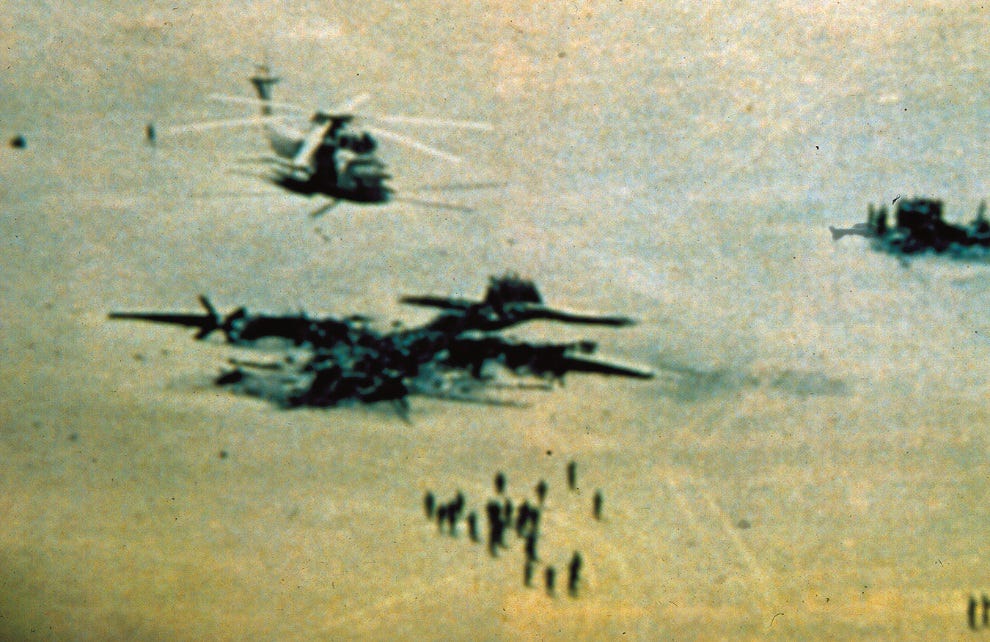
A classified April 1980 mission authorized by President Jimmy Carter to free 52 American hostages held at the U.S. Embassy in Tehran. Eight helicopters launched from the USS Nimitz. Three malfunctioned before reaching the desert staging area at Desert One in Iran. The mission was aborted. During the withdrawal, a helicopter collided with a C-130 tanker, killing eight U.S. service members. The failed mission became a defining symbol of Carter-era executive weakness for a generation of conservative military officers.
The mission was scrubbed. The remaining aircraft were ordered to pull out. In the dark, on the ground, one of them clipped a C-130 transport plane on takeoff. The fireball lit up the salt flat. Eight Americans died where they stood.
The surviving helicopters were abandoned. Classified documents inside them. Maps. Names. The Iranians arrived at sunrise and photographed everything. State television aired the footage by the next news cycle.
The Navy has a word for this. Goat rope.
Bannon has never said what he saw or heard from the bridge of the Foster that night. He has said what it did to him.
“I wasn’t political until I got into the service,” he told The Hollywood Reporter in 2016, “and saw how badly Jimmy Carter fucked things up.”
Strip out the language and that’s a clean account of a radicalization. A young officer who’d been trained to believe American institutions watched them fail in real time. He turned that failure into an ideology and carried it the rest of his life.
The mission that fell apart became the grievance that organized everything else.
Bannon left the Navy as a lieutenant in October 1983, and by the summer of 1985 he was working at Goldman Sachs in New York in the mergers and acquisitions division - the most prestigious job in American finance.
The Credentialing Pipeline
Between 1977 and 1985, Bannon built the resume Goldman’s M&A division was specifically designed to hire. He served seven years in the Navy: three at sea aboard the destroyer USS Paul F. Foster, and four at the Pentagon’s E-Ring, where he was hand-picked as staff of the Chief of Naval Operations - a slot reserved for junior officers being groomed for advancement, per Navy Times. He worked the CNO’s Executive Board under Admirals Thomas Hayward and James Watkins while attending Georgetown University at night, leaving the Navy in 1983 with a master’s in national security studies. He started Harvard Business School the same year and graduated in 1985 with an MBA, with honors. Goldman hired him out of HBS that summer.
He didn’t stumble into it. Look at the path he’d walked - elite military officer, graduate work in national security, top-tier MBA - and you’re looking at the exact resume Goldman’s M&A practice was built to hire. He didn’t sneak in. He walked through the front door of an institution built for guys with his exact background.
Goldman Sachs and Investment Banking
Goldman Sachs is one of the largest investment banks in the world. Investment bankers in the mergers-and-acquisitions division advise companies on buying, selling, and merging with other companies - they don’t invest their own money; they get paid through advisory fees or by taking a piece of the deal. Goldman’s M&A practice in the 1980s was the most prestigious in the industry. A Goldman pedigree gave you instant credibility in any business or financial conversation, and that credibility is exactly what Bannon carried into every venture that came next.
He stayed at Goldman until 1990, then left to start his own boutique investment bank. He has made movies. He has run a media company. He has been chief strategist to the 45th President of the United States.
But across every chapter of his career, the same pattern keeps showing up: Bannon never has the money.
He’s the operator - the agent who facilitates change. He spots a dormant constituency, builds or borrows a platform to wake it up, and finds the money somewhere else. When the money or the audience dries up, he moves on.
That pattern runs unbroken from the Gulf of Oman in 1980 to the War Room podcast studio in 2024, and you have to understand it to understand how the political machine that grew up after Citizens United actually works. That’s the machine I’m spending five pieces mapping in this series. Operators like Bannon don’t build that machine. They’re the kind of person it was built to feed.
The Origin Story and the Record
Before Goldman, before Hollywood, before politics, there’s one more scene Bannon has gone back to in interviews over and over. The way he tells it, this is the moment that connects the Gulf of Oman to everything that came after.
It’s a great story. The receipts tell a slightly different one, and that’s worth saying out loud.
October 2008. The financial crisis is sending markets into free fall. Bannon’s father, Marty Bannon, is sitting at home in front of the television. Marty was an AT&T lineman who had spent fifty years buying small chunks of his employer’s stock - a few shares at a time, reliably, the way men of his generation did - so he could leave it to his kids.
Jim Cramer comes on the Today show and says that anyone who needs their money in the next five years should get out of the market right now. Marty Bannon picks up the phone, sells his entire AT&T position, and loses more than $100,000. The Washington Post examined the loss in March 2017.
Steve Bannon points to that morning as the day he became an economic nationalist. “The Marty Bannons of the world were getting washed out to sea, and nobody was paying attention to them,” he told the Wall Street Journal.
It’s a powerful story, and the feelings in it are real. But the facts around it don’t quite line up the way Bannon tells it. Phillip Bump at The Washington Post ran the numbers and found that AT&T stock in October 2008 had only dropped back to roughly where it was in 2006. A real loss, sure, but not a wipeout. And Cramer wasn’t giving Marty Bannon financial advice. He was a guy on a morning TV show making a general comment about who shouldn’t be in the stock market. Marty watched, made up his own mind, and sold.
The loss was real. The villain story Bannon built around it - predatory Wall Street, forgotten workers, a political class that didn’t care - is something he added later. And that frame, dressed up and expanded, became the backbone of the economic nationalism he’d go on to sell.
The gap between the story he tells and the story the paper trail tells isn’t a small thing. You’re going to see it again and again across his career. That’s the whole point of what I’m doing in this series. I’m not arguing with the myth. I’m looking at what he actually did.
Goldman, Hollywood, Florida
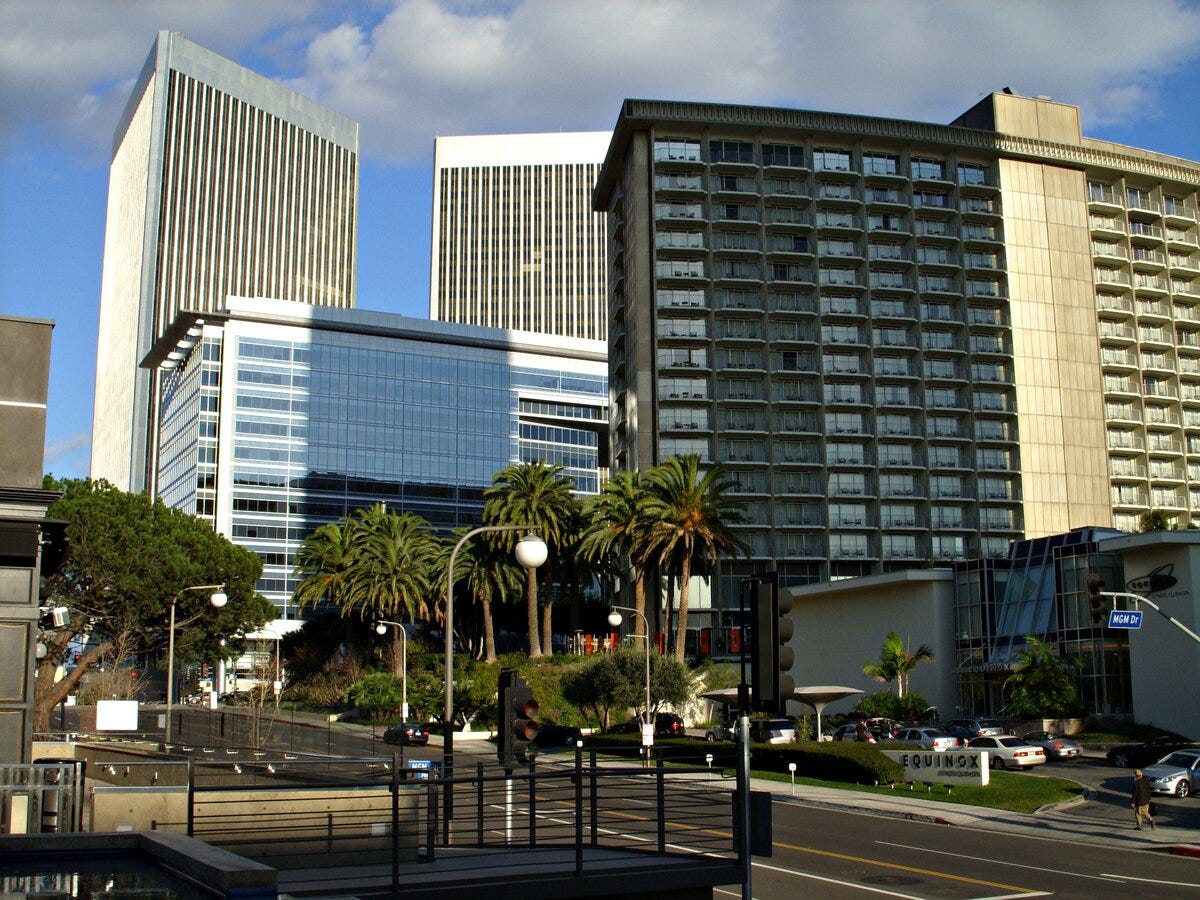
When Bannon left Goldman Sachs, he took one thing with him. Not money. A credential. The Goldman M&A pedigree was the most prestigious calling card in American finance, and it would open every door he walked through for the next thirty years.
He started Bannon & Co., a small investment bank in Los Angeles, and in the early 1990s he put together the deal that would quietly bankroll almost everything he did afterward. The deal involved Westinghouse, Castle Rock Entertainment, and Ted Turner. Turner was buying Castle Rock and came up short on cash. Bannon and his partners didn’t want to walk away from their fee, so they cut a different deal: instead of cash, they took a small piece of the future profits from five Castle Rock TV shows.
One of those shows, then in its third season, was Seinfeld.
According to Bannon’s 2017 White House financial disclosure, his Seinfeld stake has paid him between $50,000 and $100,000 a year ever since the show went into syndication. He’s never confirmed the exact percentage, and the full structure of the deal has never been disclosed. It didn’t need to be. The checks just kept coming.
Backend Profit Participation and Residuals
In the entertainment business, a “backend deal” means taking a percentage of a show or film’s future profits instead of (or on top of) an upfront fee. “Residuals” are the recurring payments that come in when the show keeps making money through reruns, syndication, or streaming. The Seinfeld residuals became the financial floor of Bannon’s entire career: a steady passive income that gave him the freedom to operate without having to answer to a boss or an investor. The White House disclosure shows the Seinfeld checks were still rolling in as of 2016, almost thirty years after the original deal.
The numbers from that 2017 disclosure tell the story plainly. Net worth of at least $10.7 million. 2016 income over $1.3 million - $191,000 from Breitbart, $494,000 from Bannon Strategic Advisors, $125,000 from Cambridge Analytica.
The man who sold himself as the voice of the forgotten working class hadn’t worked for an hourly wage in decades. He was living off a deal he’d cut with Ted Turner in the early 1990s, plus consulting fees his Goldman name and his media platform brought in. In structural terms, he is exactly what I’m saying he is. A parasitic operator, living off other people’s output instead of his own capital.
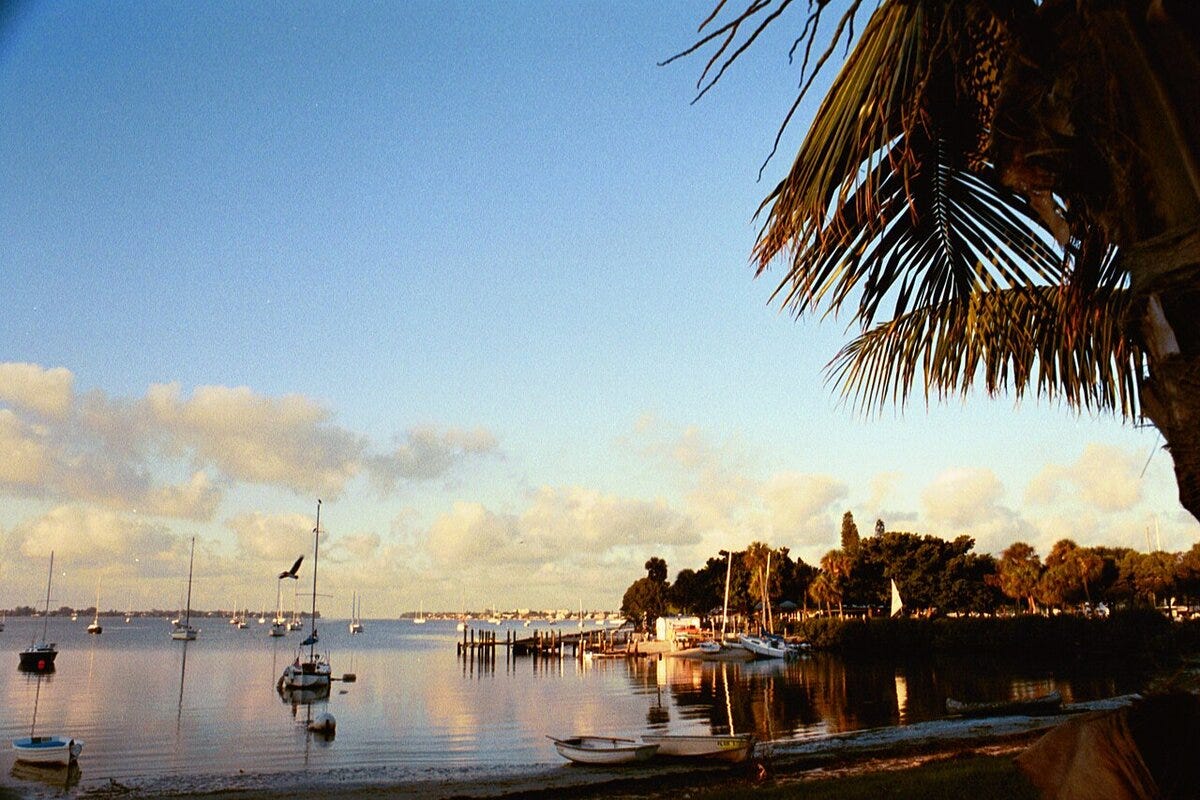
Now picture Sarasota, Florida, in the middle of the last decade. White stucco, palm trees, retirees in golf carts. The kind of Gulf Coast town where the marinas are full and nobody asks too many questions about how the boats got paid for.
This is where Steve Bannon went to work in between Hollywood and Breitbart, and it is the chapter most of his later biographers barely mentioned. From about 2003 to 2011 - close to a decade - his day-to-day environment was the pink-sheet company scene. Tiny, thinly traded stocks that never made it onto the major exchanges. Office suites in low-rise buildings off the interstate. Boards of directors with the same three or four names recycling through them.
Penny Stocks and Pink Sheets
“Pink sheets” is the informal name for the over-the-counter market where stocks that aren’t big enough or stable enough to list on the NYSE or Nasdaq trade instead. The name comes from the pink paper their quotations used to be printed on. Pink-sheet companies face far fewer disclosure requirements than companies on the major exchanges, which makes them attractive for speculation and, in some cases, manipulation. They aren’t all shady - plenty of them are just small companies - but the lack of transparency makes oversight harder and makes misconduct easier to hide.
One man is the constant across this whole stretch. His name is Andrew Badolato. A Sarasota “venture capitalist” - the quotation marks are doing some work there - who would stay Bannon’s business partner for the next twenty years and eventually sit beside him as a co-defendant in the We Build the Wall fraud case.
The Bannon-Badolato partnership ran through at least four documented ventures between 2003 and 2011. A Seattle attorney named David Otto sat on several of the same boards. The pattern never really changed. Bannon was the credentialed name on the door - Goldman pedigree, Hollywood producer credits - and other people did the work. Peripheral enough that prosecutors never came after him. Central enough that his vote got counted when the board decided things.
Shell Companies and Offshore Jurisdictions
A shell company is a corporate entity with no real business operations - it exists to hold assets, move money, or hide who actually owns something. Belize and Costa Rica are both well-known offshore jurisdictions: it’s quick and cheap to set up companies there, and the public records about who actually owns and controls them are minimal. In securities fraud schemes, shell companies in places like these are commonly used to receive funds, shuffle money between accounts, or make transactions look arms-length when the parties are actually connected.
Start with SinoFresh HealthCare. A Sarasota company that sold homeopathic nasal sprays. Bannon and Otto joined the board around 2003. A few years in, the company’s founder, Charles Fust, accused Badolato of something specific and ugly: trying to take a million shares of Fust’s own stock and put them under the control of a shell company registered in Belize - a shell controlled by a Costa Rica-based offshore operator named Jonathan Curshen. In plain English, the alleged scheme was to strip Fust of the shares and park them somewhere Curshen could sell them off later.
Remember that name. He’s going to come back.
Pump-and-Dump
A pump-and-dump scheme works like this: someone artificially inflates the price of a stock - usually by pushing out misleading promotional material (a.k.a. publishing lies or rumors) - and then sells their shares at the inflated price before the whole thing collapses, leaving regular investors holding the bag. It’s especially common in the pink-sheet market because the low trading volumes make prices easier to manipulate. Under federal securities law, both the promoters who hype the stock and the insiders who sell into the artificial bump can face criminal charges.
A court-appointed independent expert from the University of Florida law school looked at the allegations and found the counter-claims against Fust “baseless.” The disputed shares went back to him, according to settlement documents published by Haber Law in December 2015.
Then Donna Messenger Corp., a 2003 cosmetics venture. Same three men, same board, documented in Politico’s November 2016 investigation of Bannon’s Florida years.
And then there’s Bio-Flavorance. This one is different. This is the only Florida venture in Bannon’s immediate orbit that produced a criminal conviction, and the way it got there is worth slowing down for.
In 2005, Bannon, Badolato, and Otto formed Bio-Flavorance in Sarasota - a flavor and fragrance patent company, on paper. In January 2006, Bio-Flavorance was acquired by Industrial Biotech Corp (IBOT), a pink-sheet company registered to the same Sarasota office suite. The shell and the company shared an address. After the acquisition, Badolato became chairman and president of IBOT.
Reverse Merger
A reverse merger is when a private company takes over a publicly traded shell company (or a shell takes over the private company’s assets), so the private firm ends up publicly traded without going through an IPO. Regulators look at reverse mergers with extra suspicion because they can be used to obscure where a company came from or who’s running it, and because the resulting public shell makes a perfect vehicle for stock manipulation.
Two years later, the case opened. Federal prosecutors in Illinois charged Jonathan Curshen - the same Costa Rica-based offshore operator from the SinoFresh dispute - and a Florida stock promoter with running a pump-and-dump scheme that manipulated IBOT stock. Both were convicted.
Then the DOJ filings in the Curshen prosecution named Andrew Badolato as a co-conspirator and called him a “primary beneficiary” of the scheme. Trial testimony included the claim that the proceeds flowed into a Badolato-controlled account.
In a 2012 motion opposing Curshen’s attempt to vacate his guilty plea, DOJ lawyers told the court that “Badolato controlled all of the free trading shares of IBOT.” The motion laid out the payment structure: of the proceeds from selling three million IBOT shares, after expenses for bribes and promotional materials, “Badolato would take half, and Curshen and [the promoter] would each take a quarter.”
Badolato was never charged.
Let that one sit for a second. The public record doesn’t say why, and DOJ has never explained the non-prosecution decision. The most common reason a co-conspirator named in federal filings doesn’t get indicted is cooperation - the unindicted person provides information against the people who do get charged. No cooperation agreement involving Badolato has ever surfaced in the public record. But the pattern fits.
Curshen and the promoter went to prison. The man DOJ called the primary beneficiary walked.
One more. SARS Andronics, 2007 to 2011. A UK-merged gas-tank monitoring company. Bannon sat on its board starting in 2007. In May 2008, the company was sued for intellectual property theft, with the complaint alleging that a developer had been hired using a fake-name email account. Bannon resigned two months later, in July. The case settled in 2011 for $90,000, per Politico.
The Florida years aren’t really a story about Bannon as a convicted fraudster. He was never charged, never indicted, never convicted of anything. They’re a story about a man who spent a decade as the credentialed name on the boards of companies whose actual operations were run by other people, some of whom later got convicted of federal crimes.
The Goldman pedigree got him the board seats. The board seats gave a respectable face to ventures that needed one in the prospectus. When things blew up, Bannon resigned, settled, or moved on. Credential as cover, mobility as insulation. You’re going to see it in every chapter that follows.
David Otto’s path through this same network is a useful side note. In 2011, the SEC announced that Otto and a colleague named Todd Van Siclen had settled civil charges related to a separate pump-and-dump scheme involving a company called MitoPharm. Without admitting or denying anything, they agreed to pay more than $200,000 and accept a five-year ban from working in penny-stock offerings, per the SEC’s own administrative proceeding.
Otto was Bannon’s co-board-member at SinoFresh, Donna Messenger, and IBOT. That’s not a claim about Bannon’s conduct. It’s an observation about the circle he was moving in.
Bannon later registered to vote at Badolato’s Florida address, after reports surfaced that his previous voter registration was tied to a vacant property, per Politico.
The Gamer Insight
Tucked between the Florida pink-sheet years and Bannon’s arrival at Breitbart was a venture that turned out to be the most consequential thing he did before he got into electoral politics. In the mid-2000s, Bannon became chief executive of Internet Gaming Entertainment - IGE - a Hong Kong company backed by Goldman Sachs that had built a profitable business in a corner of the internet most people over thirty didn’t know existed.
IGE made its money through “gold farming” in massively multiplayer online games, mostly World of Warcraft. Players on IGE’s payroll - most of them in low-wage countries - would grind for hours, collecting in-game currency and hunting rare items, then selling them to other players for real money. Technically this was a gray-market business. Not strictly illegal, but operating in a zone the game’s rules officially banned. Blizzard, the company that made World of Warcraft, prohibited the practice. Enforcement was patchy, and the demand was huge.
Gold Farming in MMORPGs
A massively multiplayer online role-playing game (MMORPG) is a video game where thousands of players inhabit a shared virtual world at the same time. In games like World of Warcraft, players accumulate in-game currency and items by completing quests and defeating enemies - which takes a lot of time. “Gold farming” is when workers play these games for long hours to stockpile virtual goods, then sell them to other players for real money through third-party websites. Game publishers banned the practice as a violation of their terms of service, but the market was massive. IGE was one of the largest commercial operations of this kind.
Goldman had invested roughly $60 million in IGE’s parent company, RPG Holdings - later renamed Affinity Media after the gold-farming arm got sold off. The business had real revenue, real operations, and a valuation big enough to support a professional CEO. Bannon stepped in around June 2007, taking over from co-founder Brock Pierce.
The model fell apart when organized player communities lobbied Blizzard to crack down on gold-farming accounts, and a wave of bans wiped out IGE’s revenue base. But before it fell apart, Bannon noticed something. He noticed the gamers who had organized against his company.
He laid it out to journalist Joshua Green, who reported it in Talking Points Memo (July 2017) and in his book Devil’s Bargain. Bannon’s exact words: “These guys - these rootless, white males - had monster power. It was the pre-Reddit.”
He wasn’t describing a political base he was about to recruit. He was noticing an organizational structure: a huge population of young men, economically left behind and socially invisible, talking to each other through informal digital networks and capable of coordinated action when something pissed them off enough.
The insight had recognized a potential group to harvest. The application came later: Breitbart News, then the Trump campaign. The line is direct. The gamer audience became the Breitbart audience, and the Breitbart audience became the MAGA base. The platform changed. The organizing logic didn’t.
I get into Pierce’s earlier associations - and what they say about the world Bannon was moving through - in the second piece.
Capital, Breitbart, Cambridge
By 2011, Andrew Breitbart was looking for money. The website he’d founded in 2007 as a loose right-wing news aggregator was running on adrenaline and donor goodwill, without the kind of cash base to become a real, durable media organization.
Bannon had been circling Breitbart’s orbit since about 2010. He drafted a business plan that called for a $10 million investment in Breitbart News in exchange for a significant equity stake. Bannon didn’t have $10 million. He was pitching to the people who did.
According to Jane Mayer’s reporting in The New Yorker (March 2017) - still the foundational account of the Mercer political program - the plan went to Robert and Rebekah Mercer. A father and daughter. Two of the biggest donors in conservative politics. Their money came from the Renaissance Technologies Medallion Fund, one of the most profitable investment vehicles in financial history.
Renaissance Technologies and the Medallion Fund
Renaissance Technologies is a quantitative hedge fund founded in 1982 by the mathematician James Simons. Its flagship Medallion Fund, which uses algorithms to make extremely fast market bets, has averaged about 66 percent annual returns before fees - a performance record nobody else in the hedge-fund industry has matched. Robert Mercer joined Renaissance in 1993 as a computational linguist working on machine-translation systems and eventually became co-CEO. The Medallion Fund’s enormous returns are the primary source of the money the Mercers have poured into conservative political infrastructure. The Senate Permanent Subcommittee on Investigations examined the fund’s options-based tax strategy in a 2014 report. Piece 3 digs into the Mercers and their political spending in full.
Robert Mercer put roughly $10 million into Breitbart, per Mayer’s reporting. One caveat I should flag: Mayer’s account is the main public source for that figure, and it hasn’t been independently confirmed through primary documents. The Breitbart LLC operating agreement has never been disclosed publicly.
Andrew Breitbart died suddenly on March 1, 2012. Heart failure, age 43(!). Bannon took over as executive chairman. He was running the organization on Mercer money, and he had no comparable money of his own.
The shorthand you hear all the time - “Bannon bankrolled Breitbart,” “Bannon’s media empire” - is just wrong. The public record doesn’t support it.
Bannon’s actual role was the Goldman-credentialed operator who spotted the opportunity, drafted the pitch, brought in the investor, and ran the resulting organization. The investor this time was Robert Mercer. The editorial platform was Andrew Breitbart’s. What Bannon contributed was the brokerage.
By 2012, Bannon had also co-founded the Government Accountability Institute with Peter Schweizer, the author and opposition researcher. GAI ran mostly on Mercer money, per The New Yorker.
GAI produced Clinton Cash - the 2015 book and 2016 film that became a major piece of anti-Hillary messaging during the presidential campaign. Bannon’s production company, Glittering Steel, made the film, and Badolato got an associate producer credit, per IMDB.
Same pattern as always. Bannon as the organizing and credentialing presence, the Mercers providing the capital, and the operational work distributed through the network he’d been keeping warm since his Florida years.
In 2013, the Mercers funded a new venture: a data analytics company they’d call Cambridge Analytica, set up as the American arm of SCL Group, a British firm that had built its business on behavioral research and targeted messaging for foreign political campaigns, mostly in the developing world. The Mercers reportedly put $15 million into creating the American entity, per Jane Mayer’s New Yorker reporting.
Cambridge Analytica and SCL Group
SCL Group was a British private intelligence and political consulting firm founded in the 1990s, specializing in “influence operations” - using psychological research and targeted messaging to shape public opinion and election outcomes. It mostly worked for foreign governments and political parties. Cambridge Analytica was the American commercial arm, set up in 2013 with Mercer money to offer the same kinds of services to U.S. political campaigns. Its central pitch - that it had a psychographic profiling system that could precisely target individual voters - was later questioned by academic researchers, and the firm collapsed in 2018 after reporting about its data practices and Facebook’s data policies. Piece 3 digs into Cambridge Analytica and the Mercer investment in full.
Bannon joined Cambridge Analytica’s board as a founding director and vice president. His equity stake, per his 2017 White House financial disclosure, was valued between $1 million and $5 million.
The structure was, once again, exactly the same as the Breitbart deal. Bannon held the equity and the title. The Mercers held the capital. His 2016 income from Cambridge Analytica - $125,000, per the disclosure - was a salary, not a return on investment. In financial terms, he was an employee of his own investors.
Equity Stake vs. Salary
When a company gives someone an equity stake, they get ownership shares in the company itself - which might be worth money if the company succeeds but have no guaranteed cash value. A salary is a fixed cash payment for work performed. The legal distinction matters: someone who holds equity AND works for the company has a financial interest in that company’s contracts and clients. When Bannon kept his Cambridge Analytica equity stake while running the Trump campaign after August 2016 - and while Cambridge Analytica was on the campaign’s payroll - the Campaign Legal Center flagged this as a possible coordination problem. Bannon was both an owner of the data firm and the person directing the campaign that had hired it.
One footnote that closes a circle. On January 18, 2018 - the same month Bannon was being cut loose by the Mercers and pushed out of Breitbart - Cambridge Analytica signed a deal worth at least $440,000 with a Sarasota company called The USA Exchange, which was co-founded by Andrew Badolato, per Florida business records reported by the Tampa Bay Times.
The deal called for Cambridge Analytica to deliver as many as a million registered users to The USA Exchange’s website, run a psychographic research project on those users, and produce ten creative concept displays for a digital campaign.
Psychographic Profiling
Demographic data tells you what someone is - age, income, zip code, race, gender. Psychographic data tries to tell you who someone is - their values, fears, personality traits, what they want, what makes them angry, what makes them act. Political marketers use psychographic profiles to figure out which buttons to push on which kind of person. Instead of sending the same ad to everyone in your zip code, they send the angry-loner ad to the angry loners, the worried-parent ad to the worried parents, and the rebel ad to the rebels - all in the same neighborhood, all at the same time. Cambridge Analytica’s central pitch was that it had built a psychographic system precise enough to target individual voters with custom messaging keyed to their personalities. Academic researchers later questioned how well the methodology actually worked. But the appeal of the pitch - and the reason political clients were willing to pay for it - was that it promised to do something traditional polling and demographic targeting could not: change minds, not just count them.
The same Sarasota partnership that had anchored Bannon’s pink-sheet years in the mid-2000s was still doing business inside the Mercer-funded data apparatus a decade later. Badolato had moved with him every step of the way.
A source connected to The USA Exchange told the Tampa Bay Times that Bannon had a role in setting up the 2018 deal, even though he’d formally sold his Cambridge Analytica stake in 2017 when he went into the White House. Months later, Cambridge Analytica was in Chapter 7 bankruptcy, and The USA Exchange ended up listed among its 125 creditors.
What happened to that data? The honest answer is: nobody outside the bankruptcy trustee and the UK Information Commissioner’s Office really knows. The contract was signed in January 2018, Cambridge Analytica imploded in March, and by May the company was in Chapter 7 with The USA Exchange listed as a creditor on a deal that, by every available indication, was never delivered. Where the underlying psychographic models and the data behind them actually went after that - whether they were seized, destroyed, or quietly absorbed by a successor company the Mercer sisters had set up months before the scandal broke - is a thread I pick up in Bannon II.
Trump Tower, August 2016
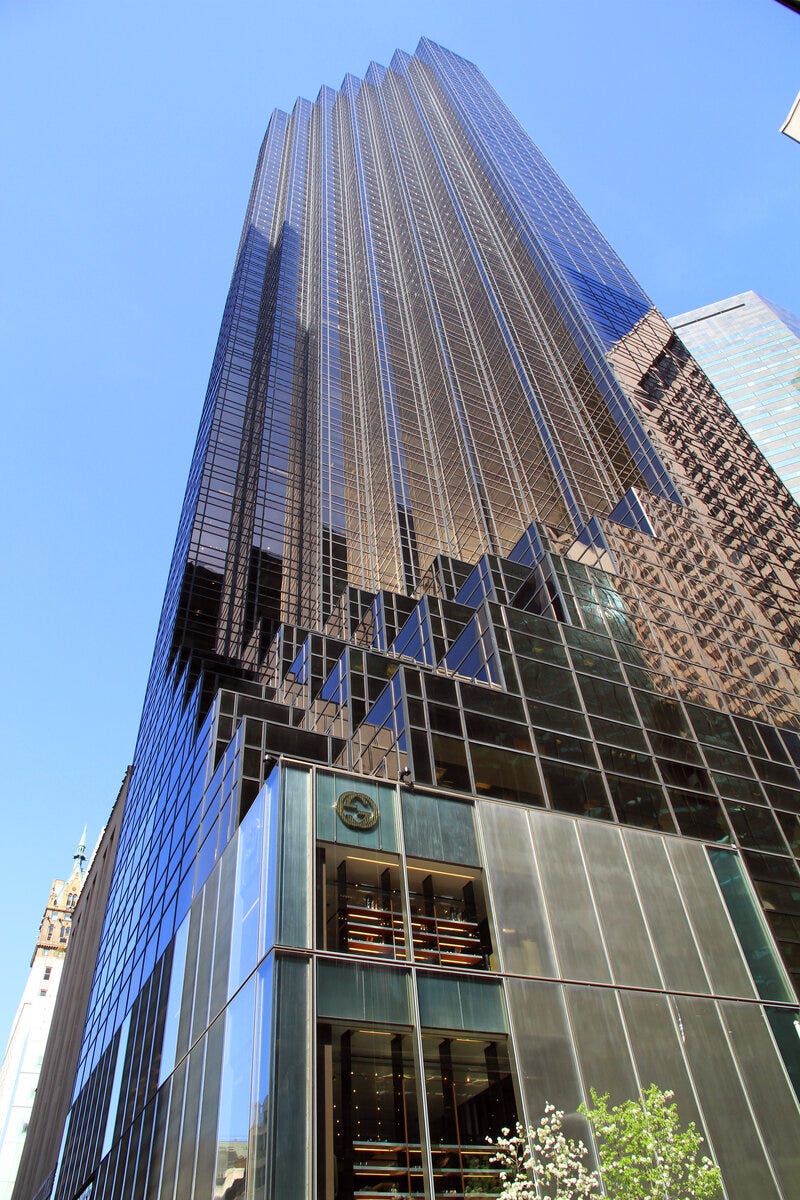
The sequence of events isn’t really in dispute. The Mercers had been major donors to the Cruz campaign during the Republican primary, and their money - along with Cambridge Analytica’s services - had followed Ted Cruz through the early states. Cruz dropped out in May 2016, and Trump emerged as the presumptive nominee.
The Mercers had a decision to make about whether to support a candidate they hadn’t originally backed, and the decision came with strings attached. Per reporting anchored in Jane Mayer’s New Yorker account and backed up by coverage of the Trump campaign’s August 2016 reorganization, the Mercers made their support conditional on two personnel moves: the Trump campaign would hire Cambridge Analytica, and it would put Bannon in charge as campaign CEO.
Paul Manafort, who’d been serving as campaign chairman, resigned days after Bannon’s appointment was announced. Kellyanne Conway was named campaign manager at the same time.
Here’s the structural problem the Campaign Legal Center flagged in documents it published in October 2020.
Bannon kept his equity stake in Cambridge Analytica the entire time he was running the Trump campaign. During that same period, Cambridge Analytica was being paid by two clients at once: the Trump campaign itself, and Make America Number 1, a Mercer-backed super PAC. Bannon’s own production company, Glittering Steel, was making ads for that super PAC.
Super PACs are legally barred from coordinating their spending with the campaign they support. So when the campaign manager has an ownership stake in a company the super PAC has hired - and sits on that company’s board - he’s standing on both sides of a wall the law says has to stay up.
I’m not claiming the wall came down. The legal record doesn’t establish that it did. What the record does establish is that Bannon was holding equity on both sides of it. FEC filing data for Make America Number 1 documents what the super PAC paid Cambridge Analytica during the 2016 cycle.
The campaign ended with Trump’s election on November 8, 2016. Bannon was named chief strategist of the White House. He left - or was pushed out, accounts vary on how much choice he had - in August 2017.
After the Mercers
What happened next should look familiar by now. The Mercer relationship had been keeping Bannon aloft since 2011 - the Breitbart equity, the Cambridge Analytica board seat, the GAI funding, the campaign CEO appointment. All of it traced back to a single family and a single source of capital that had defined the boundaries of his operation.
Then came January 2018. Michael Wolff published Fire and Fury, his account of the Trump White House, which included Bannon’s unflattering on-the-record comments about Trump’s family members and how they’d behaved during and after the campaign.
The Mercers cut him off. Rebekah Mercer issued a public statement disavowing his comments. The Breitbart board voted him out as executive chairman. Within days of the book’s release, Bannon had lost his media platform, his main financial backer, and his proximity to the president - all at once.
For most political careers, that would have been the end. It wasn’t. The second act actually proved how durable his pattern was, not how fragile.
What post-Mercer Bannon found wasn’t a new patron. It was a new business model.
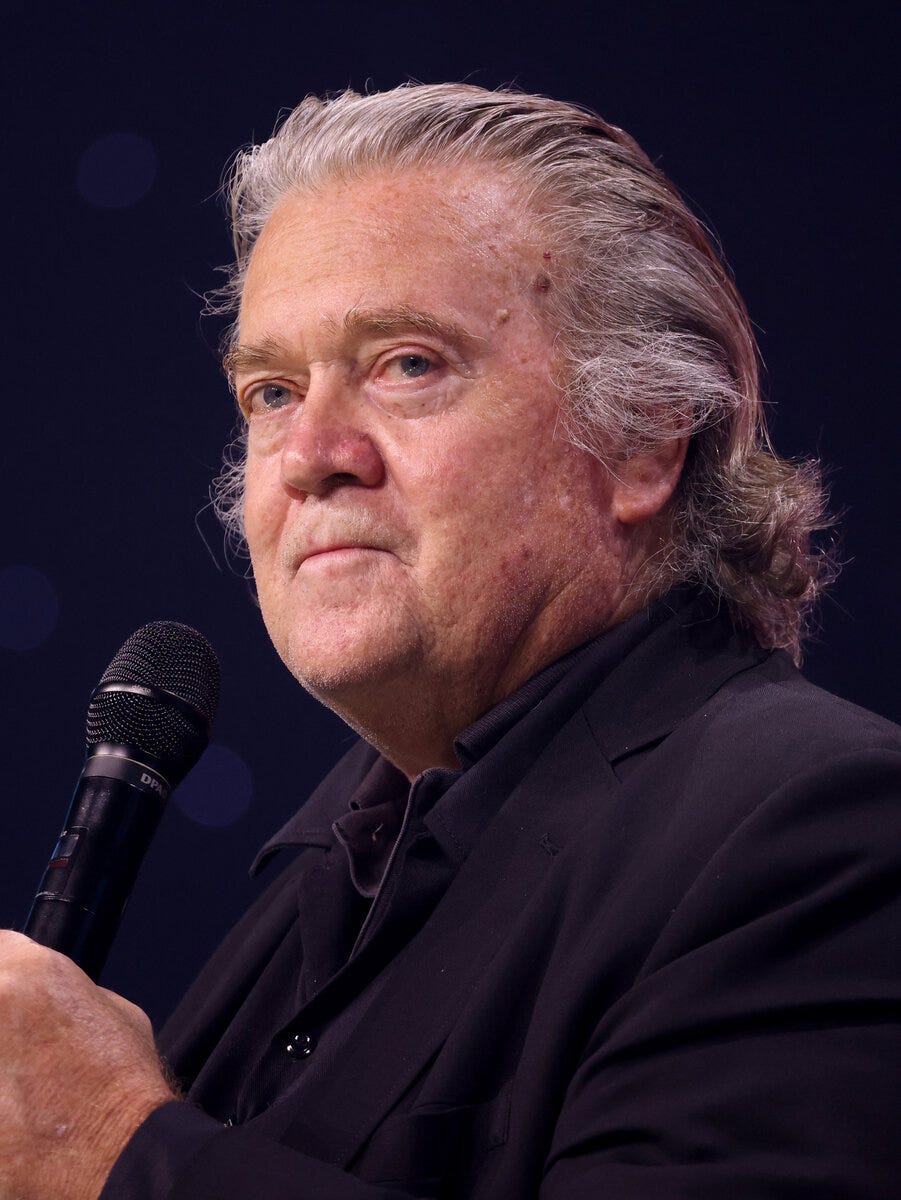
War Room launched as a podcast in 2019 and grew dramatically during and after the 2020 election. It became one of the most-downloaded political podcasts in the country, and at its peak it was pulling millions of downloads per episode. The revenue came from a mix of sponsorship advertising, listener donations, and the new digital infrastructure - Rumble, alternative payment processors - that had grown up to serve right-wing media after it got pushed off mainstream platforms.
The grassroots MAGA donor base that had formed around Trump became, in effect, a distributed funding source. It replaced the Mercer checkbook.
August 20, 2020. Off the coast of Connecticut, federal agents pulled alongside a 150-foot yacht called the Lady May. The yacht belonged to Guo Wengui - the exiled Chinese billionaire who also went by Miles Guo - and Steve Bannon was on board. The agents took him off in handcuffs.
The U.S. Attorney for the Southern District of New York unsealed an indictment that morning naming Bannon and three co-defendants. One of them was Andrew Badolato. The charges: defrauding the donors to We Build the Wall, a crowdfunded campaign that had raised $25 million on the promise that the money would pay for private construction of border barriers along the southern border.
DOJ SDNY filings alleged that more than $1 million of those donations had been diverted to benefit Bannon and his co-defendants personally. Guo himself was later convicted, in July 2024, of running a separate fraud scheme that prosecutors valued at more than $550 million, per DOJ records. Bannon wasn’t charged in that one.
Then came the pardon.
On January 19, 2021 - Trump’s last full day in office - he pardoned Bannon, and the federal charges were wiped out before any of them could be tried. Manhattan District Attorney Alvin Bragg recharged him under New York State law, which the federal pardon couldn’t reach. On February 11, 2025, Bannon pleaded guilty to one count. He got a three-year conditional discharge. No jail. No restitution.
His co-defendants didn’t fare as well.
Brian Kolfage, the wounded Air Force veteran who had founded the We Build the Wall campaign, got 51 months in federal prison. Andrew Badolato got 36 months. Timothy Shea got 63 months. Per NPR.
The We Build the Wall episode closes the loop on Badolato. The Sarasota “venture capitalist” who’d been named a co-conspirator in the 2008 IBOT pump-and-dump - and never charged - was finally serving a federal sentence. Bannon had pleaded down and walked.
The operator’s rule, applied consistently across two decades: peripheral enough to stay insulated, central enough to matter.
By 2024, Bannon had no Mercer money, no White House job, no Cambridge Analytica board seat, and a New York State plea on his record. What he had was War Room - a big and loyal audience, the organizational infrastructure of the MAGA movement, and a constituency that had absorbed his framing and didn’t need a single patron anymore.
The money came in small amounts, from a very large number of people.
The pattern hadn’t changed. The size of each chunk of money had.
Let me step back for a second.
The Citizens United decision of January 21, 2010 - which I’ll tackle directly in the final piece of this series - did not create Steve Bannon. His operator career was already well underway before the ruling. What Citizens United did create was an environment where operators like Bannon could turn an audience into political infrastructure at a scale the pre-2010 campaign finance rules had held in check.
The unlimited outside spending that Citizens United unlocked needed something to function at political scale. It needed exactly what Bannon had spent his career building: a media platform with a loyal and activatable audience, a data operation that could target that audience, and a credentialed operator who could move between the money and the constituency without belonging to either side.
He was the demand side of a machine. The supply side, I’m spending three more pieces tracing.
The Navy made Bannon ideologically activated. Goldman Sachs gave him the credential that opened every door. The Seinfeld residuals gave him the financial independence to wait for the right deal. The Florida years gave him a working set of relationships and a tolerance for jurisdictional gray zones. Internet Gaming Entertainment gave him the insight about isolated young men and digital organizing that became the intellectual seed of Breitbart. The Mercers gave him the capital and the platform to aim that insight at American electoral politics. War Room gave him a way to keep the operation running without a single patron, by turning the audience itself into the funding source.
In each chapter, the role was the same. He found the dormant army. He found the money. He activated one with the other. And when the money or the army or the moment ran dry, he moved.
Whether that pattern actually holds - when you check it against the documented record of the people Bannon chose to hire and the rooms he kept walking into across two decades - is the test of Bannon II.
Coming in Bannon II
I know what you’re thinking. We’ve covered Bannon. What else is there?
A lot, as it turns out. This piece was about what Bannon did. The next one is about who he did it with - and that’s a very different list.
Bannon II is a catalog. Names, dates, court filings, sanctions designations, guilty pleas. The people he hired. The people he replaced. The people he campaigned with after the allegations came out. The rooms he kept walking into across two decades.
The question Piece 2 asks isn’t whether Bannon did the things his associates were charged with. He didn’t. The question is what it means that an operator’s professional address book reads, on the documentary record, the way his does.
The record is the argument. Bring a strong stomach.
No posts
Comments
Nothing yet. Say the first thing.
Sign in to join the conversation.