
Note: The author is the Director of Polar Intelligence for Davie Group. The opinions and views expressed at Sixty Degrees North belong solely to the author and do not necessarily reflect those of his employer.
This is part two of my July 2026 U.S. Coast Guard Icebreaking/Polar update, in which we will look at procurement programs and ports. If you missed part one (Operations), you can find it here:
There has been quite a bit of positive news regarding the Arctic Security Cutter program over the past six months or so. This demonstrates that U.S. Coast Guard leadership is embracing new ways of doing business and working hard to ensure that we get the ships we need in a timely manner. There is another new program just starting—the Homeland Security Cutter-Light Icebreaker program— for which an RFP (Request for Proposals) was recently issued. With fourteen icebreakers now under contract, the U.S. Coast Guard is taking steps to identify where they will be based. We’ll also take a look at recent announcements covering planned facility expansions to support these ships.
We will begin, however, with the legacy Polar Security Cutter (PSC) program. This program, for which the initial contract was awarded in 2019, continues to suffer cost overruns and anticipated delays.
As others have noted, it is difficult to get current information about the Polar Security Cutter program. There are no recent press releases or photos showcasing progress. However, some information did come from recent Congressional Hearings and the Government Accountability Office’s (GAO) annual report on DHS procurement.
In April1, Rear Admiral Mike Campbell, Chief Acquisitions Officer for the U.S. Coast Guard, testified before Congress that 26 of 85 modules for the first Polar Security Cutter were under construction2. He did not say how many, if any, were completed.
Production of the first eight ‘prototype’ modules began in July of 2023, while approval to begin construction (which also allowed those eight modules to be used) was granted in December of 2024, and full-scale production work was authorized in May of 2025.
These numbers are generally in-line with what the U.S. Coast Guard told the GAO last year as relayed in the June 2026 GAO report:
Prior to full construction approval, the shipyard started construction on eight sections of the ship to inform production and, according to program officials, plans to start 16 sections in total by December 2025. Of those initial eight sections, the shipbuilder expects to complete four in 2025 and four in early 2026, allowing it to combine the first sections to build up the ship. Officials said while construction risks vary based on the complexity of each section, they consider the initial eight sections to be lower risk. By December 2025, the program plans to have started roughly 20 percent of the ship, with officials noting the shipyard plans to begin two sections a month post December 2025.
In February 2025 I noted that “The U.S. Coast Guard and Bollinger are working to revise the cost and schedule estimates for the PSC. The U.S. Coast Guard originally promised this update to Congress by the end of 2024 but has not yet delivered it (or at least it is not publicly available).” The GAO report provides the first public details of the new baseline:
In January 2025, the Coast Guard significantly revised its baseline a third time to reflect the effects of ongoing challenges with the program. The revised baseline includes a cost goal of $3.4 billion for the lead PSC— nearly the expected cost for three PSCs under the initial baseline. Further, the baseline reflects a lead PSC delivery goal of March 2033, or a 9-year delay from the initial baseline.
Or, in chart form:
Note that the new baseline is only for PSC 1, as the GAO report notes that
the Coast Guard does not yet have a DHS approved cost or schedule baseline for the two remaining PSCs. Finalizing the preliminary estimates for the second and third PSC depends on completion of negotiations with the shipbuilder, which officials said is planned for late 2026.
According to the U.S. Coast Guard’s most recent statements, last year’s Working Families Tax Cut Act, also called the One Big Beautiful Bill, fully funds the first two PSCs and long-lead items for PSC 3. This is a change from last summer, when the additional $4.3 billion was said to fully fund all three vessels. That $4.3 billion brought that project’s total funding to more than $6 billion3.
Neither the recent hearing nor the GAO report specifically state the expected delivery dates for PSCs 2 and 3. However, the GAO report notes that the PSC program’s anticipated FOC (Full Operational Capability) milestone, which will be reached when all three PSCs are delivered and in operation, is now March of 2039.
U.S. Coast Guard leadership continues to state that the first PSC is expected in 2030. But as noted above, the new baseline schedule has PSC 1 delivered in 2033. This is likely because in the 2025 revised schedule baseline, construction time ranges from five to eight years. If the five-year schedule holds, the ship will deliver in 2030. However, there is room to doubt even the 2033 date, as the GAO report notes (emphasis mine):
PSC’s revised baseline reflects some schedule risks but not others, calling into question whether the lead PSC will be delivered later than 2033. For example, the revised baseline reflects a PSC construction schedule that ranges from 5 to 8 years instead of just over 3 years in previous baselines. Officials said this range is mainly due to a risk identified by the Navy to the ship’s operational control system. The Coast Guard plans to mitigate this risk by creating a land-based test facility at the shipyard to streamline production and integration. However, the program set the lead PSC’s baseline without conducting an integrated baseline review with the shipbuilder, which, according to officials, means the baseline does not include current contractor data. Another risk to the lead PSC’s delivery schedule includes significantly increasing the workforce at the shipyard, by roughly 40 percent, between 2025 to mid-2026 and determining the total workforce needs to build all three ships.
With this information, I now understand the U.S. Coast Guard’s press release from last August concerning the land-based test facility.
Our friend Chuck Hill notes on his blog that the Navy’s recent reorganization of its shipbuilding oversight under Portfolio Acquisition Executives (PAEs) also affects the Polar Security Cutter Program4. While I appreciate that NAVSEA is course-correcting, I cannot see this change having a major effect.
When it comes to the Arctic Security Cutters (ASCs), I did write articles detailing the initial contract awards to Davie Defense (5 ASCs), Bollinger Shipbuilding (4 ASCs), and Rauma Marine Constructions (2 ASCs). Davie Defense will build an ASC based on their MPPS-100 platform. The Bollinger and RMC ASCs are based on Seaspan’s Multi-Purpose Icebreaker:
On May 13th, Davie Defense announced that it had finalized its contract with the U.S. Coast Guard:
And on June 1st, Davie Defense broke ground on its up to $1 billion investment in in Gulf Copper, with a ceremony held in Galveston, TX:
Production work for Davie Defense’s first ASC began in Pori, Finland on June 23rd. From a Helsinki Shipyard press release:
Pori I Helsinki I Finland – June 23, 2026 – Sata Shipbuilding today began construction of the first Arctic Security Cutter (ASC) icebreaker for the United States Coast Guard (USCG). The steel cutting ceremony in Pori marked a major milestone in the effort to rebuild American icebreaking capability and strengthen Arctic security.
Authorized under the U.S. Presidential Memorandum, “Construction of Arctic Security Cutters,” Davie Defense will deliver five ASCs. The first two will be built at Helsinki Shipyard supported by Sata Shipbuilding. Three more ASCs will be constructed at affiliate shipbuilder Gulf Copper in Texas, which on June 1 broke ground on a major modernization

James Davies, Co-founder Inocea Group, said: “Plans don’t defend nations, strategic assets like the ASC do. Today, we are turning commitment into action. The Arctic Security Cutter program will strengthen Western maritime security, rebuild critical U.S. strategic capability with Finnish expertise, and reinforces our position as a trusted global partner in delivering complex, ice-capable vessels. “
Alex Vicefield, Co-Founder Inocea Group, said: “By combining our operations in Finland with our shipyards in Texas we are bringing world-leading icebreaker expertise to a proven Arctic Security Cutter design and delivering critical capability to the United States by 2028.”
An in case you are wondering about Inocea Group and Davie Defense’s corporate structure:
Inocea Group, a British-owned marine industrial group with operations spanning the United States, Canada, and Finland, is the parent company of Davie Defense, Davie Shipbuilding, Helsinki Shipyard, and Sata Shipbuilding. Davie Defense is a U.S. shipbuilder, bringing more than 75 years of shipbuilding experience to the Gulf Coast through Gulf Copper Shipyard and executing the U.S. Coast Guard’s Arctic Security Cutter (ASC) program. Davie Shipbuilding, based in Quebec, Canada, is building the world’s largest orderbook of heavy icebreakers. Finland’s Helsinki Shipyard is the recognized global leader in icebreaker construction and is developing the first two icebreakers for ASC delivery, working alongside Sata Shipbuilding, a world-class steel fabrication specialist. Across the Inocea Group, these facilities design, build, and maintain mission-critical vessels, including icebreakers, warships, and luxury passenger vessels.
Later that same week, 800 tons of steel arrived at SATA Shipbuilding. According to Finland’s MTV news (original in Finnish):
Today, Thursday [June 25th], the Mäntyluoto shipyard in Pori experienced a historic moment when the first steel train in more than ten years arrived in the area.
The 16-wagon-long steel shipment arrived at the Mäntyluoto shipyard in Pori today with about 800 tons of steel…
It's not just any steel load. The material is reserved for the construction of the first two blocks of the new icebreaker to be delivered to the United States.
Note that Mäntyluoto means ‘pine islet’ in Finnish and refers to the area where the shipyard is located.
I wrote about SATA Shipbuilding’s history and capabilities in May:
According to a July 2nd press release from the Department of Homeland Security:
WASHINGTON – The United States Coast Guard announced the finalization of two contracts for the construction and delivery of six Arctic Security Cutters (ASCs), a brand-new class of polar icebreakers that will strengthen America’s position in the Arctic.
The contracts are awarded to Bollinger Shipyards Lockport, L.L.C. of Lockport, Louisiana for four ASCs, valued at approximately $2.2 billion, and Rauma Marine Constructions Oy of Rauma, Finland for two ASCs, valued at approximately $1.1 billion. The first vessel under this contract is scheduled to be delivered in 2028, and all six vessels are scheduled to be delivered by 2031.
Bollinger president Ben Bordelon told USNI News that Bollinger began working on its first ASC in April, before contract finalization:
Ahead of the finalized award, Bollinger Houma cut steel for the first of six planned Arctic Security Cutters in April, Bordelon said.
“We didn’t have a big ceremony because we were working under an [initial contract] that gave us some ability to start early,” he said. “We did some of that at risk anyway – where we went ahead and decided to focus our efforts, and frankly, dollars and resources on the program sooner than later.”
On June 30th, the U.S. Coast Guard issued a Request for Proposals for the Homeland Security Cutter - Light Icebreaker (HSC-L) acquisition program.
What is an HSC-L? From the U.S. Coast Guard’s HSC-L webpage:
The Coast Guard’s is modernizing its domestic icebreaking fleet by combining icebreaking and aids to navigation (ATON) functions into a single, versatile vessel. The homeland security cutter-light icebreakers (HSC-L) are designed to replace the aging 65-foot WYTL light icebreaking tugs, ensuring year-round support for the Marine Transportation System in the Coast Guard Northeast and East districts.
The Coast Guard plans to acquire seven HSC-Ls.
Here are the basic parameters for the HSC-L, from the RFP:
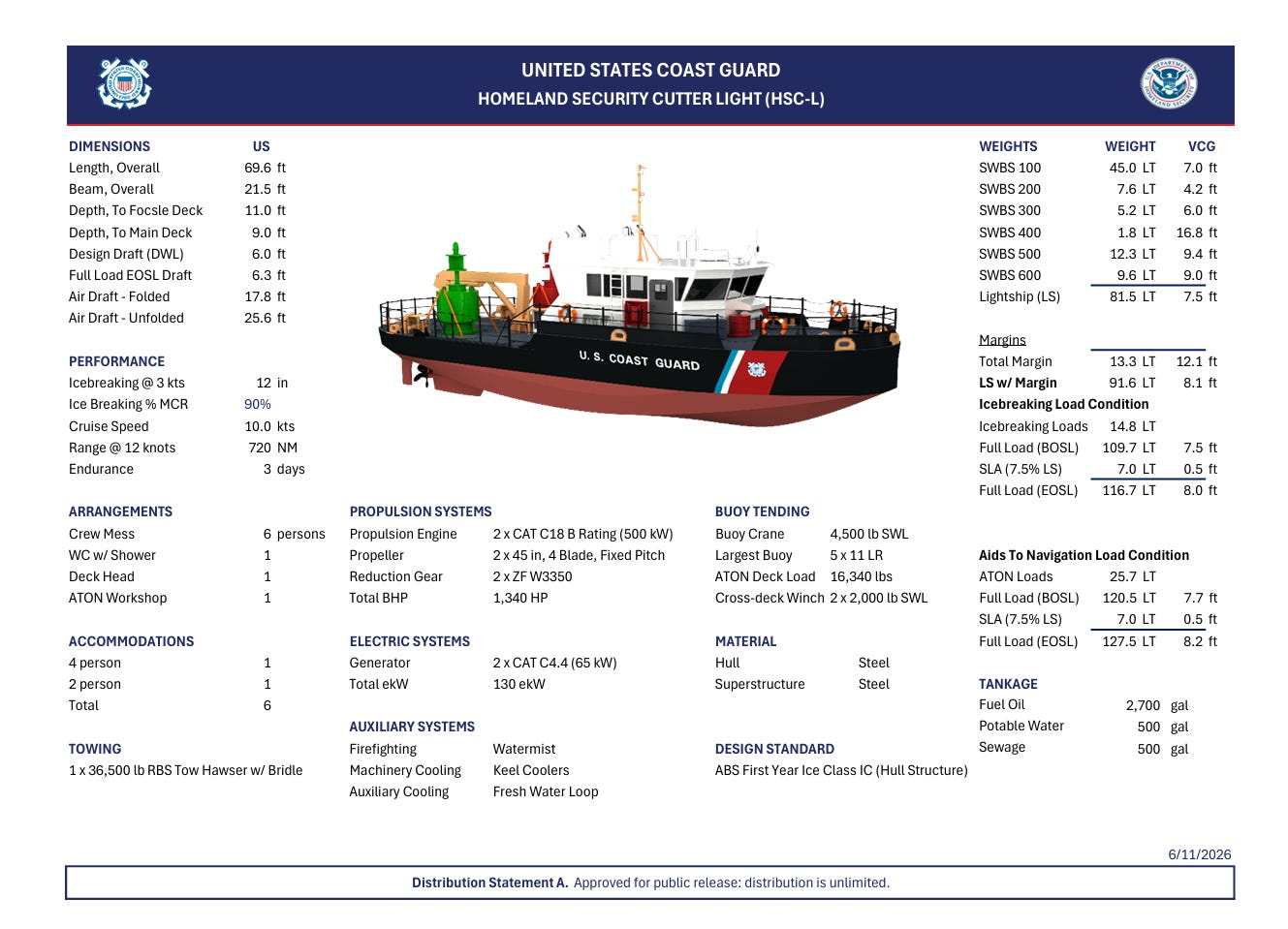
Initial submissions were due on July 14th. From those submissions, the U.S. Coast Guard will down select before proceeding to the second phase.
From the Seattle Times:
The U.S. Coast Guard is scaling back its once-ambitious plans for a polar security base along Seattle’s waterfront.
The Coast Guard announced in November that it anticipated growing its footprint just west of T-Mobile Park and Lumen Field to expand the country’s “maritime dominance.” The earliest phase of work, worth some $137 million, included plans to dredge the waters around Pier 36 and build two modernized berths, where yet-to-be-built polar security cutters could dock.
Now, the Coast Guard plans only to buy up to 5.5 acres of land at Terminal 46, adjacent to Pier 36, and another 1.1 acres nearby, the documents say. This land will be used to provide setbacks for “Anti-Terrorism/Force Protection.” That land purchase, should the deal go through, is as little as a tenth of the original proposed expansion.
At the same time, the Coast Guard plans to modernize or renovate existing facilities, the documents say. No additional ships will be able to dock at the base once the work is finished; instead, existing spaces for four ships will remain.
The U.S. Coast Guard cites environmental, economic, and Tribal treaty reasons for scaling back the project. From the Record of Decision:
Base facilities and infrastructure must be renovated and improved to provide continued homeporting for the Coast Guard’s fleet of polar icebreakers; however, the Coast Guard has determined that substantial expansion of Base Seattle would result in significant impacts to environmental, economic, and Tribal treaty resources. Therefore, the Coast Guard will seek to implement only some components of Alternative 1, as described below. This alternative does not include substantial land acquisition or establishment of any additional berths to support homeporting of other major cutters.
We can be our own worst enemy.
From a June 11 U.S. Coast Guard press release:
WASHINGTON — The U.S. Coast Guard announced it would homeport its first two Arctic Security Cutters in Kodiak, Alaska with a third Alaska Arctic Security Cutter homeported in Seward when the infrastructure is ready. This follows April’s announcement that the Service would homeport its first two Arctic Security Cutters in Alaska. With the first delivery expected in 2028, the Coast Guard is accelerating preparations to ensure each location is ready to support sustained Arctic operations including advancing critical infrastructure and housing required to support the trained and ready crews who will bring these cutters to life.
The U.S. Coast Guard issued a related press release on June 12th:
Coast Guard to build 30 additional housing units, child development center at Base Kodiak
WASHINGTON – The Coast Guard awarded two task orders in May 2026 to the Tutor Perini Corporation to construct 30 additional housing units, a child development center and other infrastructure improvements at Base Kodiak.
Both task orders were issued under the National Multiple Award Construction Contract III. The first task order, valued at $81.8 million, constructs 15 family housing duplexes, featuring 20 three-bedroom and 10 four-bedroom units. The second task order, valued at $61.6 million, supports construction of a 22,000-square-foot child development center and an 11,000-square-foot outdoor play area. Construction of both task order projects is expected to finish in 2028.
These projects mark the final phase of the Nemetz Park housing initiative, which has already delivered 50 new housing units for Coast Guard families at Base Kodiak.
When all of the upgrades are complete, we will have the Polar Star (to be replaced by the PSCs) and Healy in Seattle, Storis in Juneau, two ASCs in Kodiak, and one ASC in Seward. That will place many of our assets closer to the Arctic Circle (which is about 150 nautical miles north of Nome):
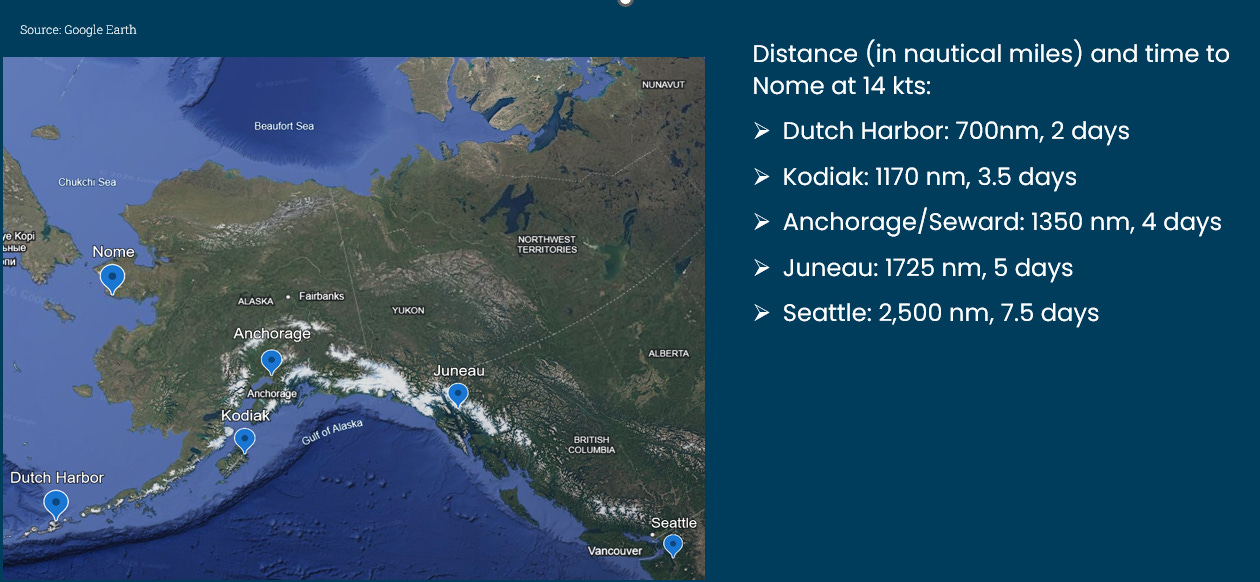
The planned expansion at Nome will make it suitable for a support location, but not for ship homeporting.
With the curtailment of Seattle’s expansion, eight ASCs still need homeports. Senator Angus King of Maine recently wrote to the Commandant of the Coast Guard, urging him to homeport at least one of them in Maine.
I think there is also a need to have these ships closer to Antarctic waters, but I will save that for future discussions.
There is not much public information available about the Polar Security Cutter program, and the information that comes out is generally not good. I would like to believe that the program is finally on track and will deliver PSC 1 in 2030, as these are much-needed vessels. But the GAO report makes it difficult to move past my continued skepticism. I am considering writing a ‘what went wrong’ article based on the publicly available information, but I’m not sure that there is enough evidence available to support broad conclusions. It could, though, explain some of the challenges.
The Arctic Security Cutter program, on the other hand, seems to be going quite well. I credit all those involved, especially in the U.S. Coast Guard, with taking the necessary steps to quickly acquire these much-needed vessels. I know many of my readers believe that a U.S. only build solution would have been better; however, the need for new icebreakers is urgent and cannot wait. Many shipbuilders assert that they can build a quality ship as quickly as the Finns do. At this late hour, though, you need to show references.
It is good to see the U.S. Coast Guard preparing home ports for the ASCs in Alaska. There will also be room in Seattle for some time, as the PSCs remain years away.
One final note: According to the U.S. Coast Guard, the Arctic Security Program of Record is for eighteen vessels. There is a need for polar research vessels, to replace the Nathaniel B. Palmer and, eventually, Healy (which is scheduled to start her Service Life Extension Program next year). Perhaps there could be an “ASC Flight III” research vessel variant to meet both of these requirements, while sharing major components with other Arctic Security Cutters.
There just happens to be a research variant of Davie’s MPPS design that meets or exceeds the National Science Foundation’s requirements for an Antarctic Research Vessel.
That’s all for today. Until next time—
All the Best,
PGR
Related reading:
Don't Double Down on the Polar Security Cutter
·
February 11, 2025
In December, the U.S. Coast Guard reported that actual construction work had finally begun on the first Polar Security Cutter, with delivery expected in 2030. Notably, according to the original 2019 contract, the first ship was expected to already be complete (in 2024). The program suffered a number of setbacks, including significant design problems. …
“Revitalizing Shipbuilding and the Maritime Industrial Base”, an April 22nd, 2026, Joint Hearing of the House Armed Services Committee’s Seapower and Projection Forces (SPF) Subcommittee and the House Transportation and Infrastructure (T&I) Committee’s Coast Guard and Maritime Transportation Subcommittee.
In a different part of the hearing, he stated that 26 modules were completed. Later, a Coast Guard spokesperson clarified that the 26 modules were under construction, not completed.
Comments
Nothing yet. Say the first thing.
Sign in to join the conversation.