
UC Riverside’s Writers Week Festival has been on my radar for quite some time and I was happy when I learned about it in time this year, so that I could attend the full festival. This was the 49th annual UCR Writers Week Festival, a number that was repeated before each session with an emphasis that next year’s 50th will be something extra special. Something to look out for. So read along on my experience this year, and make a note in your planner for next year.
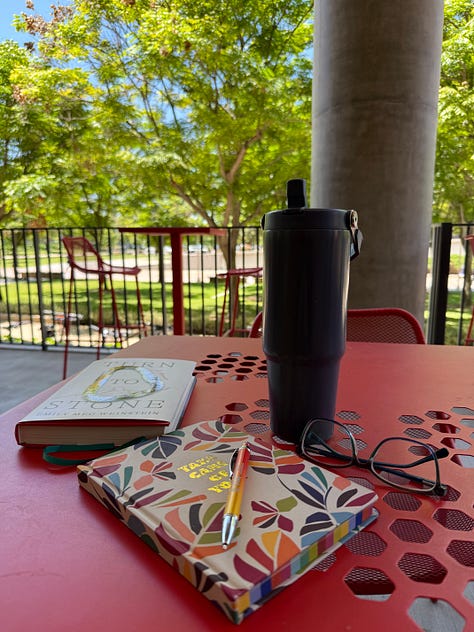
I lugged my journal and a couple of books I am working on in a tote bag each morning arriving at campus around 10:30 a.m. half an hour before the first presentation at 11 a.m. Each session started every two hours with ample time for the undergrad students to get a free book signed by the author and one-on-one time with them. And let me tell you, the authors took their time with each and every person. They were so kind and generous.
Settle in, this is a long post. If you want to skip to the highlights browse for anything in bold: Memorable quotes have been put in bold. Each day is marked with capital letters.
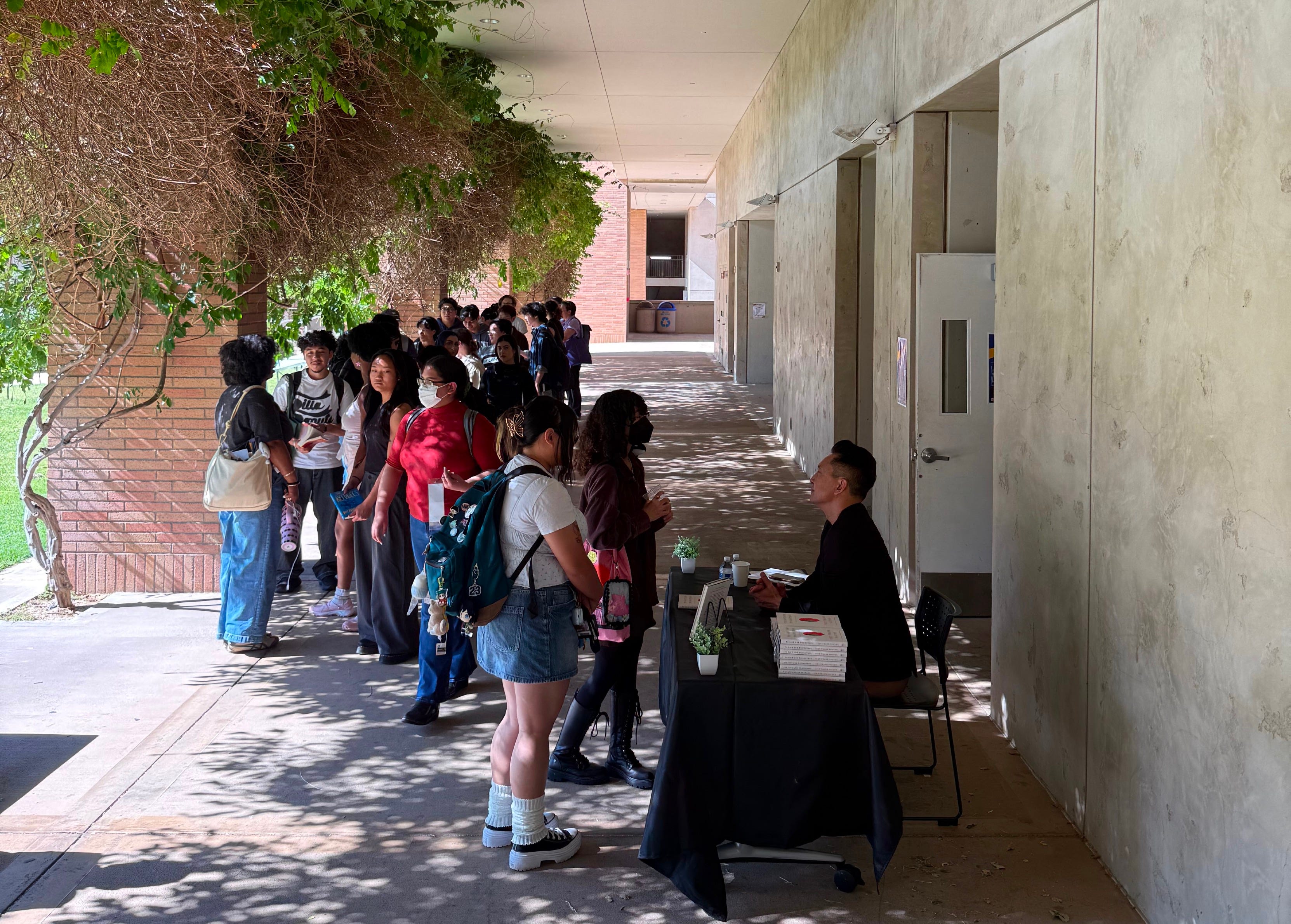
It has taken me close to a decade to call myself a writer. It is equal parts inspiring and intimidating going to an event for fellow writers (with the focus on undergraduates at UCR in creative writing or students in the MFA program). I do not have a degree in the English Language or the like. You don’t need to in order to write though if you attended the festival they would tell you it doesn’t hurt. What I do have is the consistency of writing, the will and a healthy dose of humility to ever think I belong among these great authors of which were plenty at the festival.
The festival is free and open to the public. Though on the first day, Tuesday, I think I was the only one who represented the public.
The point I am trying to make is that to have these spaces available for any writer is something radical and crucial especially for those of us (which are most of us) who make no money (or very little) for our writing. In the virtual spaces there are no lack of programs and offers that cost an arm and a leg and claim to help you get published/to write that novel/to BE a writer. Yet, what I have learned so far is that only I can do the writing, no one else can do it for me, and only luck and timing will help me on to the next step1.
I wish I had an agent or an editor breathing on my neck, telling me to write the book I’m supposedly writing (hi Cati, a fellow local writer and published author who asked me at the festival how my book is coming along).
On to the festival. I think TUESDAY was my favorite line up.
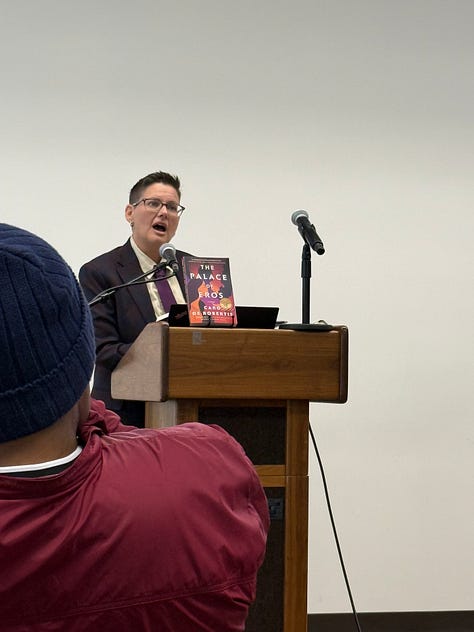
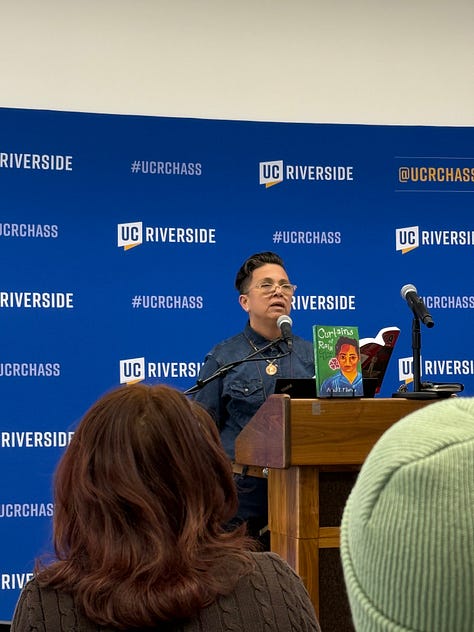
Caro De Robertis and Anel I. Flores, Latin American queer authors around my age talked about the importance of queer voices in literature while their erasure and disappearance is happening all over the US these days. “Queer and trans people have always existed,” Robertis said. When they looked at queer existence in Uruguay’s history and found none, they researched, found the data, people and stories and wrote them into existence. “We live in the reality of narrative scarcity,” they said and asked for the need to move to a narrative abundance of which they suggested to queer everything to bring balance to the world.
Robertis said that the most marginalized people today (trans) are at the heart of true freedom. Narrators like them have visions for the future.
Both Flores and Robertis were disowned and disappeared by their parents when they came out. That was why Flores said, “I name a lot of things, plants, animals, people. So many things that are disappearing.” Naming is taking power back.
Flores told us to call on our ancestors defined in a broad sense because writing can be very solitary. I wondered who my ancestors would be in the creative realm, since I read Octavia E. Butler I’ve been calling on her.
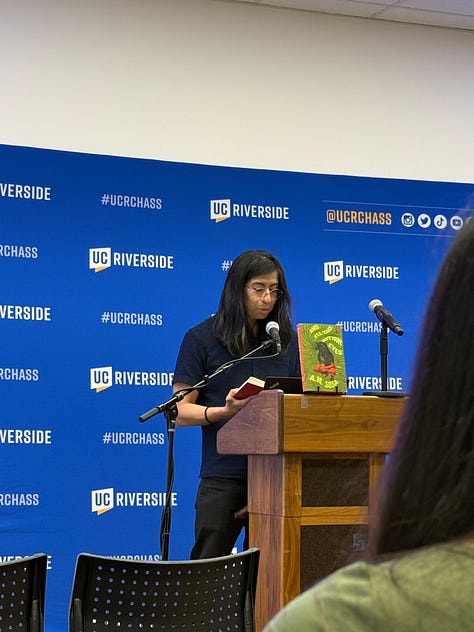
Then A.M. Sosa got to the front of the room. Now here was someone way younger than me, someone who could slap some nonconformity into me, someone who had the audacity to break all the rules and get away with it. They challenged the father’s idea of masculinity in “And I’ll Take Out Your Eyes” a title coming from the saying: Raise crows and they will take out your eyes.
Each author showed examples of incorporating Spanish in their works as a normal way of writing. “This is what it feels like in this kind of community,” Sosa said. Spanish words and phrases mingled with the English syntax, they were not translated.
They also reiterated that as a writer you need some humility to take criticism to heart but at the same time “Keep your F U attitude.” To the students in the room (and I was all ears) they said to be an art monster, be vicious about reading and writing and find a way to love and appreciate the discipline of writing.
Most of all Tuesday’s sessions were a call for queer stories to be written as they are getting banned nationwide, we need more of them not less.
Whew. One day in, three to go.
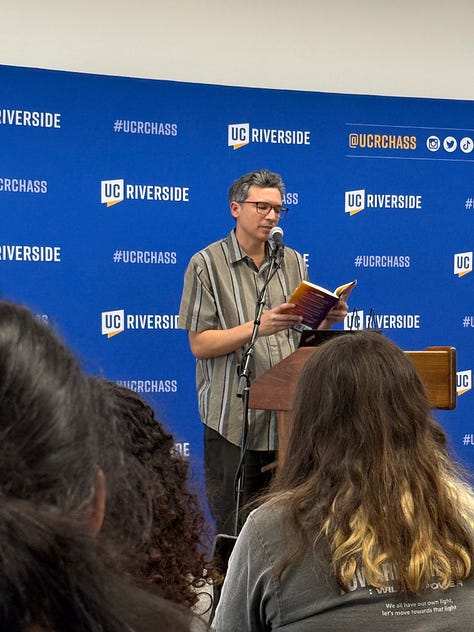
On WEDNESDAY one author had to cancel, but I spent the time wisely by writing and reading. Then Jose Vadi read from his newest skateboarding book “Chipped.” The room was packed.
His writing effused an extraordinary talent of writing about place. “Believe in the power of place,” he said, describing how place can inform our ideas of identity.
He talked about a writer’s life, that all of his essays had been hard nuts to crack but “That’s why we do it, to see if we can.” He told us to capture ideas however fleeting they might be to see how they might connect to other thoughts. He said to journal. And to do goblet squats before your skateboarding session, walk or stretch before you write.
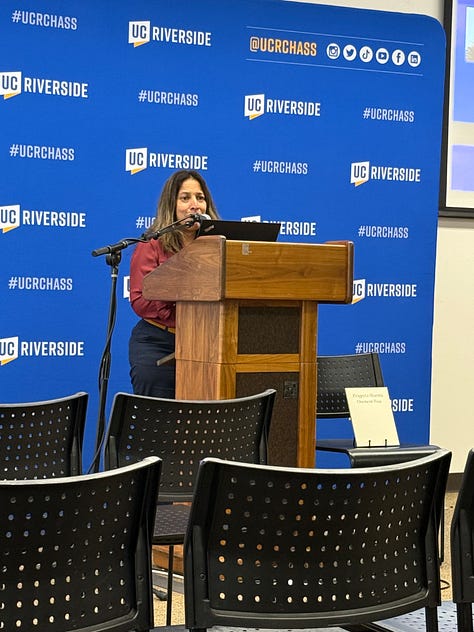
Poet Prageeta Sharma ended the day reading poems out loud. Her personal story of writing from grief when she lost her second husband2 to cancer and her mom in 2023 was so deep and comforting. “I was finding ways of thinking of suffering,” she said. I especially liked the way she considered the process of grief and how to take care of one’s self in a poem. Or the way she’s always been rebellious and write poems that challenge norms. “I’m interested in inclusive spaces where you are allowed to write as you are,” she said, giving the writers in the room permission to write outside of the Western norms.
Then came THURSDAY and I noticed a creeping of other people from the public filling the seats in the room. I met people I know from Inlandia where I’ve attended events and workshops as a budding writer.
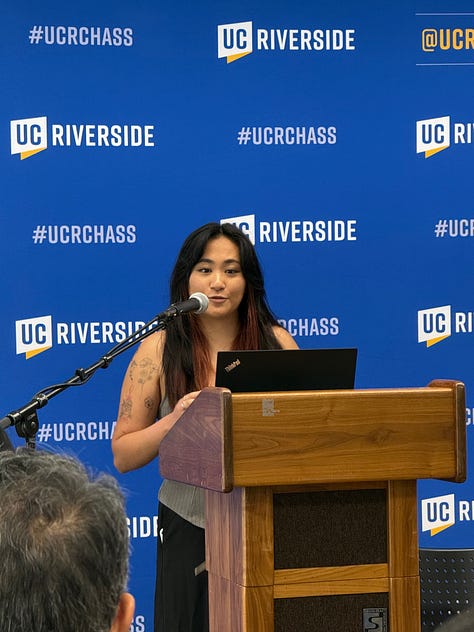
In the morning UCR students shared their writing through the Mosaic literary magazine3 they’ve revived and reinvigorated in the past academic year with three issues. They shared work from the latest issue “Archive” while giving the audience a copy of “Sculpt” (the very first issue was made by student poets in 1959).
Alyssa Miyasato, the editor in chief, said: “If I don’t write for the people I’m writing for, who is going to do it?” As a call for action for all of us in the room.
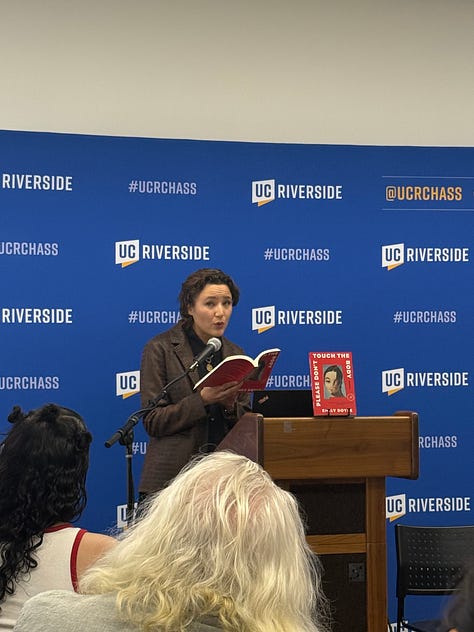
Then came Emily Doyle, a recent UCR MFA graduate, whose debut short story collection “Please Don’t Touch the Body” has been named the most anticipated book of 2026 (available in July). Lucky undergrad students got a signed copy of the book at the festival.
All of the authors read their work, either from different publications or from their recent publication for 40-45 minutes with 15-20 minutes time for questions from the audience.
At Doyle’s presentation she read one long short story from her upcoming book, it addressed anxiety and hypochondria. I identified with the anxious thoughts of the main character, where was she (Doyle) going with this? How would this story of the visit at the oyster farm ever end well? Did the wife of the Swiss couple burn their house? I wish she did. I rooted for the main character to make the right decision, but did she? And then Doyle got to the last word of the story, a quote from the main character, and that word. Man, it gave me chills. Please, please, please, promise me to get the book this summer then meet me for coffee and let’s talk about it.
Doyle told us not to be afraid of revisions. “I was afraid of revisions,” she said. “If I changed the words of a sentence, I would never write a good sentence again,” she thought to herself but that was a lie. She said, revision is looking into how to do more of what you are trying to do.
She said difficult things in your life, traumas, write around it until you write about it.
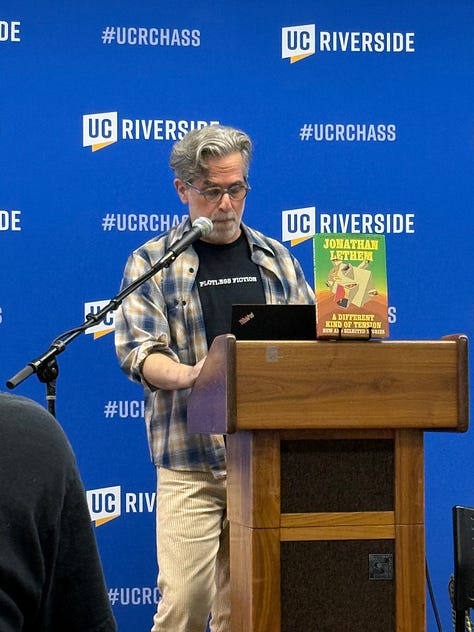
The next author, Jonathan Lethem also read a short story of his. He wrote “How We Got in to Town and out Again” in 1996 as a critique on VR headsets and the whole idea of VR. It took him 55 minutes to read the story aloud. The piece was not outdated, the questions it asked, the themes it addressed were as prescient today as it was when he wrote it 30 years ago.
His short story can be found in his recent collection: “A Different Kind of Tension.” The story he read aloud was inspired by the 1969 movie, “They Shoot Horses Don’t They?” and proletariat writers from the 1930’s. The message for all of us in the times we live in was: You lose - you lose. Fun!
FRIDAY, the last day of the festival, people of the public and students were there in throes. I was not an anomaly anymore. The organizers thanked not only the students for being there but us too (and their sponsors).
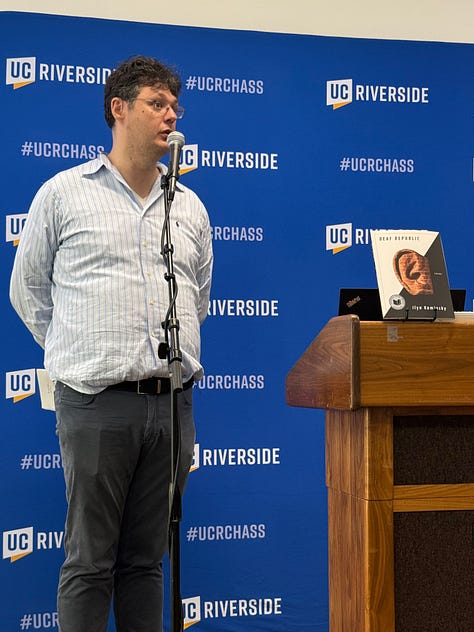
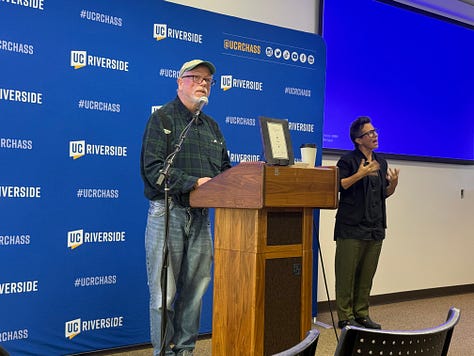
When poet Ilya Kaminsky arrived at campus printed copies of the poems he was going to read sat on our chairs. Kaminsky was born in Odesa, Ukraine (then USSR) in 1977, and arrived to the United States in 1993. He lost most of his hearing as age 4 and throughout the day two sign language translators were on stage translating for him.
His award winning narrative poetry collection “Deaf Republic” he read aloud from was published in 2019. But I could or did not understand, because every word exists in our world today, every narrative is happening now, every word spoken speaks to us now, seven years later. It felt like a needed provocation.
Before he recited his own poems, he read: “Letters of the Alphabet Goes to War” by Lesyk Panasiuk (2026). A poem Kaminsky has translated. The scene was set. The recitation was a performance and the audience clung to each word like a life raft too small to hold us in the world we live in.
Kaminsky described a poet as a professor in the five senses (through a quote from a Spanish poet). He said, “A poem is not about an event, it is the event.” He said poets are philosophers because they write about “The questions human beings are obsessed with.”
Check the website and support Kaminsky’s non-profit org here: Poems Not Bombs.
I promise, we are almost at the end of a jam packed week. This is probably why, most people from the outside only show up for one or two days, instead of all four.
Poet D.A. Powell said, “Welcome to the heatwave of the afternoon.” His poems were humorous and ‘the next one will make you gasp’ said the person who introduced him.
His poems were steeped in film lore and growing up gay in the Central Valley at a time when that could be deadly. His writing was a way to inscribe his own queer existence into the Central Valley in what he called a “Useless landscape.”
The first poem he read aloud was inspired by Batman & Robin, a comic that described anything that happened in the 1960’s according to Powell. He talked about his favorite movies, “After Hours” and “Nashville” both movies described one night and three days respectively. It was an example of how a poet thinks in precise short moments.
“Get the crappy poems out of the way as quickly as possible,” he said to the students. He himself wrote bad poems for a couple of years before he figured out whether he could maybe write good ones.
“Every time you feel you are being locked into something, always try to push against it,” he said of his writing. Whenever he felt suffocated, it felt like he was being shoved back into the closet and that was something he vehemently opposed. “I try never to tell myself what I cannot do.”
Powell did not think his poetry was written with talent as much as tenacity. And he told us writers, “Nobody cares if you’re a freak. We’re all freaks!”
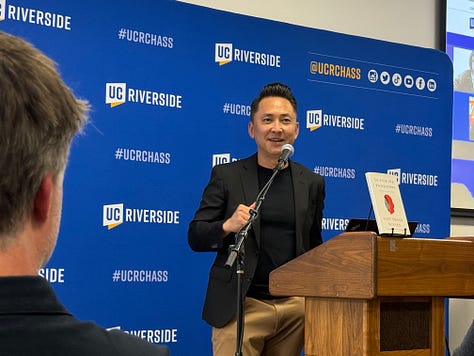
The festival ended with Pulitzer Prize winner, Vietnamese refugee and an author that challenges the dominant American narrative as said in the intro, Viet Thanh Nguyen.
Here was a smooth talker, someone who speaks for a living and has the audience wrapped around his little finger I thought. This. This type of story teller is a rock star.
Professor of Sociology, Reza Aslan described his writing as “fiction not as an escape but as a confrontation.”
Nguyen came to the US in 1975 when he was 4 years old. He was a freshman at UCR in 1988/89. He said he always had a desire to be a writer. “My parents didn’t know they were raising one of the most dangerous creatures. A writer,” he said.
He reminded the audience that the US “is a nation of strangers.” He questioned why Vietnamese people close the door for new immigrants when they themselves are grateful to be here. He wanted his writing to open the door to our hearts and minds.
Nguyen equaled stories from his refugee childhood in camps with the current detention camps which he called concentration camps. He spoke about Hollywood and it’s part of the American Industrial Complex and how the culture wars are the real wars. The negative attacks on campuses, banning books and fighting DEI and affirmative action prove they4 are needed, he said. He was not a mincer of words.
He told the students “Where you’re afraid of going is where you need to go” with their writing and about the non-linear ways of memory. He did not like to be described as an experimental writer, but saw himself as playful (he focused on the childhood sense of imagination that most of us have forgotten).
And then he spoke of raising kids, fostering their imagination, and how his then 5 year old son’s story of pirate chickens became the picture book: Chicken of the Sea.
“I wish someone had told me writing is more than craft and labor,” Nguyen said to an audience members question of what he would tell his younger self, instead he said, “[Writing] is looking into one’s own interior.”
It was a week full of 11 presentations under my belt. Imagine what my life would have looked like had I had this type of encouragement in my early twenties but no. Instead it took me twenty years to even begin my dream of becoming a writer, the last decade I’ve been claiming the title writing drafts of books hidden in a folder on my computer. For UCR to provide this kind of conference for free and open to the public is an absolute gem. It’s awe inspiring to see a community of writers in action. Because they are right, writing is solitary work but it doesn’t have to be.
I hope the undergraduate students appreciated the words spoken to them of following their dreams, to keep writing and that their stories matter so much in our world and are needed.
Thank you for following my writing. I write about events in and around Redlands that support our local community and make this city a better place. Please share, subscribe and like.
In Gratitude,
Siw
Of course there are plenty of affordable programs and people online who will give you a push in the right direction without grifting you of your life savings.
She lost her first husband to cancer too. And she was still so young.
Read the literary magazine for free on the website.
Books, higher education and education in general, DEI and affirmative action. The bulk of the culture wars. Notice how many of the authors at the Writers Week were either queer or immigrants.
No posts
Comments
Nothing yet. Say the first thing.
Sign in to join the conversation.