
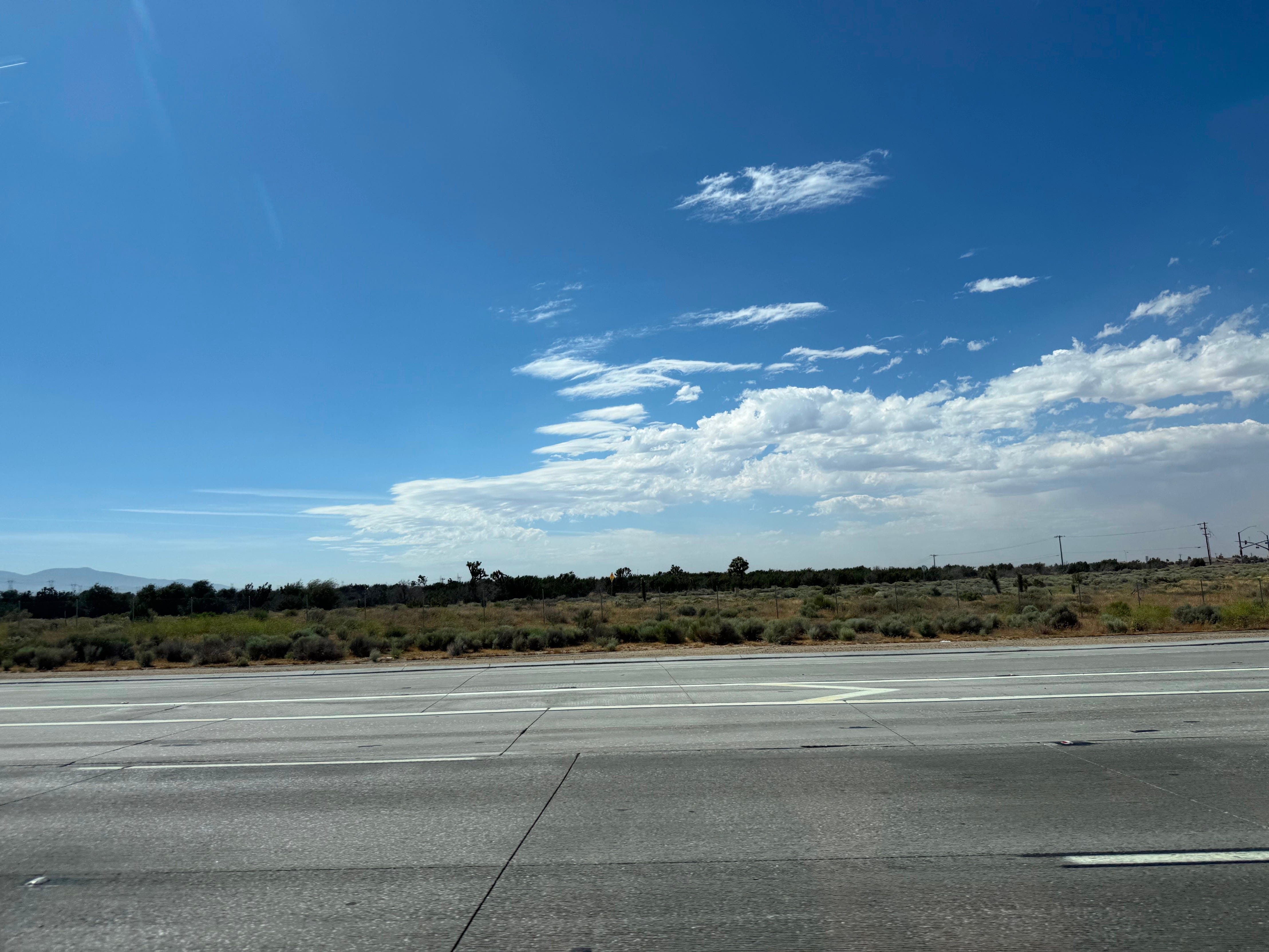
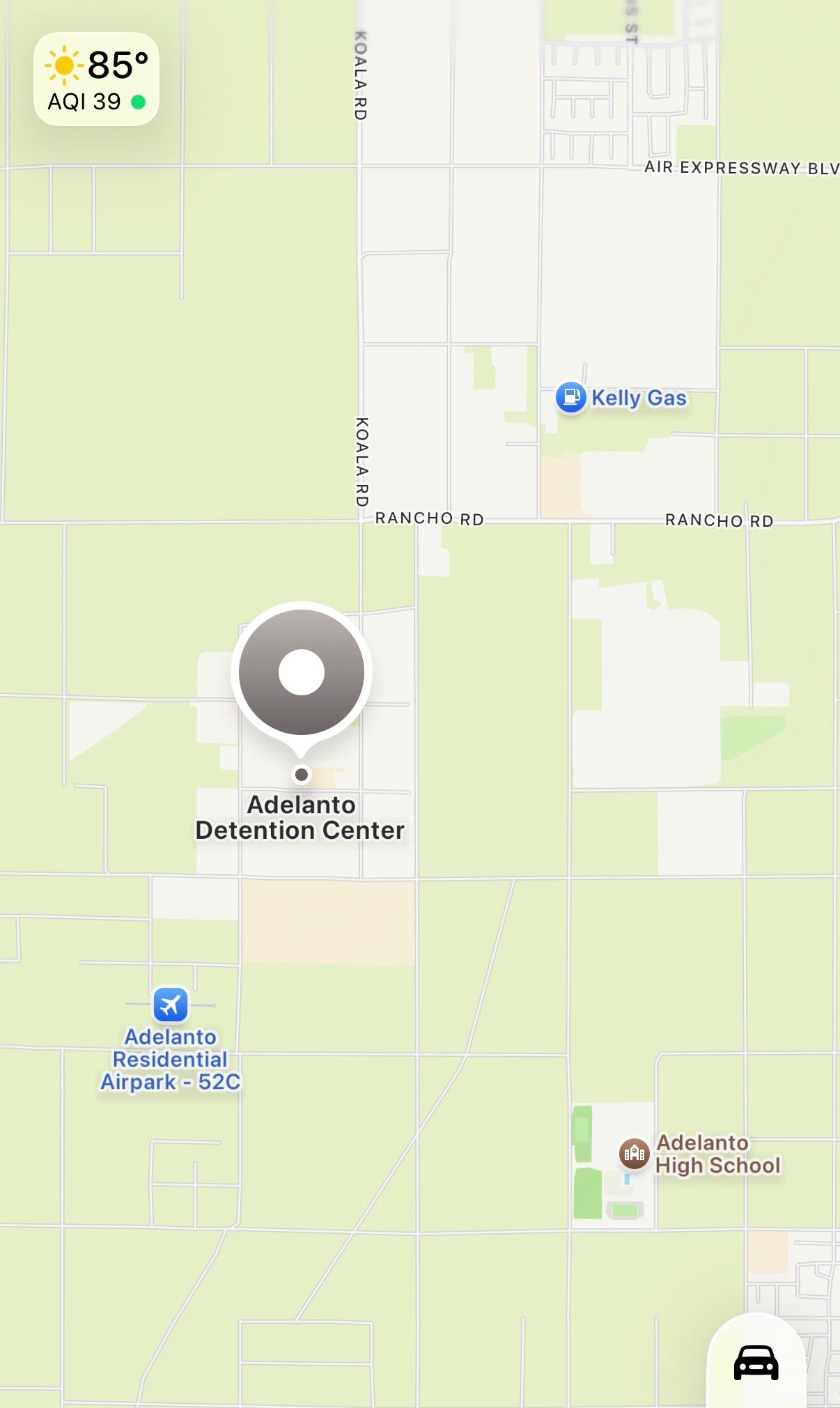
I watched the sugar white clouds weave in and out of the frame of barbed wire that coiled on top of the chain link fence. Judith and I were told to wait outside until our visit, we were there to speak to a detainee at the Adelanto Detention Center.
I thought about the snazzy Porsche parked in front, did it belong to a visitor or an employee? How long had we been waiting? Did the ground squirrel know it dug its holes within the fences and were effectively detained too? The dry desert ground strewn with gravel was the only nature around, that and the light blue sky like the eggs of a robin. Was this the only view of the detainees inside?
This week was my first visit going to jail. Unless you count the numerous times I followed my dad around on his tours of our local police station, his work place as a criminal investigator. When my class took the tour he locked (okay, closed the door) to the holding cell on the unruly boys and bullies, making them realize there was no door handle on the inside. Their agency and perceived power gone. Even for a few minutes. But would the lesson stick?
The visit that day was organized through one of the local immigrant justice organizations (Inland Empire for Immigrant Justice) that try and keep an eye on things and be a source of assistance through these difficult times. Today, our job was to be eyes and ears1. Listen to the conditions, what type of help is needed, including legal help. We had 17 questions on a questionnaire to fill out after the visit, because no phones, no paper, no notes, no pens were allowed inside. No jewelry, no leggings, no short pants or skirts and no brand names printed on the clothes (apparently that can be read as gang related).
Two of the four of us leaving Redlands that morning at 11:30am had to swing by my house so that I could switch shirt and Hannah could cut the wires out of her bra.
My youngest kid read Anne Frank this school year and asked about the detention centers. She was frantic about the people who stood quietly during the Nazi regime and did nothing. “But we are doing something, mom,” she said. I thought this visit was ‘something.’
It took us just over an hour to get to the facility and we did not want to be turned around and sent home.
A detention center is just like a prison except people who are held there has not necessarily received due process, they did not have their rights read to them, they do not always know why they are there or for how long they will be there. I listened to a panel discussion from March about the current situation and history around concentration camps, which some people call the facilities where over 70,000 people are being detained since 2025 (21st century American concentration camps).
According to Andrea Pitzer2, researcher and author of “One Long Night,” the definition of a concentration camp is mass detention based on identity (something you are rather that what you’ve done), there is no due process and trials are for show, the camps are done to entrench and expand political power for an authoritarian style government.
Judith and I talked about how us modern people have lost the skill of tracking time. We had given our ID to the front desk guard, told why we were there (to visit a friend3) and been asked to sit outside. Even though we sat in the shade, heat was creeping up. I gulped large mouthfuls from the disposable water bottle I had brought along knowing very well that I couldn’t take it inside. How long had we been waiting? 30-45-60 minutes? Then a guard asked us inside. We had waited 45 minutes.
We walked through a metal detector frame, pockets pulled inside out, then a guard unlocked and locked three doors through two hallways before we were designated a table with a number on it: 11. Then we waited some more.

The young man we met was stoic, calm, and I would say almost serene. He put his faith in God to figure out his situation. A situation of which he was an asylum seeker who went to his court appearances as he was supposed to but instead of meeting with the judge, ICE agents snatched him up outside of the building. They took away his due process. He had not done anything.
He was an able bodies, healthy young man. “Yes, we are treated well,” he said. I thought about those who are disabled, older, with chronic diseases or mental health issues. They might not fare as well in a 60 people room with bunk beds (we were told it was about double the size of the visitor room). An estimate said in 2026, 18 people have died during detainment, five of those through suicide.
The visitor room was full of visitors, family members, a mom with two little kids, a priest, a girl friend, friends. The toddler slept on his mother’s lap, his big brother tinkered with a baby toy, moving wooden blocks from one end to the other on a wire. Much like the conversations’ cacophony in the room, talking about one issue after the other, no talking would change the outcome or let anyone back outside, where Joshua trees reached their arms towards freedom.
Two of the detainees wore orange instead of navy blue. Orange is the color of criminal offense. Navy blue is the color of what offense exactly? Undocumented is a civil offense, not a crime. An estimated between 75-80 % of people detained are non criminals in the current system. Why keep them there? Our guy lost his job while being detained. He was working, paying taxes, in the immigrant system, filled out his papers, showed up to his appointments. He had been there for two to three months but said he met others inside who had been there for 15 months.
ICE agents have a quota to reach. At the end of each month, the kidnapping of sometimes even US citizens and other documented people is at its highest.
The detainment system is run by a private prison company GEO Group that landed a federal contract to open for-profit, private immigration centers all over the US. They make more money the more they keep in the system.
The Adelanto Detention Facility is almost full, just over 2,000 people are kept there, at either the East or the West wing. We visited the East wing, the smaller wing.
At 4:30 a.m. breakfast is served, lunch is at noon and dinner is served at 5 p.m. The man we spoke to said, “There is not enough protein. Many meals have no protein.” Full grown men go hungry, unless they have money for the commission, which ours did.
A phone call costs 7 cents per minute. It’ll cost you $4.20 to talk to someone for an hour, money you might not have. But you can work in the kitchen, do laundry or do the cleaning for a whopping $1.00 per day which would give you 8.5 minutes on the phone. The work they are doing means the GEO Group doesn’t need to hire someone doing that chore. You would need to work almost five days do get an hour of phone time with your loved ones. That’s a full time job.
Sometimes a guy will go nuts inside (either from untreated mental health issues or withdrawal symptoms from drug abuse), but our man told us in his unit they support and help each other. They would find a way to help that guy calm down. In other units there is unrest and conflicts between people. It mattered where you were detained, what room, what facility4.
There is an hour of library time per day Monday through Friday, one hour recreation time outside per day. To get someone to visit you kills another hour inside the room where you otherwise have nothing to read except the bible (it’s available in Russian, Spanish and English).
Judith asked if she could tell the prayer for protection to the man. He nodded.
“The light of God surrounds me,
The love of God enfolds me,
The power of God protects me,
The presence of God watches over me,
Wherever I am, God is.”
Our hour was almost up. We wished the man well, we wished him good luck on his upcoming court appearance (all court appointments happen via video call, a man in orange was called into the visitor room just before we left, he was let into a small closet like room where a computer screen greeted him). We took this man we had spoken to’s hand in both of ours. It was time to go.
I will never forget the face of the girlfriend saying goodbye to her man, cheeks streaked with tears (her man was covered in tattoos, bulky like a bull dog, in an orange suit, I thought maybe just maybe it was okay they were separated). The mom with her two little boys clinging to their dad before they were pushed out the door. The priest who stood up in his long black robe smiling to his detainee before they parted ways, or the older grey haired gentleman detainee who gently folded his hands behind his back as he lined up to leave the room with all of the other detainees. The young man who visited him nodded, like saying goodbye to his professor. And I will never forget the hopeful face of the man we spoke to.
In the car home, Keith a retired professor, Judith a retired psychologist, Hannah a teacher who started her career teaching refugee children English and I (the odd duck) talked about our visits. The car this time turned on the paved roads seemingly like it had done it a thousand times before. Hannah nodded as we drove by a taco restaurant, “They have really good tacos if you don’t mind sharing the place with ICE agents.” At that point I kind of did.
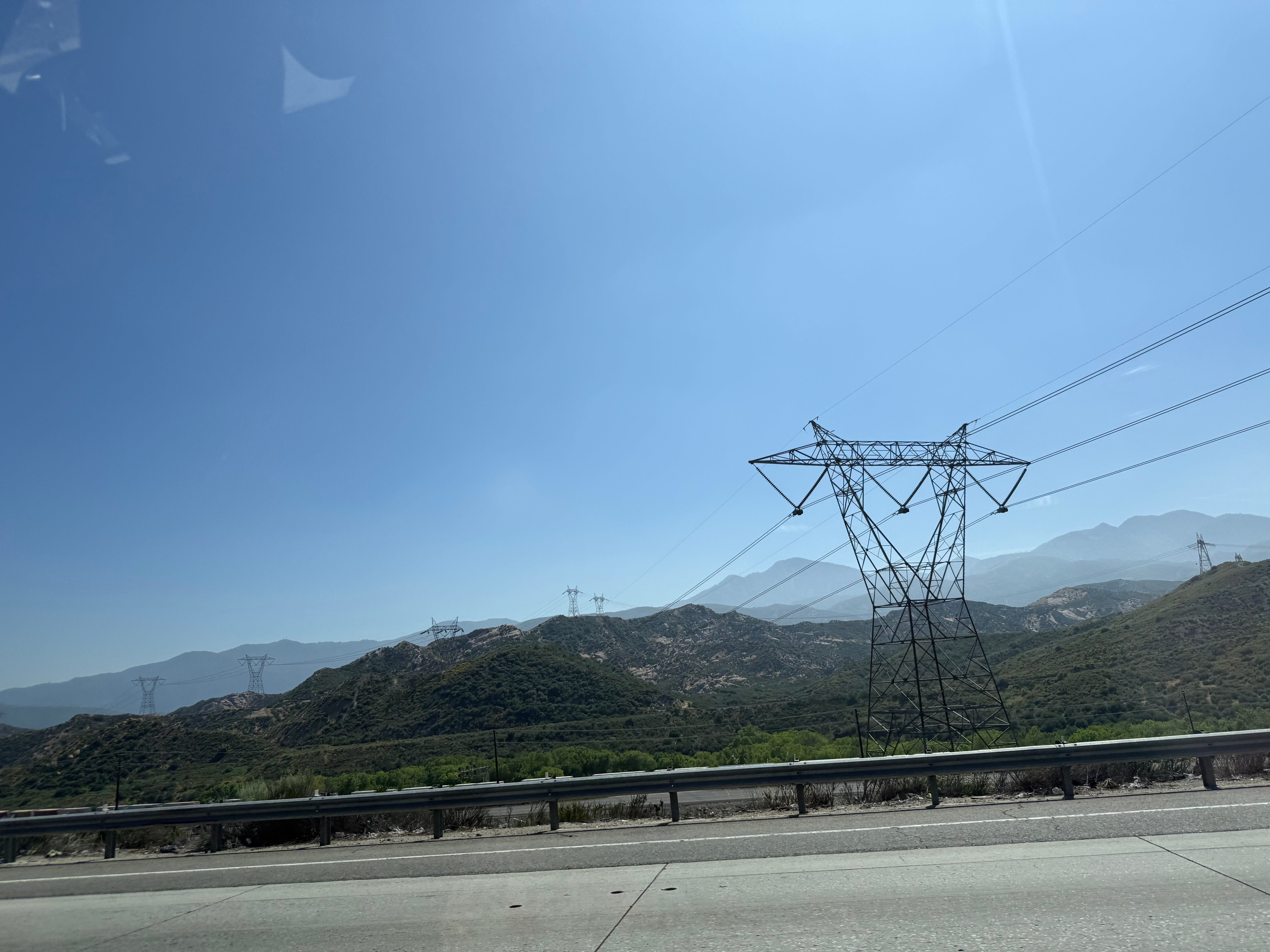
We traveled three weather zones back from the high desert to the valley, just like Judith said she used to think when she worked in the area for thirty years commuting back and forth to Redlands.
I looked at the scorched mountain sides, the brush and dirt and nothingness that mirrored the mood I was in. Here was two thousand people waiting for their fate to be decided: To stay indefinitely, to be shipped to another detention facility, to be escorted out of the country, sometimes to a different county than their origin, or to stay in the US. Would the man we talked to get out soon? Was he one of the people who they say ‘most are let out after three months’5? How would I know?
It felt like an hour investment talking to these people would haunt us for the foreseeable future. Then I looked at the birds so carelessly flying from the bushes to the sky. Maybe God (or whatever power may be) did have this man’s back, he was after all a very devout Christian man. I listened to the conversation in the car drift towards the upcoming election. The drive took us just over an hour. We beat the afternoon traffic.
According to a presentation I watched, the US government is planning on acquiring existing warehouses to add an additional 80,000 detention beds. Eight huge detention centers are planned to hold up to 10,000 people each. For reference, 7-10,000 detainees at one facility is the size of Manzanar; A blemish in US history when during the Second World War Japanese Americans were held in camps just for being who they were.
The goal is to deport 20 million immigrants according to the current administration during its time in power (four years). In comparison it took the Soviet Union more than 20 years to put 18-20 million people into the Gulag. The speed of reaching these goals today cannot be done without tremendous suffering and deaths.
Everyone knows cities like Auschwitz, Buchenwald, Theresienstadt and Bergen-Belsen. Ask your city council whether they want to be known for having a 10,000 people detention center and be connected to a concentration camp.
Ending on a hopeful note: “History isn’t what happens to us, history is what we make happen,” said Frank Abe, journalist and film maker in the presentation. “This is not inevitable.”
As long as there are enough people fighting injustices, as long as..
Watch the presentation on detainment centers in the US 2026 version by The Contrarian here:
Follow Project Salt Box, an organization that collects data on where warehouses are being acquired and how ICE gets their equipment through military contracts.
Follow IE4IJ here in the Inland Empire, take their trainings and join the fight against unjustly detaining people just to reach an arbitrary number. Immigrants are valuable - Heck, I am one of them.
Thank you for following my writing. I write about events in and around Redlands that support our local community and make this city a better place. Please share, subscribe and like.
In Gratitude,
Siw
We had to call the detention center in the morning to make sure the visits were happening. This extra step of checking in was crucial, other volunteers have gone there to be told the detainee was not available after all.
You can listen to her contribution in The Contrarian presentation which I’ve linked to at the bottom of this piece.
A stranger is a friend you haven’t met yet.
How many end up in the facility over and over again because they fit the profile?
No posts
Comments
Nothing yet. Say the first thing.
Sign in to join the conversation.