
Since the dawn of time, sexuality has been a subject of cultural explorations: from stories and paintings that predate civilisations to performance art and writing, erotic depictions transcend genres and forms and play an important role in shaping our understanding of self. Throughout history, sexuality “had little need of secrecy”, at least in the West, and laws regulating explicit imagery had been lax, if at all present.
“The Accessibility Apprentice” is a free newsletter. If you wish to support its charming author, donate a few dollars!
The British Empire’s 1854 legislation prohibiting obscene publications put an end to what Foucault described as an era of “direct gestures, shameless discourse, and open transgression”: sex ceased to be a personal matter and became an instrument for governing and policing the society by charging discourse of sex with anxiety, taboo, and tension. The hypocritical restrictions did not simply push sex into the state where “there was nothing to say about such things, nothing to see, and nothing to know”: it created a power imbalance between those authorised to discuss sex and those forced to silence their urges. The new regulations formalised the privilege of instigating discussions of sexuality, turning a person engaging in such discussions without permission into a rebel, placed “to a certain extent outside the reach of power”.
It wasn’t long until we found ourselves struggling to talk about sex. Omnipresent restrictions have butchered our art, scarred our minds, and carved "obscenities" out of our language.. To this day, the taboo on discussing sexuality continues to inspire elaborate forms of regulation: from fig-leafing Shakespeare to inventing euphemisms for death and sex to avoid account suspension on Instagram and TikTok.
The human body continues to fascinate and revolt us, and the call to revitalise open discussions of sexuality continues to clash with institutionalised and self-imposed restrictions in the name of “protecting the innocence of children”. This duality manifests in the tense relationship between the public and the USD 71.6 billion global adult entertainment market. On the one hand, supply and demand increase steadily, even in regions with strict laws prohibiting explicit materials, and the industry continues to grow year-on-year. On the other hand, adult entertainment—riddled with problems of exploitation and abuse—occupies a moral “grey zone”, tucked away from mainstream media and workplace-friendly content, and the carefully cultivated attitude toward sexuality as a "spicy" topic perpetuates exclusion through the oppression of language and stigmatisation.
The barriers to discussing sex have so deeply penetrated our social structures that we struggle to let matters such as sexual abuse — or the accessibility of adult entertainment — enter our sanitised spaces. As a result, large groups of consumers and producers with needs for sexual gratification remain absent from the discourse. People with disabilities, for instance, had long been perceived as “asexual or unable to control themselves sexually”, incapable of experiencing pleasure or having higher priorities in life, as having no need for sex or as being possessed by animalistic urges.
Adult entertainment spaces have formed with little consideration for inclusivity and faced serious challenges throughout many attempts to shatter the barriers: technical limitations, financial concerns, but most significantly, biases and taboos. Discussing accessibility invites reflection on our unnatural discomfort with sexuality.
Why should we care about making sex accessible? Who should finance it, implement it, and ensure compliance? And, to quote every bad parent and every terrible manager ever, “don’t we all have better things to worry about?”
In 1931, the US Congress established The National Library Service for the Blind and Print Disabled (NLS)—a free program to distribute education and entertainment materials to people with disabilities. Today, its catalogue contains over 300,000 talking and Braille books, music scores, magazines, and more. Over 30 books in its impressive collection are labelled “erotic fiction” and “erotic stories”, including the 1977 “The Professor of Desire” by Philip Roth and Ernest Hemingway’s “The Garden of Eden”, published posthumously in 1986.
Neatly tucked between high prose and pulp fiction, rest the legendary Braille Editions of Playboy. NLS started producing them in the 1970s, when Playboy was at its peak: thanks to its willingness to “publish things that other people wouldn’t”, the magazine had accumulated a massive library of works by established and novel writers, such as Jack Kerouac, Ray Bradbury, Arthur C. Clarke, and many others. The Braille edition, which obviously did not contain photographs, explicit or otherwise, made these publications accessible, but to concerned conservatives, the magazine’s name alone was enough to get triggered.
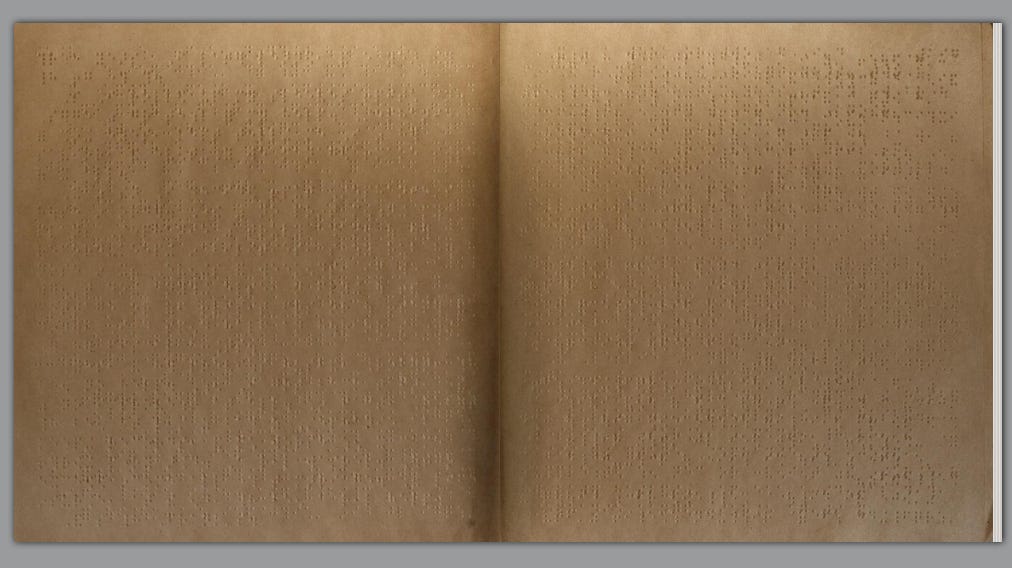
In 1981, a group of Republican politicians, having just increased their own allowances, started a funding debate, demanding to cut the state support for the production of Braille editions of “Party Jokes,” “Ribald Classics,” and “Playboy Forum”.
At first, At first, senators did not take the proposal seriously — one Republican politician was quoted defending the publication as "one of the few enjoyments people with that infirmity could have". In 1985, however, the conservatives managed to convince their colleagues that “promoting the reading of Playboy in this way does lead to undesirable activities”. NLS lost some $100,000 of annual funding, but luckily, not for long: a group of blind Playboy readers filed a lawsuit and swiftly won the case. The U.S. District Court judge condemned the Senate’s decision as the 1st Amendment violation, and the publication of the Braille Edition of Playboy resumed in 1987.
The relatively swift resolution left little room for deeper reflection on disability and sexuality. Was it fair to rob an entire group of people of a certain type of entertainment purely based on someone’s subjective notions of “desirability” and “purity”, especially when the same materials remained available to the public? Perhaps, it wasn’t, but the U.S. court, first and foremost, was protecting the freedom of speech and press, not so much calling to challenge the marginalisation of people with disabilities. The Braille Playboy returned to the library as an obscure and fascinating niche product whose existence demonstrates the need for accessible adult entertainment, but falls short of provoking a deeper discussion of sexuality and disability.
Audio descriptions in visual media have been a thing for a long time. According to Netflix, nearly every title on its platform is equipped with the audio track providing detailed description of each scene, and its Audio Description Style Guide is rich and incredibly detailed. As some Reddit discussions will show, sighted users, too, enjoy watching videos with audio descriptions from time to time.

Pornography recently began adopting audio descriptions as well. In 2007, digital artist Melania Hoff and filmmaker Horatio Baltz launched “Porn for the Blind”, a non-profit campaign to crowdsource spoken audio description of adult movie clips. A short-lived program managed to collect a number of submissions, albeit predominantly of poor quality: some critics noted a “veneer of ableism that hides behind the idea of an accessibility service”. Volunteers clearly treated audio descriptions as a comic exercise, as evidenced by the laughter some struggled to suppress, not a serious attempt to provide equal access to adult materials.
Pornhub, the most visited pornography website, launched a dedicated category of pornography with audio descriptions in 2016, and this time around, professional voice actors were hired to narrate the scenes. At the start, the collection contained 50 most viewed videos, but over the decade, the accessible library has grown significantly.
To any critics raising their puritan eyebrows, Joel Snyder, director of the audio description project at the American Council of the Blind, explains:
People who are blind have every right to access porn as they do classical Shakespeare or any other kind of video […] there’s no good reason why a person with a physical disability must also be culturally disabled.
Providing high-quality audio descriptions to adult videos is a challenging task. Audio is recorded after the fact and synced with the video, forced to coexist with its diegetic (meaning, occurring in the scene) sounds and often clashing with them. The quality of narration from both technical and artistic perspectives ranges from crisp and professional to downright unbearable. The unbiased outsider’s perspective of the narrator inevitably feels detached from the scene: when asked about her experience, one blind viewer noted that she would have “preferred that it was the voice of one of the characters that guided her imagination”.
A well-integrated professional narration is a powerful tool for enhancing customer satisfaction. A 2021 study shows that narration can provide “sighted and visually impaired audiences with a similar experience” to audiovisual clips, and with more sighted users adopting audio description, streaming platforms battling for user retention have a good incentive to ensure wide availability and high quality of narrations.
Described pornography, as is evident by the commentary under some narrated videos, may still shock and confuse some viewers, and the blind community’s massive spending potential remains largely unrealised. Nevertheless, the industry has achieved impressive results in the last 20 years. Adult content producers are slowly learning to cater to new audiences: large studios experiment with described videos and invest in professional narrations, and media platforms serving “spicy audiobooks” and NSFW-podcasts, help produce and normalise inclusive entertainment.

The “pleasure products” market, estimated at over USD 35.2 billion in 2023, is significantly older than people may think: stone dildos found in Hohle Fels Cave in Germany, for instance, were carved at least 28,000 years ago. The wooden multipurpose phallic tools of the pre-historic era, the erotic illustrations from the Middle Ages, and the Renaissance paintings serve as a vivid reminder of the place adult toys play in shaping our history and culture.
The first modern sex toys were designed to “treat hysteria”, although it did not take long for us to realise their recreational potential. Unfortunately, despite the abundance of pleasure products, finding accessible devices remains a challenge.
The cohort of customers searching for accessible devices is quite diverse:
Older folks, people with hand strains, arthritis, people with larger bodies, they really appreciate that there’s different length options. Even trauma survivors that have struggled to go to pelvic floor therapy.
The need to design and produce different models for various types of disabilities poses the first serious problem. “One-size-fits-all” solutions— such as the memory foam toy handle by Bump’n — rarely progress beyond the prototype stage. Startups that offer a variety of specialised tools struggle to find sustainable business models and close shop before their products can hit the shelves. Lack of regulation in many jurisdictions, such as North America, allows for toys containing toxic materials to remain available, making it even more difficult for people with disabilities to find suitable and safe pleasure devices.
Promoting new products requires the manufacturers to facilitate open discussions of sexuality and disability, and challenge the public’s attitude towards sexual gratification. As Bryony Cole, the founder of Sex Tech School, writes:
It feels like we’re under attack. Retailers pulling out. Investor anxiety. Censorship tightening its grip. For a moment, we thought the MeToo era had changed everything. Now? We’re back in the shadows.
It is important to think of sexuality as a human right. The ability to experience sexual fantasies, be aroused, and achieve sexual gratification is a significant part of our well-being. As Dr Sakshi Tickoo, occupational therapist and author of SexCare, reminds:
A healthy sex life, whether solo or with a partner, is vital for people with disabilities, just as it is for anyone,
All discussions of sexuality today stumble upon barriers of embarrassment and anxiety. Can we talk about accessible adult media without first dismantling desexualised spaces? Can we build and advertise personal pleasure devices when sexual cravings and preferences are ridiculed, shamed, and censored? There is a case to be made there that since suppressing the sexuality discourse normalises discrimination and abuse, the key to liberation might lie in raising awareness and encouraging empathy and introspection. Perhaps talking about accessible adult media and building pleasure devices will help tear down those walls.
No posts
Comments
Nothing yet. Say the first thing.
Sign in to join the conversation.