
We think most people have the causality backwards.
The common idea is that you get your life in order, and then, as a kind of reward, your home follows — you finally have the energy to organise the cupboard, finally feel settled enough to hang the art, finally reach some internal state of readiness that makes an ordered house possible. We think it works the other way around. The house is not what happens after your life comes together. It is one of the fastest ways to make that happen.
This is not about minimalism in the sense of owning fewer things. We are not interested in the empty room, the single chair, the aesthetic of restraint for its own sake. We are interested in order — which is a completely different discipline. A maximalist room can be perfectly ordered. A nearly empty room can be chaos if nothing in it has a place. Order is not about quantity. It is about every object knowing where it belongs and returning there.
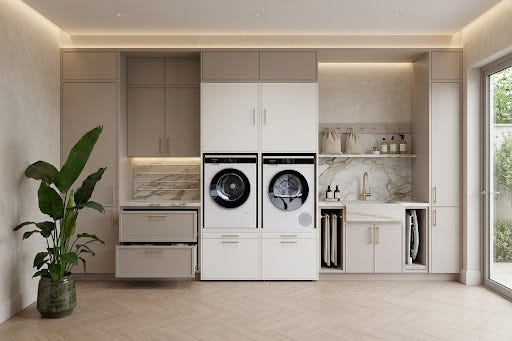
There is real architecture behind why this matters beyond aesthetics. A space that requires constant low-level decision-making — where does this go, why is this here, what is this pile — taxes the same mental resources you need for everything else in your day. A tidy laundry room with a place for the hose and a shelf for the detergent is not a small domestic achievement. It is one less unresolved decision sitting quietly in the back of your mind every time you walk past it.
We think this compounds. An ordered laundry space makes an ordered kitchen more likely, because you have already proven to yourself that a room can hold its shape. An ordered kitchen makes an ordered desk more likely, for the same reason. It is not really about the rooms. It is about building, physically, the evidence that things can be under control — and then carrying that evidence with you into decisions that have nothing to do with furniture.
This is why we take a utility cupboard as seriously as a living room. Why a client's request for a marquesina became, in our hands, a full reorganisation of where the mop lives. Nobody photographs a well-designed laundry cabinet. But we would argue it does more for someone's actual life than the statement piece everyone notices first.
Start with the room nobody sees. The order tends to travel from there.
Le désordre chez soi est rarement seulement une question de meubles. El desorden en casa rara vez es solo una cuestión de muebles.
No posts
Comments
Nothing yet. Say the first thing.
Sign in to join the conversation.