
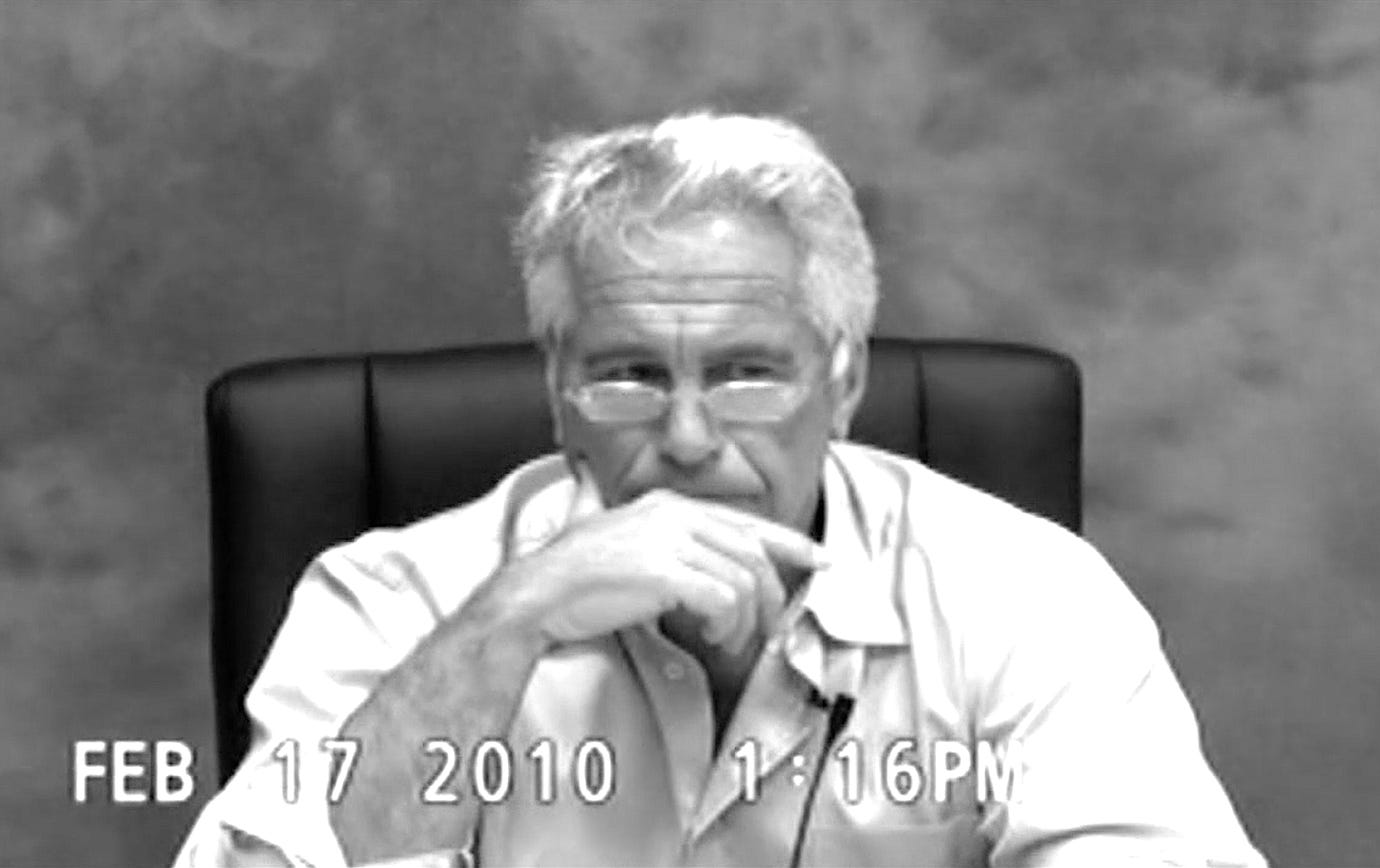
Sex offender and financier Jeffrey Epstein faces questioning by the attorney of one of his victims (2010).
This article links to my post a couple of months ago about why those who fear judgment might nevertheless judge themselves compulsively.
The role of judgment in narcissism starts as early as language permits. Implicated in its development is a family culture of judgment. There are harsh words. There is denigration. Shaming. This judgment is aimed at the child and their mind in an unmeasured way. This is the opposite of curiosity, interest and empathy. There are two less obvious kinds of judgment. Firstly, there might be the harsh judging of those outside the family based on hidden characteristics – the desires, intentions and feelings of these outsiders. This can be a characteristic of hard-lined religious families, although often the condemnation is more a reflection of the psychological needs of parents than of the religion’s message. In any case, the impact on the child is a specific fear – fear that if their own mind were better known by the adults, it too would provoke outright condemnation and attack. The end result is similar to direct judgment: an experience of deep shame that is unmanageable. It is unmanageable in part because it is unsharable: shame without comfort.
There is a third kind of judgment that has become almost invisible to us. In our increasingly narcissistic society, we no longer count admiration and praise as judgment. We put it in a different class of experience. It is not something we try to avoid, but something we value highly. And of course, emotionally it is a very different experience. It is the relief that the child primed for narcissism discovers - as an escape from shame and emotional neglect. But judgment it is.
The child who grows up in a family culture characterised by judgment will hear harsh words. But they will also hear a lot of positive judgments based on achievements, appearance and performance. By themselves, these are harmless (and some families are lacking in this area). But in this family culture, if judgment based on the external is everything, and curiosity about the internal mind is avoided, then this pushes the child towards a focus on performance, appearance and achievement at the expense of emotional development. In order to manage ourselves emotionally, and in order to manage close sustained relationships, we need to develop the capacity to notice, track, tolerate and make sense of emotions – to mentalize. The family focussed on high achievement (materially, academically, socially, etc) is at risk specifically or nurturing emotional poverty. The child learns how to perform, but when other children learn to reflect on problem behaviour, this child learns to emotionally dissociate.
Many grow up with this intense experience of judgment and do not take a narcissistic path, because there are other conditions for this to happen. But in those who develop narcissistic strategies (along the top of the map below), this judgmental climate in the home is a vital part of the algorithm. On the map of narcissism (below), repeated experiences of shaming are combined with this nurturing of performance and self-idealisation, within a vacuum of emotional empathy.
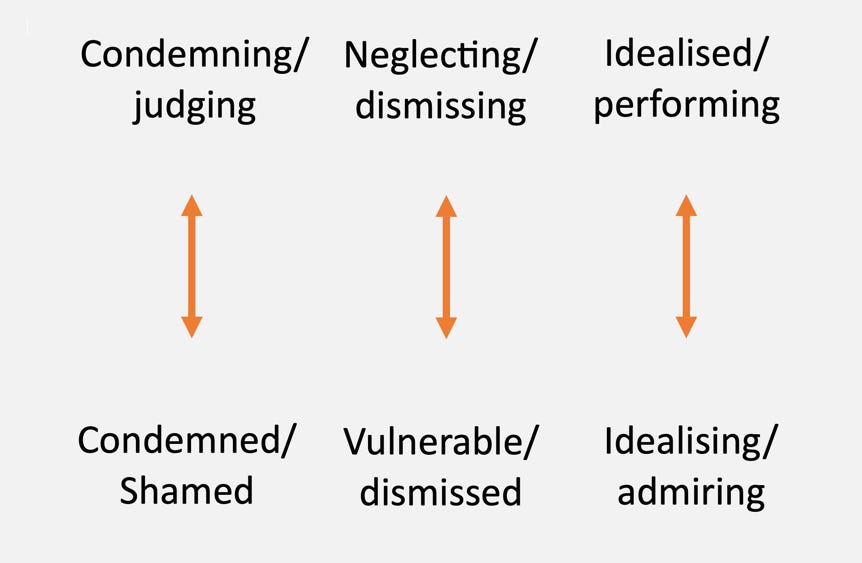
The map of narcissism1*
The hidden goal within the narcissistic adult is to find emotional distance from shame and vulnerability even in the smallest of doses. One strategy promises maximum emotional distance from the experience specifically of being judged. This strategy is that of being, in any relationship or interaction, the judge. Narcissism is born out of a particular unsafe experience of powerlessness. Judgment as a relational strategy offers an archetypal form of power – of one human being over another.
Sometimes, an extreme form of narcissism develops. As part of this phobia of vulnerability and powerlessness, power is sought urgently in this form. When the moment calls for something different, judgment is the strategy employed. It’s taken to an extreme. The other person is shamed, devalued, belittled, dehumanised. Sometimes it gets physical. Sometimes it gets exploitative.
Before long though, behaviour aimed at silencing judgment in others starts to carry the risk of provoking judgment. The strategy begins to backfire. Exposed guilt for treating others badly conflicts directly with the priority goals of seeking admiration and power. The stakes now get higher. And other strategies must be added to strengthen immunity from judgement. The false self or persona becomes more idealised and more distinct. Aided by idealisation, deception becomes more frequent, more explicit and more compulsive. The experienced reality of others must be invalidated, gaslit and treated as unreal. Accusations are crazy. Protesters are evil. Victims are attackers. The avoidance of shame has made a perpetrator. And the now perpetrator is powerful and famous.
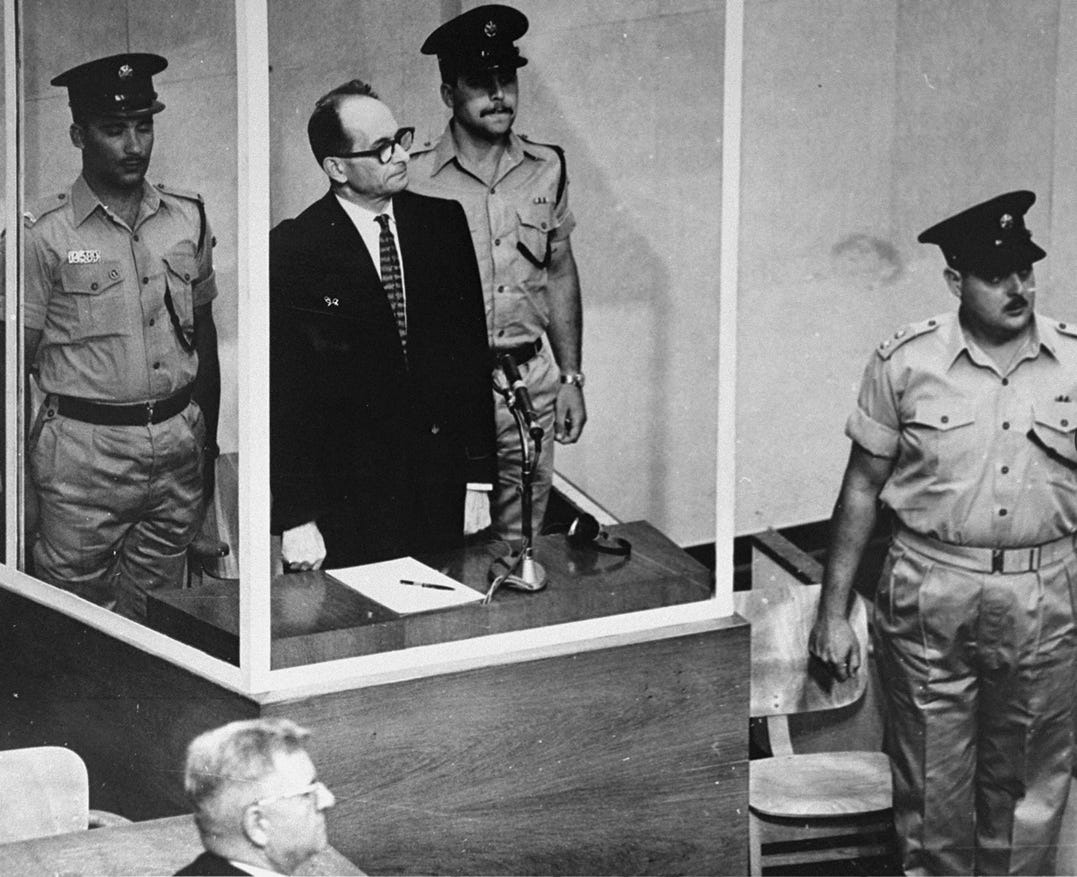
Former Nazi official Adolf Eichmann listening as a court declares him guilty on all counts at his war crimes trial (1961).
We are partners, associates, fans, followers, or a nation of voters. How do we deal with this? When the human adult crosses lines of accepted behaviour, harming others or their interests, in every culture, we have a corrective system. The vital element of this system is something opposite to the reality-bending, gaslighting, sleight of hand of narcissism. The vital stance of this system is to place truth - and the idea of truth - in the centre. Given power, it can use this to remove power from those using it to attack or misrepresent reality. In the west we call it the justice system and the judiciary. The solution to out-of-control narcissism is judgment.
In psychotherapy for narcissism, the solution would have looked different to judgment. It would have been a move away from a reliance on judgment, the bending of reality and the seeking of powers to do so. The goal would have been to let go of the special effects. Therapy would aim to equip the person to live more in cooperation, honesty and mutual need. The two most prominent treatments for personality disorder emphasise mental skills that counter judgment specifically: mindfulness (in DBT) and curiosity (in MBT). But therapy has to be sought by the person themselves. When the time for therapy has passed, the law is all that is left. The time has arrived for judgment not to be put aside, but for it to be employed. It is time for the calm, methodical, impartial and governed light of judgment to be switched on. It is time for the reality bending tricks to be brought onto a stage with no mirrors. When negotiation is all spent, the law is the final buffer. The safety net.
So, we hope.
The community of adults who are drawn to practice the law are trained and initiated into a professional culture which prioritises truth, justice and human dignity. There is separation of influence between the government executive and the legal system. There is an obligation to uphold the rule of law above personal interests and loyalties. The law applies to all citizens in equal measure.
Over time, society values this trained community of judgment with high salaries. Being a lawyer becomes equated with being successful. It attracts highly positive judgment and offers a role opposite those being judged. Lawyers and judges become famous. Adults are attracted to the law out of a desire for justice, yes. There is also prestige. There is a career path to national leadership. These possibilities are magnetic for those who have grown up with a phobia of vulnerability and shame. For many, this can be a healthy coinciding of personal needs and a valued vocation. Some of those drawn by personal needs will become the greatest of their profession. For some though, the law is a ticket to something else. As part of this same phobia of vulnerability and shame, admiration, money and power are sought urgently and as a priority. The career becomes a means to narcissistic ends. That cold impartial light of the law’s gaze becomes more like a projector spinning the film of whatever reality is needed on the day. And the judiciary – that final safety net for catching the weight of out-of-control narcissism - is fraying.

Disclaimer: All views expressed are my own unless otherwise stated, and do not necessarily reflect the views of any institution I have been employed by. The content here is for information and should not be interpreted as advice.
Notes
1. Ryle, A. & Kerr, I.B. (2002). Introducing Cognitive Analytic Therapy. Wiley.
* This mapping was not developed as an approach to narcissism only. If this approach has been used in your own therapy, this does not mean that you have narcissistic difficulties.
Comments
Nothing yet. Say the first thing.
Sign in to join the conversation.