
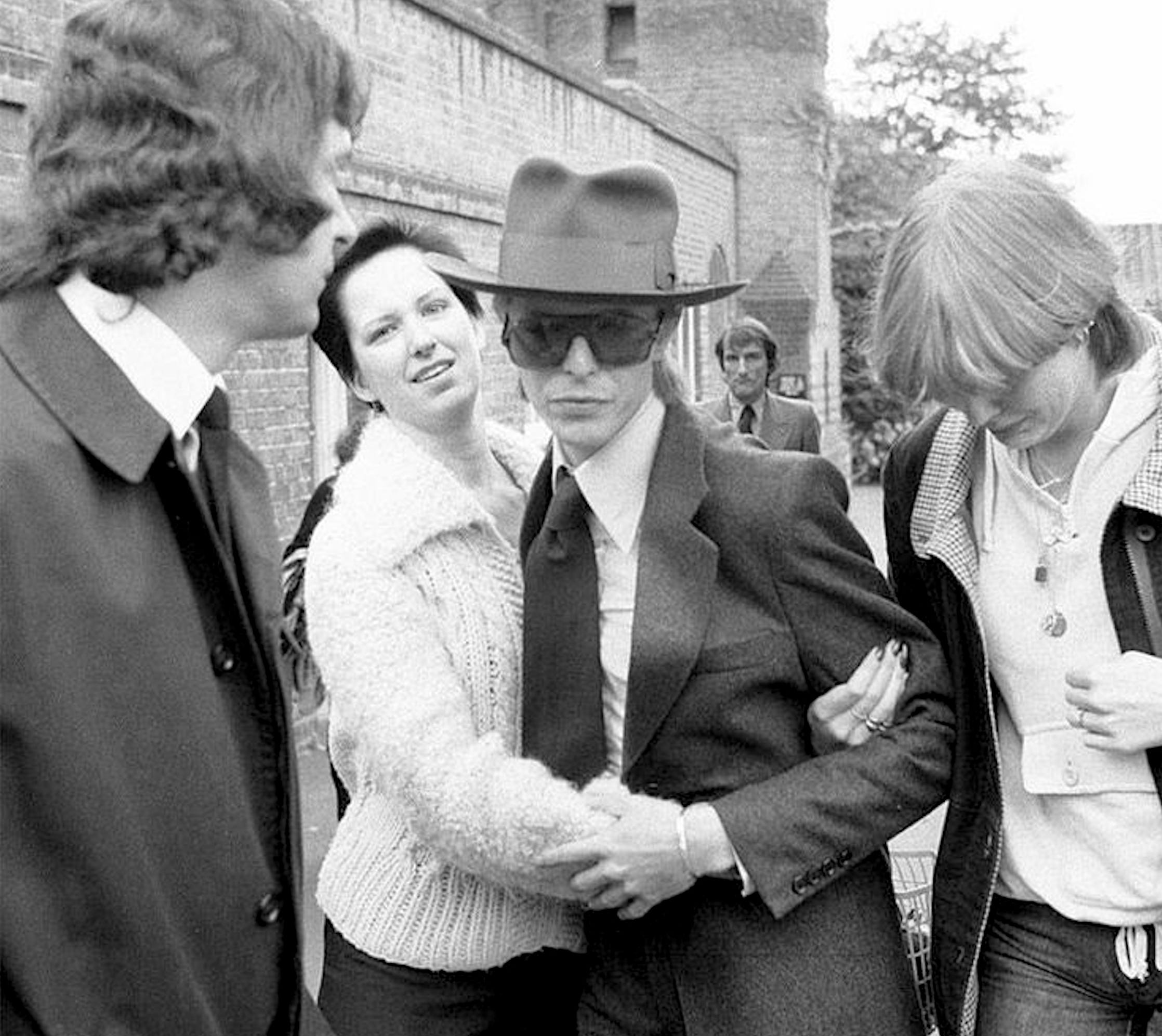
David Bowie provoked by a photographer at the funeral of friend and fellow icon Marc Bolan of T-Rex
It’s time to take a step back, because I have now explored the lives of 15 icons as part of an experiment here on Substack. This article also is a kind of a personal experiment, to look back at these 15 without reading – to reflect on what I learned and what stands out now in my mind. This can also serve as a kind of index of the 15 with links – in case you have arrived here more recently and have missed some.
I set out to explore the links between trauma, narcissism, power and fame, because narcissism as a concept can explain how trauma leads to the taking up of fame and power. Choosing 15 historic figures defined by earned and sustained iconic fame was the easy part.
1. Marilyn Monroe (actress/singer) – Marilyn was in some ways an odd choice as a starting point for a series about narcissism. The stereotype narcissist is a man. And Marilyn’s mental health struggles could be described as ‘borderline’ as much as narcissistic. But I was starting with the idea that wanting and needing to be idealised by the world is narcissistic. I think I was drawn to the sheer size of the difference between the shining persona and something underneath. What was underneath was not the ‘dumb blonde’ – this too was a persona - but someone complex, traumatised and chasing a certain kind of safety.
2. John Lennon (singer/songwriter) – As I’ve looked at these lives I’ve come to think of two faces of narcissism: the perpetrator face and the performance face. I have done this because in mainstream narratives strategies of performance, persona and self-idealisation often get left out (I wrote about this here). John Lennon is a great example of both these faces in one person. Both violence and creativity were somehow born of the same trauma. He was remembered by the world as a man who wrote about peace, and by some as a man prone to violence and bullying. Tragically, just before being murdered at the age of 40 he was being radically honest with himself and trying to live more authentically.
3. Charles Chaplin (comic actor/director)– Chaplin helped solidify something in my mind – about how children learn from their parents how to manage vulnerability – especially if their need to do so is desperate. There were his performing parents and then there was the distance they were from him. I was shocked to compare the narrative I had heard about Chaplin’s distinctive persona with the facts of his personal life which including sex-trafficking charges.
4. Michael Jackson (singer/ songwriter) – The narrative around this man in mainstream media had lurched between child talent to icon to victim to perpetrator. What I read about his father’s treatment of him was more shocking than the small bits I had heard growing up. And there was a potential link between the physicality of this abuse and the physicality of his performance, which is sad to think about. I began here to think about how we define success and what we assume leads up to it.
5. Marlon Brando (actor) – Brando was one of my most enjoyable icons to research. I knew virtually nothing about him. I was curious about what had made him such an icon. My reading led to a sense that he probably had what we now call complex PTSD. And then there was his compulsive sex life – which in some ways looked similar to Chaplin’s. Brando had apparently invented the term sex addiction to describe this. In his childhood was a cruel father and a mother whom he had to rescue from the effects of both alcohol and men.
6. Jimmy Savile (TV presenter/ DJ) – I revisited Savile recently to help with understanding the celebrity sex offender playbook in the Epstein context. Lesser known in the US, he was exposed after his death as a prolific sex offender. But in Savile’s case there was a national inquiry. He seduced not only his victims, but also those with the power to protect him. This made me think about the idea of narcissistic (as opposed to antisocial) psychopathy which I wrote about in a separate article here.
7. Tupac Shakur (rapper/ actor) – certain kinds of traumatic experience can prime a child for narcissism. And certain kinds of trauma can be passed from one generation to the next. Tupac grew up in a community impacted by racism and also attempting powerful ways to overcome these impacts. What really struck me about Tupac was the distinctiveness of the uncompromising gangster rapper persona we know today. The roles of poet, actor and politician were different, but all were options. Does this hold a clue about politics in general?
8. Elvis Presley (singer/actor) – my criteria for choosing icons was earned and sustained iconic fame. So, I had to come to this man at some point. In this man I was surprised to find behind the idealisation and success someone with little ability to maintain romantic relationships combined with an unquenchable appetite for sex. Not unlike Brando, this became a huge source of unhappiness and was not apparently any after effect of fame and success. I began to question my assumptions about the sex-life of the sex-icon (and wrote about this here). And like Brando who was similarly sex-addicted, his childhood relationship with his mother betrayed a reversal of roles.
9. Elizabeth Taylor (actress) – Two things stood out in my mind about Elizabeth. First there was her experience of specifically narcissistic parenting. As with John Lennon, there was no space for Elizabeth’s own mind with its wishes and desires. This can leave the child with a sense of the external and visible being the only sources of validation. Colourful jewels became a huge part of Taylor’s adult life. Secondly, she became for me an example of the rescuer face of narcissism which I later explored here.
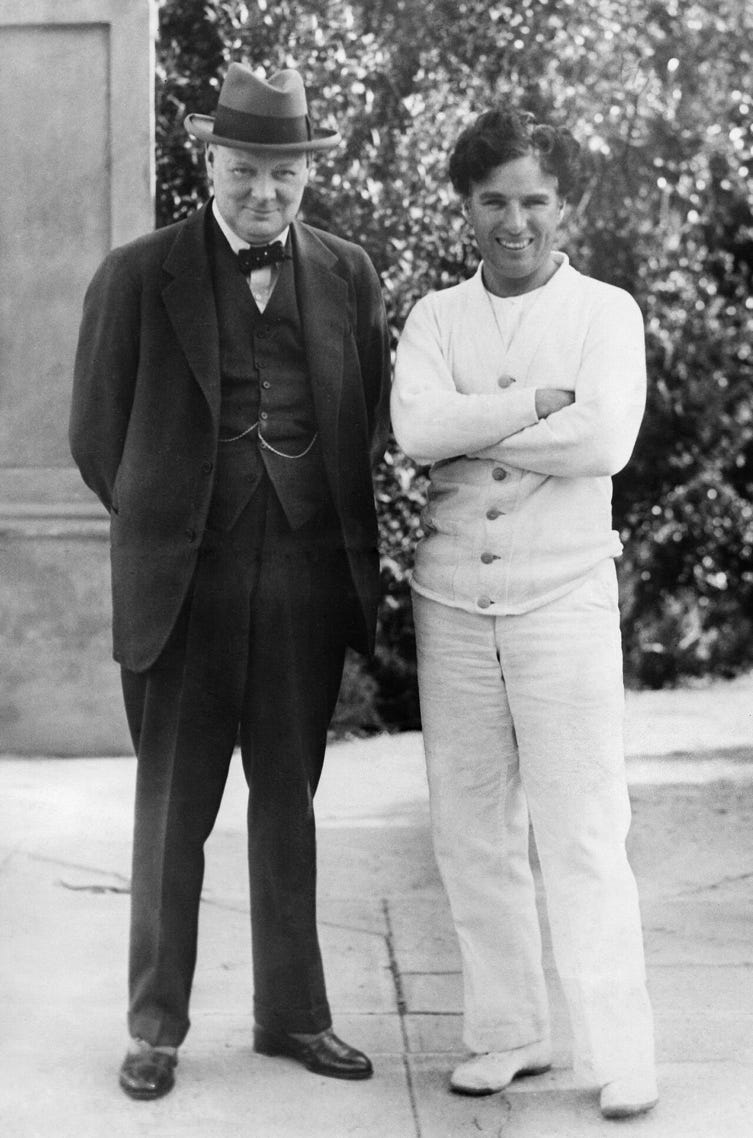
Sir Winston Churchill with comic actor Charles Chaplin
10. Freddie Mercury (singer/Songwriter with Queen) – I had noticed with Chaplin how his iconic film role had been connected with his specific childhood trauma. Freddie’s most iconic performance was the 1984 Live Aid concert set. I was surprised to find out what his relationship to this whole performance might have been. I was also shocked to find myself interpreting the lyrics of his great Bohemian Rapsody in a way that no one seems to talk about.
11. Humphrey Bogart (actor) – there really are a lot of quotes from Casablanca that are kept alive. Bogart looks from the outside to have had a comfortable start in life. But like Elizabeth Taylor he suffered highly narcissistic parenting that is recorded in some detail. A wealthy upbringing can be an emotionally brutal one. Bogart was famous before the age of one. One unique aspect of this article was a sketch made of him at 13 being used as a nude for his mother’s art class. The carefully captured expression on the face of this boy stayed with me.
12. Louis Armstrong (singer/ musician) – Like most of the others, I knew nothing about Armstrong’s background. It was uncomfortable approaching this man’s life from a narcissism angle. After his music and voice, he is known best for his warm smile. But Armstrong was a really complex man. In some ways his childhood story could be told as one about another ‘youth offender’ and the potential any youth offender might have. The other thing that stood out for me was how music was the only ticket he could get that promised escape from vulnerability and shame. I got a vivid sense of how he observed performers and what he took from those observations about how to rise above helplessness. Why hasn’t a great biopic been made about this man’s childhood? It was incredible.
13. David Bowie (singer/songwriter/actor) – I was never a huge Bowie fan, but I had seen him live once and really liked a few of his big singles like Heroes. When I had looked at the life of Chaplin, I had been shocked to find him charged with sex trafficking. With Bowie, I was shocked to find him technically a trafficking victim himself. Like Mercury, there was a narrative around his sexuality and his preferences. But like Mercury and Brando there was little curiosity at the time, or since, around the compulsive nature of his sex life, and the consequences of it.
14. Sigmund Freud (founder of psychoanalysis) – as a psychologist, the childhood of Freud shocked me the most of these 15. This was not because it was more extreme than any other, but because it had never been mentioned at work or in my training. Was this institutional denial? About denial in this iconic intellectual? Who, yes, discovered denial? I am still puzzled and uncomfortable about it. There was more that I left out just because there was not enough evidence. Does his own struggle change the value of his ideas? I think a more important question is about why we need him to remain ideal and not a troubled and difficult man.
15. Winston Churchill (British Prime Minster) – I took a long time to get round to a politician in this series. I had more confidence to write about music, film and psychology as spheres of work that can make someone iconic. But here again, is a pattern of persona being needed before fame had been achieved. Like Bowie, Churchill’s MO was in part to be an imposter in order to become one day what he was pretending to be in the present. It was difficult to find a balance between his difficult personality and failures and his historic achievements. Churchill also stands out for me as an illustration of, like Tupac, having a number of performing personas that carried completely different roles: politician, artist and author. And yet our narrative about him is of politician – rather than the thread that runs through these three: performance.
I can see some themes emerge from looking at these 15. There is persona contrasted with the authentic self. There is the development of persona as escape from unsafe vulnerability. There is the role assigned to an icon by the popular narrative about them: politician, singer, actor etc. But this might sit along alongside other roles that actually carried the same function of performance, power and idealisation for them personally. IN some, there is the playing out over time of the performance face of narcissism in parallel with its perpetrator face. When the latter is exposed, the press narrative falls into a familiar corrupted-by-success story that often does not fit the chronology. I have learned so much about narcissism from these 15 – from trying to put myself in their shoes as children, and by applying the simple map of narcissism as a frame.
Narcissism is a fascinating paradoxical phenomenon which resolutely refuses to look like any other kind mental health problem. Those who perform and rise to power can change popular culture, make us laugh or cry. When we look for inspiration, we look to those who have been given power or who perform. I have learned from these 15 that we often misunderstand the process that has selected these inspirational figures. They can create some of the high points in our lives. And yet those who work so hard to reach our screens or compete for our leadership are often propelled by trauma. For some, we now know this was a ticking bomb. For how many alive today, is this also the case?
With some of these icons, I have had to give up a perspective I had grown up with. I had been given an idealised picture of them that I had enjoyed. For others though, I had already come to feel let down or condemning of the person. Now, I see most of them as human beings who started out with the same vulnerabilities as the rest of us. How they ended up managing these vulnerabilities was a different story. Their strategies were powerful and extreme, for better and/or worse. When we see in someone the best of talent and performance, how do we work out if this is a warning flag for the worst of adult behaviour or for an underlying fragility that is waiting to explode? Who would you pick for no 16?
Disclaimer: All views expressed are my own unless otherwise stated, and do not necessarily reflect the views of any institution I have been employed by. The content here is for information and should not be interpreted as advice.
Comments
Nothing yet. Say the first thing.
Sign in to join the conversation.