
Thanks for reading Anti-Capitalist Musings. It is a small operation, and I hope it offers something worth your time. There will be no premium subscriber content here: everything published will remain free to read. If you value these pieces and want to support the writing, buying me a coffee helps fund media subscriptions and the books that keep the analysis grounded. Every contribution, however modest, is genuinely appreciated.
The most interesting thing about the politics of Reform UK and Restore Britain is not that they frighten people. Politicians have always done that. It is that fear is becoming the organising principle through which everything else is understood. Immigration, crime, economic decline, Islam, judges, human rights law, NGOs, the civil service and “woke ideology” are pulled into the same account of a country being lost. Once that account settles in, removing one threat does not necessarily remove the fear. Another threat can take its place.
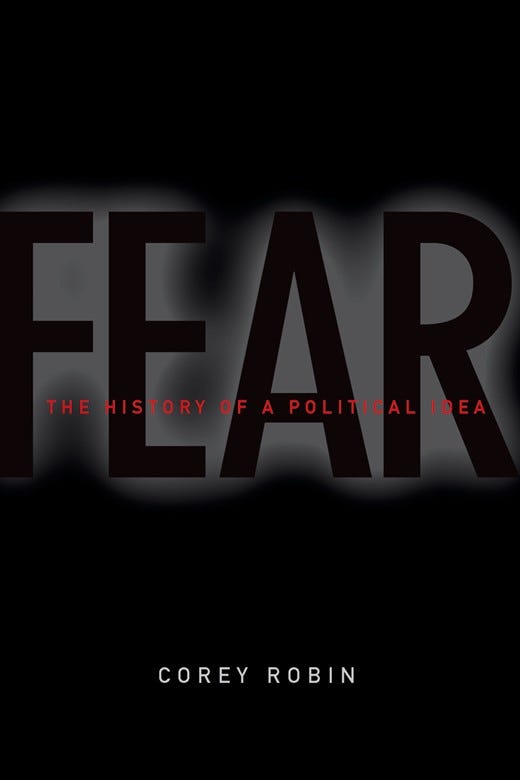
Corey Robin’s Fear: The History of a Political Idea is useful because he refuses the comforting explanation that political fear works by inventing imaginary dangers for gullible people. It usually begins with something real. Politicians then select which dangers deserve political attention, decide what they mean, identify their causes and propose the appropriate response. There are always more possible objects of concern than politics can accommodate. The exercise of power begins in deciding which ones will fill the available space. A chosen threat can eventually dominate the political agenda and crowd out other explanations of what is happening.
Britain does have a migration problem. Small boats cross the Channel. Some people enter the country and claim asylum despite having weak claims that appear primarily economic. Those who genuinely need asylum find themselves dismissed as “fighting-age men”. The system for processing claims and removing people who have no right to remain has serious weaknesses. None of this means immigration is politically insignificant. Reform does something more with it. Its policy platform says illegal immigration is “out of control” because politicians refuse to enforce the law and allow foreign courts to prevent Britain controlling its border. The answer is a five-year emergency programme, withdrawal from the ECHR, repeal of the Human Rights Act, a new Deportation Command, detention capacity for 24,000 people and as many as five deportation flights each day. The party says its new command would use “all the levers of state”.
Zia Yusuf’s Operation Fortress sharpens the language. “Britain is being invaded,” the Reform website announced on 4 August. Those crossing the Channel are repeatedly described as “fighting-age males”. Their numbers are compared with the Allied force that landed in Normandy on D-Day. The Royal Navy would intercept boats as part of a vast maritime security operation. Immigration has moved from a difficult question of law, state capacity and international movement into the imaginative territory of war.
Robin finds the mechanics of this in Hobbes. A danger need not be fabricated to become politically magnified. Fear can be “swelled beyond the warrant of objective fact”, allowing something distant or uncertain to be experienced as imminent. He describes fear as highly plastic. People can be persuaded to fear dangers that are neither clear nor present because speculation about future harm operates partly through imagination, ideology and existing moral assumptions. That is a better description of what is happening than the familiar accusation of lying. The boat exists. The arrival exists. The political work consists in turning it into invasion, national emergency and proof that the state has ceased to protect its own people.
The same method now runs through Reform’s treatment of crime. Nigel Farage wrote in July that Labour and the Conservatives had left Britain “lawless”, and in August described law and order as the biggest issue in national life that was not being adequately discussed. A particularly horrific alleged crime involving a Sudanese man in Belfast was immediately made evidence of “Britain’s broken borders”, followed by a promise to ban visas for Sudanese nationals. Reform’s own report described the political choice as “brutally clear”: the existing parties had created the situation and only Reform would tear it down. An individual crime becomes an argument about a whole population, the border system and the moral character of the political establishment that permitted entry.
Restore Britain starts from a darker place because catastrophe is already contained in the party’s founding description of the country. Its website says Britain has been “run into the ground” for thirty years. Mass immigration sits alongside economic collapse, “woke ideology” and the advance of radical Islam as evidence of national decline. The British people have become a “shell of our former selves”. The changes required will be painful because Rupert Lowe does not propose reforming the status quo. He calls for a democratic revolution.
Different problems are made to reinforce one another. Economic decline no longer needs to be explained primarily through investment, productivity, ownership, wages, deindustrialisation or the distribution of wealth. Cultural change does not have to be distinguished from fiscal policy. Islam, immigration, state failure and economic deterioration become features of the same damaged landscape. A person worried about housing and somebody worried about cultural change can find themselves inside the same story without agreeing on very much else. Britain was once coherent. It has been hollowed out. Someone did this. Restoration requires identifying what must be removed.

Michael Shellenberger@shellenberger
Progressives thought they were on the right side of history. When they wake up to the reality that their policies resulted in the sterilization of children, the killing of mentally ill addicts, the decimation of education, and more, they will be horrified.

2:56 PM · Aug 26, 2026 · 1.06M Views
3.33K Replies · 3.32K Reposts · 22.5K Likes
Restore’s immigration policy is explicit about how far this goes. It does not stop at illegal migration. A legally resident foreign national who cannot speak English, lives in social housing, claims benefits, refuses to work, fails to integrate or is considered hostile to the British way of life may be deported under its proposals. The party says that if this means millions leave, then millions leave. It predicts that “native Brits” will eventually become a minority and presents reversal of mass immigration as the answer. The question has moved from who is legally entitled to enter Britain to what demographic composition Britain ought to have.

Restore Britain@RestoreBritain
A Restore Britain Government will mass deport every single illegal migrant living in our country. Restore Britain's @Harry_pitt explains how...
12:07 PM · Aug 26, 2026 · 263K Views
161 Replies · 591 Reposts · 3.65K Likes
Robin describes one form of fear as being particularly suited to a nation imagined as a cohesive community confronting an alien presence. His examples include foreign enemies, criminals and immigrants. The leaders and those they address are presented as members of the same threatened group. The political community can then be built without requiring substantial agreement about its future because fear supplies a thinner but more immediate bond. People are united because they are threatened together.
Robin puts the point sharply elsewhere. The frightened crowd can achieve unity without sharing the same aspirations. Once the object of fear is placed outside normal politics, disagreement about it becomes more difficult because the threat is treated as something that cannot be bargained with. It must be contained or defeated. Reform and Restore can therefore hold together voters with very different economic interests because the promise is not initially a detailed settlement between those interests. It is protection.
This is also where Adam Curtis’s The Power of Nightmares comes back into view. Curtis’s argument was made in a different political moment, but its central insight has aged well: when political movements lose confidence in their ability to mobilise people around a convincing vision of a better future, protection from danger can become a substitute. Political authority no longer rests primarily on the promise of what government will create. It rests on the catastrophe from which government, or the movement seeking government, promises to save you.

Reform and Restore increasingly speak this language of protection. They do not begin with a picture of the society people might collectively build and work backwards towards the institutions needed to create it. They begin with the nightmare. Britain is being invaded. Britain is lawless. British people are becoming a minority. Radical Islam is advancing. Elections are being distorted. Judges and international institutions prevent the country defending itself. The nightmare supplies the urgency and the movement supplies the protector.
Curtis and Robin meet at an important point but they should not be collapsed into one argument. Curtis is strongest on what happens when positive political horizons weaken and protection takes their place. Robin asks the harder question of power. Who defines the nightmare? Why this danger rather than another? What disappears from political view while attention is fixed upon it? And what new powers become acceptable because they are presented as necessary for protection? The nightmare is not merely a story. It alters the permissible range of political action.
Protection also requires somebody from whom protection is needed, and that creates a problem once a movement has organised its supporters around the relationship between danger and protector. What happens when the danger recedes?
A government built around an emergency cannot easily announce that the emergency is over. If boat crossings collapsed, wages would not automatically rise. Rents would not fall. Local government would not suddenly recover. Britain’s productivity problem would remain. Hospitals would still need investment and social care would still be expensive. The political movement would either have to develop a different account of those problems or find reasons why restoration had yet to be completed.

Zia Yusuf@ZiaYusufUK
Shoplifting hit a record high last year, and robbery is now more common in London than Chicago. Here’s a clue as to why: Foreign nationals account for a staggering 80% of arrests for theft of passenger property on British trains. They made up 38% of arrests for all crimes on
7:18 PM · Aug 16, 2026 · 83.5K Views
225 Replies · 766 Reposts · 4.23K Likes
Zia Yusuf@ZiaYusufUK
Andy Burnham is about to dump 1200 unvetted adult male illegal migrants on a tiny village, resulting in locals putting up with a ratio of SIX MEN TO EVERY WOMAN. The Home Office is boasting about closing a few asylum hotels. Only about 5% of small boat migrants have been sent
10:30 AM · Aug 15, 2026 · 146K Views
258 Replies · 909 Reposts · 4.71K Likes
The nightmare has to remain politically available. This does not mean Farage, Yusuf or Lowe must consciously invent a new enemy whenever an old one loses its force. The pressure is built into the politics itself. If legitimacy rests increasingly on the promise that only you can protect the country from catastrophe, the disappearance of catastrophe also weakens the reason people need you.

Rupert Lowe MP@RupertLowe10
We are being invaded, and Europe needs to wake up before it's too late. Do that, now, or we're all going to lose far more than any election.

5:22 AM · Jul 31, 2026 · 304K Views
950 Replies · 5.48K Reposts · 37.9K Likes

Nigel Farage@Nigel_Farage
BREAKING NEWS After 315 illegals arrived yesterday, even more are on their way today. Our country will pay a terrible price for this invasion of young, undocumented men.
9:26 AM · May 3, 2026 · 936K Views
2.81K Replies · 4.92K Reposts · 20.8K Likes
The structure already allows the object of fear to spread. Migrants are one problem. Politicians who allowed them to come are another. Courts that obstruct removal become part of the story. Human rights law becomes a mechanism through which the border is supposedly stolen from British citizens. Reform promises to end NGOs “facilitating illegal migration”. Its commentary repeatedly presents legal and institutional barriers not simply as disagreements about policy but as evidence that the political order refuses to defend the country.
Restore has moved further into this terrain. Its election policy says mass migration has produced “fragmented demographics” and identifies ethnoreligious bloc voting as a threat. Foreign nationals would be barred from voting or standing in British elections and the party promises to restore “British elections for British people”. The anxiety is no longer confined to who crosses the border. It reaches into the political conduct of people already here.
The same widening can be seen in Restore’s economic language. Its website talks about remittances as money being “drained” from Britain and says most migrants from poorer countries come not to contribute but to extract wealth. High-street businesses such as barbers, vape shops, dessert cafés and phone repair shops are singled out for investigation by a new multi-agency unit where ownership or trading patterns appear suspicious, with immigration enforcement brought into the process. A politics which begins with the border has started to acquire an everyday geography. The suspicious person is joined by the suspicious shop, the suspicious neighbourhood and the suspicious economic transaction.
An external enemy tends to create the problem of the internal accomplice. If the threat is as obvious and overwhelming as claimed, somebody must explain why it has been permitted to continue. The migrant is joined by the politician who admitted him, the judge who prevents his removal, the lawyer who represents him, the NGO that assists him and the institution that insists upon inconvenient legal limits. Opposition can then begin to look less like disagreement than obstruction. Push the logic far enough and refusing the description of the nightmare itself can be treated as evidence that you are part of the problem.
Rupert Lowe MP@RupertLowe10
Fantastic to see Fauci held to account by politicians, at least in some form. A Restore Britain Government will do the same to Chris Whitty.
8:17 PM · Jul 29, 2026 · 367K Views
1.04K Replies · 2.97K Reposts · 24.9K Likes
None of this means every voter who supports either party accepts the whole worldview. Fear does not require that. Robin makes the point that the chosen object need only become dominant enough to structure political attention. Nor does it require an endless supply of fictitious enemies. There are always crimes, institutional failures and examples of illegality available. The political skill lies in deciding which incidents become representative of the country and which remain incidents.
This makes fact-checking necessary but insufficient. A false number should be corrected. An exaggerated claim should be challenged. But disproving one statistic does not dismantle an account of Britain in which every new event can be fitted into the same structure. If one claim fails, another example arrives the following morning. The argument being sustained is larger than any single data point: the country is deteriorating, hostile or alien forces are responsible, the establishment has failed to defend you and stronger action is therefore necessary.
Restore’s programme gives a clear sense of where that logic can lead. Its mass-deportation paper proposes a Great Clarification Act to assert parliamentary sovereignty over the courts, repeal of the Equality Act and Human Rights Act, withdrawal from the ECHR and abolition of the existing asylum system. It envisages perhaps half a million voluntary departures a year encouraged by a hostile environment, alongside between 150,000 and 200,000 enforced removals. Its wider immigration policy proposes deliberately austere holding facilities on government or Ministry of Defence land, with planning restrictions bypassed under emergency provisions and mandatory detention pending deportation.
Restore simultaneously wants the state reduced to roughly the share of GDP inherited by Tony Blair in 1997. Its August economic paper sets an ambition to shrink government from around 45 per cent of GDP to about 33 per cent over two parliaments. Yet the political programme being assembled elsewhere requires detention, removals, immigration enforcement, expanded policing powers, new investigative units, surveillance and a major legal reconstruction of the state’s capacity to act against designated groups. A small state in economic life can coexist perfectly well with a formidable coercive state. There is no contradiction once the question becomes which state functions are being cut and which are being strengthened.
Robin distinguishes between fear aimed across society and fear operating down its hierarchies. One identifies a common danger from which the population requires protection. The other uses sanctions or the possibility of sanctions to secure obedience and preserve relations of power. The two can reinforce one another. Restore supplies an unusually literal example. Fear of illegal migration justifies the expansion of coercive capacity, while the hostile environment is designed to make another group sufficiently fearful that large numbers leave voluntarily. Fear is first the argument for power and then part of the means by which that power operates.
This is where Curtis needs Robin. A politics of nightmares can look, if treated only as media narrative or political psychology, as though frightened populations are simply being manipulated by clever storytellers. But fear leaves institutions behind. Detention centres remain after the speech has ended. Surveillance systems remain. Legal precedents remain. Executive powers remain. The important question is not only whether the nightmare was exaggerated but what was built while people were afraid.
Robin’s account of counterrevolutionary fear adds another element. Successful movements of this kind have often raised the spectre of an “all-encompassing disorder”, claiming that failure to act will not merely produce an undesirable government but something closer to social collapse. Restore’s politics repeatedly approaches this register. Its law and order programme says British women face a growing threat of physical and sexual violence “primarily due to mass legal and illegal immigration”, advocates widespread stop and search, proposes a referendum on restoring the death penalty and says exceptional circumstances demand exceptional measures. It describes Islamist extremism as an immediate national security threat and proposes closing mosques that preach extremist doctrine. The picture is not simply of a country with serious problems. It is of ordinary protections failing across the board.
Fear of that kind is difficult to satisfy because familiarity weakens it. Robin notes that when terrors become familiar they lose some of their ability to generate dread. A politics trying to build itself upon fear therefore feels pressure to find a darker danger. You can see the inflation in the vocabulary. High immigration becomes mass immigration. Mass immigration becomes invasion. A weak border becomes national emergency. Crime becomes lawlessness. Political Islam becomes a threat to the civilisation itself. Ordinary institutional restraints become evidence that the state has been captured or prevented from acting. The language that shocked yesterday eventually becomes ordinary, and stronger language is needed to recreate the original sensation.
There is a reason this can be very hard to leave behind. A person living within the account is not simply frightened of a migrant, a criminal or an Islamist. They have acquired an explanation for the country around them. New information is processed through it. A horrific crime confirms the threat. A falling crime rate can be dismissed as official statistics failing to capture reality. Reduced migration can be interpreted as proof that pressure worked, while continuing economic problems demonstrate that the damage done previously was even greater than imagined. The worldview is capable of absorbing evidence in several directions.
Curtis’s nightmare therefore has an afterlife inside the person who has accepted it. Protection is no longer a response to one danger but a political expectation. There must be something from which the country needs saving. Once politics has trained people to look upon society through that relationship, the disappearance of one enemy can create an absence waiting for another to fill it.
Britain has produced enough insecurity to make such an account politically fertile. Housing is expensive and often insecure. Wages have stagnated for long periods. Public services have deteriorated. Investment is weak. Regional inequalities remain large. Whole communities have experienced the disappearance of stable employment and public institutions. These are not psychological inventions. The mistake is to imagine that because the anxiety is real, the political explanation attached to it must also be correct.
Robin’s central insight is that political fear cannot be understood apart from power. It directs attention towards some dangers and away from others. The collective fear of an outside threat can obscure inequalities inside the threatened community, allowing existing distributions of wealth and authority to survive behind the language of national unity. He argues that fear can reinforce the distribution of power and resources while shaping public debate and policy.
That is the ground on which Reform and Restore need to be confronted. Telling people not to be afraid will not work because many have good reasons to feel insecure. Nor will endless argument over whether individual voters are racist, stupid or deceived. The harder question is what their insecurity has been made to mean. A housing crisis can be understood through land, rents, housebuilding and ownership, or attached to the presence of migrants. Wage weakness can lead towards questions of bargaining power and investment, or towards competition with foreign workers. A decaying town can produce an argument about capital flight and the disappearance of public provision, or become evidence that national culture has been destroyed.
Reform UK and Restore Britain offer something emotionally powerful because they join these experiences together and provide an enemy who appears easier to act upon than the social relations that produced the insecurity. Deporting somebody is imaginable. Reconstructing an economy around higher investment, stronger labour power, affordable housing and functioning public services is much harder. One produces the appearance of immediate agency. The other requires organisation, conflict over resources and years of political work.
Curtis saw what happens when politics loses the confidence to promise that kind of future. It offers protection instead. Robin shows why we should ask who benefits from the resulting fear and what happens to power while the population waits to be protected. Put together, they illuminate something unsettling about Reform and Restore. Their strongest political proposition may not finally be a programme for Britain at all. It is a relationship: you are in danger, the old establishment will not save you, and we will.
A politics built in this way risks becoming unable to arrive at its destination. Restoration must remain unfinished because the disappointments that generated the movement will survive many of the people it removes. If the political community has learnt to understand itself through danger, those disappointments invite another search for whoever prevented the promised renewal. The deepest problem with Reform UK and Restore Britain is not simply that they use fear. It is that they are constructing a politics which may always need somebody to fear.
Thanks for reading Anti-Capitalist Musings. It is a small operation, and I hope it offers something worth your time. There will be no premium subscriber content here: everything published will remain free to read. If you value these pieces and want to support the writing, buying me a coffee helps fund media subscriptions and the books that keep the analysis grounded. Every contribution, however modest, is genuinely appreciated.
No posts
Comments
Nothing yet. Say the first thing.
Sign in to join the conversation.