
Recently, with regards to one of the Asian countries I have lived extensively in, the younger son of the founding father of the country has become an asylum refugee in the U.K.
The older brother was the previous Prime Minister of the country and the only daughter of the founding father has passed away from chronic illness, I observed at an age roughly more than 10 years younger than our country’s usual life expectancy. The two brothers still alive are also embroiled in a public feud over their family house.
Due to my naivety, I am uncertain how much democracy we enjoy, I may be wrong, thus I will just say we benefit greatly from the leadership of our government.
Nonetheless, all this hoo-ha makes me wonder if the Asian values I often hear lauded in the Asian media are all that they are cracked up to be. What are Asian values you may wonder? Aren’t Asians just little yellow-skinned people whose cultures are backward and some have newfound wealth? >< Your humble writer at hand will give you a very short 101 course in basic Asian values that people born here are pressured to abide by, in the hope of giving you an insightful gleam into the East. ><
In a number of Asian cultures, it is quite common and socially lauded to have married couples living in the room next to their parents’ room in the same flat/apartment.
Governments have even been known to have special housing schemes to encourage such living conditions.
Well, who wouldn’t want to live near their families? Most people, even estranged children or feuding families will eventually need to send their parents off and parents can be a source of emotional support and help for those who are lucky. Thus, close living quarters make sense.
Nonetheless, too close a proximity for multi-generations do not work out well for various reasons which one can imagine and is often an enforced happy facade with simmering tensions underneath that do not work out for everyone.
My mother lived with my father’s mum, my grandma all her life and she is not happy with that. Growing up, I often hear her lamenting to her sister over the phone how my grandma treats her.
Even after my father’s death, she does her duty and lives together with my grandma, taking care of her.
To put into context what kind of mother-in-law my grandma is to my mum, my grandma took care of me growing up and I lived with her as my mother had to work. Only went back home to be under the same roof as my parents at age 12. My grandma, due to her insecurities growing up as a foster child lied to me that my mother did not want to come to my kindergarten’s graduation ceremony; in the hope that I would be closer to her, and not my mother.
Thus, imagine my hurt and also my shock when my mother showed up to my kindergarten graduation ceremony in a huff, and a particularly ominous mood between her and my grandma ensues; while I retreat into my own world. However, till now, my mother is still living with my grandma(her mother-in-law) today, after my dad’s death. My grandma does treat her much better now in her old age, as far as I know.
The animosity between different generations of females in Asia also has its roots in the misogynistic culture of abandoning female babies or giving them away in the not-so-distant past. My own maternal grandparents gave away one of their daughters, not their sons. The most amazing thing about this is that the grown-up daughter came back to find her and did not bear resentment. I find it mind-boggling.
This tension between different generations of females in Asia is often a popular theme in Asian drama series in Japan and South Korea. In all fairness, have read about these practices in certain western regions and Ireland too.
This is essentially life-long enforced community service, particularly carried by the female gender, engendering ripe conditions for resentments and potentially worse actions. Taking care and being close to your parents is totally admirable but put into context something my elderly female neighbour living on her own says,
‘ Sons can choose not to take care of their parents but females have to. '
Westerners may not understand this but the rationale behind her speech is that sons are more important and Asian females should redeem their value by serving their families as they let them live and even in many cases, provided a good education for them.
I had a professor teaching some multi-cultural ethics class in university. I think he was in his 50s then. He shared that while his father was dying, their sister bore out the burden of the caregiving by moving her work commitments and moving over but in their father’s will, the father chose not to leave a single penny to their sister. He shared that he and his brother advised their father to leave some money for their sister and change his will as that is simply not right. He shared the story with us and asked us what we think.
The socially lauded model of multi-generational living under one roof in the ubiquitous Asian apartment gives rise to many strange multi-generational tensions that could be wholly avoided if we have the straight-foward arrangement of couples living with their young children; and the spouses can visit their parents’ house weekly or even multiple times weekly. Thus the shiny Asian value of happy multi-generational living often shows cracks.
I visit another family’s home regularly and the husband’s parents have gone back to their home country for retirement after living with them here in the same apartment for over ten years. The first thing the wife did was to remove all the furniture and bedsheets the grandparents were using and buy new furniture, even though the furniture is in perfect working condition. This amazes me as I always thought they were on good relations but it makes me wonder.
Where I live in Singapore, it is said to have one of the highest percentage of females in the labour force. This is due to the high cost of living and not because Singaporean females are uniquely emancipated in Asia from a higher standard and requirements to be carved out from their gender. Hope this brings an understanding to what misogyny really is, and not just by a superficial metric of labour force participation.
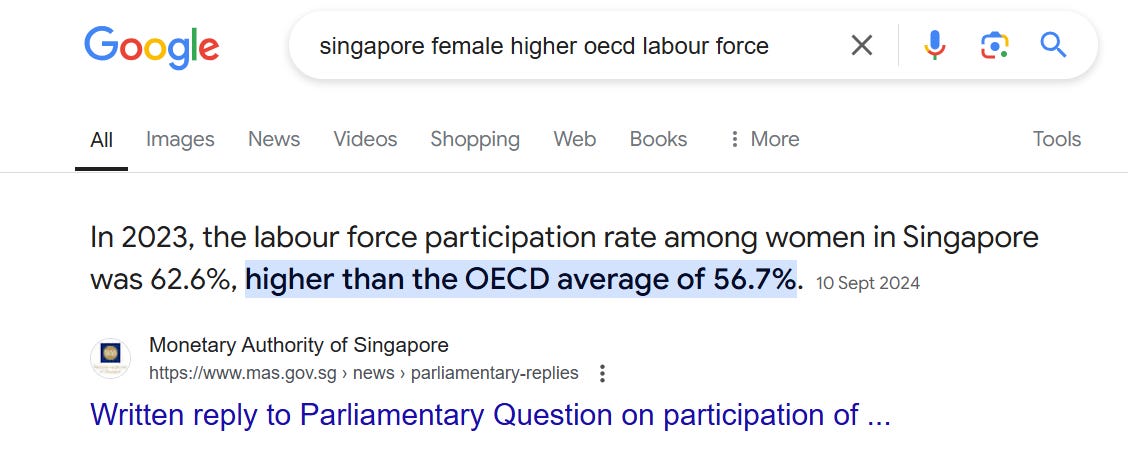
Google search result and screenshot retrieved Nov 2, 2024
In the 2008 Beijing Olympics Opening Ceremony, there was a melodious young kid’s voice coupled with a cute child’s face. The only scandal is that the melodious voice belonged to another kid who was deemed to be “not as cute” thus the organisers carried out a lip-sync swop on stage in an attempt to improve their perceived aesthetical value of the ceremony.
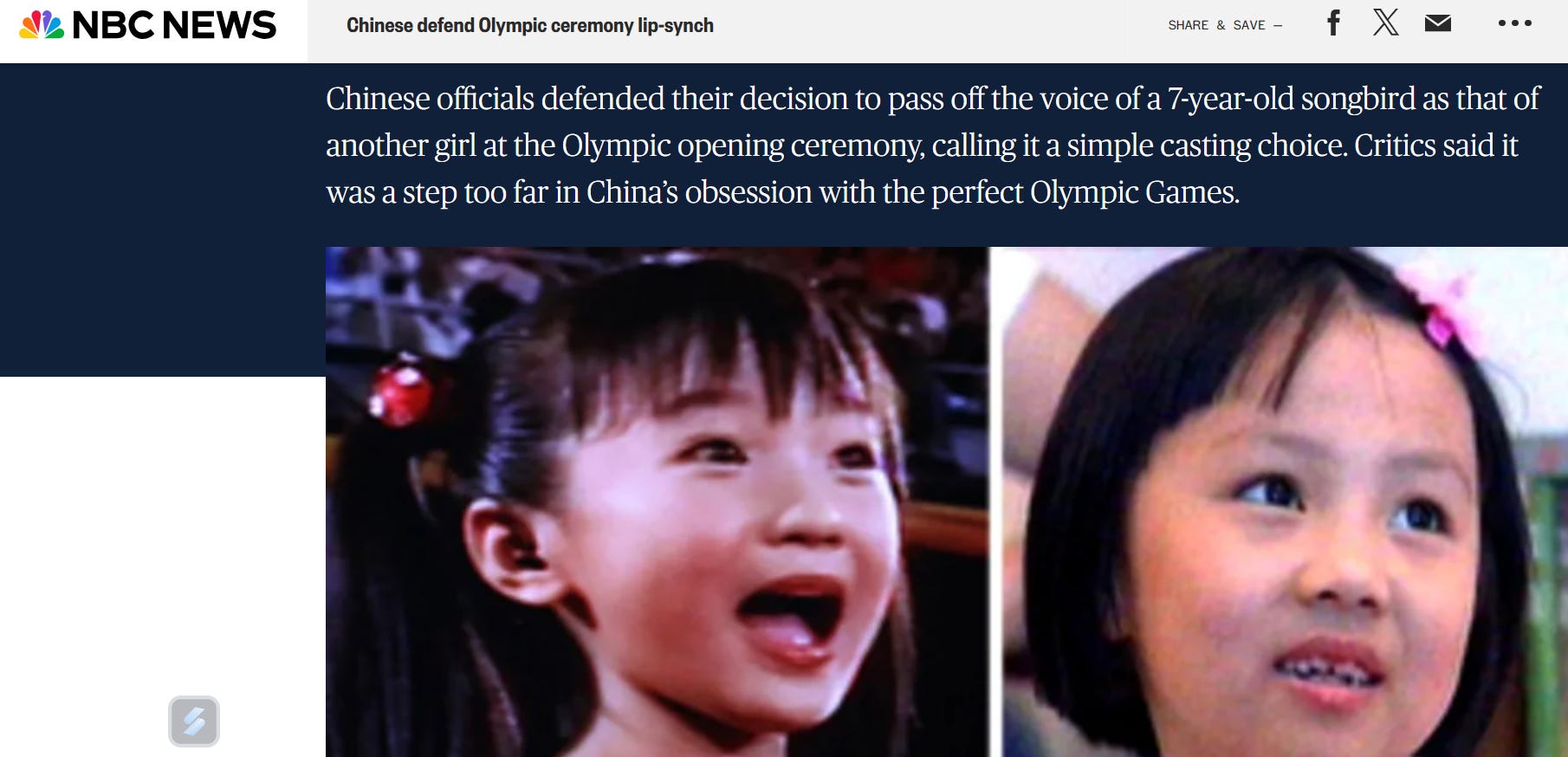
Picture source: Chinese defend Olympic ceremony lip-synch, NBC News hyperlink and picture retrieved Nov 2, 2024 , https://www.nbcnews.com/id/wbna26182056
In Singapore where I grew up, for the major festival of Lunar New Year, one of the biggest things to do for Lunar New Year is to get new clothes / attire for the occasion and give away money or receive money in red packets. As you can tell, appearances are very important unlike Thanksgiving where you just gather to be with family, even if it is tedious relations.
I also found out and confirmed today >< that Asians are supposedly big buyers of luxury brands. Was in a beginners’ foreign language class just now and the professor/ teacher was asking what French words we know. The Malaysian and China students in my class started naming French brands like Louis Vutton and I thought shucks, did I miss something they were smart enough to know? I must think of some brand now and I only know the Evian water mineral water brand which I don’t drink. ¯\_( ͡❛ ͜ʖ ͡❛)_/¯
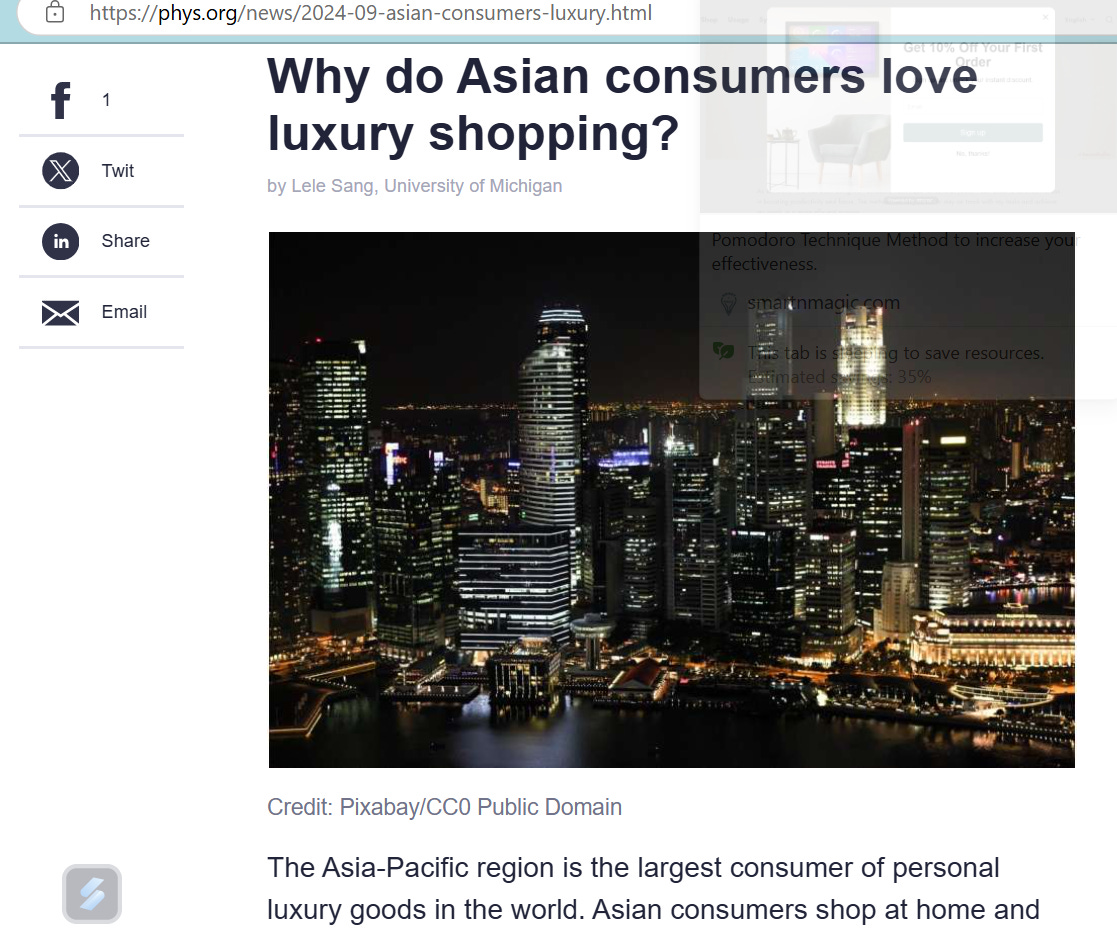
Source: Why do Asian consumers love luxury shopping? © Phys.org 2003 - 2024 powered by Science X Network, retrieved Nov 2, 2024
To be honest, maintaining appearances is the part I hate most about Asian culture because it brings no direct value to the underlying meaning of one’s life, and perhaps can distract from it. This post will be short (maybe I will edit it and add on more info later if there’s demand, let me know any queries) so I move on to my next point.
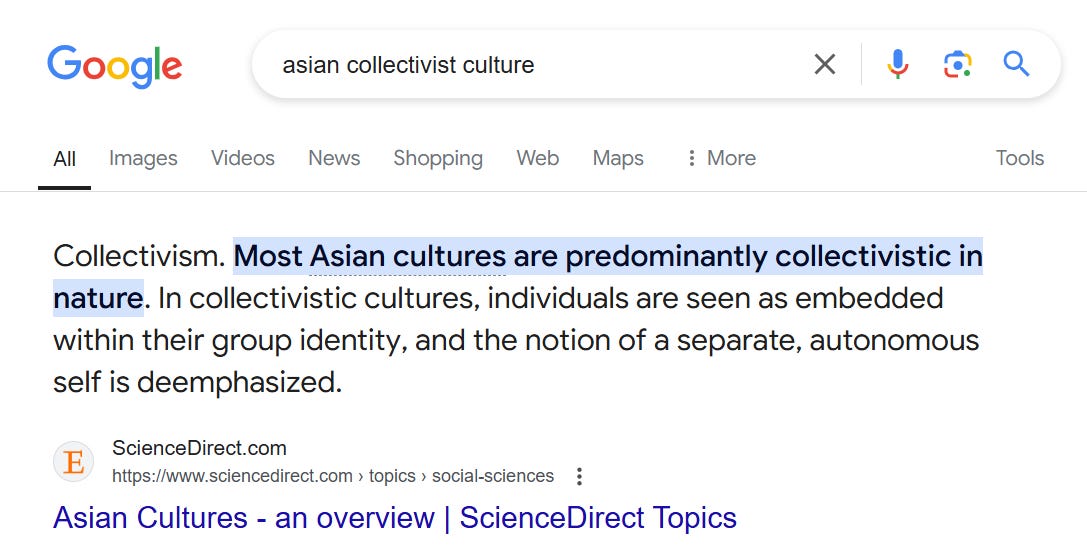
Google image and search result above retrieved Nov 2, 2024
This means that one should decide one’s life and actions according to the best interests of the family, their community and their nation. A very popular slogan in Asia as far as I could tell.
The underlying argument goes like this: Before you do any action, think of the impact on society.
Of course, the dilemma arises - is the collectivist value that is usually dictated by the authority or government necessarily the best path for your life and family and what is the impact on individual happiness and autonomy? Asian countries account for approximately 60% of the world’s suicides.Ying-Yeh Chen, Kevin Chien-Chang Wu, Saman Yousuf, Paul S. F. Yip, Suicide in Asia: Opportunities and Challenges, Epidemiologic Reviews, Volume 34, Issue 1, January 2012, Pages 129–144,
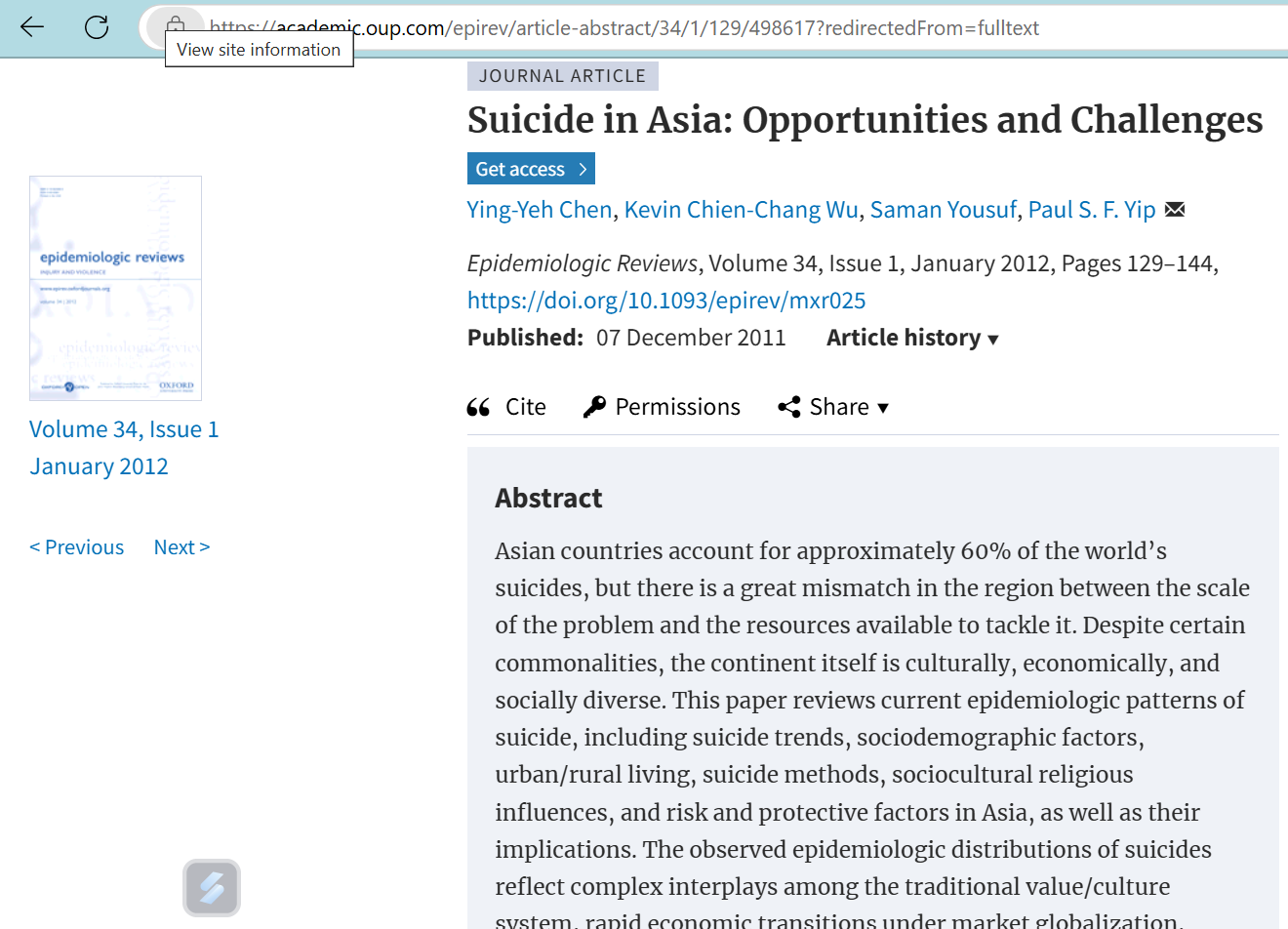
Image source and partial abstract from Suicide in Asia: Opportunities and Challenges | Epidemiologic Reviews | Oxford Academic , retrieved Nov 2, 2024
https://academic.oup.com/epirev/article-abstract/34/1/129/498617?redirectedFrom=fulltext
Here are some of my past posts for new readers!
Past posts:
https://sillysmartatom.substack.com/p/book-review-paulo-coelhos-eleven
https://sillysmartatom.substack.com/p/thoughts-on-land-space-and-democracy
https://sillysmartatom.substack.com/p/podcasts-that-nourish-me-recommendations
https://sillysmartatom.substack.com/p/book-review-of-a-tiger-mums-manual
https://sillysmartatom.substack.com/p/how-do-shopping-malls-affect-democracy
https://sillysmartatom.substack.com/p/doodles-while-travelling
( ◡́.◡̀)(^◡^ )
Comments
Nothing yet. Say the first thing.
Sign in to join the conversation.