
This is not the post I had planned for this week. However, I somehow managed to overwrite the Word document I was working on with a blank version, thereby losing an entire day of research and writing. In desperation, I turned to my ‘draft posts’ folder, which is why you’re getting this extremely random and somewhat anomalous post that I began a couple of years ago as a follow-up piece to a couple I’d written about my time as a part-time video store clerk. (All I’m saying is that there’s a reason why it languished in my drafts folder for years.)
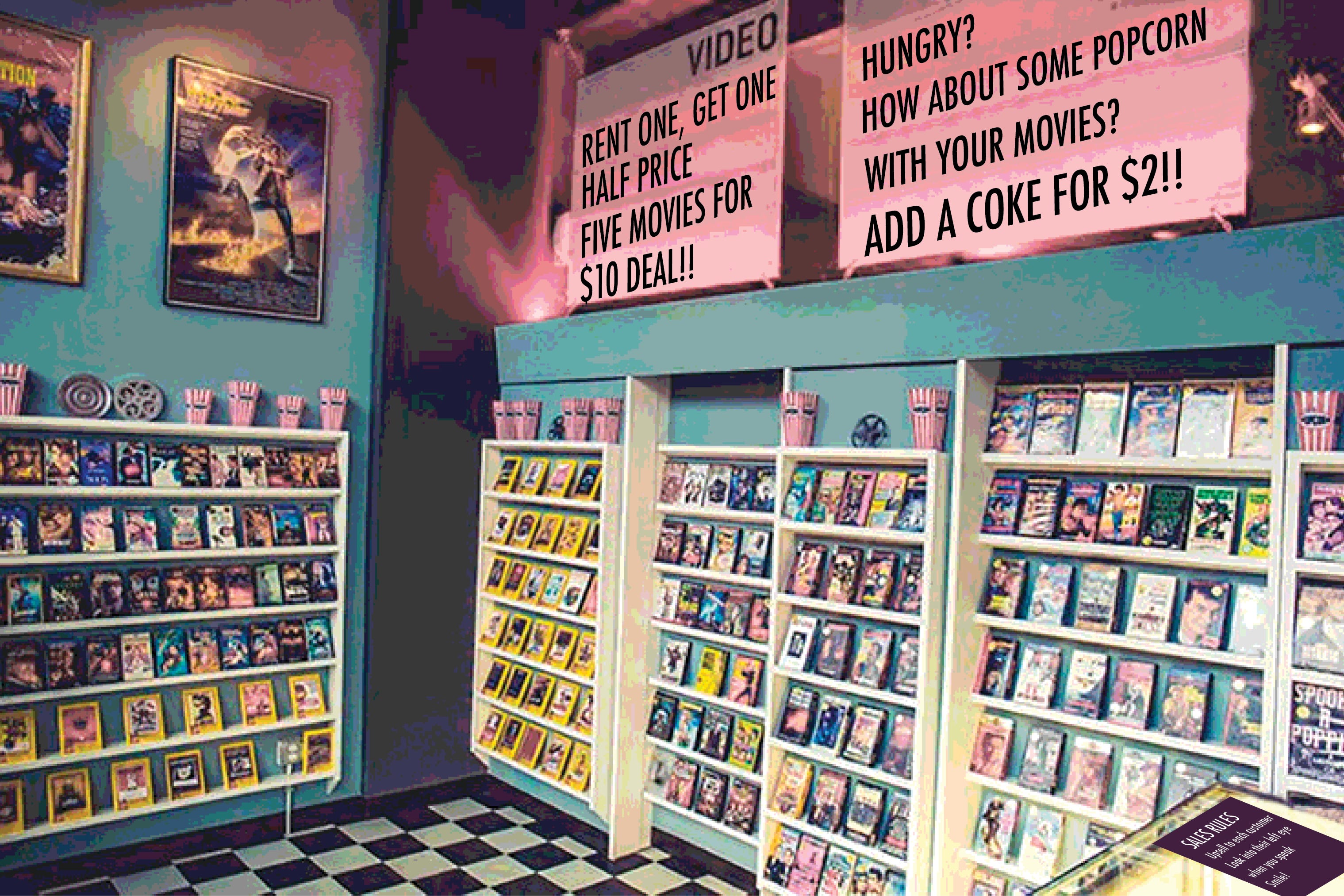
Between the ages of 15 and 25, I worked part-time at a video store—a job that I like to think was good training for becoming a professional anthropologist. I’ve previously written about customers, including those who rented porn and those who rented kids’ movies, but in this post I want to focus on video stores themselves.
For most of my years as a clerk, I worked at a locally owned video store. It was not, by any means, a perfect job. For my boss, Single White Female was not merely our most successful video rental of 1993 but a job requirement.1 He didn’t believe in unions and a condition of employment was that we weren’t allowed to join one. This meant that we had a flat hourly rate regardless of whether our shift was on a Wednesday morning, a Saturday night, or Christmas day.
He also purchased films according to his own personal preferences and was appallingly bad at predicting what videos would do well. Army of Darkness, which was already well on its way to becoming a cult classic upon video release, he declared unwatchable, initially refusing to purchase copies until customer demand forced him to relent. Conversely, Showgirls, a movie that was universally panned, he deemed a ‘top little flick’,2 purchasing 20-odd copies, most of which languished on the shelves after the initial flurry of rentals.
During the seven years I worked there, I dealt with occasionally unpleasant customers and a few bizarre events, including a venomous snake that somehow got into the shop,3 videos returned in a bag crawling with maggots, and, most memorably, a stabbing. A ten-year-old Aboriginal girl stabbed another in the back with a steak knife and they turned to me to clean up the blood and resolve the dispute.
Still, aside from the endless free movies I had access to, I always felt valued as an employee. Once my boss realised my love of movies and virtually encyclopaedic knowledge of them, I was the go-to staff member when anyone had a question about actors or films.
There’s a scene in the movie Clerks4 where the protagonists Dante and Randal are comparing annoying customers and Randal, who works at a video store, discusses the customers who expect clerks to be mind readers—like the one who asks ‘Do you have that one with that guy who was in that movie that was out last year?’ The thing is that customers would do this all the time and I would generally know exactly what film they were talking about.5 Basically, video store clerking wasn’t just a job for me as a 15-year-old, it was a calling.
I worked at the local store from 1990 until the beginning of 1998, when I embarked on my doctoral fieldwork in South Korea. By the time I left the store, I was their longest-serving employee and I expected to resume the job when I returned home. However, during my year-long fieldwork stint, the store went bust—an early sign of the video rental industry’s impending demise, although I didn’t know it at the time.
When I got back to Townsville at the end of 1998, I found a role at a national video store chain—let’s call it Video Sleazy.6 Although the chain was a mixture of franchised shops and corporate-owned ones, all the Townsville stores were corporate-owned. This basically meant they were accountable to shareholders and run out of the head office in Sydney.
Notably, my previous years of experience working in a video store were not considered an advantage in my new job. I was bluntly informed in the interview that this typically produced a number of bad habits that would need to be corrected. I suspect that working at McDonald’s would have been viewed more positively, primarily because Video Sleazy’s entire business model seemed to be premised upon copying it. This became clear when they handed me a huge training manual, with the admonishment to complete it (in my own time, of course) before my first shift.
Consisting of a three-ring instructional binder and five different training videos to watch, it covered every single aspect of the job, from the type of pants that were acceptable as part of our uniform (navy and pleated) to how customers should be greeted. A warm ‘Welcome to Video Sleazy’ was required within the first 30 seconds of the customer entering the shop—no exceptions! However, as the manual repeatedly emphasised, I was no longer a clerk but a salesperson.
The videos were full of pseudo-scientific sales techniques we were expected to master. For instance, we were instructed to focus on the customer’s left eye when speaking to build trust and rapport. However, the central focus of the videos was the art of upselling—basically, the ‘Would you like fries with that?’ pitch pioneered by McDonald’s.
Translated into the world of video rentals, this meant that if someone hired a new release, staff were required to ask if they wanted a second one to get the ‘Two for $10’ deal, or if they would like to add a bottle of coke and a packet of chips to get our ‘movie meal’ deal. Oh, and just in case we were tempted to ignore the advice in the instruction manual, we were warned that secret shoppers hired by the head office regularly made trips into local corporate branches to ensure that staff were abiding by the training.
Video Sleazy could not have been more different from the local store I’d previously worked in, with its casual, familial atmosphere. When I started working in the latter as a 15-year-old, my mentor was the assistant store manager Toni. Confident and friendly, she was the kind of person who called everybody ‘matey’ and seemed very worldly and wise to me,7 although I doubt she was more than 20. Toni had a deep and unshakeable love of Tom Cruise and used to spend the quiet periods during our joint shifts gossiping with friends on the phone. I was very fond of her and sad when she left a few years later, after getting pregnant.
Conversely, the main person I remember from Video Sleazy was James. From the corporate office in Sydney and the head manager of the Townsville stores, he seemed to have modelled himself on Alec Baldwin’s abrasive sales trainer Blake from Glengarry Glen Ross—minus the intellect and charisma. We were regularly pulled in for team meetings where we got similar speeches about the need to increase sales and the consequences of failing to produce them.
You see, at Video Sleazy, the frequency of our shifts was determined by our average weekly take. This was basically the average amount spent per customer on our shift that was logged to us. If your average take was lower than the expected minimum, your shifts would be reduced accordingly.
During my first week, someone purchased $100 worth of videos, thus dramatically inflating my average take. Although the purchase had zero to do with my sales skills (which are non-existent), I was briefly labelled a ‘high performer’—a dubious privilege that earned me the choicest shifts, along with the enmity of my colleagues. Still, it didn’t matter much because staff were constantly rotated between the video store branches, presumably based on the premise that friendly co-workers are unproductive workers.
I hated everything about the job, which didn’t even come with the side benefit of free movies.8 The icing on the cake was the investigation launched by the Australian Competition & Consumer Commission about a year after I started working for the company. Accused of unfair price rises in the lead-up to the introduction of the national goods and services tax, and facing a fine of up to $10 million, a group of corporate bigwigs flew up from the head office in Sydney and held back-to-back panel interrogations with all the Townsville staff. Although I was about to finish my PhD and had just been offered an academic job in the US, it was still a deeply unsettling experience, because we all knew they were looking for a scapegoat.
In 2001, about a year after I made my escape, Video Sleazy admitted to misleading customers. Two years after that, the company had sold off most of their corporate stores, and a decade later they were basically dead in the water. By 2010, there was barely a video store to be found anywhere in Australia.
In the grand scheme of things, video stores had a remarkably short lifespan. Like the characters in the 70s cult classic Logan’s Run, they were killed off after 30 years—and in both cases, it was the computer wot dun it. If video killed the radio star, streaming killed the video store.
In many respects, the history of the video store is a microcosm of the history of industrialisation and capitalism itself. For instance, I suspect my experience of transitioning from a family-owned video store to a corporate one wasn’t too dissimilar from what it was like for a late eighteenth-century artisan moving into a factory. I also got a front-row seat to what the sociologist George Ritzer has termed the ‘McDonaldization’ of business and society, with its emphasis on efficiency, calculability, predictability and control.
In hindsight, video stores were arguably the first major—or at least most visible—victim of digitalisation. In the blink of an eye, they went from a mainstay in shopping centres and urban neighbourhoods to basically extinct, a process we are now witnessing at scale in high streets across the country. Still, every time I sit in front of my TV screen, scrolling through film after film in a mostly fruitless search for something to watch, I think to myself, for what feels like the thousandth time, ‘God, I miss the video store.’
Also, to this day, he is the only person I’ve ever met who referred to the toilet as ‘the little girls’ room’—a linguistic sin even greater than calling women’s underwear ‘panties’ or boobs ‘titties’.
Given that the reputation of Showgirls has been rehabilitated* in recent years and it’s now frequently claimed to be a misunderstood masterpiece,** history may prove him right.*** If so, I guess this means that Folks!—a thankfully obscure Tom Selleck vehicle my boss adored—is actually a comedic masterpiece.
*Wrongly.
**It’s not.
***It won’t.
It was a common brown, which are ubiquitous in Queensland and one of the most venomous land snakes in the world. Random side note: shortly after I moved to the UK, I was bitten by a spider while watching a movie at the local cinema. Given that my finger swelled up, being Australian, I naturally assumed it was poisonous.* I crept out the theatre and tried to describe the spider to the clerk at the front desk as best I could, in the event that I was about to go into convulsions or a coma. The clerk, not being Australian, clearly thought I was nuts to be carrying on about a tiny spider bite.
*In my defence, I actually knew someone who was bitten by a redback spider—she was a regular customer at the video store. They managed to give her anti-venom quickly, but her arm, neck and cheek were still extremely swollen when she came into the shop.
Another movie that quickly developed a cult following on video; naturally, we only carried one copy.
Primarily because that’s what I did call it. Any Australian of a certain age will recognise the store in question.
It was Toni who taught me how to disconnect yourself from your farts by waving your hand frantically behind your arse and then leaping away from the now detached smell.
I didn’t find that out until after I started the job. I was offered a job at Subway the same day I was offered the Video Sleazy job. I was so surprised to receive two job offers in one day that I didn’t tell them on the phone that I’d already accepted another job, resulting in an extremely awkward follow-up conversation. In hindsight, I doubt the job at Subway could have been any worse.
Comments
Nothing yet. Say the first thing.
Sign in to join the conversation.