
Thanks are owed to Jill Hughes, who introduced me to the German stare.
Recently, I travelled up to Oxford via train with a friend. As available seats were limited and I get motion sick if I’m not facing the direction of travel, we ended up sitting opposite each other at a table. This meant that we were in very close proximity to the two random strangers who were sitting at the table with us.
Given that we hadn’t caught up for a while, we did so throughout the hour-long train trip. Naturally, the two strangers sitting at our table, who were also unknown to each other, did what strangers normally do when confronted with the private conversation of others: they ignored us, or, at least, politely pretended to. Still, their proximity made the illusion of privacy virtually impossible to maintain. They couldn’t not overhear our conversation, even if they wanted to,1 although we all tried very hard to act as if the situation was otherwise.
Erving Goffman, the pre-eminent sociologist of public life, called this phenomenon ‘civil inattention’. In Behavior in Public Places he defined it as follows:
‘What seems to be involved is that one gives to another enough visual notice to demonstrate that one appreciates that the other is present, while at the next moment withdrawing one’s attention from him so as to express that he does not constitute a target of special curiosity or design.’
A perfect illustration of this phenomenon can be found in the 1995 version of Pride and Prejudice where Mrs Bennett is trying to crudely engineer a marriage proposal from Mr Bingley to her daughter Jane. She ushers her younger daughters out the room on patently false pretences and Elizabeth stays behind to maintain propriety. However, she immediately signals to both Jane and Mr Bingley that she’s not listening to their conversation by picking up her embroidery and positioning her body away from them. Her body language is screaming, ‘Go ahead and talk. I’m definitely not listening avidly to every word you say.’
Civil inattention can occur amongst friends and acquaintances. An example Goffman provides is when the person you’re talking to receives a phone call. The polite thing to do is to signal that you’re not listening, even if you are. You do this by shifting your gaze from your friend and focusing intently on something else, like your fingernails or your phone, or gazing blankly into space as if you’re mentally composing an aria. However, the practice is most common amongst strangers. Via civil inattention, we simultaneously let people know we have registered their presence and signal our intention to give them privacy.
As the sociologist Mervyn Horgan observes, ‘Shared commitment to civil inattention through the mutual indifference of strangers makes ordinary everyday urban life amongst strangers possible.’ It’s civil inattention we have to thank for not being drawn into endless conversational entanglements with random strangers whenever we leave our homes. Still, this isn’t straight indifference, but the respectful kind.
Goffman differentiated civil inattention from treating other people as nonpersons (i.e., acting as if they simply don’t exist2), otherwise known as uncivil inattention. Looking straight through someone is an example of such. At the other end of the spectrum is uncivil attention—like a hateful stare, or an overtly sexualised one.3 This points to the significance of eye contact to civil inattention, and the fine balance required between not enough attention (looking through someone) and too much (staring).
Writing about the US context, Goffman observed that civil inattention typically involves the eyes of the looker passing over the eyes of the other person without overt recognition. This pattern typically changes on streets, where the passersby eye each other up to approximately eight feet, and then cast their eyes down as they pass each other. However, this is a behaviour we have to be socialised into—as anyone who has ever been subject to the intense, unblinking gaze of a toddler can attest.4 This is why the rules surrounding the level of eye contact are culturally distinct. We have to learn how to look—and look away.
These cultural differences are illustrated in what is widely satirised as ‘the German stare’. This is basically the extra couple of seconds of eye contact common in Germany when people are practicing civil inattention, which visiting Americans, Australians and Brits often find deeply disconcerting.
The online language school Lingoda has an entire blog post devoted to the topic. Citing Goffman, it states,
‘Looking away is a way to avoid “intruding” on someone. However, Germans often view looking away as shifty, suspicious, or even insincere. To look someone in the eye, even a stranger, is a signal of transparency. By holding a gaze, a German is essentially saying, “I am an honest person with nothing to hide, and I assume the same of you.”’
However, the post goes on to observe that sometimes the German stare is actually a sign you’re doing something wrong—like talking too loudly on your phone in public. Goffman makes this point of civil inattention more broadly, arguing that the right to it is withdrawn when we behave without regard to social propriety. This results in either censorious stares or studious avoidance. In this respect, civil inattention and its opposites act as an instrument of social regulation—as the sociologist Carol Warren discusses.
Still, for the most part, people take civil inattention for granted.5 In fact, we’re so used to acting as if we have a small bubble of privacy around us that we frequently come to assume it’s real. I’m often amazed by what people will reveal in public places based on a completely false assumption of privacy. For instance, I once sat next to a middle-aged guy on the tram who was clearly sexting with someone. I glanced over casually and could see the entire conversation because he used a ridiculously large font on his phone.6
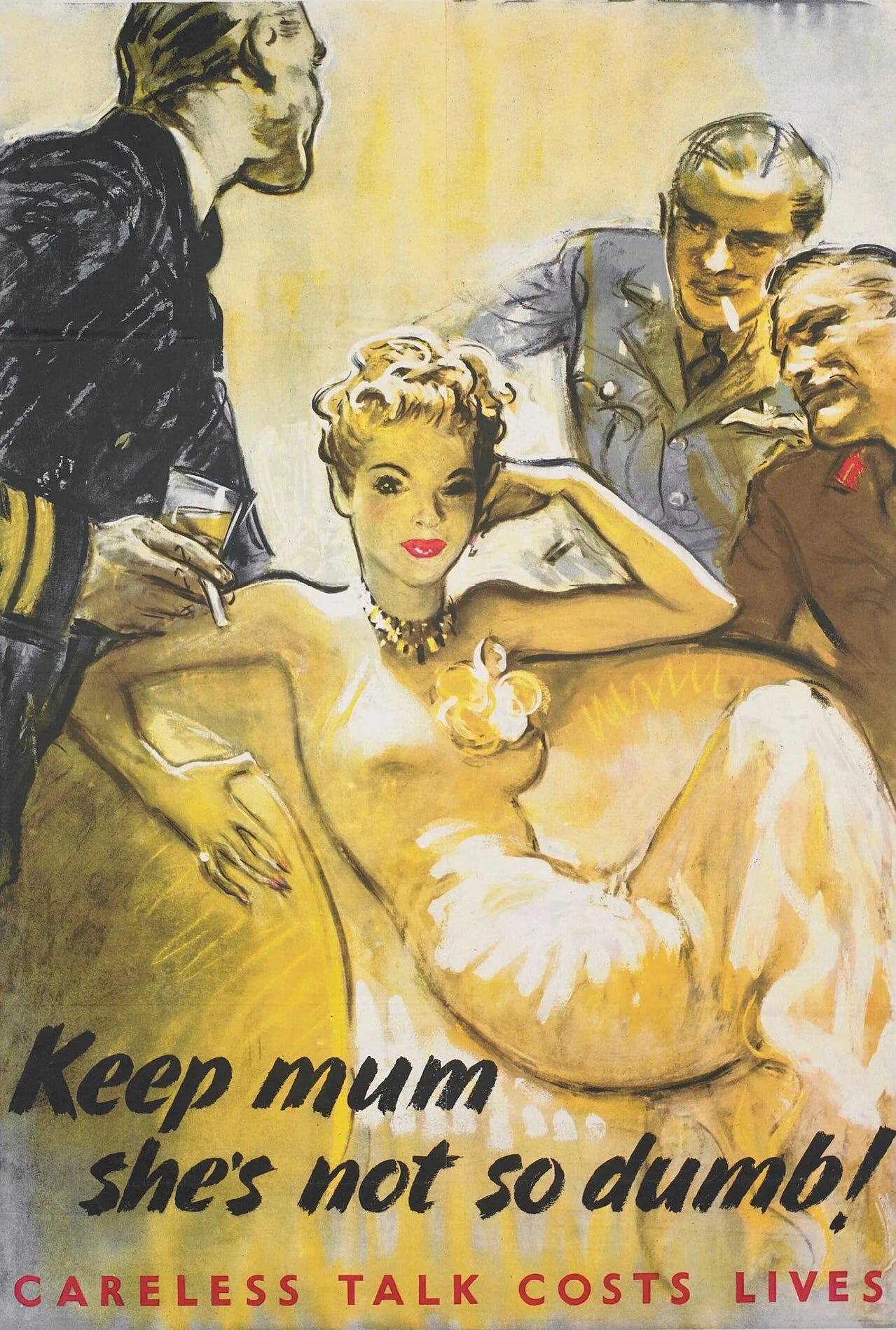
Goffman pointed out that undercover workers often make good use of civil inattention. In his words, ‘the form adhered to is that of non-acquainteds offering each other civil inattention; but underneath is a one-sided, concealed relationship.’ During World War II, the public had to be constantly reminded that civil inattention was sometimes an act—via the British government’s ‘Careless talk costs lives’ campaign, and the Americans’ ‘Loose lips sink ships’ variant.7
Civil inattention is such a core component of contemporary life that we only become consciously aware of its existence when confronted with someone who fails to practice it. Sometimes this is because the rules surrounding social interaction have become genuinely ambiguous. In my experience, this is a particular problem on flights. Because you are stuck next to someone for hours on end, civil inattention can start to seem rude when resolutely practiced, and further social interaction is often required. However, most of us have had the experience of sitting next to someone we soon regret making polite conversation with, because they refuse to shut up for the entire flight.
But even in contexts where the rules are clear, you occasionally meet people who ignore them. My husband and I had this experience in Kraków a few years back while we were having dinner at one of those outdoor restaurants that can be found in market squares all over Europe. Characterised by crap food, sky-high prices and tables jammed closely together, they are populated primarily by tourists because the locals are not dumb enough to frequent them.
We were chatting over a pre-dinner drink when the guy sitting alone at the table next to us interrupted our conversation to proffer his opinion.8 We chatted with him for a few minutes, assuming that he would then go back to quietly eating his meal when our food was served, but he took our polite chitchat as license to invite himself to our dinner. Eventually, we made our excuses and left, tired of a conversational entanglement we’d neither invited nor enjoyed.
The incident stood out because it’s basically the exception that proves the rule. What’s striking is how comparatively rare violations of civil inattention are, despite the intrinsic lack of privacy that contemporary urban life entails. But it shows that while privacy might be an illusion, it requires mutual cooperation to be sustained.
So the next time your eyes fleetingly meet those of a stranger before you both look away, take a moment to appreciate the most subtle yet significant interpersonal ritual of contemporary urban life. Because contrary to all appearances, the real secret of a well functioning society is not a polite smile or a greeting from a stranger, but two random people on a train resolutely ignoring your conversation with your friend.
In part because I have a naturally loud and piercing voice. My inability to speak quietly has got me into trouble on more than one occasion. All I will say on the matter is that you should be particularly cautious on stairwells, because sound carries much further than you think.
Civil inattention, by definition, becomes uncivil if you’re trying to attract someone’s attention and they’re ignoring you—something most of us have experienced in restaurants. Good wait staff illustrate that civil inattention is actually an art form,* as they generally seamlessly vacillate between civil attention and civil inattention—i.e., knowing when to take your order without either interrupting your conversation or hovering unnecessarily. Bad ones tend to get this wrong by being overly attentive or ignoring you (although in North America this is invariably followed by an attempt to ingratiate themselves when they present the bill, in a belated bid for a good tip).
*I speak from brief personal experience, having been the overly attentive sort in my sole night as a waitress at an annual Townsville ball. By the end of the night, people were vigilantly shielding their drinks whenever they saw me coming because my over-zealous attempts to clear tables meant that I frequently took people’s cans before they’d finished their beer. I was not asked back the following year.
Uncivil attention was the focus of a well-intentioned but frequently derided campaign on London transit a few years back focusing on seven types of inappropriate gendered behaviour, one of which was ‘intrusive staring’. Tube posters warned ‘Intrusive staring of a sexual nature is sexual harassment* and is not tolerated’, and urged commuters who experienced it to call the transit police.
*For the record, intrusive staring, while unpleasant for the recipient, does not legally constitute sexual harassment, and the campaign received much criticism on this front. Despite headlines such as ‘Staring on the tube could land you in prison’, the case in question involved a man staring at a woman and then crowding her and barring her exit from the train.
There appears to be a whole genre of videos devoted to this phenomenon that involve men mimicking toddler stares (like this and this).
Except, it must be said, when they are using their mobile phone. One of the many ills mobile phones are responsible for is pervasive uncivil inattention.
In my view, if you’re texting the words ‘angry red cock’ on your phone in 20pt font in a crowded tram, then you’ve only got yourself to blame if you attract the attention of bystanders.* That said, because I’m a nosy anthropologist (or just plain nosy), I do systematically check out whatever the people sitting next to me on transit are watching. Mostly it’s shows, shops and socials, but sometimes it’s porn. Happily, because people are glued to said phones, they are oblivious to what would otherwise be considered rather uncivil, or at least, inappropriate, attention.
*Unless, of course, you’re selling an aggressive rooster.
It should come as little surprise that the Germans took a blunter approach in their own campaign: ‘Shame on you, blabbermouth!’ (Schäm Dich, Schwätzer!)
An American clearly determined to live down to every national stereotype.
Comments
Nothing yet. Say the first thing.
Sign in to join the conversation.