
For centuries, edge meant knowing something others didn’t. From trade routes to market signals, knowledge was the moat. But when cognition is free and AI makes insights cheap, edge has a new meaning.
But what happens when knowledge is no longer scarce—when your competitor isn’t another human, but a machine? When the memos, market maps, and pitch decks that once took weeks and armies of analysts can now be spun out in seconds by anyone with a free AI tool?
Looking at the last year’s tech developments, we already live in an age of cognitive abundance. A founder can generate a polished pitch overnight. An associate can summon a 20-page market analysis at the click of a button. A consultant’s presentations that once cost millions can now be created by a teenager with ChatGPT. Sure, I’m exaggerating—slightly. But the point stands. The performance of “looking smart” has collapsed in value.
So where’s the edge now? What advantage still compounds when everyone can summon knowledge instantly, at scale?
Emad Mostaque (Founder of Stability.ai) calls this the Alignment Economy: a paradox where humans gain the ability to command near-infinite cognition, yet risk becoming irrelevant if they abdicate judgment. In his book The Last Economy, he argues that our role is not to out-think the machine, but to guide it—to provide taste, wisdom, and moral direction. The AI may be the ship, but we are the compass. The machine can sail infinite oceans of possibility, but only humans can choose the destination.
That is where I see the new edge. Not in competing with AI as a faster player, but in conducting it as an Orchestrator — the one who shapes how infinite instruments combine into something coherent, human, and compounding.

I’ve argued before in my previous essay that value lies in orchestration moats at the company level. The same logic applies at the individual level.
Head-to-head with machines on speed or scale, we lose every time. An AI can outpace, out-simulate, and out-recall us by orders of magnitude. Which means the edge cannot be in raw cognition.
Now, don’t mistake this with “prompting.” There are too many channels flooded these days with self-proclaimed prompt engineers. Don’t get me wrong, prompt engineering is real—but it’s 2004 Google query optimization real. Fluency in tools isn’t mastery. It’s table stakes.
In my world, edge isn’t cognition—it’s vision.
Imagine an orchestra of the world’s greatest musicians, each one flawless. Left on their own, they produce brilliance but without coherence—a big mess. That is AI: infinite “knowledge” without direction.
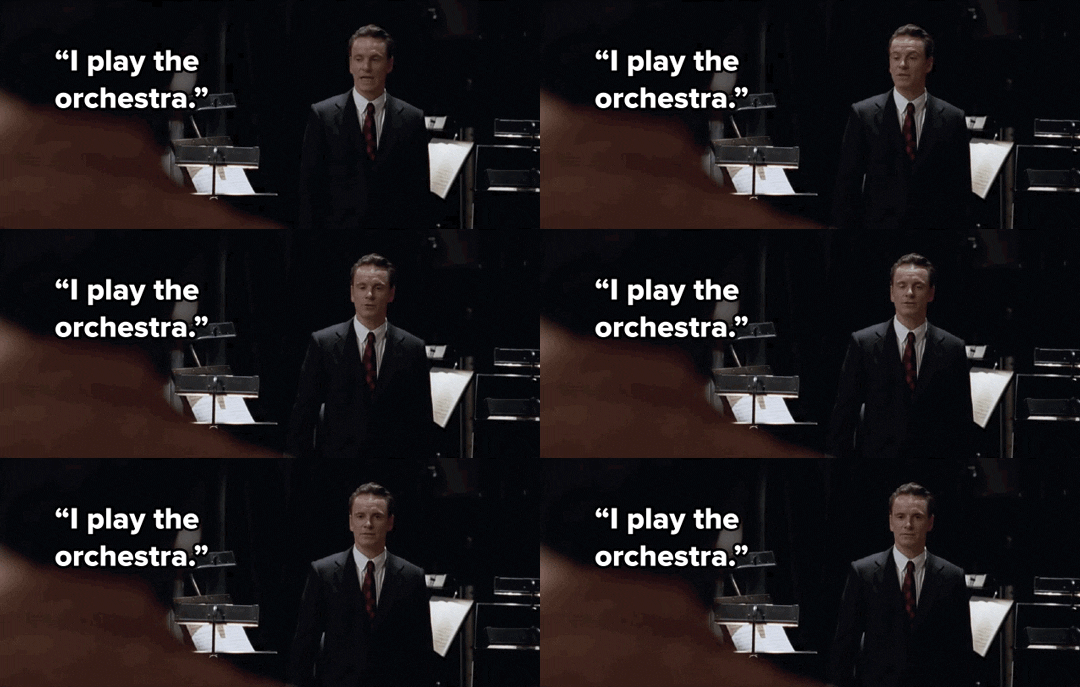
The Orchestrator is the conductor. They may never play a note, yet they decide when to summon the strings, when to silence the brass, and how to build a crescendo that moves an audience. Their power is invisible to the untrained eye. They don’t generate the sound—they shape it. They are the master of the system, not a player within it.
So what does it mean to be an Orchestrator in the age of cognitive abundance? I see four disciplines that define the edge: Taste, Inquiry, Synthesis, and Allocation.
And here’s the catch: abundance without orchestration is chaos. Those who fail to develop these disciplines don’t just lose edge—they drown in noise. The machine doesn’t wait for you to catch up; it floods you. Orchestrators thrive because they choose, frame, weave, and focus—everyone else risks irrelevance.
Taste is not soft. It is a brutal filter. An AI can generate a thousand images, a hundred business strategies, or ten versions of a memo. But it cannot tell you which one matters. Taste is the discipline of discernment, developed through years of deliberate exposure, pattern recognition, and critical judgment. In a world of abundance, power belongs to the one who chooses what to keep and—more importantly—what to discard.
The value no longer lies in answers. Those are cheap. The value is in asking the question no one else thought to pose. Forget prompt engineering—that’s table stakes. Inquiry is strategic: What are we really trying to learn? What’s the fastest way to break this assumption? How do two unrelated ideas collide into something new? Brilliance applied to a weak question is still mediocrity. The Orchestrator wins by framing the question that shifts the game.
AI is a PhD “Rocket Scientist” trapped in a box. It can give you everything about Venture Capital, Healthtech business models or even everything about Zaibatsu corporate structures in Japanese history, but it cannot tell you how one might reference the other. The Orchestrator lives between boxes. They weave insights across domains into something new—something coherent, resonant, and actionable. The AI owns the threads; the Orchestrator owns the tapestry. This way a synthesis is a moat no machine can replace, because it is built from the architecture of human experience and worldview.
The rarest edge in infinite cognition is knowing what not to know. Allocation is the ruthless economy of attention: when to unleash the machine for brute force, and when to preserve silence for original thought. The Orchestrator’s power lies in scarcity management—guarding focus like treasure, and ignoring everything that dilutes it.
Put simply: too much of a good thing is just noise.
The real power move in cognitive abundance is selective ignorance—the choice not to know, but to wonder. Allocation is not just about capital; it is about where you place your finite cognitive energy.
Let’s take my domain of Venture Capital and startups. If cognition is free, then the job of a human VC is no longer to be the smartest analyst in the room. That edge is gone. The job of the investor now is possibly harder yet also more human: to create differentiated beliefs, to compress time-to-truth, to coordinate founders, customers, and capital into alignment, and create narratives that make markets. These are the jobs worth “hiring” VCs for in the age of cognitive abundance. AI can supply infinite options, but only the human can decide which hill is worth dying on, which founder is worth following (with all the human biases included), and which vision is worth compounding.
In the age of AI, cognition is infinite. Judgment isn’t. And just like an orchestra, infinite sound without a conductor is only noise. The edge belongs to the one who dares to lift the baton, cut through the chaos, and decide what music the world will hear.
Cheers!
S.
No posts
Comments
Nothing yet. Say the first thing.
Sign in to join the conversation.