
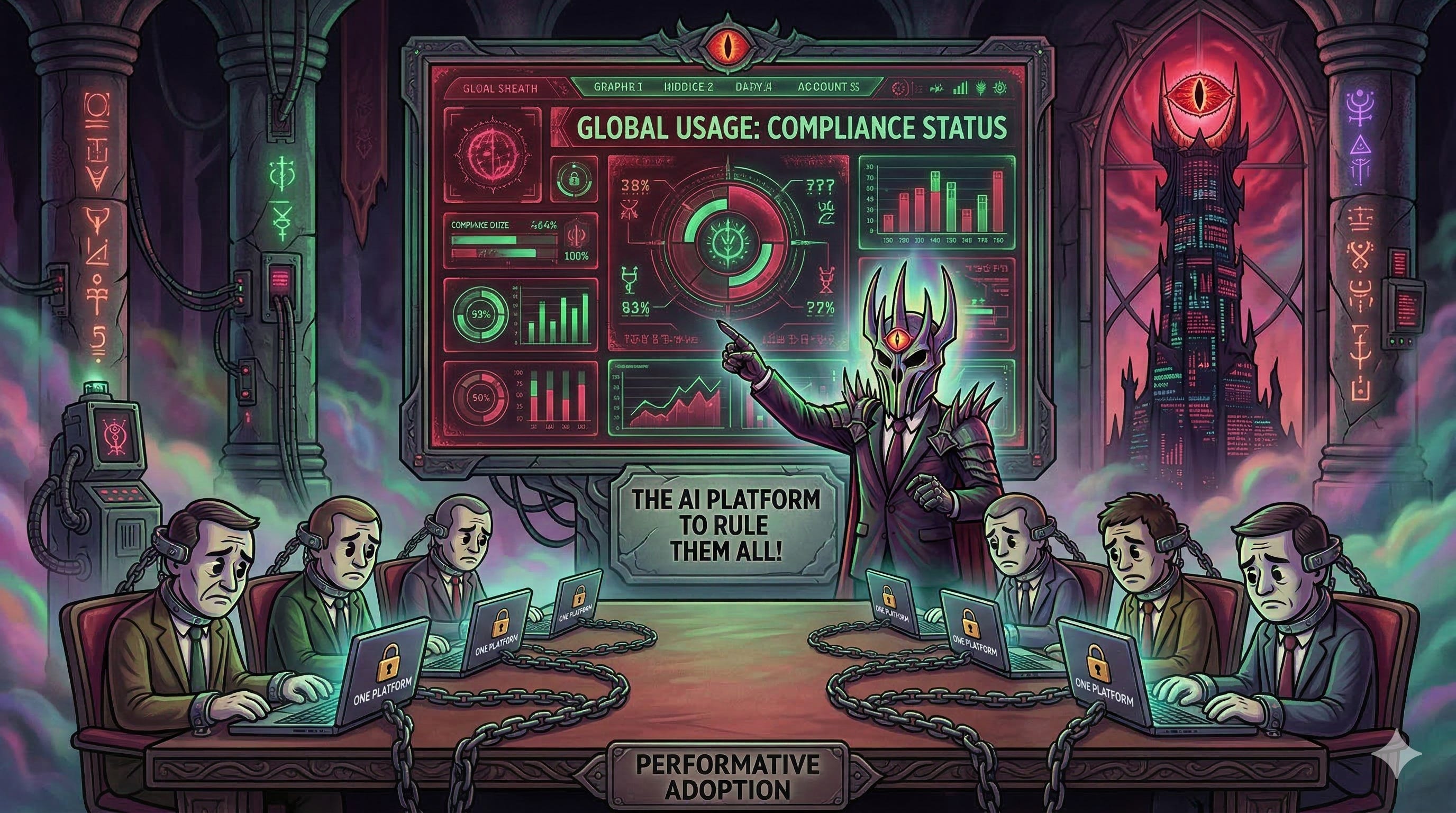
Imagine this: it’s Monday. Weekly standup in an hour. Somewhere across nine Slack DMs, nine people are frantically updating Notion pages, closing Asana tickets, and moving Airtable cards to “Done” — work that was actually finished on Thursday, now being performed for the dashboard.
Is it really adoption? I don’t think so. It looks more like a protection racket — everyone performing compliance long enough to keep the platform off the agenda, then going back to doing exactly what they were doing before.
I’ve seen this. Done this. And lately started wondering why.
Is it an AI tool problem? A platform problem? A people problem?
Or maybe none of the above.
After many deep dives with Claude Code and conversations with others thinking about the same issues, we came to a different conclusion: it might actually be a surface problem. Nine people think in nine structurally different ways — and the assumption that they should all work through one interface might be the bug, not the feature.
SaaS historically assumed that the interface was the product. AI quietly breaks that assumption. The real product is becoming the intelligence layer underneath.
When an organization mandates a single platform (SaaS or AI-enabled), something quietly breaks.
People will log in enough to show activity metrics. Dashboards look healthy. Weekly active users appear to rise. But if the tool doesn’t align with how someone actually thinks, the real work continues elsewhere. Most companies call this adoption. In reality, it’s theater.
Here’s what it actually looks like. The compliance person at a fund has refined their Excel workflows over years — formulas, conditional formatting, audit trails baked in. These aren’t just habits. They’re load-bearing infrastructure.
Meanwhile, the deal sourcing team lives in Airtable with kanban views and relational databases. These aren’t just different tools. They represent different cognitive styles. Some people think in rows and formulas. Others think in cards and relations. Force both onto “the AI platform” and you get polite resistance from both sides. Not because the AI is bad — but because the surface is wrong.
Recently I spoke with a founder who rolled out an AI-powered knowledge base for their 10-person team. Beautiful product. Great search. Usage stats showed weekly active users.
Impressive, right? When I asked how people actually used it, the answer was:
“Mostly to find the Slack thread where the real answer was discussed.” The platform had become a search engine for the tool people actually trusted — an expensive middleman. Leadership sees dashboards that confirm adoption when the reality disagrees. It’s the corporate equivalent of reading the table of contents of a self-help book and claiming the transformation. The promise is always the same: one tool, one workflow, one dashboard.
One platform to rule them all.
Tolkien wrote about this exact fantasy. It didn’t end well for the guy who forged the Ring either.
Previously I wrote about how judgment decomposes into layers — some tolerate formalization, others resist it, and that resistance itself is informative.
Interfaces behave the same way.
The intelligence layer — analysis, scoring, research, synthesis — can and should be shared. But the surface layer is irreducibly personal. Trying to standardize both is how you get performative adoption.
As I dug deeper into this idea, I realized it isn’t specific to AI. The same fork appears in every major technology wave.
Prescriptive vs connective.
“Do it our way” vs “connect what you already have.”
And it resolves the same way almost every time.
ERP (1990s)
SAP told the world: “Do business our way. Implement our modules.” Corporations did. At double the budget and with large portions of functionality quietly abandoned. SAP won the contracts. Accenture and Deloitte got rich fixing implementations. SAP projects are where optimism goes to die.
Cloud (2010s)
Salesforce said: “CRM in our dashboard. Our workflow. Our reports.” And it worked — until it didn’t. Zapier quietly connected thousands of tools with almost zero adoption friction. MuleSoft built the enterprise-grade version of the same idea: API-led connectivity across systems. Eventually Salesforce bought MuleSoft. For $6.5 billion. Because when you can’t build the connective layer, you acquire it.
Collaboration (2020s)
Monday.com, Asana, ClickUp — each promising to be the one place where all work happens. They’re still competing with nearly identical feature sets. Slack won by being the bus, not the destination. Salesforce bought Slack too. Sensing a theme?
AI (2025+)
Now we’re seeing the same dynamic emerge again. Platforms promise “AI for everything.” Underneath, a quieter layer is forming: orchestration gateways, API-first intelligence systems, protocol-level integrations. Still unfolding. But the script looks familiar. The meta-pattern is brutal in its consistency.
In every wave, the platform player wins the early market because it demos well and procurement understands it. The connective player captures long-term value because it meets people where they already work. Eventually the platform player acquires the connective player.
So what actually works?
Not “no interface.” Some futurists claim the interface disappears entirely. It sounds impressive in conference talks, but try selling “invisible software” to enterprise procurement.
Not “the best interface wins.” That was the SaaS assumption — and it only works when the interface is the product. The more plausible model is something in between:
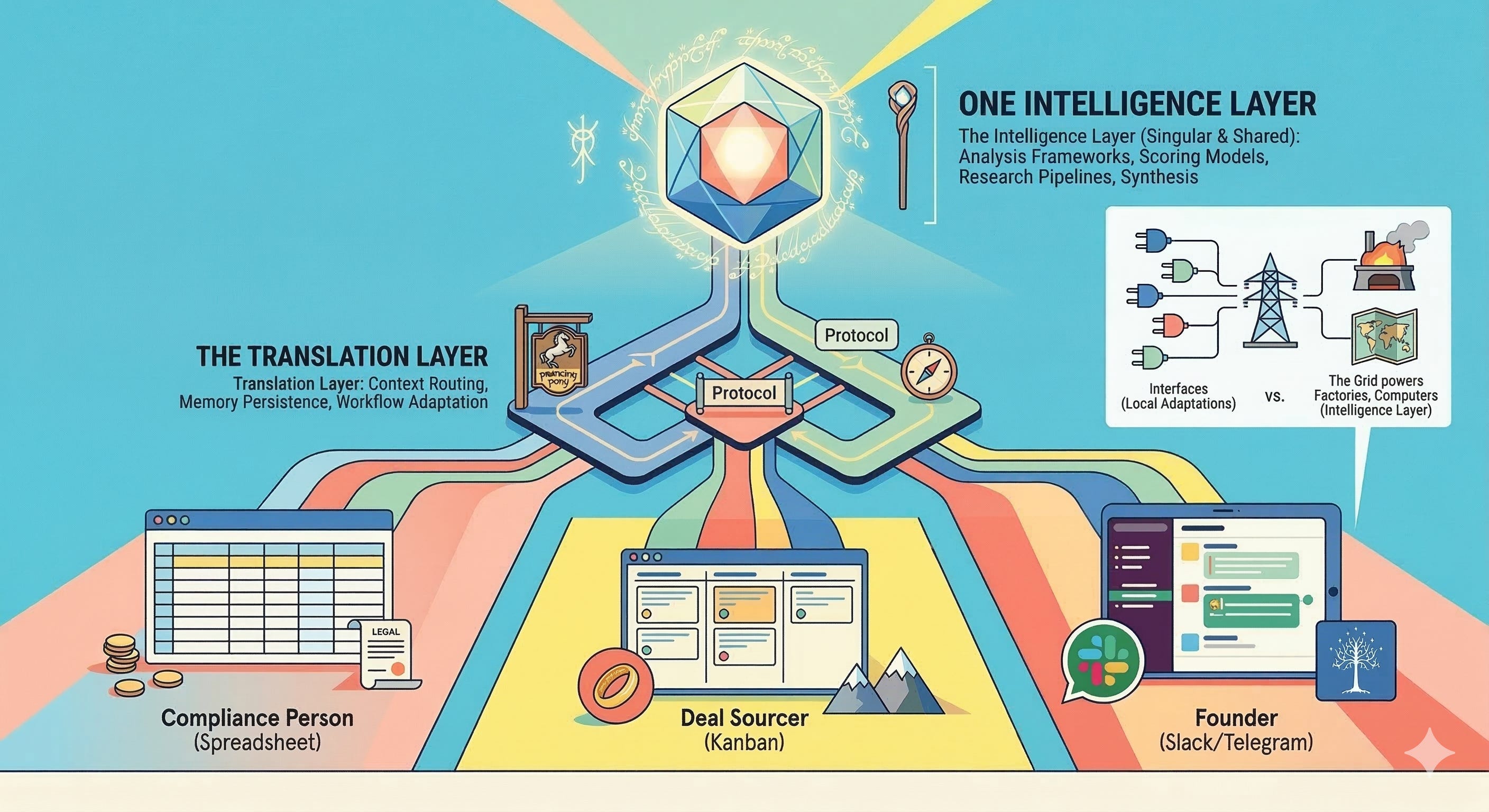
Many interfaces. One intelligence layer.
The intelligence — analysis frameworks, scoring models, research pipelines, synthesis — is singular and shared. But the surface is plural and personal.
The compliance person gets AI inside their spreadsheet. The deal sourcer gets it inside their kanban board. The founder interacts with it through Slack, WhatsApp, or Telegram. Same intelligence. Different surfaces. Between those layers sits the piece most people aren’t talking about yet:
the translation layer.
Context routing. Memory persistence. Workflow adaptation. Making the same intelligence useful across whatever surface a user prefers. That’s the real engineering problem.
But the value doesn’t live in the translation layer itself. Just like the internet protocol stack, most connective infrastructure eventually becomes a commodity.The durable value sits one layer above — in the intelligence that flows through it.
Think of electricity.
Countries have different plug shapes. Nobody chooses their home appliances based on the socket standard.But the grid isn’t where the value sits either. The value sits in what the electricity powers — factories, computers, data centers.
Interfaces are local adaptations. Protocols move the current. But the intelligence layer is the machinery actually doing the work.
As I continue experimenting with my personal operating system, I’ve started evaluating new tools differently.
Instead of asking whether a product has the best UI, I ask three simpler questions first:
Does it have an API?
Is the documentation good?
Is there a free tier for testing?
Instead of jumping between Airtable, Notion, and Google Workspace, everything now connects through a small personal system that lives in my Terminal. Why a terminal instead of a GUI? Less noise. Maybe it’s just me, but after wiring things together this way and gradually improving the setup, I’m more productive than I’ve been in years.
What’s interesting is that when I speak with peers across VC and startups, the surface tools look almost identical: Slack, Notion, Airtable, Asana, Google Sheets. AI is everywhere and nowhere at the same time. Everyone has tried something — ChatGPT here, a Notion AI block there, maybe an automation experiment that lasted two weeks.
The common feeling is frustration. A sense of being overwhelmed. And the biggest friction usually appears when teams try to standardize their stack.
But the problem isn’t the tools. It’s that people on the same team often think in structurally different ways. The ops person thinks in rows. The project lead thinks in cards. The founder processes everything through Slack or WhatsApp threads and considers anything else a detour.
AI doesn’t fail because it isn’t clever enough. It fails because SaaS historically assumed everyone should work the same way — and people have always quietly resisted that assumption.
AI just made the resistance more visible. And the solution more possible.
There are real exceptions.
Some tools are not just interfaces — they’re thinking environments.
Design tools, spatial knowledge tools, visual canvases. In those cases the surface is inseparable from the thinking process itself. You can’t pipe that experience into a spreadsheet and expect the same result. This thesis holds strongest for transactional intelligence: research, scoring, triage, synthesis, coordination.
Creative and spatial work still depends heavily on the surface. Both models can coexist. They’re solving different problems.
There’s also a commercial reality. Prescriptive platforms are easy to sell. Clean scope, beautiful demo, simple procurement story. Connective systems are harder to package. Enterprises don’t buy architectures — they buy products.
When your offering looks like a set of APIs, Markdown files, and integrations between them, the sales narrative becomes less obvious.
That’s a real problem. And one I don’t have a clean answer for yet.
If this pattern holds — and the historical record suggests it does — the implications are fairly concrete.
For investors:
The open question is where the value will ultimately concentrate. One possibility is the classic pattern repeating itself — an “AI MuleSoft” emerging as the connective layer between intelligence systems and human workflows.
But the AI stack is already blurring those boundaries. Frontier model companies are simultaneously building the intelligence layer and the interface. Tools like coding agents are starting to act as orchestration layers as well. So the real question might be different:
Does the long-term alpha sit with the platform that owns the intelligence, or with the system that can route intelligence across every interface people already use?
History suggests connective layers eventually matter more than early platforms. But this time the platform players may be trying to own both.
For builders:
Design your intelligence layer API-first. Your UI should be surface #1 — not surface #only. If your system’s intelligence can only be accessed through your dashboard, you may have just forged your own One Ring.
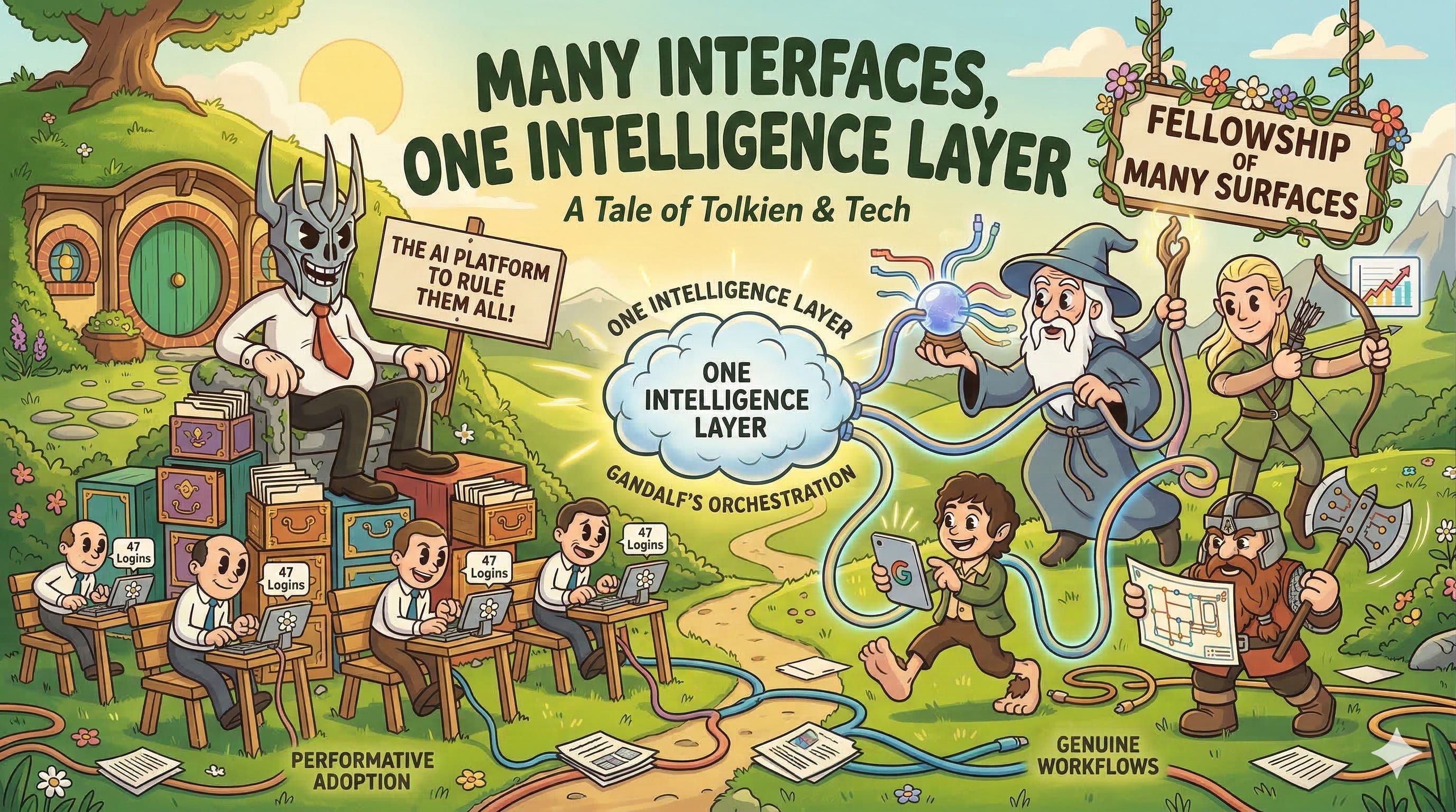
The intelligence should serve the workflow. Not the other way around. And the future probably isn’t one interface for everyone.
It’s many interfaces — powered by one intelligence layer.
S.
No posts
Comments
Nothing yet. Say the first thing.
Sign in to join the conversation.