
A couple of weeks ago, Harry Stebbings posted his now-viral “24 Hours to Term Sheet” example on LinkedIn. I’ve been a fan of the 20VC podcast for years—Harry brings on smart people and pulls out real insight—but that post hit differently.
Not because I thought it was wrong or flawed. Quite the opposite—it was too perfect. It captured something real. A particular style of venture investing. A game, really.
And it made me realize just how differently I approach this work.
For a while, I felt like I was missing something. In countless conversations with other investors, I’d hear things like:
“We try to see every deal in the market—we need more dataset volume.”
The logic checks out. If you're optimizing for optionality, then the bigger the funnel, the higher the chance of catching an outlier.
But my recurring question was always: “Do you actually know what you’re looking for?” Honestly, even at Verge HealthTech—a specialist fund with a clear thesis—we often debate internally what, exactly, we are looking for.
More often than not, the answers from my peers were always something around “Exceptional founders.” “Big markets.” “Product velocity.” You know the drill.
Which brings me back to Harry’s post. It was the cleanest real-world representation I’ve seen of what could be called The Momentum Game.
The strategy goes something like this:
Find the “hot” deal before others do
Get allocation, fast
Provide “value-add” (introductions, cheerleading, LinkedIn hype)
Mark up, cash out in 2–3 rounds
Call it what it is: a velocity trade. The actual product/market/company is secondary. What matters most is access and perceived momentum. The investor plays the game of entry and markup.
Yes, it sounds crude. But it works. If you move quickly, get in early, and position well, this model can deliver very real financial returns. Especially in bull markets when narrative matters more than fundamentals. (Hello “AI startups” :))
And let’s be honest—venture capital is a financial instrument. There’s nothing morally wrong with this strategy, as long as all parties understand what game they’re playing.
To illustrate the point, let’s borrow from the VC version of South Park’s Cartman:
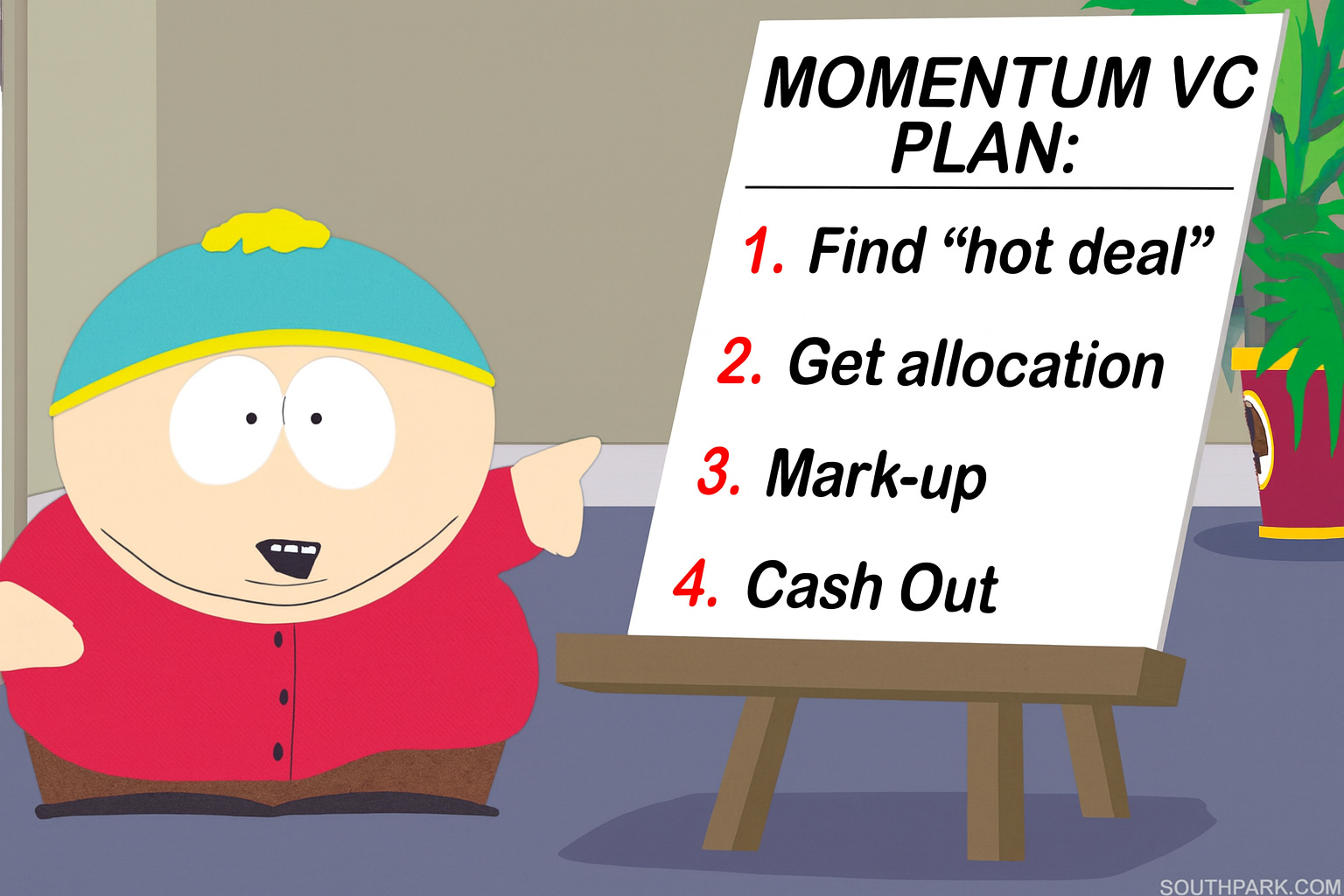
The Plan:
Find “hot deal”
Get allocation
Mark-up
Cash out
Yes, it's a joke. But if you've raised or deployed in the last few years, you’ve seen this playbook in action.
Now contrast that with something slower, quieter, and harder to measure in 12-month cycles.
Let’s call it The Dynasty Game.
Here, the investor isn’t chasing hot rounds. They’re studying. Mapping. Waiting.
They aren’t looking for the next rocketship—they’re looking for the category-defining company in a space they’ve spent years understanding.
The process is messy. Feedback loops are slow. And conviction often looks like stubbornness—until it doesn’t. Not to mention the decision making process may be slower than that of the Momentum one.
In this game, the investor starts not with the “deal” but with the “theme.” The thesis comes first. The company second.
The Dynasty Game looks like this:
Develop deep, long-term conviction in a space or emerging shift
Build context—before companies even exist in that niche
Back early, usually at the “non-obvious” stage
Stay involved for a decade, through pivots, down rounds, and everything in between
Momentum VCs move fast to capitalize on energy. Dynasty VCs move deliberately to shape outcomes.
You won’t find Dynasty VCs posting screenshots of term sheets with timestamps. You might find them in the back of a founder’s office, debugging a GTM motion or sitting through a pharma onboarding mock meeting in an emerging market city. Because for them, this is the work.

Dynasty VCs are often the ones who seem "quiet" for long stretches. But when their companies hit—really hit—it’s not luck. It’s design.
Why does this matter?
Because founders are too often misled by surface-level similarities. Everyone has a thesis slide. Everyone claims to be “founder-first.” Everyone talks about value-add.
But the game they’re playing will show up later—in your board meetings, in your next round, and in how they behave when things get hard.
If you’re building a company that requires deep technical belief, long-term alignment, and trust through uncertain paths—you probably don’t want a Momentum player betting on your round to make a markup in 18 months.
Likewise, if you’re riding a wave and want someone who can make intros, amplify momentum, and help you close a round in 48 hours? That Dynasty VC may feel like they’re moving in slow motion and don’t bring much value to you.
Both strategies are valid. But they are not the same.
If you want to cut through the noise, ask questions like these:
“What’s a space or theme you’ve been tracking for years—and how has your view on it changed?”
Momentum VCs usually won’t have a real answer and “AI will change the world” answer also doesn’t count. On the other hand the Dynasty VCs light up here.“Tell me about a company you backed that took years before it showed traction—what kept you in the deal?”
Reveals patience vs. quick-markup mentality.“How do you measure success in an investment before an exit or markup?”
Momentum players talk about follow-on rounds. Dynasty players talk about customer impact, team resilience, and market shifts.
These aren’t trick questions—they just surface what game your potential investor is playing. And knowing that will tell you far more than any pitch about “value add.”
S.
No posts
Comments
Nothing yet. Say the first thing.
Sign in to join the conversation.