
Let’s start with a shoutout to one of the best ClimateTech content outfits called MCJ that is doing incredible work out there. If you read this, thanks team!
A few months back, they published a very nice Global ClimateTech map representing a few dimensions of startups to represent what ClimateTech was about: removing carbon, enablement and adaptation to the new climate conditions.
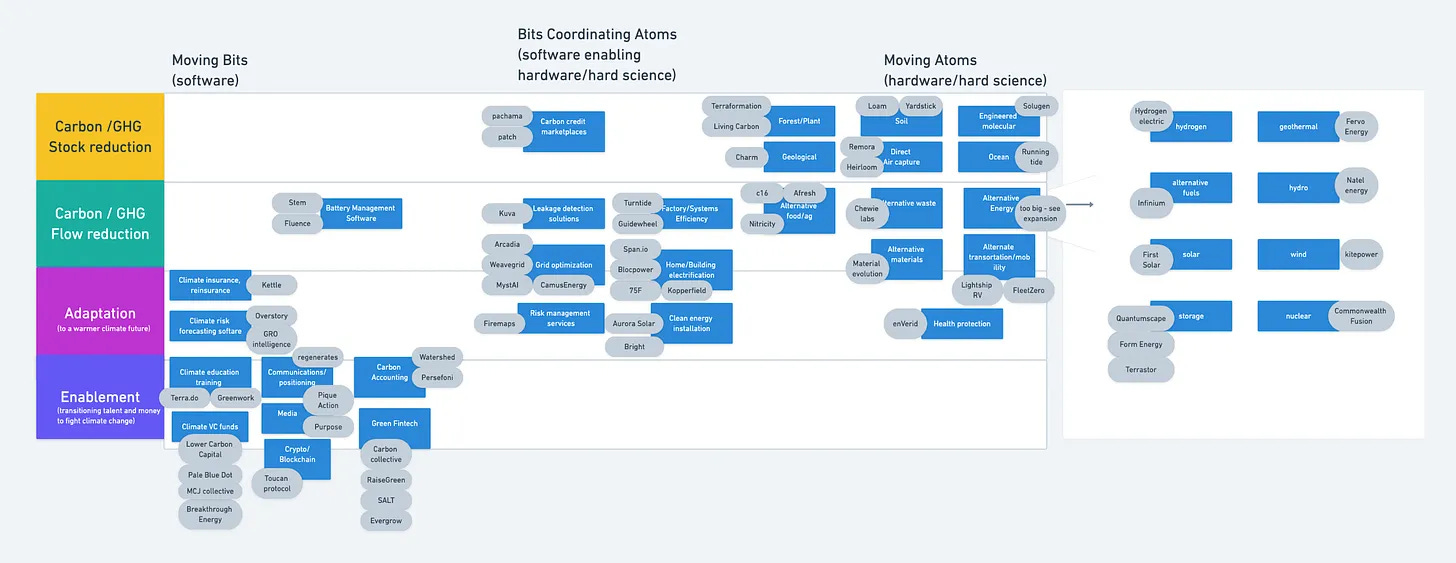
Full detailed map here:
https://whimsical.com/climate-tech-map-Wtu9LamabbBCcvkSZ26mMF
We loved it a bit too much but were also puzzled by the fact that none of the companies present were representing Southeast Asia where the opportunities in the region are so vast and so we went and built our own featuring only the region data and organisations.
We recognise the 3 dimensions presented earlier with the caveat that we believe that all ClimateTech have some degree of Adaptation regardless if they contribute to atoms being moved around as per physics properties and physical movement (decarbonisation) or some bits being moved around as in moving no physical properties of elements whatsoever (enablement) and so we simplify the framework for our own purposes.
We were actually interested to see how the framework was going to unveil:
The categories of startups in a specific space relative to others with regards to its strengths and potency of helping us decarbonise and its strengths in offering us better adaptation skills ie resilience to the climate crisis
We were also interested to understand how many startups in the region were distributed across the map and where the potential gaps of innovation are yet to be covered by local incumbents
And here is what we found:
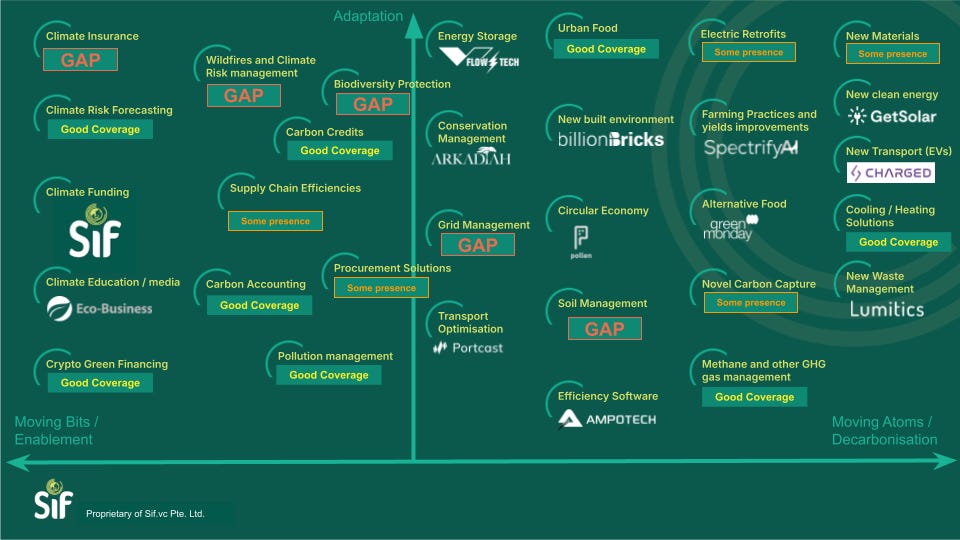
The coverage of the region is comprehensive, most spaces have found plenty of solutions that are already pushing the agenda of localised versions of global winners or even better, found representation of solutions of the same global problem but with a much more locally relevant solution.
For instance, the electrification of vehicles in the region demand solutions for 4 wheelers that are similar to the rest of the world but there are also millions of 2-wheelers that will also require their own electrification revolution. Some local players are charging ahead (pun intended) with local manufacture of electric 2-wheelers that have higher carbon potential of transformation than even any 4-wheeler manufacturers could dream of.
We have also unveiled that the region is not producing enough startups in some niches where Innovation and more importantly monetisation has yet to realised:
Grid management: Most advanced economies understood that the decentralisation of the grid was required for a true and safe decarbonisation of the Electricity utilities. In other regions, this required a set of companies tackling this decentralisation and help larger utilities with load balancing and electricity transport optimisation. The region, due its own Utility Conglomerates and quasi-monopolies have yet to unveil their plans for this decentralisation to occur fast and safely.
Soil Management: measurement of carbon and other content in the Soil is currently not being tackled aggressively enough. The demands for traceability from the EU taxonomy will require a tracking of Carbon all the way to farms and their own practices which this advantageous technology can help tackle well.
Biodiversity Protection: The Climate agenda is shifting to adaptation domains like understanding of the biodiversity impacts of projects and offer monetisation of that data that require specialist technologies to offer datasets that are today very rare to come by and business models where Corporates with objectives in this domains would need to most likely buy this data from startups in the region.
Wildfires and climate risk management: Our region is less exposed to wildfires, but other climate risks such as floods and sea-level rise are not yet well understood. These risks are not adequately priced into property valuations by managers, and no comprehensive solution has been established to predict the risk to infrastructure and real estate. Our region is particularly vulnerable to these risks, making it crucial to address this knowledge gap.
Climate Insurance: Related to the previous point, insurers in our region have not yet fully adopted climate modeling to assess exposure to climate impacts. While startups in this space could effectively factor and price these risks, few are proposing solutions. This gap presents an opportunity for innovation in the regional insurance market.
Other categories have some coverage but not enough to see the emergence of many local winners and would require more companies tackling the opportunities to see a well covered market:
New materials: Materials is a critical category for our identification of solutions to climate change. Applied biology, physics and chemistry are required in all parts of the categories that we need substantial changes to. Some companies are leading the charge here and yet we need much more innovation and research to identify materials that can disrupt and offer efficiencies to old and new infrastructure. One interesting category of solutions are emerging from the utilisation of Biosynthetics.
Electric Retrofits: Custom motors and machinery are present in the manufacturing world and yet we are still missing a lot of machinery to be fully electrified and specifically methods to retrofit existing machines to be working on electric motors could certainly be seeing a lot more innovation. Some specific examples are, for instance electrification of creation of heat in manufacturing processes or remote machinery using diesel in mining processes.
Novel Carbon Capture: We are seeing very Innovative solutions and companies pushing the agenda for Carbon Capture solution and particularly Direct Air Capture devices and infrastructure and yet so far not many implementations nor homeground solutions in the region. A special consideration to long term storage of carbon and other safe disposition of GreenHouse gases would be required here. See our previous article on these technologies.
Supply Chain Efficiencies: For logistics improvements, many companies have focused on last-mile optimisations but the rest is the Supply chain efficiencies are not yet fully efficient with great need of full solutions to understand how to optimise transport.
Procurement Solutions: Our global supply chain has been digitised for years and yet the angle of sustainability is not yet fully baked in and we still wonder or model scope 3 of corporates as the procurement solutions, supply chain and specifically the carbon within the supply chain is not yet understood enough.
In some categories with good coverage we wanted to call out a few companies doing outstanding work out there. Shout to the teams:
To all founders, thanks for your hard work. We are in awe and inspired by your drive to help us find great solutions to address Climate Change.
To aspiring founders, feel free to approach us and we would love to help get this off the ground.
If you are not yet there but want to find out what to do to help, feel free to check those 2 articles (part 1, part 2)we wrote a while back.
Side note: If you are interested in following more publications in the Climate Space in Southeast Asia, we usually repost on https://t.me/SifNews
@David Pardo for @Sif.vc
No posts
Comments
Nothing yet. Say the first thing.
Sign in to join the conversation.