
In modern foot rehabilitation, Foot Intrinsic Muscle (FIM) training has established itself as an essential strategic intervention. It goes beyond mere localized strengthening to optimize the kinetic chain of the entire lower limb. As the body’s primary interface with the ground, foot dysfunction often serves as the starting point for ascending musculoskeletal disorders.
The biomechanical roles of the foot are centered on three functions:
Shock absorbers:
Dispersing and absorbing impact energy during initial contact.
Weight support structures:
Providing a stable base of support to bear loads.
Locomotive effectors:
Functioning as a rigid lever to generate efficient propulsion.
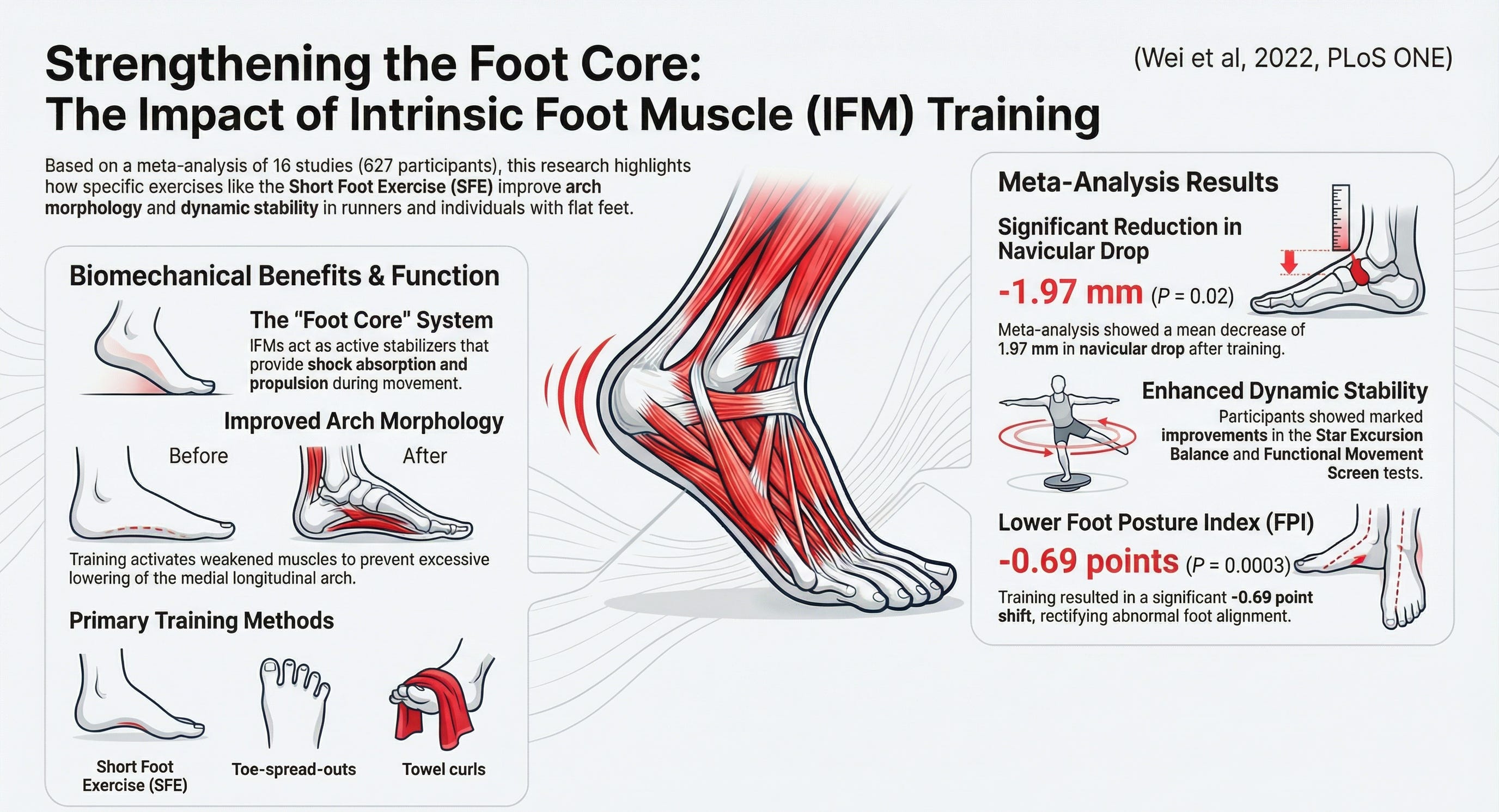
Recent research highlights the concept of the “Foot Core System.” Within this framework, FIMs act as the “active subsystem,” performing the following:
Dynamic Stabilization of the Arch:
Controlling the stiffness of the medial longitudinal arch and switching between flexibility and rigidity based on load.
Proprioceptive Feedback:
Stimulating plantar receptors to fine-tune postural control during standing and gait.
Energy Management and Performance:
During running, the foot acts as a “spring,” providing 8% to 17% of the mechanical energy for each step. This directly enhances running economy and propulsive impulse at toe-off.
Understanding these multifaceted roles is the first step in developing effective treatment strategies for complex foot pathologies.
FIM training is a science-based approach effective for patients with foot alignment abnormalities or chronic musculoskeletal disorders stemming from them.
This article focuses on the following primary conditions:
Flexible Pes Planus (Flat Foot):
Optimizing tension in the medial longitudinal arch through FIM activation to suppress over-pronation. This improves subtalar joint stability and reduces abnormal rotational stress on the knee and hip.
Chronic Ankle Instability (CAI):
Compensating for structural instability caused by ligamentous laxity by improving neuromuscular control and reacquiring proprioception through FIM strengthening.
Running-Related Injuries (RRI):
Reducing the risk of plantar fasciitis and hallux valgus. According to Taddei et al. (2020), a control group that did not perform FIM training had a 2.42 times higher injury risk over 12 months compared to a group that followed a 16-week protocol.
Clinical Insight: Impact on the Kinetic Chain
When FIMs are weakened or inhibited, the foot’s shock-absorbing capacity diminishes, causing abnormal stress to spread to the plantar fascia and surrounding soft tissues. This is not just a foot problem; a collapsing arch induces internal rotation of the lower leg, creating a “weak link” that leads to misalignment of the knee, hip, and pelvis. FIM training is the key to rebuilding this foundation and normalizing the lower limb kinetic chain.
The following interventions should be adopted in clinical settings. Success depends on understanding the characteristics of each exercise and preventing compensation by extrinsic muscles (e.g., flexor digitorum longus).
Short Foot Exercise (SFE): Pulling the metatarsal heads toward the heel to lift the arch.
Target Muscles: Abductor hallucis (AbH), Flexor digitorum brevis (FDB).
Note: Minimize flexion of the distal phalanges (toe curling) to isolate FIMs and prevent extrinsic compensation.
Toe Spread Out: Spanning the toes out like a fan.
Target Muscles: Abductor hallucis, Abductor digiti minimi.
Note: Extremely effective for AbH re-education in hallux valgus patients.
Toe/Great Toe Extension: Individually extending the big toe or other toes.
Target Muscles: Abductor hallucis, Flexor digitorum brevis, Lumbricals.
Note: Improves interdigital coordination and neuromuscular control.
MPJ Loading Training: Performing flexion movements at the metatarsophalangeal joints (MPJ) under load.
Target Muscles: Flexor digitorum brevis, Quadratus plantae (QP).
Note: Objective strength can be measured using a digital grip dynamometer.
Clinical Refinement of Short Foot Exercise (SFE)
The most recommended SFE focuses on shortening and elevating the medial longitudinal arch by mobilizing plantar muscles. The decisive coaching point is “avoiding clawing.” Curling the toes allows extrinsic muscles to become dominant, hindering the intended intrinsic activation. Clinicians must strictly monitor that the patient elevates the arch while keeping the distal phalanges flat on the floor.
Meta-analysis data proves that FIM training brings significant improvements to foot biomechanics and alignment.
Comments
Nothing yet. Say the first thing.
Sign in to join the conversation.