
Light spoilers ahead.
Hello hello,
Writing this review between spates of rain. My dog clings to me during these nightly downpours, so much so that I wake up with him flush to my body, his head directly under my chin. I took a bit longer to contemplate what is now my movie of the year, closely followed by Julia DuCournau’s Alpha. I hope you enjoy a more personal review Xx
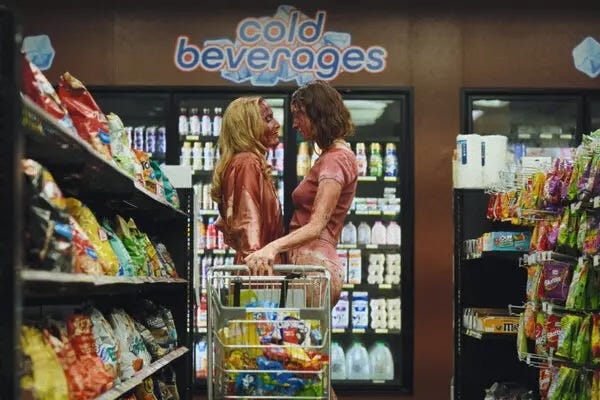
I had spent most of the day prone before seeing Teenage Sex and Death at Camp Miasma.
The real effort was moving from the bed to the couch. I was in that type of depressive fatigue where once in place for the day my body fossilized: no movement, no real attempt to either, no eating. The only real stimuli that occurred for several hours was my dog alternating between lying on the floor or at my feet.
My state was as such that my partner suggested we not even go to the movie at all. That didn’t feel like an option, much as my head and body protested. I had been looking forward to Camp Miasma when it burst onto the Cannes scene, soon as the posters of Gillian Anderson and Hannah Einbinder in a Carrie-esque, blood soaked homage began circulating Reddit. Plus we had committed to going with friends, and that commitment managed to pull me out of the hole no matter how deep in it I am.
Said friends almost got mowed down by a server carrying popcorn when we arrived at the theater. He was a bro-type, flat top hat, shockingly accommodating. “Whatever you want,” he told them, penance for the near mishap. The apology came in the form of frozen margaritas and boxes of Reese’s Pieces, Sour Patch Watermelon, and Buncha Crunch delivered with aplomb and a few bashful nods.
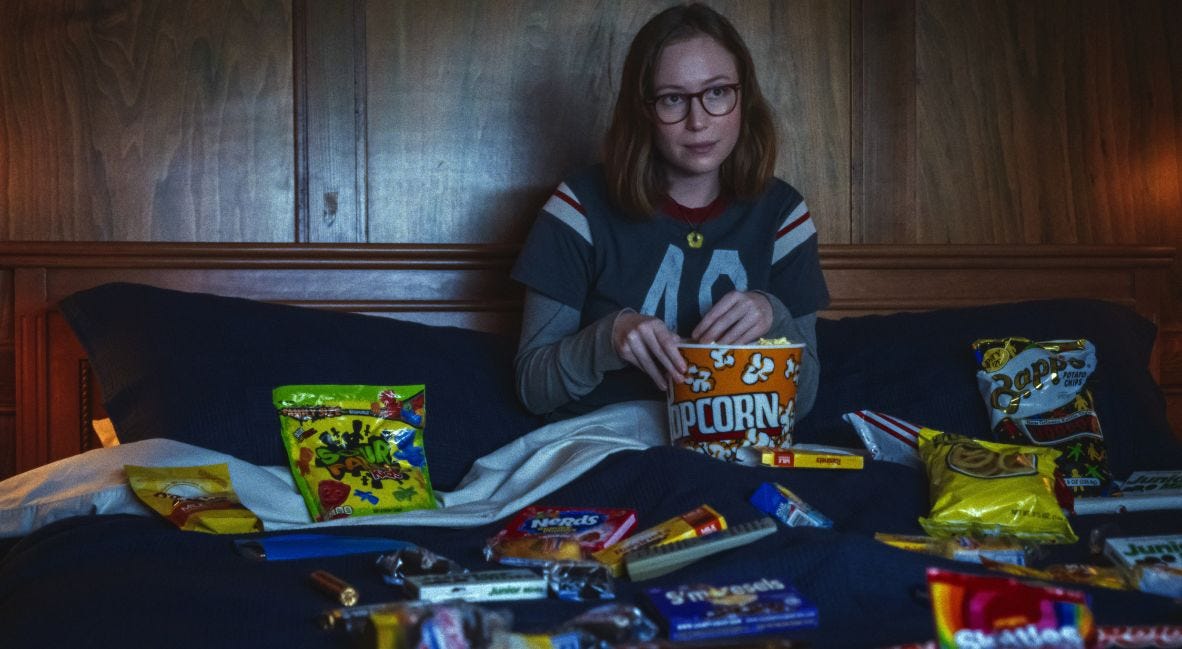
The marg hit me like a freight train, and thank god we had communal candy to nosh on. The four of us mirrored independent filmmaker Kris (Hannah Einbinder) surrounded by her spoils as she dove into a DVD of Camp Miasma. Between the vat of popcorn and the mounds of candy wrappers around her, Kris looked how I do when watching a film I love: Reverent, embodied, and present.
Jane Schoenbrun’s Teenage Sex and Death at Camp Miasma is a true love letter to the horror genre and filmmaking, true love being willing to acknowledge and claim the nastier parts of both. Having broken out of Sundance as the next big queer talent, Kris is tasked with reviving the problematic “zombie IP” of Camp Miasma, a slasher known for its anti-trans narrative and sex-negativity so embedded in the genre. The main antagonist, a Sleepaway Camp coded entity known as “Little Death” (Jack Haven), was forced to live both as man and woman, dressing half the week as a girl, half the week as a boy even at camp. Little Death was bullied due to the forced cross-dressing they underwent and ultimately drowned in the lake.
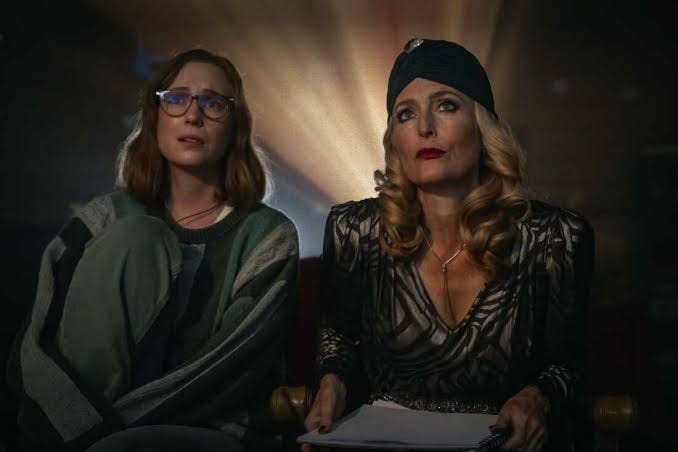
For all the things she knows the studio demands to see in her remake, Kris wants to speak to one person: Billy Presley (Gillian Anderson), the original final girl from the first film. She decides to trek to Billy’s place in the middle of nowhere in a deep snowstorm, her connection to her world growing as faint and intermittent as the bars on her cellphone.
Where Kris is all logos and ethos, her cynical thinking about the film industry evident in their first snowed-in encounter, Billy is complete pathos. Her southern drawl and done-up beauty and furs offset the rundown campground she lives in, the set of the original Camp Miasma movie that proved a more harrowing experience than what we see in the film-within-the-film. Billy says to Kris to tell her about herself, and Kris answers with her festival circuit-honed spiel. Billy correctly clocks this as work talk. She demands a better answer.
Kris, for all her preparation, doesn’t have one. She’s made work her life, theoreticized herself into a poly relationship (too many good women lose themselves trying to go poly), and is at odds with the world around her demanding newness when she herself yearns for the past. The entirety of her working and romantic life, the machinations of her agent, the studio, and her partner, are all explored through technology, everything buffered through a Zoom call or FaceTime. Nothing about those aspects of her world can she feel or touch.
Movies, despite their artificiality and own technological buffer, do offer Kris that physical and emotional experience she so desperately seeks. At my own viewing, I practically applauded watching Gillian Anderson dust off Billy’s print of Camp Miasma and play it on a projector, the old guard reminding the new one why they still have such pull in a world that seeks convenience. Further, Billy doesn’t allow Kris’s thinking to color the experience through a modern reading. When the audience is introduced to Little Death, Kris says “This part is transphobic,” to which Billy immediately replies “Shut up.” This feels like a Schoenbrun statement, but it’s also Billy’s insistence that Kris not analyze the film. She wants her to be physically present, to let the experience move her rather than insist on exerting logic over emotion.
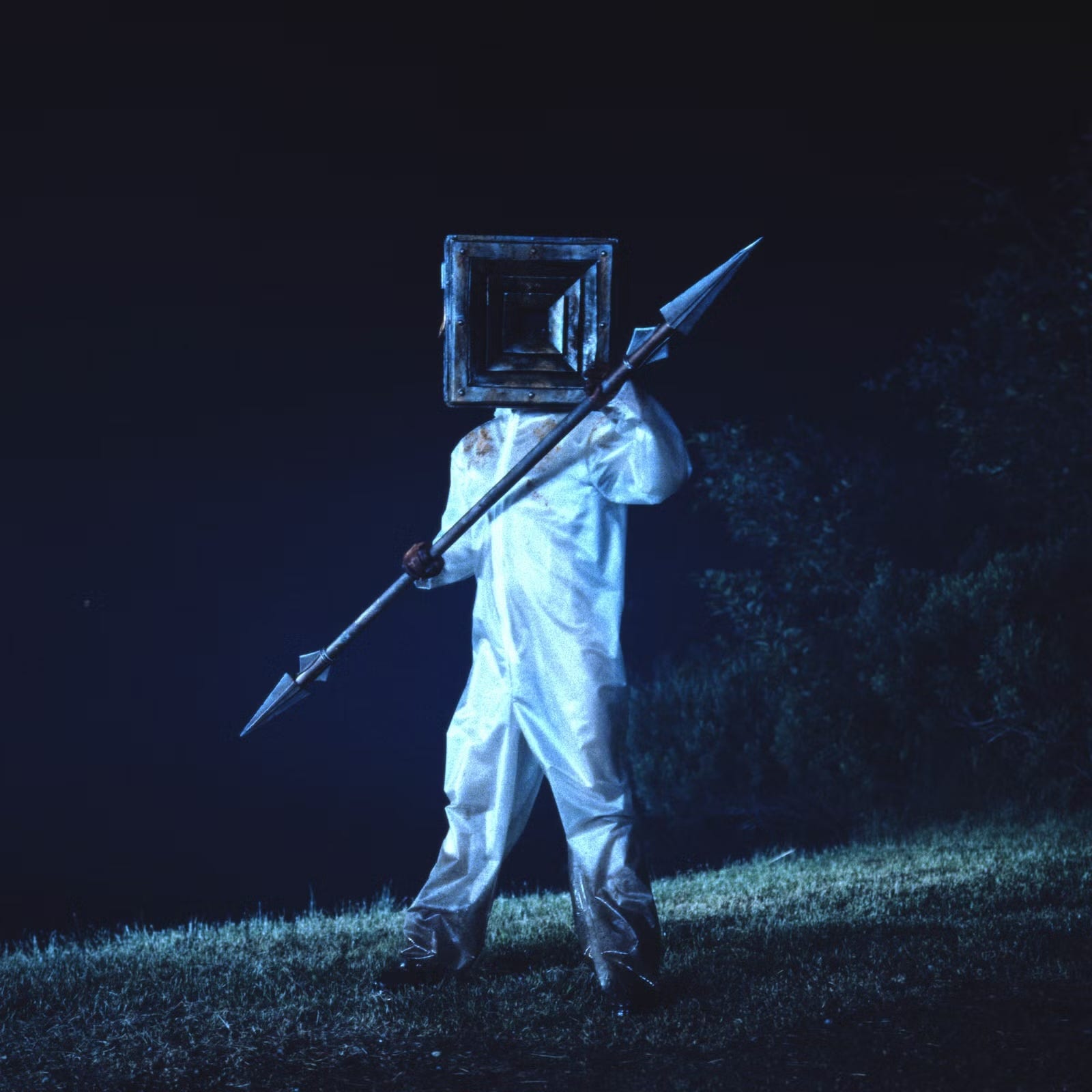
Watching the print of Camp Miasma, Kris is moved, and so was I. The sequence where Little Death emerges from the lake to wreak havoc on the camp counselors transcended any slasher I’ve seen. Against a backdrop of gore-filled kills and geysers of blood, Little Death achieves an ecstatic state, so embodied and full of purpose in their actions. The Counting Crows needle drop accompanying this montage made me shed a single tear, just like Kris watching Billy’s first sexual experience on screen with fear and curiosity in her eyes. Through the filter of the film within a film, Kris and I were both moved to tears, the logical state finally quieted and transcended to the physical and emotional.
It’s difficult to make art, let alone as someone who lives in her head. I saw in Kris the yearning to accommodate everyone but herself, please the studio and shareholders and partner before she even attempts to ask what she even wants. Surrounded by candy wrappers in front of a fire, she confesses her sexual fantasy to Billy: to be a “slut” running through the woods at Camp Miasma in a skimpy t-shirt, her run more Baywatch than Terminator 2. In this confession, she acknowledges that bifurcation of self she’s created, the superego and id non-compatible, the capable director and the bloodied ingenue at odds.
It’s in Kris’s own confession that I saw my own bifurcation of self: someone who feels at odds with their body that isn’t fully capable but not entirely broken. Someone who wants to be in the physical world sans thought when the theoretical world feels more comforting, more exciting even. And someone who wishes that intelligence and sensuality not be so at odds. In recent months, I’ve found myself bumping up against these boundaries and wondering where I feel them fall away. Where can I find my own Camp Miasma of sorts that allows me to be at peace with these seemingly opposing forces, even mend this bifurcation?
I don’t want to spoil too much of the film as I found my initial viewing so pivotal, but Schoenbrun’s answer to Kris being at odds felt comforting, even hopeful at a time when there is very little of that in the air. The answer lies in that bloody true love, the unabashed awe at the feeling achieved in Sleepaway Camp and Videodrome and Friday the 13th standing beside wanting to find the highs in one’s own experience. Getting to that wholeness is filled with mess and scar tissue, zeniths and valleys. But in the end it’ll feel tangible. Just like flesh.

No posts
Comments
Nothing yet. Say the first thing.
Sign in to join the conversation.