
When you’re considering a screenplay and making a shotlist, there are simply so. MANY. scene transition possibilities.
Though the basics are limited — sharp cut to the next scene, cut to black, crossfade — elements of both scenes on either side of the transition and additional sound and colour techniques make the combinations seem endless.
You can cut from a wide to a closeup, or the other way around; you can J-cut, or its reverse the L-cut; you can match cut; you can fade out and then smash in, or smash out and fade in; you can go from dark to light, or light to dark; you can mix and match multiple elements of some of these; some transitions may be so ‘invisible’ you don’t immediately realise scenes have switched.
This is an ongoing series looking at (some of) the infinite ways to transition between one scene and another.
Today we’re looking at:
Saving Face, Giri / Haji, The Player, Home Alone 2: Lost in New York, Widow’s Bay
Two of these transitions specifically use a photography flash, though in different ways to each other; one uses several white flashes more abstract ways; and one uses the white flash to stay in the exact same frame.
In this wordless sequence, it’s all about visuals, how the characters interact, body language and acting. It uses the flashes of white to move from scene to scene, as well as show passage of time and depict grief.
The white flashes serve to demonstrate grief coming in waves, leaving strange memory gaps in those first days reckoning with new and painful loss.
When Griffin Mills (Tim Robbins) looks straight through the fourth wall and clicks, the camera flash turns the whole screen white.
The transition takes us from one place to another: from white flash, to white office decorated with trophies . . . which is clearly how he sees the object [of his affection] through his camera lens.
Like The Player, this transition uses a polaroid, but instead of taking us from one scene to another, the white flash takes us from shot to shot — from Kevin (Macaulay Culkin) taking a photo, to a discombobulated Harry and Marv (Joe Pesci and Daniel Stern), and then — with another flash! — transitioning back to Kevin.
This white flash transition keeps us in the same place, makes it clear not much time has passed, but something significant has changed . . .
The flash of white shows a whiskey glass exactly where it was left, but with a crime scene marker next to it. The room has a bluer tinge, and then you realize there’s someone in the corner of frame wearing coveralls . . .
The in-scene reason is (post-transition) explained as crime scene photography, but pragmatically it’s also a clear, simple way of signalling a guest was expected, somebody arrived, and our whiskey pourer has met an abrupt fate. The flash also puts viewers on alert, signalling us to note differences between one shot and the next, and gather clues to what may have happened.
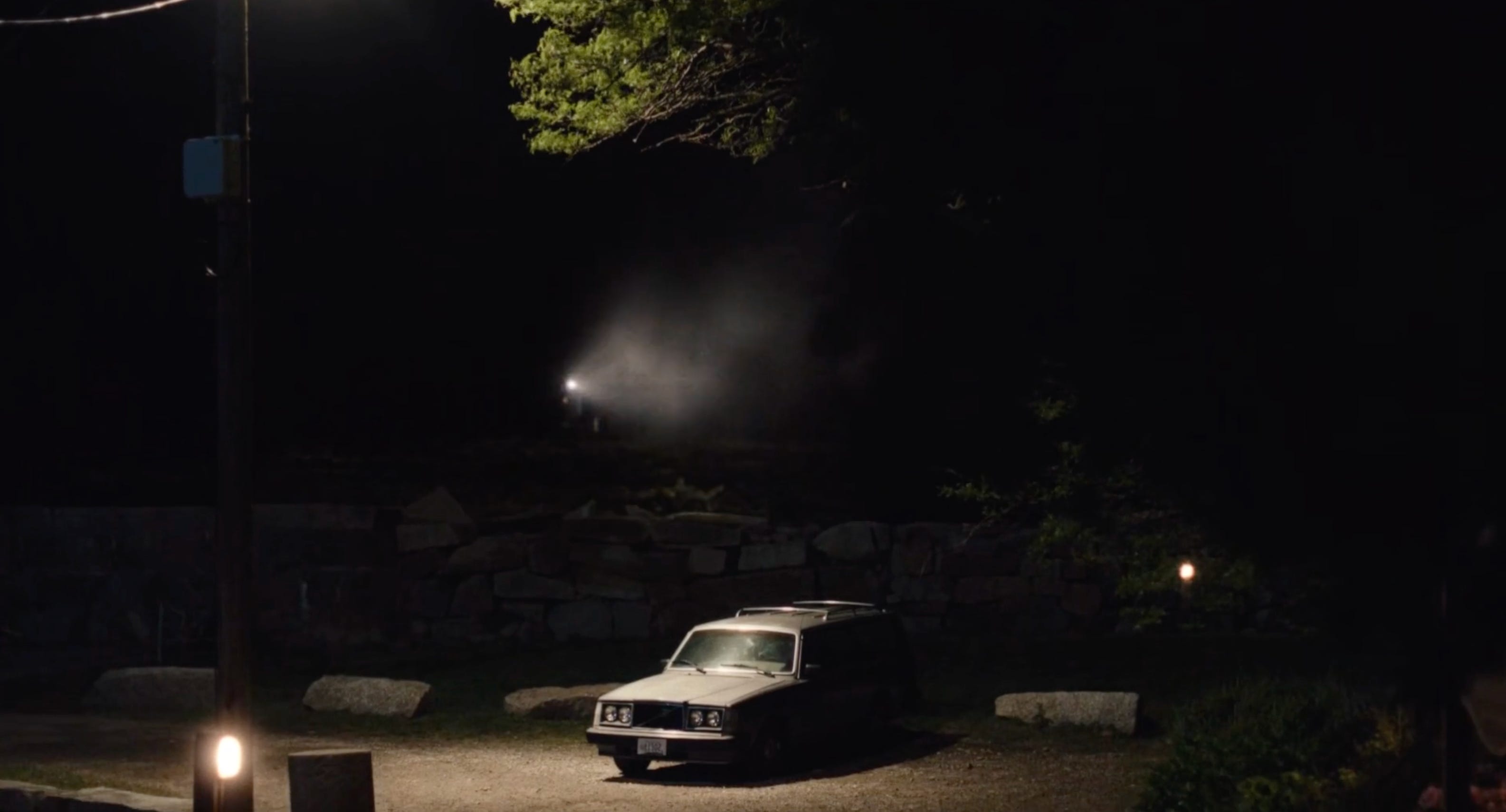
If you’ve got a lighthouse as a key to your show, you HAVE to use its rotating beam to 'flash’ the screen with a white light . . . and Widow’s Bay does just that to transition from its very first title card.
The lighthouse is set up far, far in the distance as the camera pans up, then FLASH! as it crosses the screen, the scene cuts to a very different setting, where the camra pans down.
The scenes on either side both centre vehicles; Scene A a boat in the middle of a dark ocean, Scene B a car in the middle of a pool of light.
Wonderful stuff.
Comments
Nothing yet. Say the first thing.
Sign in to join the conversation.