
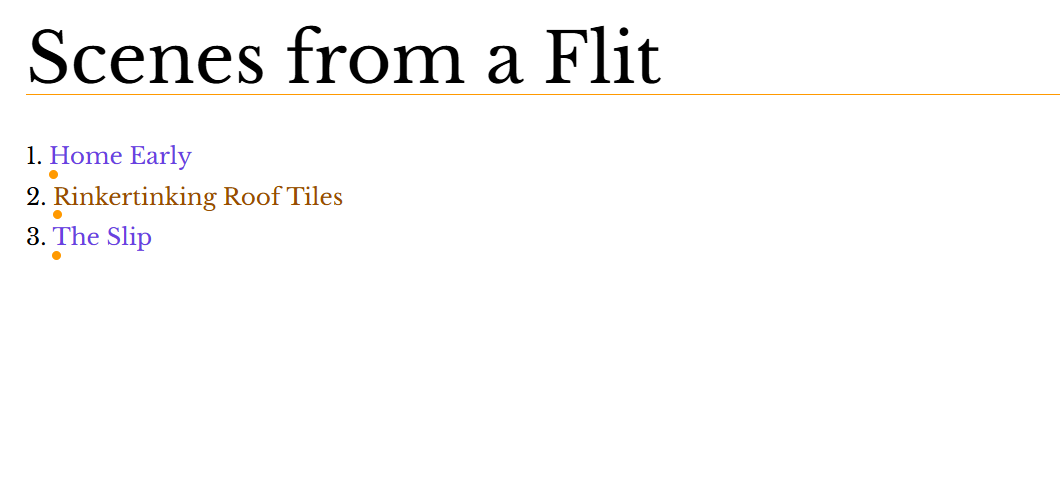
I’ve just published a new ludokinetic poem, ‘Scenes from a Flit’, on itch.io, the site for independent game creators which is increasingly inhabited by poets experimenting with interactive forms. It’s a poem in which I cast you, the reader, as a thief. You steal, you flee, you hide, via three brief vignettes. It’s part of a broader project, but I won’t go into that now.
What I will say is that I’ve been actively interested in and messing around with games of thievery, trespass, intrusion and so on for a little while. Starting exactly when? I’m not sure. I’ve always liked thiefy characters: you can find a poem about Ishikawa Goemon in School of Forgery, a smuggler in Sandsnarl, and so on. I went to Mexico two years ago to deliver a conference paper entitled “‘Hey! You’re not supposed to be here!’: Simulated Trespass and Intrusion in Virtual Playgrounds”. The basic premise of this paper was that the appeal of trespass is to pull on a thread — to stress-test a system by experiencing first-hand the meaning of its boundaries, what it seeks to hide or apportion. Doing so gives us insights into whether those boundaries might stand to be drawn in some other, better way.
Of course, the consequences of such stress-testing in real life can be dire. I tried to illustrate this in the slides with the ending lines from Rebecca:
The road to Manderley lay ahead. There was no moon. The sky above our heads was inky black. But the sky on the horizon was not dark at all. It was shot with crimson, like a splash of blood. And the ashes blew towards us with the salt wind from the sea.
So we channel our impulses into the unreal spaces of simulational and fantasy media, where forbidden zones almost always contain something which has been unjustly kept from us.
Thieving is just an extension of this — it’s a socially destructive act because outside of a fictional context the victims are usually poor and innocent. But the romance of the thief is that they function as a redistribution mechanism, tipping the scales in the right direction, overturning established rules just enough for a more evolved moral logic to take hold. So given the chance to steal in games, or to root for outlaws in books and movies, we take it readily.
Oddly enough, I found myself touching on the same theme in a chapter I’ve contributed for a new edited collection, Crime Plays: Detective Fiction in Video Games — that is, even the detective archetype, once turned over to the control of the player via game media, becomes an instrument of indelicate intrusion, the better to experiment with changing the world.
So that’s one bit of work I’ve been up to. I’ve also been invited to deliver no less than three keynotes this year. At the end of the first, at Norwich University of the Arts’ Rhymeposium in March, I introduced a workshop exercise for making a simple ludokinetic poem. It involved taking a few cards or similarly sized sheets of paper and writing, on each one, a one-sentence description of a scene — metaphysical, naturally — and an instruction. The cards could then be mixed up and handed out to the player, acting as a kind of maze for them to traverse.
I took this idea for myself and mixed it up with a long-running burglary-themed game project called Hot Hot House. Below are images of some of the notes I made to myself:
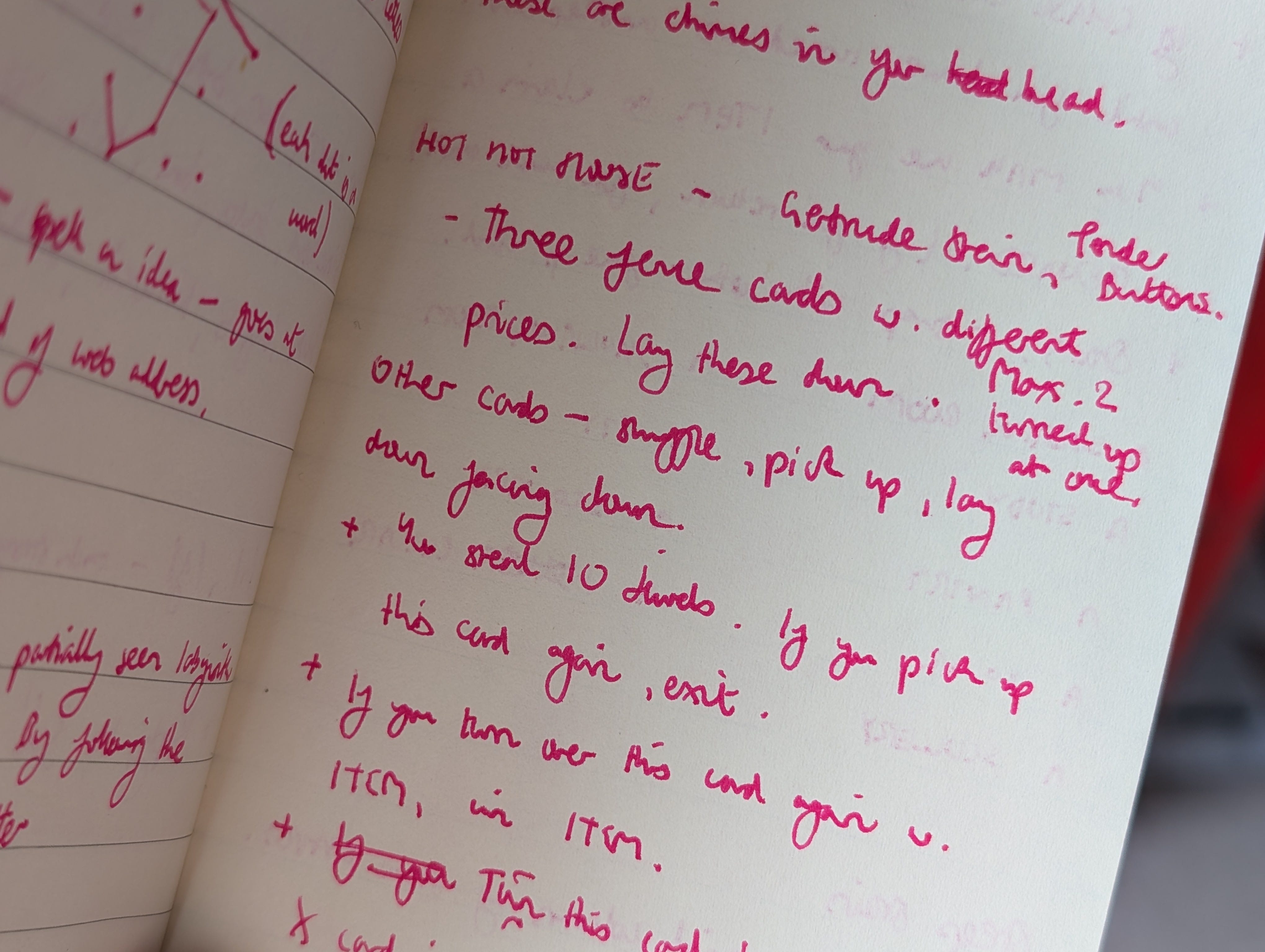
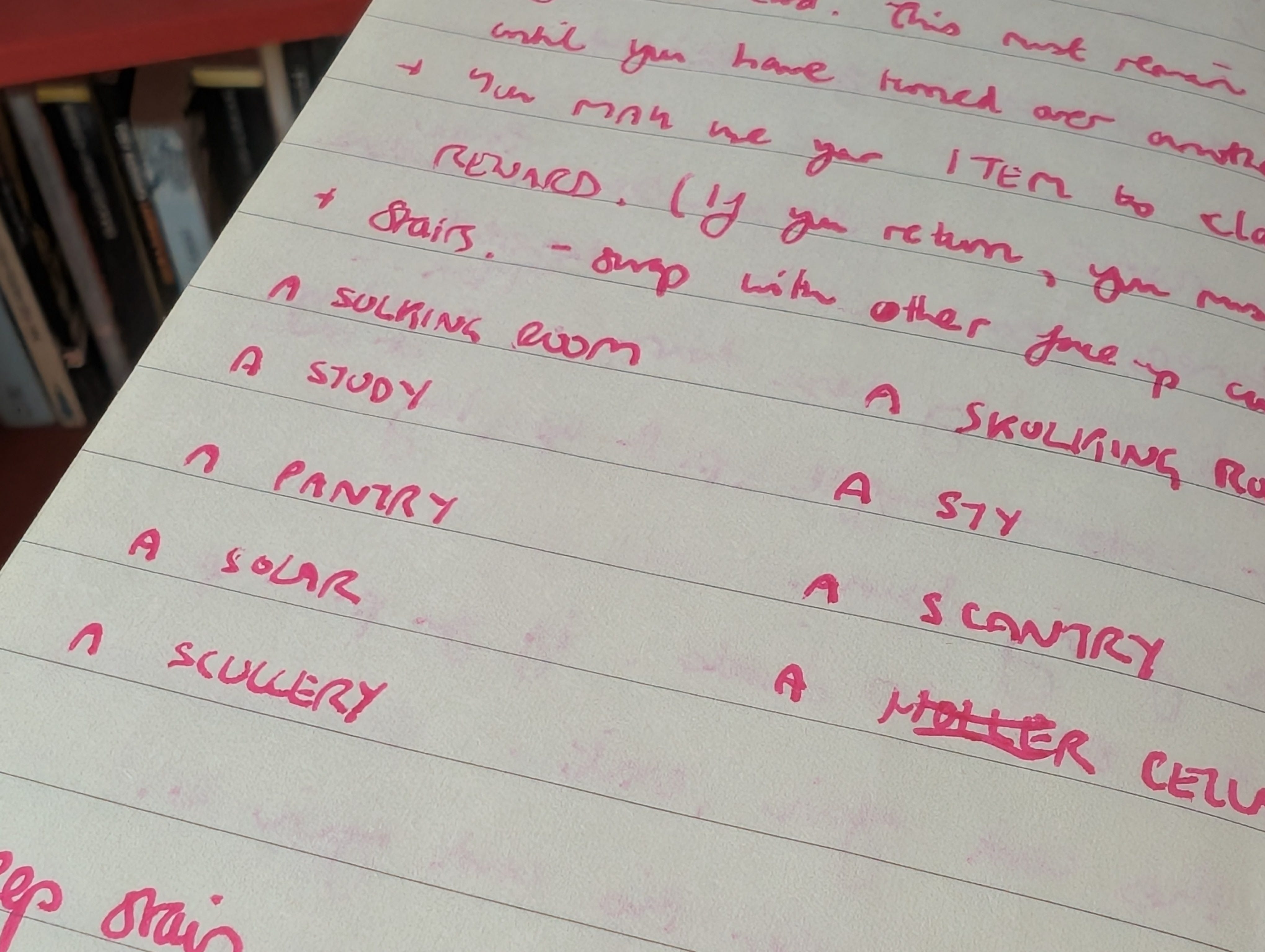
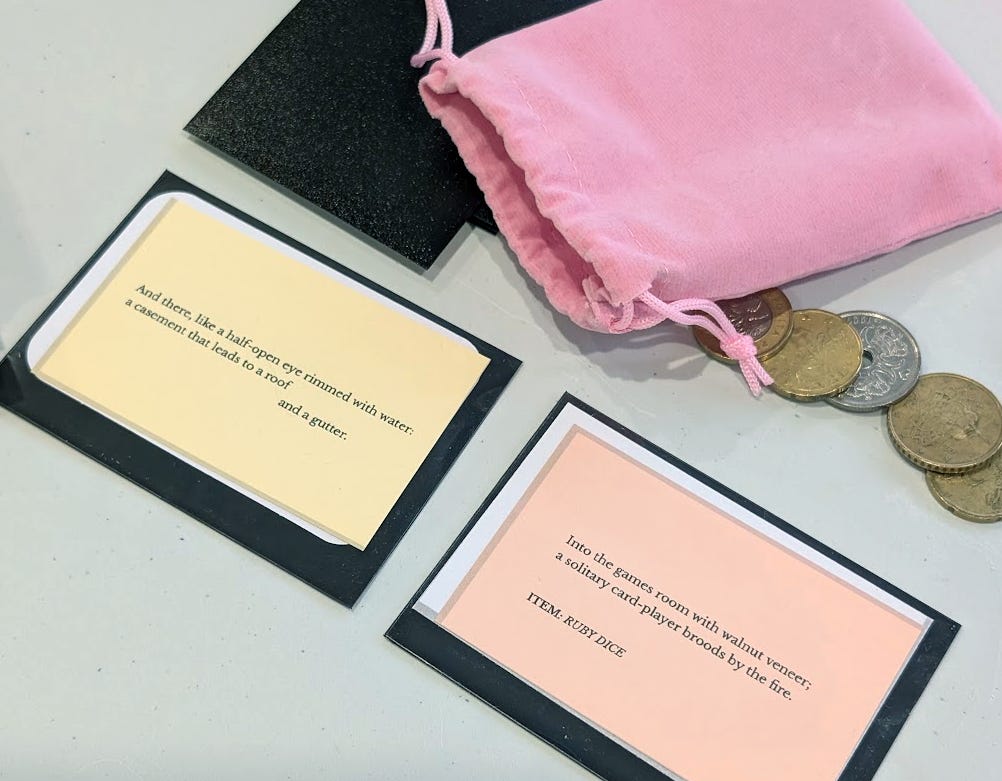
By the time of the third keynote — which I’ll talk more about in a later post — I had put together a basic prototype, introducing this as an example of a labyrinth poem where the aim is to stay in the labyrinth as long as possible (the labyrinth as forbidden space). The basis of the game is Concentration — you must remember the cards you’ve turned over and come back to them in the right order. The act of placing cards and returning to them simulates that of infiltrating a mysterious, shifting mansion, poking your nose into rooms and hiding whenever you’re in danger of being spotted.
I tested it out with a few people at University of South Wales, Cardiff at the start of July, as part of the BDiGRA Annual Conference, adjusting some rules on the fly. Didn’t have time to print tokens so I used actual leftover change from various trips abroad to represent in-game money.
I have other half-developed games and poems with similar motifs to this, and am weighing up how I might approach a short monograph on the subject. I guess if I’m honest, part of my interest is because the feeling of being an intruder — of being, more specifically, an uninvited guest, taking from tables that were laid for others — has dogged me for much of the time I’ve spent trying to participate in literary and academic culture. Yeah, I know — me and every other bleeder. But rather than just marinate in the feeling of outsiderness, or use it as a kind of battering ram against those doors that are closed to me, I like the idea of embracing it as a role, and showing others how to play it.

No posts
Comments
Nothing yet. Say the first thing.
Sign in to join the conversation.