
I’m going to say something that might sting a little. I say it with love because I’ve been saying versions of it for twelve years and I believe it completely.
I cannot make your career for you.
Nobody can. Not your coach, not your gallerist, not your curator, not your program director, not me. What we can do is open doors, make introductions, offer feedback, share resources, and show you the map. But you have to walk the road yourself.
And walking the road yourself means being self-sufficient. Not self-isolated. Not going it alone without support. Self-sufficient. There’s a difference.
I had a moment recently where I said out loud what I’ve been feeling for a while. I was talking about helping artists become sustainable and I realized that sustainability only happens if artists become self-sufficient first.
It’s not going to happen if I’m always giving you the same answer ten times. It’s not going to happen if you email me asking for something that’s already in the email I sent you yesterday. It’s not going to happen if the answer is in the Signal group and you didn’t check.
I know that sounds harsh. I know we’re all busy and overwhelmed and living in an information-saturated world where things get lost. I understand that. And also: reading your emails, following directions, showing up prepared — these are not advanced skills. They are baseline professional behaviors. They are the floor, not the ceiling.
Here’s the thing I’ve come to understand after thirty years in this field. The artists who build sustainable careers are the ones who take ownership of their professional infrastructure. Not the most talented. Not the most connected. The ones who manage their own business, follow through on their own commitments, and don’t outsource basic problem-solving to everyone around them.
Researchers who study creative careers call this professional self-structuration. Which is a very fancy way of saying: you build your own career by doing the unglamorous work of running it.
What does that actually look like?
Reading and acting on communication. Check the email before asking the question. Nine times out of ten the answer is already there. Every time someone has to re-send information or re-explain something they already explained, that’s energy that isn’t going toward something actually useful to you.
Following directions precisely. Application guidelines, submission formats, gallery requirements. These exist for practical reasons. Ignoring them gets your work rejected for reasons that have nothing to do with the quality of your art. And nobody is going to tell you that’s why.
Being easy to work with. Consistent pricing. Honoring deadlines. Communicating promptly. These are not niceties. These are the specific behaviors that build trust with galleries, curators, and collaborators. A gallery that can’t trust you to deliver on time or price consistently will not represent you regardless of how good your work is. This is documented. It’s not an opinion.
Managing your own research. Knowing how to find grants, calls for entry, residencies, and opportunities independently. Not waiting to be handed them. The artists who thrive are the ones who are constantly looking, not the ones who wait for someone to bring opportunities to them.
Owning your business fundamentals. Pricing, contracts, invoicing, basic record-keeping. Learn these once. Really learn them. Stop needing someone to solve the same recurring problems for you.
Building systems that work with your brain. A calendar. A spreadsheet. A submission tracker. Whatever you’ll actually use. Because if nothing depends on your memory and everything lives somewhere reliable, you stop dropping things and start moving forward.
I want to say something about what self-sufficiency is not.
It’s not isolation. It’s not doing everything alone. It’s not refusing help or pretending you have it all figured out.
Community is still essential. Mentorship is still essential. Having people around you who will help you backtrack when you lose your train of thought mid-sentence, who will share a grant deadline they just found, who will come to your opening and tell you honestly what they see — all of that is essential.
Self-sufficiency is what happens before the community can help you. It’s handling the baseline responsibilities of professional communication and follow-through so that your mentors and your galleries and your collaborators can spend their energy on the things that actually require them: opportunities, introductions, honest critique, strategic advice.
When a mentor keeps re-explaining the same logistics, re-sending the same links, answering the same questions that were already answered in writing, they’re not doing mentorship anymore. They’re doing your job. And that doesn’t help either of you.
Here’s the thing I’ve come to understand about sustainability. Sustainable careers for artists require balancing artistic goals with financial stability and personal wellbeing. Researchers talk about three pillars: your creative output, your financial self-sufficiency, and your personal health. If any one of those pillars gets low enough it eventually takes down the whole structure.
Self-sufficiency is the first pillar. Not the most glamorous. But the one everything else rests on.
Career self-management is the literal mechanism by which artists convert opportunities and relationships and mentorship into a durable career rather than a series of one-off favors. I’ve watched it be true for thirty years.
The artists who are still going twenty years from now are not necessarily the most talented. They’re the ones who show up consistently, manage their own professional lives, are easy to work with, and keep learning. That’s it. That’s the whole secret.
So what does this mean practically?
Set up a system for tracking deadlines, emails, and opportunities. A spreadsheet, a calendar, a notes app, whatever you’ll use. Don’t let anything depend on someone else’s memory or your own.
Read everything you’re sent before asking for it again. The instructions are usually there. The link is usually there. The answer is usually there.
Learn your business fundamentals once and actually learn them. Pricing, contracts, invoicing. Take the Masterclass. Read the guides. Do the homework.
Respond to professional communication promptly and follow through on exactly what you said you’d do. Reliability is the number one thing galleries and curators and funders use to assess risk. It is more important than you think.
Treat consistency and discipline as artistic skills equal to your technical craft. Because they are. Showing up regularly without external pressure, doing the administrative work even when you don’t want to, building a practice that sustains itself — this is what a career actually is.
None of this is about being perfect. I am not perfect at any of it. I lose things, forget things, drop things. I have ADHD tendencies and perimenopause and depression and I am also building and simplifying and trying to do fewer things really well instead of many things partially.
But I do show up. I do read the emails. I do follow through. And I do keep going.
And if you want support while you’re building it, I’d love to have you in Shoebox for the rest of the year.
$400 gets you in through the end of December 2026. Everything on Zoom, most sessions at 11am PST, and most are recorded so you can watch when you’re free.
Here’s what’s coming:
September — How To Get Invited To Shows Not open calls. Not juried submissions. How to actually get invited. How to build the relationships that lead to exhibition opportunities.
October — Building Confidence as an Artist Imposter syndrome, rejection, the voice that says your work isn’t ready. Where it comes from and how to keep making work anyway.
November — How To Curate an Exhibition Concept, story, logistics, working with artists. Everything I know about putting a show together that actually means something.
December — Planning for Your Future Next year, five years, your lifetime as an artist. We end the year with a real plan.
Email shoeboxartsla@gmail.com to sign up for the rest of the year.
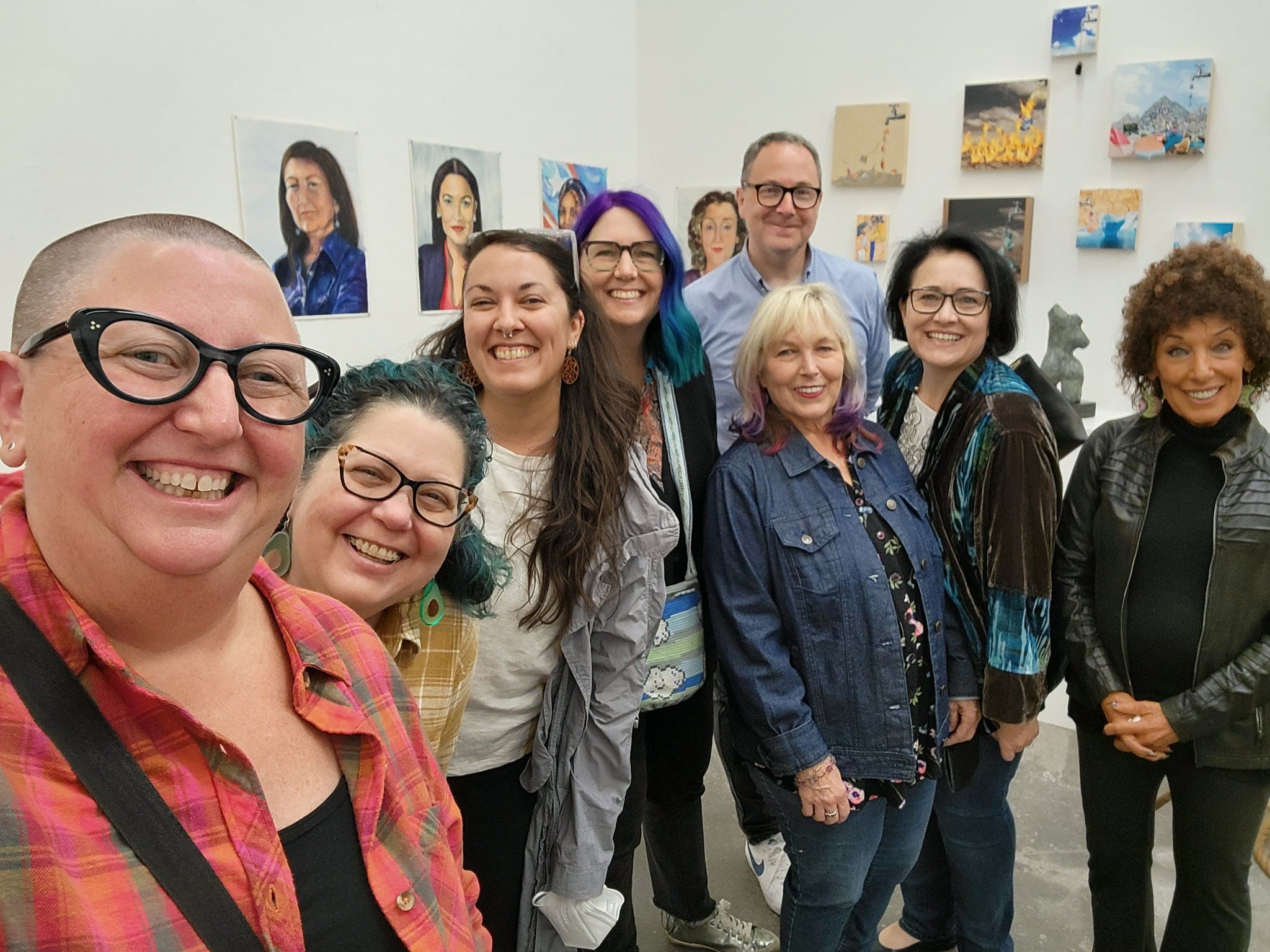
Shoebox in the house, at Inglewood Open Studios - Visiting Susan Amorde’s studio at 1019west a few years ago
No posts
Comments
Nothing yet. Say the first thing.
Sign in to join the conversation.