
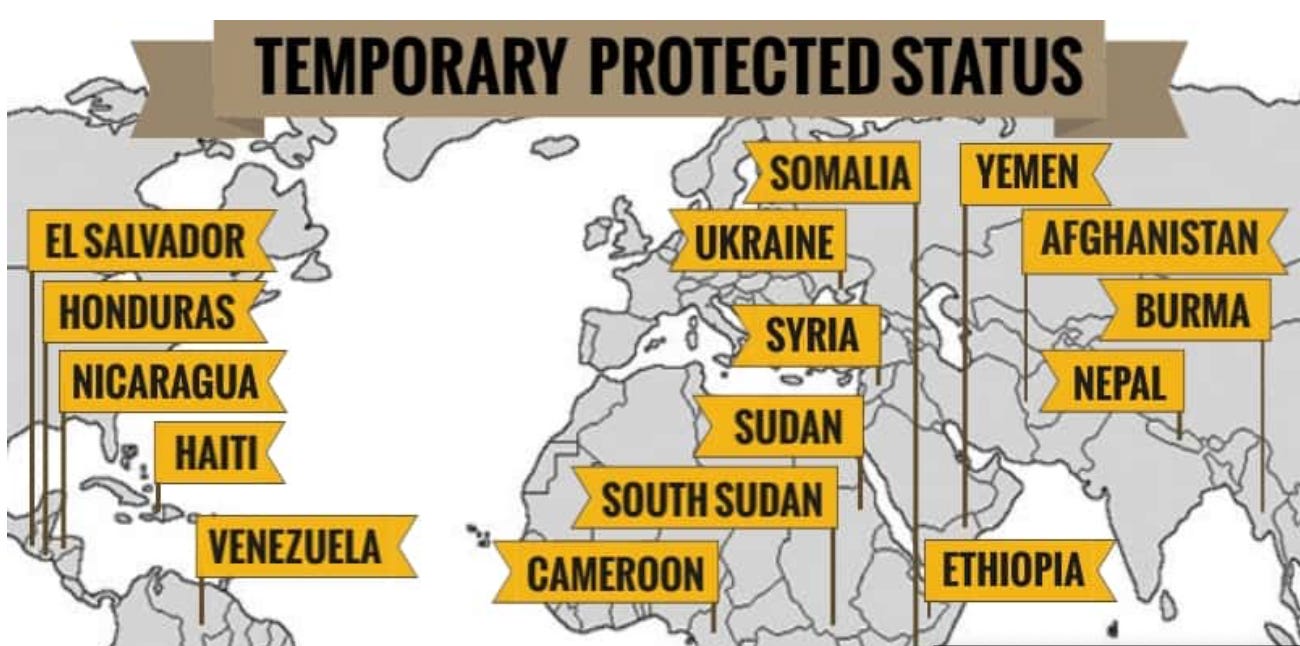
The Supreme Court has now reversed two injunctions issued by District Judges in New York and Washington DC — and upheld by the Second Circuit and D.C. Circuit Courts of Appeal — that prevented DHS from ending “Temporary Protective Status” for Syrians (NY) and Haitians (DC) as directed by Orders entered by former DHS Sec. Kristi Noem.
The district judge in the DC case — “Miot” — was Judge Anna Reyes, a Biden appointee. The D.C. Circuit, in a 2-1 decision, with two Biden appointees in the majority, denied the Trump Administration’s application for a stay of Judge Reyes’ injunction.
In the New York case — “Doe” — the district judge Katherine Failla , an Obama appointee. The three Second Circuit judges who voted 3-0 to summarily deny the Government’s application for stay in Doe were all Biden appointees.
Important to remember in the NY and DC cases is that both involve applications to stay lower court injunctions — not full decisions on the merits. But, in a signal to where the outcome was headed, the Supreme Court treated the applications to stay the injunctions as “petitions for cert prior to judgment” and agreed to hear both cases on their merits — skipping over entirely the appeals in the Circuit Courts.
The TPS statute at issue includes a provision — 8 U.S.C. Sec. 1245a(b)(5)(A) — that reads as follows:
There is no judicial review of any determination of the Attorney General with respect to the designation, or termination or extension of a designation, of a foreign state under this subsection.
The district judges ignored this jurisdiction-stripping provision by considering the issue as an APA claim (Administrative Procedures Act) challenging the “process” used by Sec. Noem to come her decision ending TPS. They all held there was judicial review under the APA for claims that the decision was “ultra vires” — contrary to law — and/or “arbitrary and capricious” in violation of the APA. All the district judges distinguished challenges to the process from from challenges to the actual “determination” made as a result of the process.
Justice Alito, in a 6-3 decision dispatched the need to consider the alleged process flaws found by the district judges to justify their injunctions. He agreed with the Government’s argument that the jurisdiction-stripping provision applied to the “determination,” and the “process” was bundled up with the determination for purposes of review.
Comments
Nothing yet. Say the first thing.
Sign in to join the conversation.