
As a ritual and byproduct of tourism, a camera always remains in my pocket. After years of struggles and attempts to capture a polished view, I, involuntarily, must accept whatever rushes into my lens these days, and shift my job to leech most meaning out of them.
Meticulously composing feeds one’s preoccupation with their own view. I made this flawless statement after completely giving up on improving my photography skills, swiftly sneaking to this opposite extreme to defend my new move with dubious justice.
Risking face-pressing into a sweaty back every two steps among Licheng District, Quanzhou, I desperately fixated on my newly proposed argument. Before setting foot in a place, we’ve been instructed how we should travel and where we should visit on social media, mainly, by tempting images. The towering facade. The rugged mountains. The spacious and tranquil Airbnb room with windows reaching the ceiling, greeting natural light that sank through. The miniature people thonging in the open, stretched district. With my limited traveling experience with my family, we’ve fallen into this photo scam plenty of times, yet we choose to indulge illusions again and again.
In travel, we are more the middleman than just visitors. I mean, photowise. We prioritize visiting what we consumed on social media first, and we raise cameras, from a similar enough angle, striving to freeze the exact moment, and tout again on the same platform. Through that, we ascend ourselves from one group to another of equal standing.
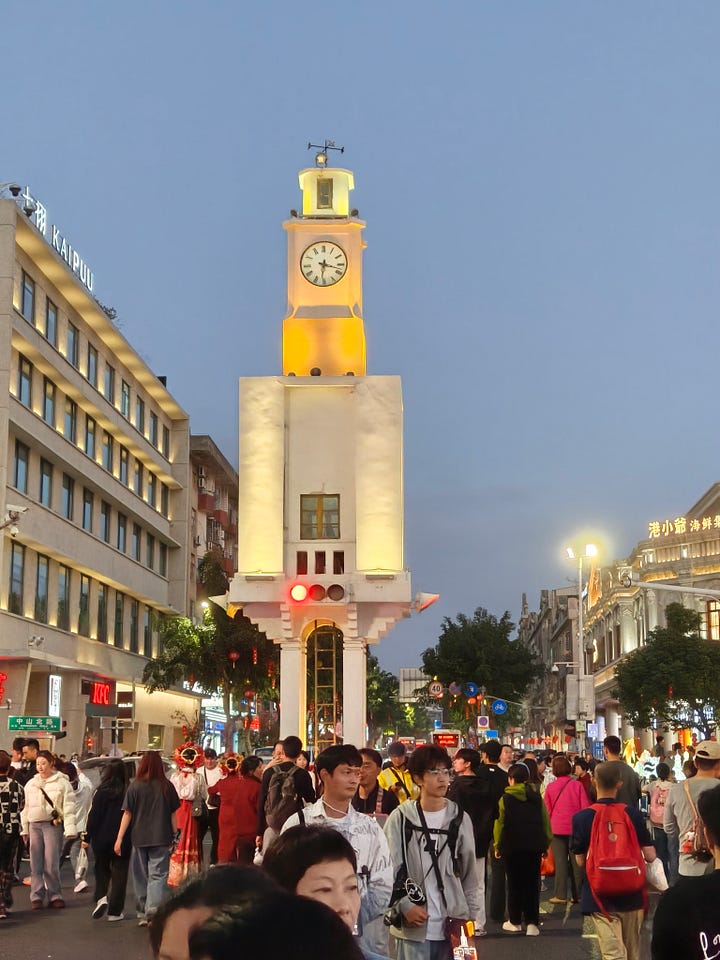
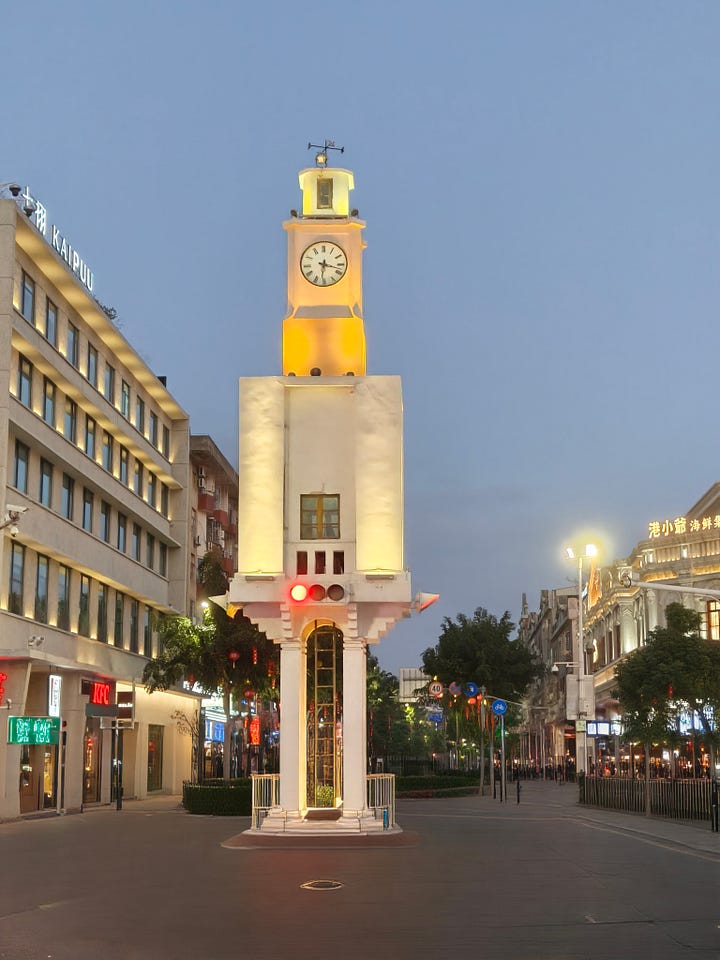
AI foresees our intention better than we do. Our smart AI camera apps effortlessly reduced my mom’s toil, elbowing through and fumbling the shot. And hurrah—we are honored to time-travel to Hollow Avenue during COVID-19.
This took me back to the long-winded 10-minute pitch, as we shopped for this new phone, with which a salesperson reasoned through that AI was an up-to-date feature to lavish upon. His dry and flat voice and cold, flickering commercial light in the mall crackle whenever I lay my eyes on the photo. I couldn’t help but chuckle inwardly at this salesman—after all, what better testament to a landmark than the buzzle swarm?
After filtering these ‘noises’ beyond the lens, it’s hard to say where we believed we visited. Or we can say, we never fully agree on the place we visit as they talk. As though rummaging through a pile of loose vegetables at a wet, crowded market, we pick, sniff, and toss most of it back without examining. Vendors — they are not decent enough. Motorcycles — they are too arbitrary to fit in. As for tourists? We despised each other secretly across our lenses. Eventually, it only leaves the safest option for us.
Yet one may ask, how can we possibly have the audacity to decide the legitimacy of one appearing on camera?
On the other hand, my camera brought me endless pleasure. I particularly love challenging myself by randomly setting the camera and watching within and outside the frame. As though watching a play without a theater, appreciating every actor and prop staging on and off.
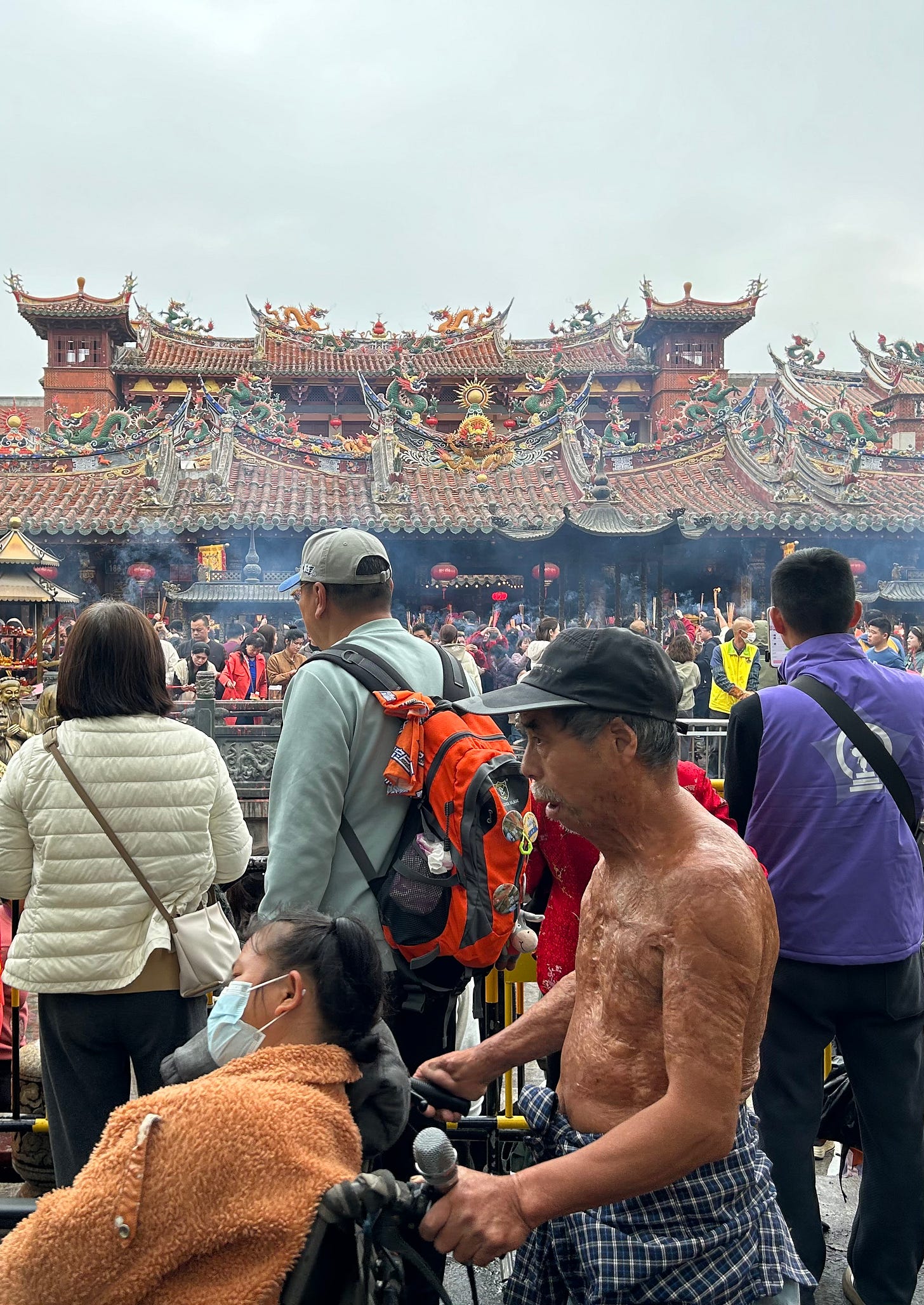
We paid a visit to Tonghuai Guanyue Temple on a cloudy morning. The temple stood majestic and venerable, blocking the cyclorama at the rear, indifferent to the visitors at its feet. Immersed in the smoke of burning incense, the flocks milled around, bent over, and exhaled the deepest desire from their chests as a gesture of sincerity. Even so, setting up such a scene in a frame would seem rather plain.
If you zoomed back your camera a little, beyond the railing stood witnesses, curious yet aloof - a live streamer pointing their camera towards earnest worshippers, urging remote audiences substitute ‘likes’ for physical offerings, gathering blessings through cyberworship. A wanderer wheeled their fellow, strolled past the edge of your camera. Clearly, life had granted them no fortune—no one has spared a glimpse for them, all eyes fixed instead on the deity presiding within the hall.
The entire play has been intensified among incense smoke, suturing neglect with concentration, where desire outgrows reality. Our spectacular temple has been folded into a powerful symbol, ‘an unyielding force’, dispelling all earthly struggles, whether concerning career and wealth or love and offspring.
We, travellers, staged a scene with local attractions and urban governance, all subscribing to this narrative—where the deity within the hall can relieve all sorrow and bitterness, as long as you genuinely whisper how strongly you desire it and donate via incense generously. This always reminds me of those late-night moments when one seeks solace from desire, reaching climax through sex tape—reality requires neither recording nor observation. It can be dismembered and pieced together into Frankenstein's Monster, subjugated to our need, and served to unleash our desires.
We CREATED the stories, we SUSTAINED the stories, and from a moment we don’t remember, we EXPLOITED and RAVAGED the stories.
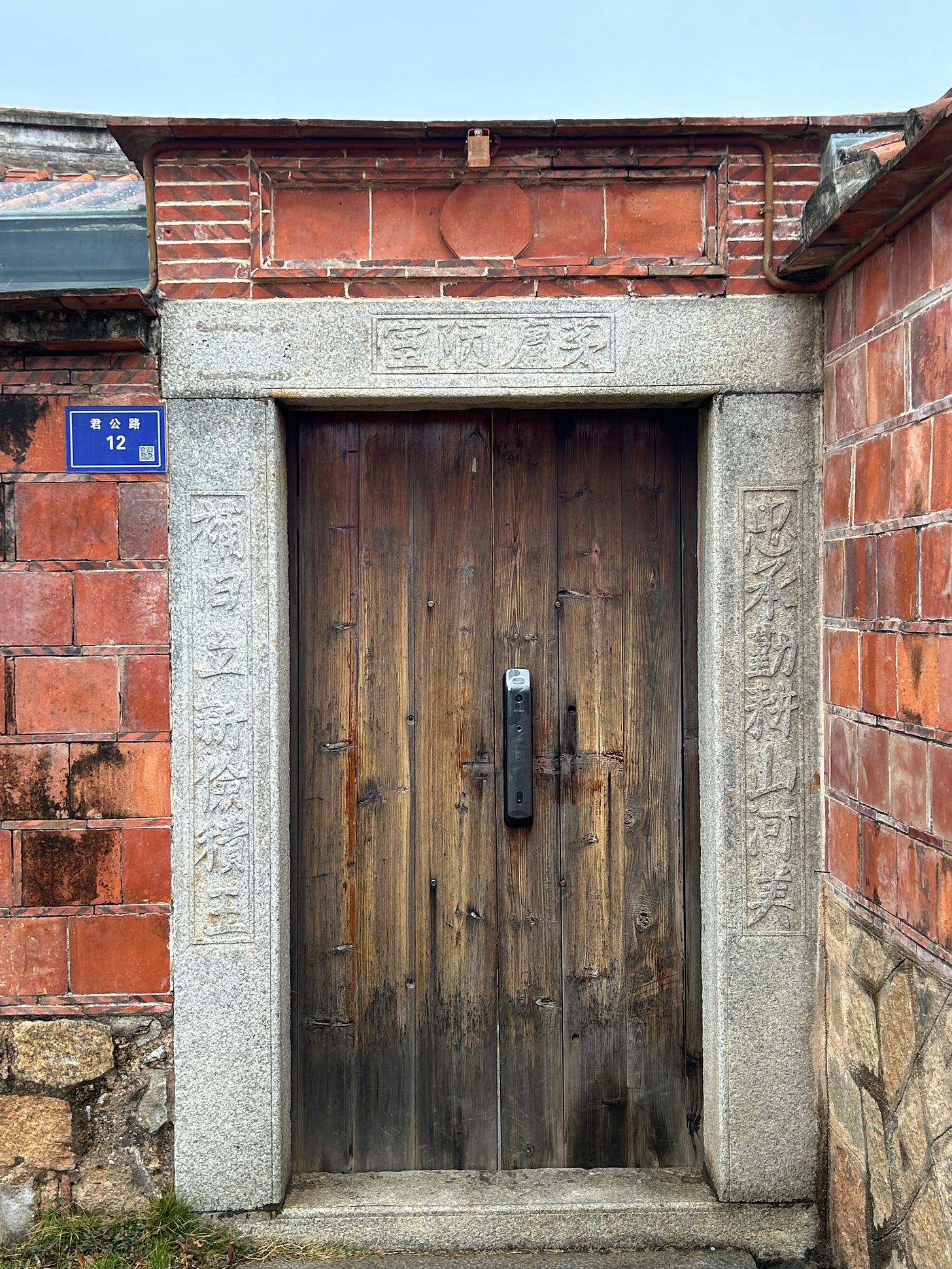
Wulin Traditional Village has been situated and flourished since the late 17th century, harboring overseas Chinese families and Hokkien cultural legacies through the relentless turbulent years and societal succession. Everything here is bathed in a patina of age, weathered and aged, cracked and soaked, permeated with the briny scent of the sea. Oddly enough, an electronic lock is guarding the entrance to one of the houses.
I couldn’t help but wonder—for whom was this lock intended? Who requires a camera-monitored yet time-scratched door? What are they guarding against? My mind conjured countless possibilities about the owners: Had they grown weary of tourists and researchers? Were they secluded from the world, guarding secrets meant only for familial inheritance? Or did they still dwell here, silent as living scenery, for others to gaze upon?
I am content with deciphering these photographs and stories, back and forth, to and fro—about tourists, street vendors, drifters, and those whose names you will never know. And tales are never still, just as our history is, and what we called as culture.
No posts
Comments
Nothing yet. Say the first thing.
Sign in to join the conversation.