
The religious and spiritual Left needs a PR campaign.
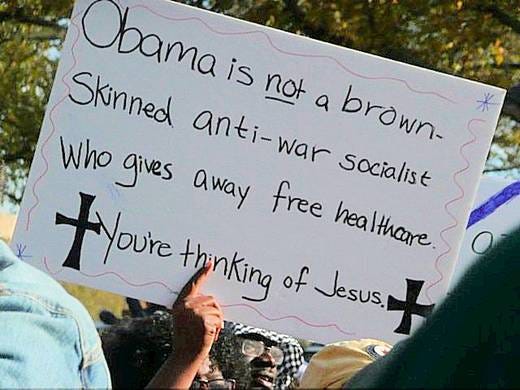
They need to be seen and heard. You see their signs among the thousands of the massive protests but there is little sense of the active movement.
Religion and politics are supposed to be separate in the US. They never have been completely so and certainly are not now. The swirl of religion and politics is at a fever pitch, largely dominated by the Christian Right.
I am calling for the religious Left to step out. “Out” because the religious Left has long been stepping up but, as has been the case with much of the Left, too few know about what they are up to. For many people younger than 35,” religious” and “Left” is an oxymoron. There are many religious people on the active Left, but they have been crowded out of the public imagination. Right now is the time to become more visible.
The Pope and the president are sparring. Evangelical Christians are reading the whole Bible in Washington DC at a demonstration. Memes, barbs and cries of blasphemy are flying around the internet. The sands are shifting. Many in the religious Right are questioning previous political alliances. So, the field is open—take it back.
You will notice I did not say “Christian Left.” While Christians must remind the public that the dominant public face of Christianity in this country is not the only face, the public face of Left spirituality must be diverse. That diversity is a plus rather than a minus, with what I have called the “glorious multiplicity” of US culture. If the movement is to kick into higher gear, Christians should organize with all the rest.
Despite the common perception, spirituality is bipartisan.
The US is the most religious of the Western countries. The vast majority of Americans believe in higher beings. Pew Research indicates that 83-90% of Americans believe in God or a spiritual force. Seventy percent of Americans even believe in angels and others believe in ancestral or other close-by spirits who also care about the details of our daily lives. Just as importantly, declines in religion and spiritual belief have stopped, except for evangelical Protestants, down to 23%. Churn is opportunity. If you are not offended by my being strategic about religion (although religions are strategic about religions all the time), now would be a good time to make a move.
While US American are leaving brick and mortar churches, they remain spiritually active. In true US fashion, most of us really follow a rich hodge-podge of beliefs. The three Abrahamic religions, Christianity, Islam and Judaism, have much in common and there is a lot of Buddhist, Hindu, Yoruba, Wiccan and Voudoun in US popular practice (if the latter two surprise you, spend some time on Etsy). If practiced anywhere near its original cultural context, yoga is rooted in religious practice; those herbal teas that you drink as medicine and those candles you light are divine rituals, watered down but demonstrating that one does not have to be steeped in doctrine to reap at least some feelings of the divine. When I traced the origins and paths of the Sacred Dark Feminine, I found her everywhere, from the origins of Alcoholics Anonymous to Oprah.
People are already doing the work. Broad ecumenical coalitions, such as the World Council of Churches and the International Religious Liberty Association, avoid doctrinal differences to foster larger understanding, joint actions and social justice. Sojourners is an organization of “faith and action,” from climate justice and immigration to early childhood development and global poverty. Faith in Action is an international interdenominational organizing and action platform that says,” Together, in our religious, ethical, and spiritual traditions, we find the means and imperative to encounter, disrupt, re-imagine, and prophetically act out justice in the world today.”
Gender and Sexuality Justice
Gender and sexual discrimination are strategic points for action. Treatment of LGBTQIA+ people is mattering greatly in shifts in religious practice, even among those who are not gender or sexual minorities. Younger adults are more accustomed to a diverse world; one third say that they are leaving churches because of discriminatory church stances.
Women are right now the most Left-wing demographic. They say they are leaving mainstream churches due to stances on gender and LGBTQIA+. For instance, Southern Baptists and Catholics, two denominations that dominate the Right’s political base, with majority conservative voters, still forbid the ordination of women. Even within both denominations there are Left activists who are going up against their own national conventions. They could use some back up.
At the same time, at least anecdotally, young men have been observed as moving toward orthodoxy, attracted by the more traditional and patriarchal positions. Yet, the religious “revival” seems to be that in the most physical sense, of attendance to one or two-day tent meetings; there have been large and enthusiastic gatherings but much less long-term involvement. They have not yet shown up in statistically significant ways.
Virtue with Strength, Power and Attention
There are some concepts that can get in the way. Religion and spirituality often call us to be humble. They do not call us for to be invisible.
We have many images of evil as strength and power. Many people can visualize and do good in all kinds of ways, but virtuous people are not supposed to think about power. Virtue plus power is harder. It is more common for us to attribute virtue to suffering rather than to power and we don’t have many everyday images of goodness and extreme strength. When I searched for them, I came up with Michael, the fearsome archangel, and Sir Gallahad, the good knight who, according to the Arthur stories, became an angel to sit with God. And Joan of Arc, who had heavenly visions and was burned at the stake. Maybe the bar is too high?
Maybe it is not clear what ordinary good people actually do? There are stories every day of good people doing good things, but they don’t break through to the serious news cycle. They are presented as “boosts,” cute, personal anecdotes that lift our spirits, not as a movement. They won’t be seen as more without more push. Empathetic goodness needs a national PR campaign.
See more in my previous article: The Meek Will Not Inherit the Earth
Toward a Balanced Humility
Stepping out appears to fly in the face of the teachings of humility, power and publicity by most religions. Good people are not supposed to seek the limelight. They are supposed to do the work without seeking the attention. I too am suspicious of those who seek the limelight for its own sake. A balanced, public path in the space between humility and ego-driven grandstanding is not as well trodden as it should be. There is very little conceptual space between humility and conceit. What is a healthy amount of exposure? What is ethical self-promotion? This is a personal challenge for me. As a Black woman, I had to learn to speak up or be invisible but it still dangerous. We need more models of people who are living balanced moral lives in the light, of strategic ethical publicity,
We can learn from the early mistakes of the environmental movement; for ethical reasons of equality, they chose not to pick visible leaders or spokespeople, so the media just picked people out of the crowd, with the result that the messaging was muddled and disorganized.
Calling Out Hypocrisy: The Special Role for White Christians
An affluent White Christian congregation asked me, “What can good White people do?” We conducted three workshops worth.
I have been saying for years that decent White people need to take their race back from the racists.
This is a refinement of that call. Within the religious Left, White Christians have a specific role to play. I have learned that strategically, some conversations are more impactful if White people call out other White people. As a friendly not-White strategist, I offer a talking point, suggesting that calling out hypocrisy is in order.
As my father would say, not everyone going in the church door is going on to heaven.
“Do not take the Lord’s name in vain” is one of the “top three” of the Ten commandments. It’s not just about language. Theologians include hypocrisy—misusing the Lord’s name for false and self-serving purposes, which is exactly what the extreme Christian Right does every day. Some of the Christian Right support the bombing of Iran because they feel it will speed us to Armageddon and the long awaited Second Coming, but they overlook that their behavior and doctrines violate pretty much everything that the historical Jesus is recorded as saying. If the Second Coming happened today, Jesus would take one look around, pack up and go back home. The Ten Commandments are present in the original or some other form in Jewish, Christian—Catholic, Protestant and Orthodox—and Islamic doctrine. The Hindu Yamas and Buddhist Dharma practice specifically warn against spiritual hypocrisy.
Practical Empathetic Leadership
All the major religions agree that we should be kind to one another. Empathy for people outside of one’s family and friends is the main division of the Right and Left. The Right speaks of the “concentric circles” of empathy, the further away from you and yours, the less empathy. It has been used to back up “America First” and cutting social support programs. The Left is defined by large scale empathy for others. What does balanced, strong, public empathetic leadership and action look like?
It requires a different definition of leadership—with the people instead of in front.
Antonio Gramsci wrote of “organic leadership,” in which a non-authoritarian servant-leader comes from and identifies with the collective. Empathetic Leadership extends the concept into specific practices. speaking to the need to observe and respond to people’s needs. It focuses on the workplace but has much to teach social movement organizations. Terri Givens applies the concept of intellectual empathy for her conceptualization of Radical Empathy (see a short introductory video) getting to the roots of our and their biases and behaviors, and presenting a powerful, pragmatic model for stepping step up and out.
*Personal and family note: I came of age at Calvery Presbyterian Church a historic, progressive church in Asheville, NC. (There are more than 100,000 Black Presbyterians in North Carolina.) My mother, Helen Parks, was longtime Clerk of Session, the most pivotal, elected church officer, and pioneered the city’s first soup kitchen, shelter and the first baby born “out of wedlock” to be christened. My brother, James Parks, is past Moderator of the Baltimore Presbytery and remains a ruling elder and an important voice in the national church’s social justice work. I’ve spoken to and worked with local churches, and two national conventions on social justice and helped the General Assembly mount a national project on youth entrepreneurship in disinvested communities.
Comments
Nothing yet. Say the first thing.
Sign in to join the conversation.