
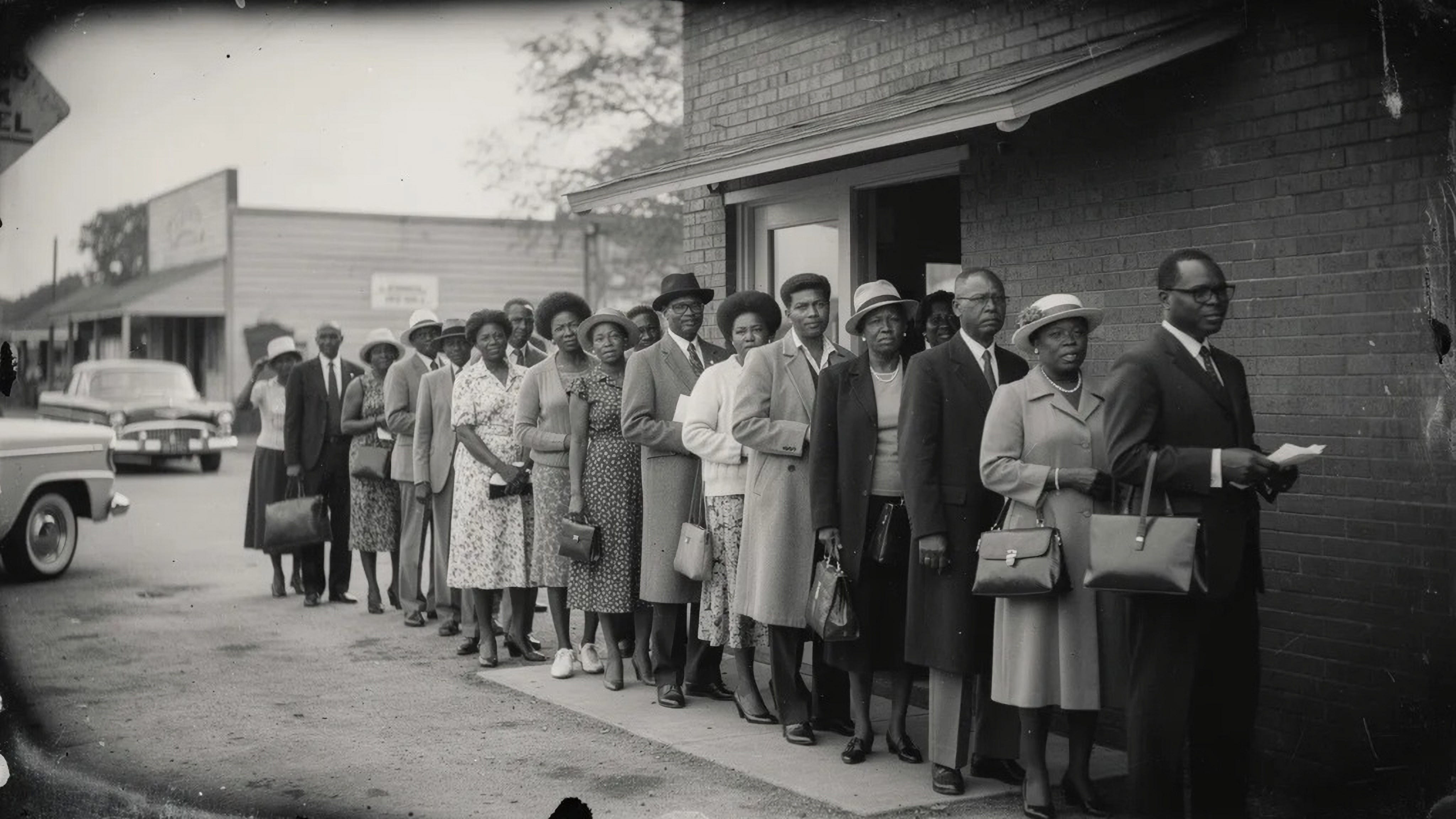
Voting Day was special. I was a little Black girl, sitting in the back seat of our car, watching. My mama and her teacher colleague were dressed up. Not in church dresses but the best of their shirtwaists, ironed, starched so that they flared out from their cinched and belted waists. They did wear their church hairdos, carefully curled and sprayed, and shoes, stilettos that made them stand up straight and arch their backs a little. Stockings. Lipstick. I saw them lift their chins and smile at each other as they walked into the school, knowing that there were people nearby who did not want them to vote, that Black people had died so they could. They were careful to take in their purses their driver’s licenses and proof of current residence in the district, such as a current electric bill.
I and many of my Black friends and family still vote in that spirit, proud that we can vote, that we must vote because people died for us. It is a sacred practice, sanctified by our ancestors’ suffering. If I am my ancestors’ wildest dream, today they are weeping.
Section 2 of the Voting Rights Act of 1965 prohibits voting practices or procedures that discriminate on the basis of race, color, or membership in a language minority group. Census data has been used to redraw districts to fulfill the promise of Section 2, to protect the voting power of minorities. This week the US Supreme Court voted to limit the use of racial data in redistricting. Supreme Court Justice Elena Kagan wrote in her dissent that the Right has completed their “demolition” of voting rights. Reuters called it a “gutting.”
This is not some high-minded discussion. It is about “White discrimination.” This is about managing votes. In 2020, CNN’s John Blake called out voter suppression as Jim Crow 2.0 . We are now seeing those efforts succeed in the courts. While it has never been a perfect relationship, the fact remains that African Americans reliably vote Democratic.
It is important to point out the fallacy. We are witnessing the demolition of the idea of protected classes, supported by the willful ignoring of the presence of forces still in place that minorities need to be protected from. The stated assumption is that there are no longer discriminatory policies and practices in place. That is not the case. Extreme gerrymandering is going on now. The current push for the review of voter records is designed for voter suppression.
Voter intimidation at the polls still stands. Stationing police or ICE at polls is intimidation. It is often said that people who are innocent have nothing to fear. From the perspective of people of color, that is not true. Black neighborhoods are heavily policed and despite the law, residents are often stopped for light infractions, such as minor speeding or burned-out taillights that go unnoticed in other communities. Any interaction with the police has the potential of dangerous, life-changing consequences.
African Americans still regularly experience discrimination, still have to practice protective behaviors. Eighty three percent of African Americans say that racism against them is prevalent--I want to know where that other 17% lives.
It is not about people’s hearts. Americans know. According to Gallup, 64% of Americans of all races believe that racial discrimination of African Americans is still widespread. But when times get tough, as they are now, a certain ruthlessness arises and some people might believe that it’s either you or them.
“Divisiveness”
Chimamanda Adichie warned against the danger of the single story. During Kamala Harris’ presidential campaign, the Right called her “divisive.” It seemed counterintuitive at first, but it is clear now that what was meant was that we should get in line behind them and their narratives, to accept their version of history and the current social reality.
We cannot. We will not.
Out of the rubble, a different truth can emerge. Unlike Nazi Germany or Apartheid South Africa we never have had a Truth and Reconciliation process for the historical treatment of African American, Indigenous, Japanese, Chinese or Latine people. Academics and journalists have dug out the hidden histories anyway and the bravest ones continue to do so; the foundational research exists. The job before us and those who care about us is to move it deeply and widely into public awareness.
DEI was never enough.
Let’s be honest. Affirmative Action and then DEI were gentle person’s agreements. Bandaids. While there were and are people and institutions who sincerely worked for racial justice, the purpose of too many was just to keep their companies and institutions from being sued through the court system. Many on one side pretended to care and we pretended that was enough.
But many of those companies and institutions jumped off the DEI train at the first stop of the new conservative landscape. Their apparent lack of conviction means we can move in different ways.
It’s not over. Legal experts are saying that the court left enough gray area that it is not clear how it will play out. There will be more legal wrangling, and the congressional midterms might usher in new legislation. Remember that the courts are only supposed to interpret laws, not make them. In the meantime, I want to consider the way race works as a political tool and to suggest how to strategize around it.
Race is a decoy.
Certainly, there is racial discrimination that none of us can achieve our way out of, but in addition to the more obvious racial discrimination, race plays a role in the ways that “White” people discriminate against each other. Without losing focus on race, social class presents an opportunity for coalition building.
I have written about the ways in which affluent White people have propagandized poor White people into fighting their battles and taking their punishments as the price of belonging to the club of Whiteness. I have written about the racialization of poverty in this country, so that poverty appears to be a Black problem. Most of the poor people in this country are White. Approximately 50 million US Americans live in households below 125% of the poverty line and are counted as low income. Only 11 million are African American, so 39 million are not.
Poor White children are just as hungry as poor Black or Brown children
Twelve-point nine percent of US American households, or 43.7 million people, qualify for SNAP, unable to meet their basic food needs. SNAP and similar food assistance programs are now cut for millions of people so the need to build coalition is urgent. People who have never been before are showing up at food pantries. The widening wealth gap means that even more people are less affluent and have more in common.
Historically, the main public discourse discusses poverty as a personal problem. Many families experience financial shame and work to hide how they are struggling with money. We need to talk out loud about poverty, not as a personal problem but a structural problem that is getting worse instead of better. Enough Americans realizing they have a common struggle to feed their families could make for a formidable movement.
Comments
Nothing yet. Say the first thing.
Sign in to join the conversation.